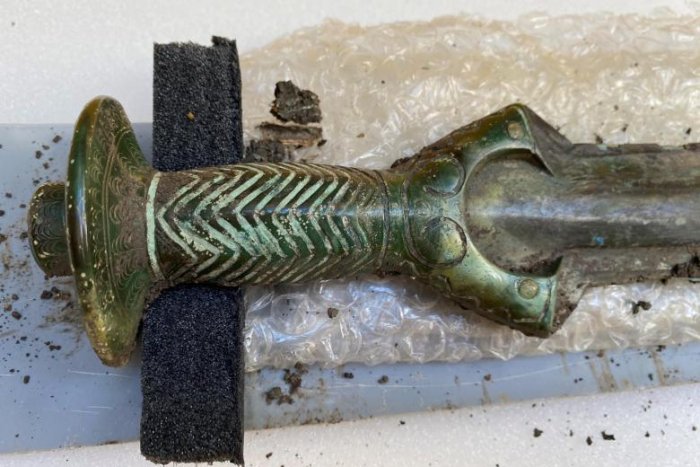
3000 year old sword found - amazing bronze design

Ita extremely well preserved. I had this coffee table book on medieval weaponry and most of them were completely Swiss cheesed with rust some of the swords had to be tweezered out piece by piece and these swords were only a few hundred years old, not 3k.
But im no expert in how or why some appear better than others
For better preserved low oxygen levels - clay or cold deep water for iron & steel, even peat bog, I believe.
 
Bronze can sit in the earth for many thousands of years and do nothing but patina.

There are bronze artifacts from digs dating back at LEAST 4500 years. And that's just stuff we've found. There could easily be undiscovered bronze, human-made objects out there that are 5000- 6000 years old.
 
Here's another view of the handle after they pulled it out of the ground, for some reason the pic won't embed, it shows more detail in different lighting, it's actually not all shiny like in the other pics:

Another one here:

octagonalswordgermany.jpg
 
I really want to believe this and it probably is legit, but something about it just keeps nagging at me. The whole thing seems fishy. It almost looks a little too perfect.
The find is from 2023, so there have been a couple of years for study.
 
  • Like
Reactions: DMG
The find is from 2023, so there have been a couple of years for study.
I get that. But “studies” can and have been faked before for various reasons. I’m not saying it’s fake, but I’m not so trusting as automatically believe something just because “they” say it’s so either. Academics can and do lie.
 
Yeah, bronze doesn’t corrode like iron, it just gets a green patina due to the copper in it. Most ancient bronze finds could be cleaned and polished and it would look as if they were made yesterday, and swords are even still sharp on occasion.


The fun part about looking for Bronze Age artifacts vs. Iron Age artifacts it's how bronze preserves in contrast to iron. You have artifacts from the Viking Age that are often less than half as old and much, much less intact.


Anyone questioning the validity of this find due to the well-preserved nature of the sword, needs to do some reading.
 
Yeah, bronze doesn’t corrode like iron, it just gets a green patina due to the copper in it. Most ancient bronze finds could be cleaned and polished and it would look as if they were made yesterday, and swords are even still sharp on occasion.


The fun part about looking for Bronze Age artifacts vs. Iron Age artifacts it's how bronze preserves in contrast to iron. You have artifacts from the Viking Age that are often less than half as old and much, much less intact.


Anyone questioning the validity of this find due to the well-preserved nature of the sword, needs to do some reading.
As stated before, I get all that. It’s not just the state of the sword, but that’s a whole other story and this wouldn’t be the time or place to debate all that anyway.
 
As stated before, I get all that. It’s not just the state of the sword, but that’s a whole other story and this wouldn’t be the time or place to debate all that anyway.
This is a blade form, and this thread is about the sword find, IMO this is absolutely the place to discuss doubts about its validity. As long as one's reasoning doesn't amount to the vibes being off.
 
Either this whole thing is fake ....and/or it belongs on "Ancient Aliens " .

Does no-one else notice the classic UFO saucer on the pommel ? 😏 👽
 
Bronze is amazing stuff. The fundamental shift that was figured out going from bronze to iron is really remarkable when you think about how they are almost completely different forms of production. Bronze is generally melted and cast while iron/steel is hammered and forged.

Obviously bronze has serious limitations in terms of durability compared to iron, but the ability to craft a meticulous mold and pretty much make anything you want and have a material that can be remelted and reformed over and over again is pretty great. I would love a piece in my collection.

Fun fact, the whole Vikings wearing pendants of Thor's hammer Mjolnir was something borrowed from the early Christians of that timeline often thought as a way to potentially hold up traditions that many felt were slipping away in the 8th or 9th century as sort of counter culture, some believe. There were bronze cottage industries in cities where trinkets and jewelry we sold to travelers, traders, and pilgrims. Mold out a cross, pour your bronze, and sell it to a Christian. Block off the top of the cross, pour your bronze, and hang it upside down...your pagan buys a Mjolnir.

The way bronze could be utilized makes it some of the most incredible material humankind has come up with. The stuff practically lasts forever if left undisturbed.
 
I get that. But “studies” can and have been faked before for various reasons. I’m not saying it’s fake, but I’m not so trusting as automatically believe something just because “they” say it’s so either. Academics can and do lie.

They are also susceptible to confirmation bias and, especially, motivated reasoning. Just like anyone, they can lack or simply put aside unbiased critical thinking for various reasons. Grant money, sensationalism, making a name for themselves in their field of study, or sometimes simply being a weirdo. They may steal another's work or credit, or discredit rivals.

Cool sword tho. 😆
 
They are also susceptible to confirmation bias and, especially, motivated reasoning. Just like anyone, they can lack or simply put aside unbiased critical thinking for various reasons. Grant money, sensationalism, making a name for themselves in their field of study, or sometimes simply being a weirdo. They may steal another's work or credit, or discredit rivals.

Cool sword tho. 😆
This stuff happens all the time. A disappointing, concerning amount. ESPECIALLY in the archaeology field.


This dig, and this sword are as real and legit as they come, however.
 
Last edited:
Back
Top