3V vs. INFI

Status
Not open for further replies.
yeah. Metallurgy. i did a quick spell check and messed up.

i actually did a search for infi steel and this post came up, i was trying to learn more. i didnt realize (until after i posted) that i was in a Busse forum.

i didnt say anything bad about INFI. i said its probably better than 3V. but it also cost 2 or 3 times what 3V does...and i have no idea why

i love collecting knives and i do have a genuine interest in the steels used, but i need help understanding INFI...i know it has great performance. but i really want to know more than just that. where infi comes from could just be the start, but i would also love to hear about the science used to develop it. how Busse found it. why no other makers can use it. all that good stuff...i said i love Busse and his sub companies, but i havent bought a piece of INFI because i cant justify that purchase -yet. but, like i said, i will likely be buying a Busse in the future...because i know he makes an excellent blade that most manufactures cant come close too.
 
Last edited:
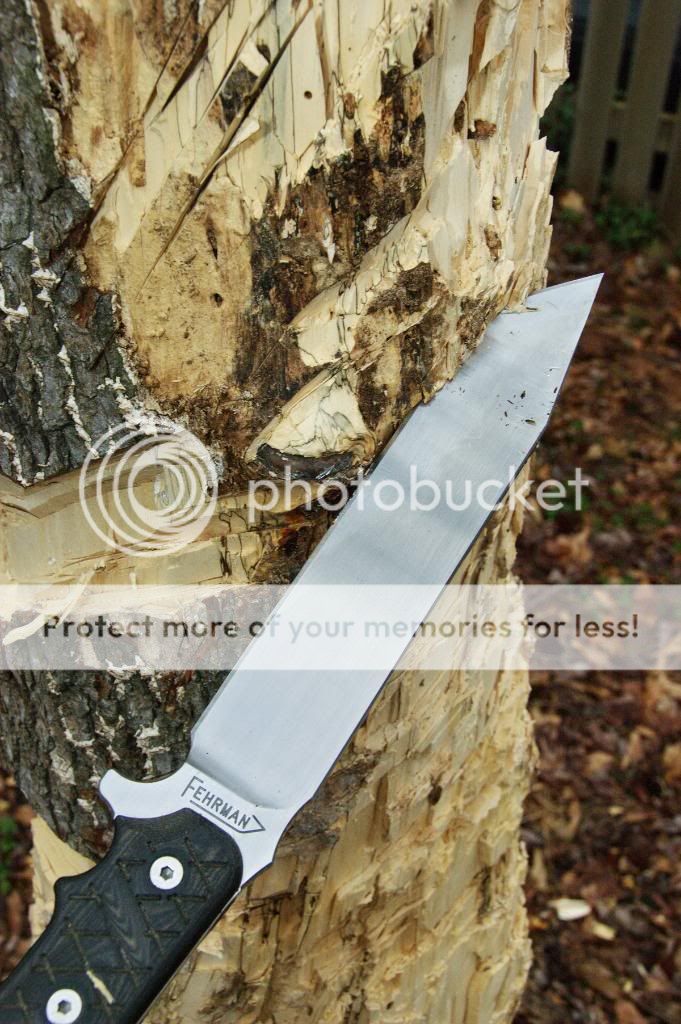
I was defending myself against a tree in my backyard recently.

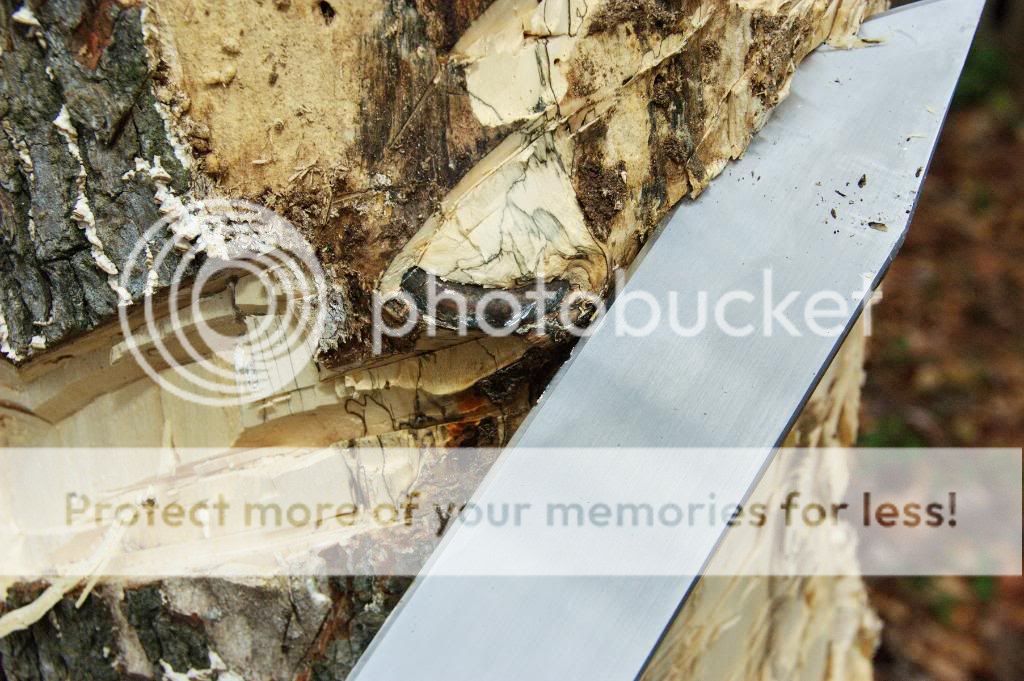
So after skinning my denim (I don't know what that means but I read it somewhere here and it sounds tactical) I struck the tree with my Fehrman but the tree was a sneaky adversary and it blocked the blow with a concealed metal hook, buried in its trunk.

I did not notice the tree's defense and struck it again. The result was two very minor dents in the edge:

DSC_1493_resize.jpg

DSC_1490_resize.jpg


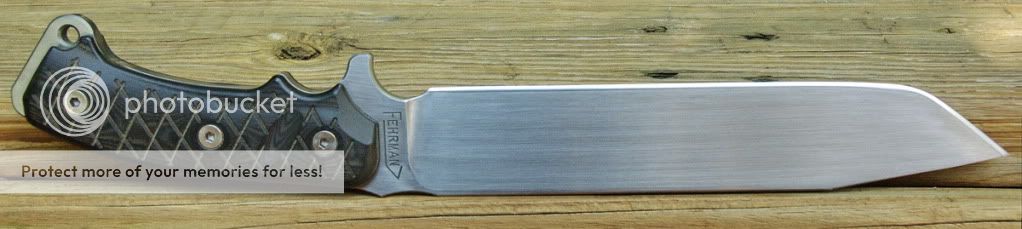
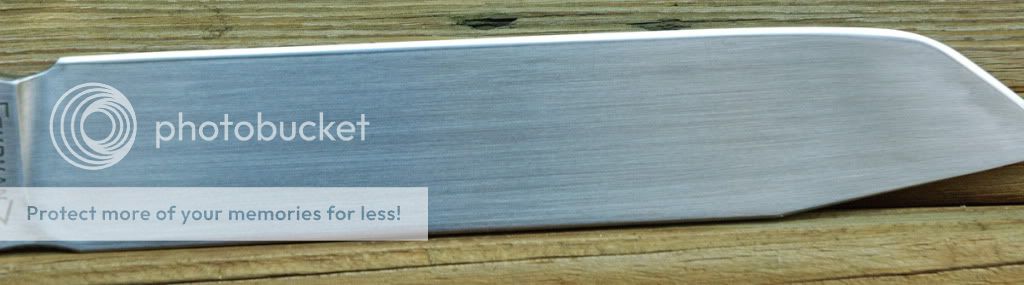
That I sharpened out easily with mousepad and sandpaper:

DSC_2378_resize.jpg

DSC_2379_resize.jpg


Unfortunately I cannot compare how INFI would have fared as I did attack the tree again with INFI and other assorted metals but I struck from behind and at night, so it could not throw up its metal defenses.

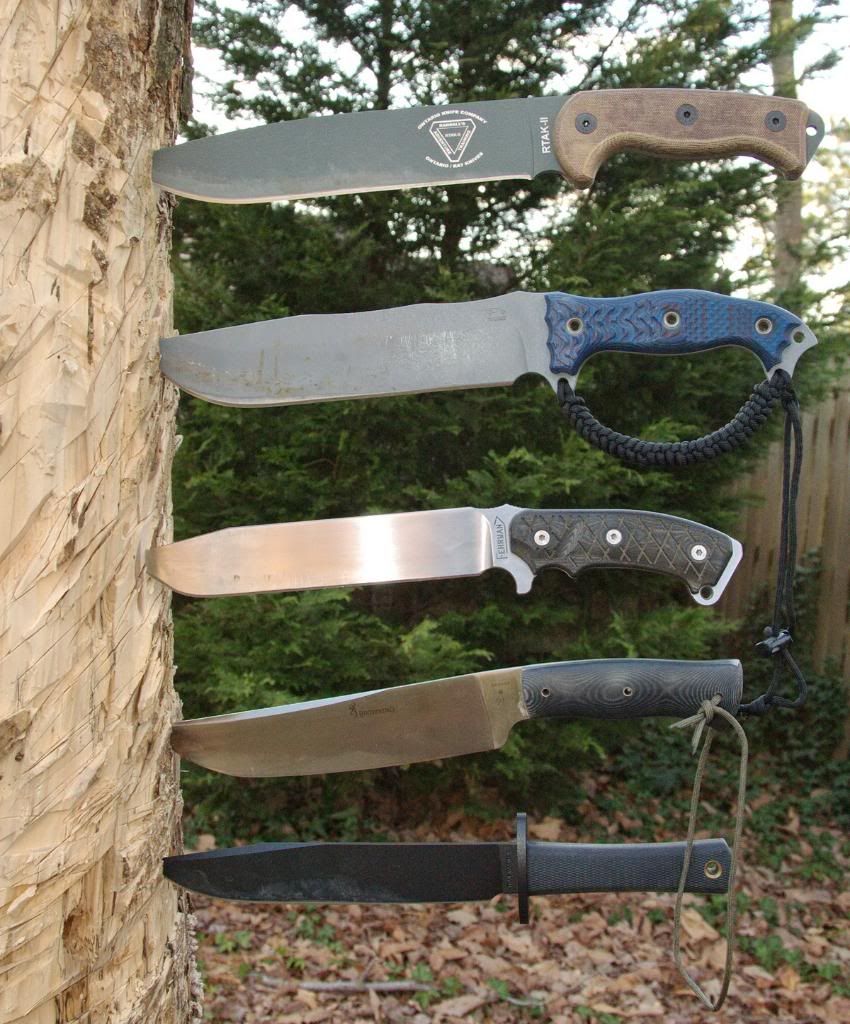
What I can conclude from this test is evident in this last picture; Satin 3V reflects the late afternoon glowing sun better than coated INFI.

DSC_1518_resize.jpg
 
Last edited:
Alright, I don't post much stop by often and read. From what I know, you guys are a good group of guys. So, I think that we should give Burdan a bit of latitude before we jump on him about his post. He did not said that Infi was crap, on the contrary he said it's probably an excellent steel.

The OP asked the how Infi compares to 3V. Burdan gave his input that while users can give testament to the performance of Infi vs. 3V, it is difficult to give a compare the two when we don't know what the composition of one of the steels. Burdan's frustration stems from the fact that he can't "pop the hood" on Infi and get a better idea what goes into Infi. I can see where he his coming from.

That being said, I have a Fehrman First Strike in 3V and a handful of blades in Infi. I think I've pushed both steels hard. Infi seems to hold a better edge to me and rolls where I've seen 3V chip. Other than that, Infi seems to resist rust a bit better. But, unless one has two blades (one in 3V and one in Infi) with identical geometries and tested in a controlled environment, experiences may vary. Even then, we can generalize the performance of the steels for the given parameters of the test.

ok, i'll put the tar and feather's away.:(


i'm messing with ya, that's a very good point you make there.
 
Alright, I don't post much stop by often and read. From what I know, you guys are a good group of guys. So, I think that we should give Burdan a bit of latitude before we jump on him about his post. He did not said that Infi was crap, on the contrary he said it's probably an excellent steel.

The OP asked the how Infi compares to 3V. Burdan gave his input that while users can give testament to the performance of Infi vs. 3V, it is difficult to give a compare the two when we don't know what the composition of one of the steels. Burdan's frustration stems from the fact that he can't "pop the hood" on Infi and get a better idea what goes into Infi. I can see where he his coming from.

That being said, I have a Fehrman First Strike in 3V and a handful of blades in Infi. I think I've pushed both steels hard. Infi seems to hold a better edge to me and rolls where I've seen 3V chip. Other than that, Infi seems to resist rust a bit better. But, unless one has two blades (one in 3V and one in Infi) with identical geometries and tested in a controlled environment, experiences may vary. Even then, we can generalize the performance of the steels for the given parameters of the test.

I agree, I see no reason to jump all over Burdan. He didn't say anything that bad.

The composition of INFI isn't a secret. It's around here somewhere...
 
INFI is not a mystery steel, the composition and heat treatment are known, I don't have it but I'm sure someone else will gladly post a link.


What does a steel's name really mean besides a distinction between others?

Its all about the heat treat anyways so what's the fuss?

Have you check the price of a Fehrman?
 
"How exactly is a rainbow made? How exactly does the sun set? How exactly does a positrack rear end on a plymouth work? It just does"
 
So after skinning my denim (I don't know what that means but I read it somewhere here and it sounds tactical)

Oh man, I can't stop laughing:D

I just saw that not long ago and was sure hoping it would NEVER catch on, and danged if I haven't already seen it in less than an hour:grumpy::p


I think that dude liked a line in Tombstone, and couldn't quite figure out how to apply it to a knife discussion:confused:
 
INFI is not a mystery steel, the composition and heat treatment are known, I don't have it but I'm sure someone else will gladly post a link.

What does a steel's name really mean besides a distinction between others?

Its all about the heat treat anyways so what's the fuss?

Have you check the price of a Fehrman?

Here ya go... :)

The heat treat protocol is proprietary so it is not known by many outside Busse, BUT... INFI's composition is:

V 0.36% Vanadium
Cr 8.25% Chrome
Fe 87.79% Iron
Co 0.95% Cobalt
Ni 0.74% Nickel
Mo 1.3% Molybdenum
C 0.5% Carbon
N 0.11% Nitrogen


This is widely known and is not considered a secret.
 
Fair enough I guess.

But I don't give a **language** what foundry stock-X comes from.

Nor do I care where the steel that's in the frame of my car came from.

Or where the aluminum in the lower receiver of my rifle came from.

I *use* my knives, and base *all* important judgments on such use.

Pretty simple really.
 
Last edited by a moderator:
l2lku2, that's incredible how well that Ferhman stood up to that metal hook. Thanks for posting that.
 
I just got my first Fehrman a month ago! The last time I was that impressed with a knife was my first Busse :thumbup:

Both Busse and Fehrman lead the way in quality, durability, and warranty.
 
l2lku, how do you find Fehrman's 3V in terms of corrosion resistance compared to that of INFI?
 
I have no 3v to compare to.

I have never knowingly used 3v.


I do, however have Infi.


I am also pretty Damned Awesome!

So I am going to say that Infi wins in every performance category by about 57.3%.

I make this bold and unsubstantiated statement without ever using a knife made out of 3v just based on my own total awesomeness.........


If I am 99.9999999999% more awesome than any other people on the planet, the steel in my knives are at least 57.3% more awesome than any other steel out there.

It is a scientifically proven fact. The math backs me up on this.
 
I have no 3v to compare to.

I have never knowingly used 3v.


I do, however have Infi.


I am also pretty Damned Awesome!

So I am going to say that Infi wins in every performance category by about 57.3%.

I make this bold and unsubstantiated statement without ever using a knife made out of 3v just based on my own total awesomeness.........


If I am 99.9999999999% more awesome than any other people on the planet, the steel in my knives are at least 57.3% more awesome than any other steel out there.

It is a scientifically proven fact. The math backs me up on this.

I have double checked this math. It is correct, well done sir!
 
l2lku2, that's incredible how well that Ferhman stood up to that metal hook. Thanks for posting that.

Yep, it took quite a bite into that hook. The tree is not too happy and is not talking to me anymore.

l2lku, how do you find Fehrman's 3V in terms of corrosion resistance compared to that of INFI?

I wish I could be more helpful and provide some answers, I have 3V from 4 manufacturers and INFI from at least 1 manufacturer that see good use but I have not really exposed them to the elements for prolonged periods so it will be irresponsible for me to state an opinion.

So for corrosion resistance all I can say is that they all hold up pretty well to their challenging, climate controlled, Tuf-Glide coated cushioned and entitled existence.
 
Last edited:
Here ya go... :)

The heat treat protocol is proprietary so it is not known by many outside Busse, BUT... INFI's composition is:

V 0.36% Vanadium
Cr 8.25% Chrome
Fe 87.79% Iron
Co 0.95% Cobalt
Ni 0.74% Nickel
Mo 1.3% Molybdenum
C 0.5% Carbon
N 0.11% Nitrogen


This is widely known and is not considered a secret.

And then it all became clear. :p

The Search function is your friend.

Busse has been doing cryo since the early 1980's. Back then it was a very primitive process involving an old cooler, dry ice and about a gallon of acetone. Process: pack the blades in dry ice, pour the acetone over the ice to speed the evaporation process, and hit somewhere around the -190 degree mark. Do a normalizing temper (approx. 350 - 450) and voila! Prehistoric Cryo!

In the late eighties we began the employment of a deep cryo treatment (-300/320 degrees) which was done in a dry, controlled, atmosphere. This process allows us to take our blades down to temp. over the course of 10 hours hold them at temp. (-300 degrees) for approx 50 hours, and then bring them back up to room temp. over the course of the next 10 hours at which point they receive 3 more, individualized, oven tempers. This is the same process that we employ to this day.

Some makers are out there just plunging their blades into liquid nitrogen which can shock the steel so dramatically that microscopic cracks and fissures can form that could cause massive blade failure in the field under heavy and/or light use. That is why it is crucial that the blades be cooled slowly and brought back to room temperature slowly and then normalized with a few oven tempers for stress relief.

Of course there are also some makers that I know of who claim to employ cryogenics because they stick their knives in the freezer over night. Scary! Alway ask the maker to give as much detail of his cryo process as possible.

Knowledge is power! Arm yourself!

Yours in Nuclear Cryogenics,

Jerry Busse
 
Last edited:
I always get a laugh from the novice knife collector/enthusiast that gets very involved with steel composition, yet forgets the most important component of any blade.... heat treatment.

Steel composition will always take a back seat to heat treatment. Knifemakers that take the time to perfect their steel like Busse and Fehrman will consistently produce blades that will outperform the vast majority of production blades and most customs.

In short, steel composition is far less important that heat treatment. ;)
 
I have no INFI in my collection to share, but I do have a Fehrman Last chance, and this blade is ridiculously tough. I abandoned an attempt to put a mirror polish on it, because it just wouldn't bow down to my repeated attempts to polish it up. It holds up incredibly well to hard use, and has the toughest steel of any that I own.

The downside is that it does corrode readily, and because of this I have begun taking my ESEE knives on my kayaking trips instead of my Fehrman. Too much moisture and the Fehrman will start to rust and I even noticed some small spots where I could see the steel begin to "pit". Not cool. The one major difference between INFI and a 3V heat treated as well as Fehrman's is that, from my understanding, INFI is more corrosion resistant. Again, I do not have any INFI to back up this claim, but maybe some of you out there can confirm this.

Either way, love my Ferhman, and one day I will get a Busse to beat on in the bush.

I gotta give some love to 1095 though! My ESEE's will take anything my Fehrman can and smile... I haven't pushed either of these knives beyond their limits yet, so in my opinion, the differences between them are negligible, because all have withstood some serious punishment.
 
If you call Eric, he'll pre-coat the blade with his own brand of rust-inhibitor for an extra $50 or so, and then apply the black finish. 3V is on par with INFI with respect to toughness and ease of sharpening. I still think A2 and 01 make wonderful knives which are woefully close to both 3V and INFI. If you are still hung up on what INFI is, you'll be forced to ask Mr. Hossom for proper clarification.
 
Status
Not open for further replies.
Back
Top