- Joined
- Jun 11, 2006
- Messages
- 8,651
So the other day I heat treated 4 kitchen knives for a customer who will remain anonymous unless he wants to chime in on this thread. Everything went perfect up to the quenching. All the blades got there normal 3 step grain refining cycles from 1650 to 1450 in 100 deg steps. After this thy looked great, one had a little bow but noting out of the ordinary. The next night I did the actual heat treat on 2 blades. Fired up the Oven to 1475 (this temp gives me the best results with 52100 66-67rc) and let it soak for 1hr (the oven). At this time i also fired up the parks AAA quench tank and set the pid to 120deg. After everything was heated and ready to go I double checked the AAA quench oil with a hand held thermometer.
I then did one blade at a time with a 15min soak. Right out of the oven and straight down into the oil with a slight edge to spine sweep like I always do with blades. The first blade was the one that had a bow and it kept this bow after the quench. So after the quench and still smoking hot (normal hand straightening temp) I slipped it between the quench plates to keep it straight. I then put the other blade in the oven and quenched it the same way. It came out with a slight bow as well so it also went between the quench plates. I grabbed both blades and proceeded to clean the oil and gunk off them to get them ready for tempering. This is when i noticed one blade had a crack in the spine but the other one was OK. Thy both got clamped to the temper plate and got there 400deg temper for 2 hrs twice. Thy settled at 62 rc which was the desired hardness of the customer. I was rather concerned about the cracked blade and was trying to figure out why. The next night I heat treated the other two blades. All 4 blades where identical in profile and thickness. I did these blades exactly like the 2 the night before same temp of oven and oil. these came out straight from the quench so no quench plates needed. I went to clean the oil off and both blades had cracks in the spine.
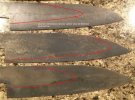
I don't know what is going on, I have never had any cracking issues with 52100 before. Any time i have gotten a crack its because the blade warped really bad and it snapped while straightening. But even that is rare as I have changed how I treat badly warped blades. So I'm coming to you guys for help as I am left scratching my head and don't know what is going on. And yes I used the correct oil, its hard to mix up AAA with parks 50, for one thing AAA has a smell that's unmistakable and #50 does not smell. I even went out and double checked the oil in the tanks was the correct oil. Here is the pictures of the blades, I was absolutely sick to my stomach to break the news to my rather loyal customer.


I then did one blade at a time with a 15min soak. Right out of the oven and straight down into the oil with a slight edge to spine sweep like I always do with blades. The first blade was the one that had a bow and it kept this bow after the quench. So after the quench and still smoking hot (normal hand straightening temp) I slipped it between the quench plates to keep it straight. I then put the other blade in the oven and quenched it the same way. It came out with a slight bow as well so it also went between the quench plates. I grabbed both blades and proceeded to clean the oil and gunk off them to get them ready for tempering. This is when i noticed one blade had a crack in the spine but the other one was OK. Thy both got clamped to the temper plate and got there 400deg temper for 2 hrs twice. Thy settled at 62 rc which was the desired hardness of the customer. I was rather concerned about the cracked blade and was trying to figure out why. The next night I heat treated the other two blades. All 4 blades where identical in profile and thickness. I did these blades exactly like the 2 the night before same temp of oven and oil. these came out straight from the quench so no quench plates needed. I went to clean the oil off and both blades had cracks in the spine.
I don't know what is going on, I have never had any cracking issues with 52100 before. Any time i have gotten a crack its because the blade warped really bad and it snapped while straightening. But even that is rare as I have changed how I treat badly warped blades. So I'm coming to you guys for help as I am left scratching my head and don't know what is going on. And yes I used the correct oil, its hard to mix up AAA with parks 50, for one thing AAA has a smell that's unmistakable and #50 does not smell. I even went out and double checked the oil in the tanks was the correct oil. Here is the pictures of the blades, I was absolutely sick to my stomach to break the news to my rather loyal customer.