80CrV2

Give it a quick lookup. Think about temperature and carbide dissolution rate then it could be obvious. grain boundaries merge by higher temperature/energy and loss of carbides/pinners, thus larger resultant aust grain.

Yes, I had thought that higher Aust temps cause larger carbides and grain to form. That's what Willie was saying and I though Rick, too.

You seem to be saying the opposite: that higher Aust temps make the carbides smaller.
 
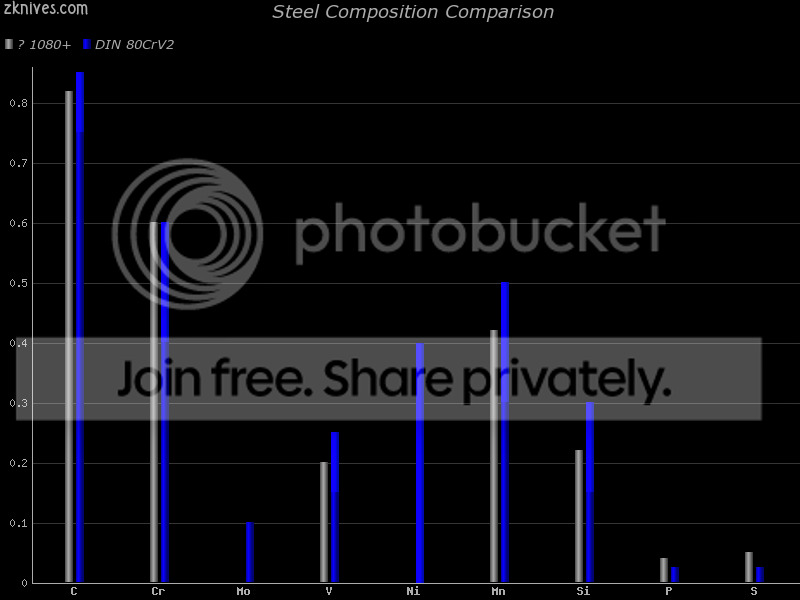
Good lord......now we are quibbling over the name of the steel. Chuck came up with the term 1080+, and I personally think it fits well. 5160 on steroids? If you want to call it that, I am not going to argue about it, I find no point in nitpicking in that area. I've heard people call CFV 52100 on steroids. ?????? Whatever. 5160 only has around .6% carbon, but is known for being a "tough" steel, as is 80CrV2.
index_zpsiwzqapkc.png


As I said earlier, the main difference is the Nickel in 80CrV2. Yes, that can make a big impact on performance.
 
Good lord......now we are quibbling over the name of the steel. Chuck came up with the term 1080+, and I personally think it fits well. 5160 on steroids? If you want to call it that, I am not going to argue about it, I find no point in nitpicking in that area. I've heard people call CFV 52100 on steroids. ?????? Whatever. 5160 only has around .6% carbon, but is known for being a "tough" steel, as is 80CrV2.

As I said earlier, the main difference is the Nickel in 80CrV2. Yes, that can make a big impact on performance.

I'm sorry - the only "quibble" I had was that 80CrV2 is going to take a little bit more control than 1080 to heat treat because it is going to require a soak. So it might not be as good a starter steel.
 
Back
Top