a model for edge retention and the results of cardboard cutting on four S30V blades

Cliff Stamp

BANNED
Joined
Oct 5, 1998
Messages
17,562
Recently I began a series of comparisons of very similar blades on cutting a very abrasive type of cardboard. This was 1/4" double ridged and the cuts made on a slice through 4 cm of blade with the middle 3 cm measured for sharpness slicing light cord. I started off comparing one S30V knife to one ZDP-189 knife with the intention to do a bunch of steels. I then wondered if it would not be more informative to do less steels and more knives. Are all my S30V knives the same? Are all of them less effective slicing cardboard than all of my ZDP-189 knives? So I set off to do a fairly absurd amount of cardboard cutting. Six trials on each knife through a random sampling of cardboard with the force applied and the speed of cuts controlled.

To answer the question of "better" in a significant way I needed a way to model the performance. Forget about splines and power interpolation, I needed a real physical model and ideally a simple one. So it came to me, isn't this a really simple physical situation? Yes - rate of blunting is inversely proportional to the extent of blunting. Isn't there a known solution to that relationship? Yes - y=sqrt(x). Now it isn't going to be ideally that equation for a few reasons which I will mention later on so the model is :

Dullness = (edge retention coefficient) * (amount of media cut)^(law coefficient)

or basically

y=a*x^b

At zero material cut the dullness is zero and thus to model the blunting this initial sharpness is just subtracted off all the measured values of sharpness, or it can be just included as another parameter, but it is the same for every knife and isn't a physical parameter in that sense, though it could be for high polishes at low angles. The law coefficient (b) is between 1 and 0.5. At 0.5 the blunting is a perfect inverse relationship and at 1 it is perfectly linear. The edge retention coefficient (a) is the parameter which measures the resistance to blunting. In this case, I was studing cardboard, so it includes strength, wear resistance, caride stability, fatigue/strength, etc. .

Ok, that is the theory, does it work. The knives were all reground to primaries of 8.0 (5) degrees per side. Yes this is fairly acute, these are knives after all not axes. I experimented to see if it made any difference if I cut the primary with a x-coarse DMT then polished it on 600 DMT and finished with 1200 DMT, or did the first two steps with waterstones. I did three runs each way with each knife. I also did two runs by just resharpening the micro-bevel and not regrinding the primary clean (this is instant, 5 per side on 600, 5 per side on 1200 - done). None of it made any difference. The median performance :
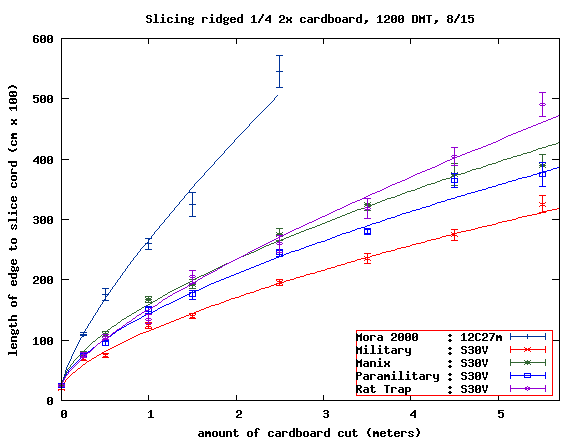
card_1_4_rough.png


I finally coded the points and the lines the same color in the graphs which makes it easier to tell which data is for which line. The graph includes a 12C27m blade for reference. The work was mainly to look at the S30V blades, I just wanted one external benchmark to give it meaning. Now it is obvious that the model works very well. It is also possible to generate a value for the strength of the coefficients and thus say statistically if one blade actually has better edge retention than another.

I'll post up the gory numerical details later on as I am putting all the details on the web now. But in short, the Rat Trap, Manix and Paramilitary are not statistically different. The Military however is and this obvious if you don't measure anything. At the end the Military is still cutting clean while the others are starting to rip the cardboard. Now the question I have is this, if I run the exact same thing on the three ZDP-189 knives I have will all of them be better, or will the average be better. Will the law coefficient be the same - meaning do they blunt the same way?

The other thing I should mention is that if the law coefficient (b) is the same, then the relationship between the edge retention from one knife to the other is LINEAR. This means if the edge retention coefficient for one blade is 20% more then it directly means it will be 20% more blunt at a given point. This makes it very easy to make definate statements about steels in an easy to understand fashion. I have more to say about this law and how to use/interpret it, which I hereby name the Swaim blunting equation, but that is enough for now. I will note though that it isn't restricted to cardboard, it is a *general* law for blunting on all media - how is that for comprehensive.

The unfortunate thing is that I have in front of me the insane task of looking at all the data I have collected in the last ten years because now I can model it all, or at least attempt to do so. I should check the equation on carpet, ropes, woods, etc. to determine its versatility. This is a good thing but I wish I had thought of doing this in 1998.

-Cliff
 
Interesting.

Why is it that the blunting rate is not affected by the angle of the edge, as well as the angle of the primary grind?

Also, wouldn't the length of material cut during the blunting process interact with the length of the blade of the knife doing the cutting (i.e. blunting distributed across larger distance = less blunting per unit of edge)?

-j
 
biogon said:
Why is it that the blunting rate is not affected by the angle of the edge, as well as the angle of the primary grind?

The edge angle is a factor, the above model is semi-emperical meaning it has variable parameters rather than a direct quantitative model which would include directly the wear resistance, strength, fatigue strengh, etc. as well as abrasiveness of the material, hardness of the material, etc. . These can not be fit directly because many of them would be 1:1 correlated such as the wear resistance of the knife and the abrasion level of the media being cut. I think in some knives the model could be expanded by using more than one power as the deformation blunting is likely to be a different power law than the wear based, but this would take a lot of data points as otherwise I think it would just be indeterminate. The above power law is of course basically an "average" behavior off all the blunting effects.

Many of these individual coefficients can be determined using a multi-data set approach and fitting multiple knives across multiple media as required. For example, in the simplest case if you assume that all blunting is just wear based, no deformation/chipping, then the edge rention coefficient ratio from two of the same knives at the same geometry on two different media would give the abrasiveness ratio of the material being cut. With two different steels on the same media, the ratio of the wear resistance coefficient would give the wear resistance ratio of the steels - again, assuming blunting is all wear (it isn't).

In the same manner you could study the effects of angles and thus deduce the loss/gain of changing angles by constraining the other variables. It isn't of course necessary to constrain anything. You can do a multi-variable fitting and float a bunch of parameters at the same time and just constrain them accordingly to match the set conditions. In general though you tend to do this last to examine the correlations and refine the estimates because it gets very difficult to do this initially unless you have a very good idea of the starting values of the parameters in a multi-variable non-linear fit.

Also, wouldn't the length of material cut during the blunting process interact with the length of the blade of the knife doing the cutting (i.e. blunting distributed across larger distance = less blunting per unit of edge)?

Exactly right, this would factor into the abrasiveness of the material. In the above all cuts were done on 25 cm sections of cardboard and the cuts made on a smooth draw through the four cm of stock. You could determine the effect of this parameter by the same way by doing a run over 2 cm vs 4 cm and again taking the coefficient ratio. You would expect making the same cuts over 2 cm would cause the blade to "see" a much more abrasive material.

Note that the above behavior is again for *slicing* edge retention, push cutting edge retention can be different even on the same material. All of those S30V knives fractured readily during the cutting, this tended to produce and edge which retained an extended sawing ability. It isn't unusual for the cutting performance to actually increase after more material is cut as the fractures and carbide tearouts produce jagged edges. The sharpness then decreases as this wears away an then increases again when it fractures again. The above curves basically smooth out this behavior because it is a random process and happens at different times in each run.

I shuold contrast this with the push cutting sharpness on similar knives, however measuring this is really annoying unless I do it qualitiatively which is why I have been avoiding it as of late. However I have noticed some of the reviews are getting a bit misleading because this is being ignored and it may be promoting the idea that these heavy carbide steels are in general better edge holders which isn't necessarily true.

-Cliff
 
Ahh, I think I understand where you're going.

In the first case, you've assumed a linear contribution, given the same edge angle on all test subjects. In the second, assuming 4cm of stock.

Got it... very interesting.

So why does the Military have substantively better edge holding, especially over the Manix?

If we hold the following steady: edge angle, steel composition, length of blade involved in the cut, (assumedly heat treat and hardness) what would one use as a variable to predict increased edge retention?

The only variables remaining are blade profile, thickness, and height (what am I missing?)

-j
 
Also, it's interesting (although I suppose obvious) that cutting performance (as a measure of sharpness) declines reasonably linearly as a function of work done after a certain amount of work; however, "sharpness" falls off quickly between no cardboard cut and the first measure, suggesting that there are two factors involved in blunting?

Presumably in cutting soft materials (tomatoes?) the nonlinearity in the first few cuts would be less pronounced?
 
Looking at the three Spyderco's is something interesting. I noticed something. All a very simular Blade shape. Blade length's are in order Military @ 3 11/16, Manix @ 3 1/4, Para @ 2 15/16. All out of 5/32 stock, could someone get blade height? All also s30v, and sharpened alike.

As I read Cliff's experiment I would think a longer Blade would be king. But that's only holding true First place. But in second with the shortest length of the second? Why? :confused:

Cliff Stamp said:
Now the question I have is this, if I run the exact same thing on the three ZDP-189 knives I have will all of them be better, or will the average be better. Will the law coefficient be the same - meaning do they blunt the same way?

From what I hear about ZDP sure. I think it would be (ZDP's I know Cliff has tested)1st:Caly, 2nd:Horn, and Delica. Unless they all have the same blade characturistics I don't think it's that valid of a test of the steel or this test. Close approximation, but if your going though all the effort of taking such detailed notes. Looking at your ZDP Delica test it will already do better than the Mili. So much for length being King (as I read it). As too blunting coefficient, I think it will be shallower and lower.

Thinking back to the Deerhunter tests, they were a great chance to look at three different steels, on the smae knife. Maybe a test looking at a ZDP, AUS-8, and VG-10 Calypso jr, and a S30V UK Pen Knife is a better for the things your looking at. Take length right out of the equastion.

Cliff, any chance of not using yellow on your graphs? It's hard to see against the white. Thanks.
 
biogon said:
So why does the Military have substantively better edge holding, especially over the Manix?

The Military's steel is very different from the others. On the Manix when it is sharpened from the x-coarse DMT you can see parts under 10x mag which have chunks ripped out of the edge. These are so large that when the edge is then polished with the 800 grit waterstone or 600 DMT and you just look at it by eye you can see the pieces missing. I assume these are segregated carbides which were torn out.

The micro-bevel is applied until the edge is uniform however the removed carbides would leave a section of edge with a low carbide density and thus a lower resistance to wear / impaction. The Manix also feels softer and which seems to be supported by the greater initial blunting. The Rat Trap which does the lowest doesn't have as much chipping induced aggression as the others. The edge tends to wear more smoothly.

Note that production knives in general have quite a larger tolerance range than most people think on hardness. A number of posters have had S30V blades rehardened and found out that the hardness values were as low as 55/56 HRC on knives which are promoted at 59/60 HRC. Now you would expect to see a rather large difference between a 55 HRC S30V knife and a 60 HRC S30V knife especially since there are many ways to drop hardness. It would be informative if the above blades were all HRC tested and then broken to examine the grain structure. I might do this later on.


If we hold the following steady: edge angle, steel composition, length of blade involved in the cut, (assumedly heat treat and hardness) what would one use as a variable to predict increased edge retention?

The only variables remaining are blade profile, thickness, and height (what am I missing?)

There are minor (in this case) issues like handle ergonomics, which can be very important with extended work long term as you see issues with fatigue and then loss of control, precision and problems with frustration. However the above work is very low volume and the ergonomics are not an issue. In the above the primary grind and gross profile are not really an issue as the cardboard is so minimal in binding that there is no signifiant force increase on either blade - if this was the case it would effect edge retention by reducing control and general precision.

biogon said:
Also, it's interesting (although I suppose obvious) that cutting performance (as a measure of sharpness) declines reasonably linearly as a function of work done after a certain amount of work; however, "sharpness" falls off quickly between no cardboard cut and the first measure, suggesting that there are two factors involved in blunting?

To understand this take a piece of wood (or similar) which has a sharp corner, like a 2x4. Now run a plane along that edge and thus smooth it out. Examine the thickness of the edge after each pass with the plane and see how it changes. You will find that the first pass makes a massive difference to the edge thickness but after awhile you have to do a lot of planing to change it significantly.

The actual edge on a knife is about 1-0.1 micron thick when optimally sharpened (depends on the grit finish). Thus if even just a hint of material is removed the thickness will double and thus there is a massive decrease in sharpness. By the time the cutting in the above has stopped the edge thickness is between 10-100 microns (it varies along the edge). So if you assume the wear of the cardboard is the same on each pass you would assume to see a massive change early but after awhile it should be reduced down to a trivial amount per cut.

Specifically for example lets assume that each pass thickens the edge by 1 micron. So after the first pass the edge could go from 1 to 2 and thus the sharpness is halved. However on the next pass is goes from 2 to three and is only reduced to 30%, then 25%, then 20%, then 18%, etc. Now again what is happening is a bit more complex that this, but this is the basic reason why the responce isn't linear.

Presumably in cutting soft materials (tomatoes?) the nonlinearity in the first few cuts would be less pronounced?

Exactly right, on the really low blunting materials the graph is really stretched out so you don't see such a dramatic contrast.

Saberman said:
I would think a longer Blade would be king.

The cutting is constrained to a 4 cm section in the middle of each blade on the flat section of the edge, no curve through the tip used. If you drew the cuts through the full blade lengths then the longer blades would have a significant advantage.

... and a S30V UK Pen Knife is a better for the things your looking at.

I would have used that but I broke it awhile ago splitting would.

...any chance of not using yellow on your graphs? It's hard to see against the white.

These are done in gnuplot, in order to change the colors I need to know the hex codes for the palette. I will be looking into this shortly for that exact reason. I want the graphs to be more strongly constrasting to make it easier to see which one is which, plus use color like black, dark purple, orange, deep green, etc. .

-Cliff
 
The discussion seems to hint that the loss of sharpness is from the loss of material from the edge, which is proportional to the amount of material worked on, ie

-dv = a dx

Where v is volume of metal at the edge and x is the amound of material cut.

This seems like a fairly simple and straightforward model for abrasive wear.
 
Cliff Stamp said:
I would have used that but I broke it awhile ago splitting would.
Oh man:eek:, that sucks. That's no way to treat a Gents knife. How far did you get befor it broke?

Is there a way to fip the back ground to black instead?

So, it seems are you thinking that HT has a has a lot to do with how these knives acted?
 
Well, allow me to chime in and say this sounds like it could have a dramatic effect on the way we quantify edge holding, but right now I think I can't get my head wrapped around the concept. I have a feeling I should be more excited about this if I actually knew what it all means. Guess I'll wait until you "say more about this law and how to use/interpret it".
 
kel_aa said:
The discussion seems to hint that the loss of sharpness is from the loss of material from the edge, which is proportional to the amount of material worked on, ie

-dv = a dx

Where v is volume of metal at the edge and x is the amound of material cut.

What happens a mix of deformation and wear. The wear takes place by several methods, fracture, direct abrasion and fatigue. In all of these cases, for reasons I outlined in the above, the general law should be

dy/dx~1/y

So the rate of blunting is inversely proportional to the amount of blunting. The solution to this is just y^2=x, or y=sqrt(x), now it isn't going to be an exact 0.5 power for a few reasons, but that is the basic starting point. I didn't want to deal with the math in detail because fundamentally that isn't the critical issue. What is more important is that the very complex graph can be reduced to two, and in most cases just one number, and this number is linear in the equation. This means it easy to talk about the graphs in a very simple manner because a 10% increase in that coefficient just means the knife will be 10% blunter at a certain point.

It is also a fundamental relationship which tends to hold irregardless of what material is cut or even how because the power coefficient makes the law very flexible. If the law coefficient changes from one knife to the next it would also make a powerful statement as it implies they are blunting by fundamentally different methods where as the edge retention coefficient just says by what rate they are blunting. The equation can also be expanded as noted by including different powers. The effect of corrosion for example should be linear so you would give an additional power in that case. Fundamentally if you knew the material and steel properties I think you could use this approach to actually model the exent of deformation vs fracture.

Note as well it doesn't depend on how you measure sharpness either. In the above I am slicing light cotton under tension and using the length of edge required but this doesn't matter because this is just the measurement, any measure of sharpness will follow the same pattern so you can use whatever method you like to quantify it, being consistent will all the knives of course. In fact you could just judge it by feel on a 1-10 scale and it would follow the exact same pattern. It would make a large change initially and then slow down following the above equation. The more precision you put into the equation the more precision of course will come out of it.

Saberman said:
How far did you get befor it broke?
It went immediately, these type of steels typically will not bend far before they break if the steel has sigificant thickness. This isn't of course a problem with the knife/steel. It is a really nice knife it was also interesting in that it didn't lock but was modern and "hi tech" so it was an interesting way to introduce some very traditional people to new steels/patterns.

Is there a way to fip the back ground to black instead?

Yes, note then all the axes/text has to be changed. I am looking into it now.

So, it seems are you thinking that HT has a has a lot to do with how these knives acted?

Yes, I should correct the above, it isn't 55-60, the hardness has been tested higher as well, up to 63 HRC, which likely explains some of the chipping problems. In any case it means there is likely going to be a large variance seen in the behavior reported when you have S30V knives circulating from 55-63 HRC.

the possum said:
...I can't get my head wrapped around the concept.

Most of these concepts are easier to demonstrate with physical models. But the math isn't the issue, it is just the details by which you arrive at the fundamentals. Consider as a parallel some of the concepts you outlined regarding balance. How to calculate the moment of inertial for physical bodies is actually complex as it is basically a three dimensional volume integation of the mass density. However you don't need to actually be able to calculate the integrals to understand some basis ideas, even just to realize that center of mass isn't the whole story, even if you don't understand the complex interaction between rotation and linear movement. Some of this is hard to see unless you do it which I noted recently after doing a lot of chopping. It is the same here, as in general with most models.

-Cliff
 
Cliff Stamp said:
It went immediately, these type of steels typically will not bend far before they break if the steel has sigificant thickness. This isn't of course a problem with the knife/steel. It is a really nice knife it was also interesting in that it didn't lock but was modern and "hi tech" so it was an interesting way to introduce some very traditional people to new steels/patterns.

Agreed, I love the fact that it's a slipjoint. I see it as a nod to the classics, But Sal doing it his way.

As for it breaking, it's thin stock to begin with. I wouldn't expect it to that. Do you have many 3mm thick blade pass that test?

Back on topic:

There has been alot of talk about S30V and where Hc should be. Where is it's sweet spot? I've seen it act differantly depending with different knives. Is what I'd like to know? I'm tending to think harder is better.
 
Saberman said:
Do you have many 3mm thick blade pass that test?

The opening hole does remove a lot of strength, that is where it broke and it is ground through the thickest part of the blade so the knife essentially has the functional stock just below the hole. It wasn't really a test as just as much as a spurr of the moment thing. It isn't a functional issue with that blade.

There has been alot of talk about S30V and where Hc should be. Where is it's sweet spot? I've seen it act differantly depending with different knives. Is what I'd like to know? I'm tending to think harder is better.

Going soft is problematic with some of the high alloy steels because you mainly have three choices; soak low and leave a lot of alloy in heavy carbide and get a soft martensite matrix, soak optimally but temper high and run the risk of hitting an embrittlement zone, or soak very hot and just produce a lot of retained austenite. In general none of these are very good for different reasons so if you are not getting the required toughness you are usually much better to go to a different and usually simpler alloy. This is also usually cheaper to buy and to grind and harden.

Wilson runs his at about 60 and has tried harder but prefers around there for a combination of edge holding and toughness. His blade was solid all around. I am going to hopefully run his and see where it falls in the above. His blade is likely harder as he HRC tests all of them, however he soaks hotter and dissolves more carbide and this will lower the wear resistance at a given hardness (usually). To complicate matters, the edge should be more stable due to the lower carbide fraction but this may reduce the edge retention when slicing long term but may enhance it early on.

Even though there is some variation in the Spyderco blades, and the Rat Trap, I actually like all of them as users and none of them have significant issues and all have seen hard work, except for the Rat Trap which I have yet to extensively carry. Ideally I would repeat all of this work but then *push* cut the cardboard and see what happens as there the edges chipping will be a drawback. I have other things to look at though. I was recently asked to comment on a new "experimental" forging technique by looking at two sample blades. Hopefully they will reveal something startling and I will get to tell Cashen he is wrong and forging is all that and then challenge him to an axe fight or something.

And man do I rule in axe fights, over 100k trees cut down and not a single blow ever returned. I am still however looking for the six fingered man. It has been a long time and I am starting to get discouraged.

-Cliff
 
Cliff,

Thanks for the discussion and the ideas/theories you suggested. :)

I'll be following the thread closely.

Modelling real-world behavior is always interesting to me.

Good luck!

-jon
 
I should mention that I am not opposed fundamentally to the idea that the nature of the primary grind could effect edge retention. I see that it will effect how the cardboard travels around the blade and this will effect the local tension in the cardboard but I would find it hard to believe that this has such a large effect.

Note if this were the case it would have a dramatic impact from a user perspective. If you accept the idea for example that a hollow grind does significantly enhance edge retention, and to clearify I am speaking specifically of measuring sharpness and *not* gross cutting ability, then you could for example get someome like Krein to improve the edge retention of a knife by hollow grinding a blade.

If this is true then how much of an effect is it? If Krein hollowed out a VG-10 blade would it then have better edge retention on the above work than a S30V blade which was flat ground and had the same edge angle or could it make even AUS-4 out last S30V? The hollow ground blade will obviously cut better at the same sharpness, but if it actually stays sharper as well then that would really open things up. Note that the above equation can be used to answer that question as well, it isn't limited to steels, it will just as readily tell you if a given geometry has superior edge retention characteristics as well.

I have actually seen this with chopping blades. If you take a large chopping tool, axe or knife it doesn't matter, and add a large relief grind and/or work the primary bevel so you radically increase chopping ability you can increase edge retention because the edge becomes more durable. This is because if the knife cuts deepers the edge "sees" a longer impact time and thus there is less shock and twisting on the blade. This is easy to understand and why if you are comparing large dynamic cutting and trying to infer properties of the steels then the blade should be very close. However the above is very static cutting.

In general, even if you can't isolate steels you can still make a meaninful comment about one knife vs another knife, or one maker vs another maker/manufacturer in regards to edge retention. You would of course want a decent number of samples to say this holds for the population with any definate determination. I would propose rather strongly for example that if I were to repeat the above with a bunch of Manix vs Military they would just oscillate around each other. As noted there is just quite a variation in hardness being reported for S30V and thus it isn't unlikely to see variance from one to another (this probably holds for all steels).

This does allow you to make a definate statement on consistency as well as you can quote the coefficients average and spread and say something like the range of edge retention coefficients were within 15% (or whatever) for maker A but had a spread of 30% for maker B. This is informative because even if the averages are the same, one maker is much more consistent than another which is important from a user perspective. I should have the ZDP-189 work done in a few days and then I'll put up the numbers and speak in a little more detail about how the comparisons are made.

-Cliff
 
Very interesting work Cliff. It seems to make intuitive sense to me as well.

I suppose another inresting test would be to run several examples of the same knife through the test and assuming no other changes detrmine how the RC affects the curve. Then perhaps that could be incorporated into the equation as well (for a certain steel).
 
Yes, exactly right, it would be interesting to see what would happen by varying heat treatments as there are many variables such as the use of cold/oil, soak temperature and tempering temperature. There are even multiple ways to get to the same hardness

-Cliff
 
Ok, the good news is that I finished the ZDP-189 results, the bad news is that I ran out of materials and only managed to get a total of 14 runs done with the three blades, so they are not as consistent as the S30V blades which had 6 runs each. But they are far more accurate and precise than any work I have done to date anyway. Ok first we present the pictures. I have worked with the color codes so hopefully these are a bit easier to interpret. First the S30V results :

card_1_4_rough.png


These are the same as the previous graph with just a change in color code. It is the same link so the above graph will now show the same color scheme. Now the ZDP-189 results. The Military (the best S30V blade) used as a reference and I kept it with the same color for ease of reference :

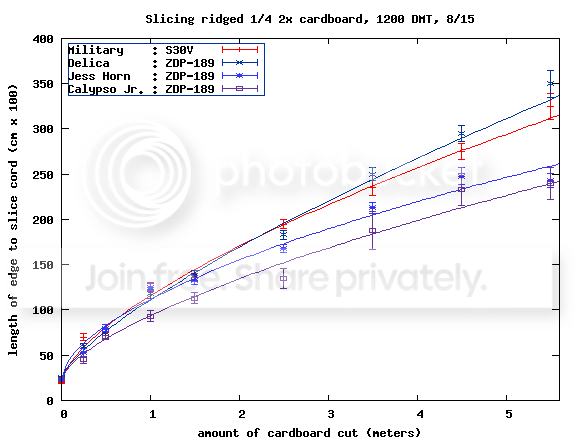
card_1_4_zdp_189.png


The lowest ZDP-189 blade stays with the Military and the two others are significantly ahead. Now what you want of course is some kind of estimation of the average behavior of the steel as seen in all the blades so we reduce all of this data to the following graph using medians over all the data to get the following :

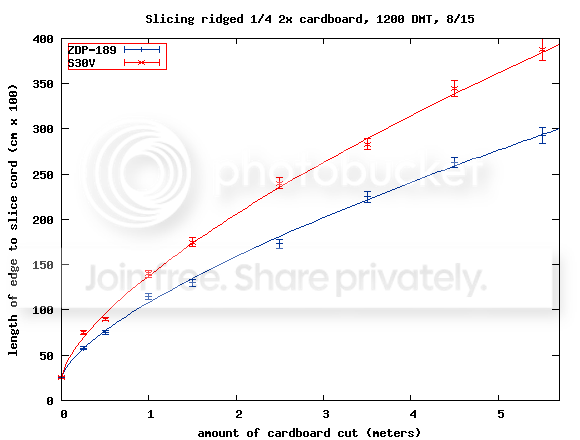
card_1_4_s30v_zdp.png


The output of the fits of the above equation represents the data quite well, in both the early extreme and late behavior. It shows that clearly that S30V will be 36 (5)% blunter after slicing a given amount of cardboard as ZDP-189 and that ZDP-189 can cut 85% more material before reaching a similar state of bluntness as S30V. This is what I meant by using the equation to reduce a very complex graph to very easy to understand numbers.

Now to clearify a few points, it is possible that another manufacturer will have their steel significantly better or worse. So generally you would infer from the above a perspective on Spyderco's heat treatement of the two steels with a hesitant comment on Swamp Rat's as it only includes one blade. In general though it would be hard to imagine for example that say Buck has a vastly superior heat treatment of S30V than Spyderco. I would be really curious to see what would happen with such a comparison. I would bet strongly the blades would just oscillate around each other.

As noted in the above, in order to obtain a total picture of edge retention you also need to compare the push cutting edge retention and sharpness of these steels. Because some of the properties which tend to increase slicing aggression actually decrease push cutting edge retention. It will be interesting to see if the same performance increase is seen. The full gory numerical details can be seen here :

http://www.physics.mun.ca/~sstamp/knives/blade_testing.html#cardboard

I just noted that the same point style is repeated in two of the graphs, I'll fix that shortly.

-Cliff
 
Back
Top