A number of questions about edge polishing and strops.

Ok, good news. went to napa and bought some 1500 and 1000 wetordry. therein lies the question. do i use it wet, or dry? is wet, how do i go about wetting it?

 
Ok, good news. went to napa and bought some 1500 and 1000 wetordry. therein lies the question. do i use it wet, or dry? is wet, how do i go about wetting it?

I use it dry. Especially if used on top of a leather backing. It's purely a preference thing. The wet/dry nature of the paper makes it easy to clean up afterwards. Can be rinsed off, or blotted with a damp sponge, rag or paper towel.

If you want to use it wet, I'd just use a sponge or paper towel, soaked in water, to drip some water on the paper. Wet it enough to keep the metal swarf in suspension while working. It'll dry out pretty quickly, so you'll need to re-wet it pretty frequently. The main downside to using it wet, so far as I'm concerned, is when it dries, the edges of the paper will tend to curl up. If it's not glued down, sometimes the curled up edges can get in the way, resulting in cuts at the edges of the paper. This is the main reason I use it dry.
 
95% of the time I use it dry, much easier to get rid of the debris that accumulates. Only exception is when using the 2000 grit (in your case the 1500) I find I can get a little more refinement with a little water on the sheet. My set-up is a chunk of 2x4 about 9.5" long and cut to 3" on the long edge, with a slot cut across both short ends. I cut a piece of 9x11 paper into thirds. Just wrap the paper around the end and wedge into the slots. Pack varying amounts of leather or nothing under the paper depending if convexing or V grind. I use a small sponge and just tap the paper a few times to lightly wet it and reapply as needed.

HH
 
When you say "strop" you're talking about sandpaper, right? It'll all depend on how refined your edge is to start. If you're going with the 1000 grit sandpaper, you'll see it start to go to work within a few passes. How long it takes to raise a burr will depend on how much pressure you're using and how much grinding is needed for your bevel to become uniform (assuming it isn't already). With a light touch it could easily take a hundred or more to really clean up the edge on your first go. Touch-ups after the first time should only take 10-15 passes/side depending on how hard you've used it. Best advice I have is to keep that paper clean - use a fingernail brush, large eraser, I use a chunk of rubber made for unclogging sanding belts. If you let the paper choke up it'll make things a lot tougher/slower and it messes with your ability to "feel" what's going on.

HH
 
have you tried a slotted paper wheel? it makes things shine up to a mirror and works much faster then damn near anything else out there to get that hair wittling edge your going after (If your technique is off a bit, it wont be as sharp as perhpas a leather strope but if your technique is that bad, chances are your not gonna be able to get that edge even with the best leather strop out there...). Give it a try with some white rouge compound.
 
What about making your own polishing compound if it's possible? Always wondered if you could use brake dust or something else. Has anyone tried?
 
What about making your own polishing compound if it's possible? Always wondered if you could use brake dust or something else. Has anyone tried?

If I'm not mistaken, brake dust is mostly graphite. VERY SOFT stuff (relative to steel), wouldn't likely do you much good. Graphite's main advantage is as a lubricant (dry). It also dissipates heat very effectively, which makes it perfect for use in brakes.

There are other sources of powdered abrasives (actually, a LOT of sources). Silicon carbide, in particular, is widely available in various grit sizes as a powder/grain. I'm pretty sure you can also get the green stuff, too (chromium oxide), and aluminum oxide as well. Search for 'powdered abrasives' on the 'net, and I'm betting you'll find lots of options.

There's a fairly recent thread on the topic of making your own compound. I'll see if I can dig it up, and I'll link it here if I find it.
 
Before I really get into the topic, I want to thank all the people on BF (especially Knifenut1013, ObsessedWithEdges and HeavyHanded) for sharing so much of their knowledge and skills and somehow giving me the final push towards freehand sharpening...I am at the very beginning of the learning curve and I already realized it's a long way to go but from what I've tried so far I'm more than sure that it's worth taking it.
Personally, polished edges are not my goal...at least yet. My target now is getting an edge that shaves hair on my arm. So far I have been practicing with the suggested steps 400/600/800/1000/1200/1500/2000 sandpaper on "soft" backing (mousepad) and waiting for my DMT continuous stones to arrive...and meanwhile I am trying to understand the faults in my technique. I have to say I got my knives (few cheap kitchen knives) almost sharp, took me alot of time working with very light pressure and concentrating on the angle and on where I put pressure as I handle the knife. I know I have to improve my technique, but my question is: do u think that stropping with some compound (or on bare leather) would help me somehow? I mean, at the point of the learning curve where I am now, u think it could help me to add stropping, or I should rather learn how to put a shaving edge on sandpaper (or on stones when I will receive them) and then eventually move to strops for refining later?
Thanks again
:cool:
 
First off thanks for the mention, as someone that had to teach myself about 80% of what I know about sharpening I'm glad to share. If I can save anybody some grief, or spare a nice knife or two from a terrible fate, I've done good.

As for stropping, I have come to the conclusion that it is almost indispensable no matter what level of refinement you're shooting for. Two reasons - IMHO there is no other way to really remove all traces of a burr from an edge without some form of loose grit strop. Second is that it saves a lot of extra work maintaining the edge and lets you keep it in good shape without removing too much metal. Strops are not just for final refining at the very high end of sharpening. I have and use strops at 60 grit, 120, 220, 600, 1200 and .5 micron. Just get a strop grit that's close to the edge grind you're working on. Using sandpaper makes this very easy, and the strop material can be very cheap leather glued to a board. It can be diamond, SiC, or at the least the Sears black emery (approx 600) and white aluminum oxide (approx 1500-2000) can go a long way. The black compound works well from 400 up to 800 grit sandpaper and then the white can take over. Anything lower or higher deserves a stropping grit size a little more specific. At the low end it makes a tremendous difference in the quality of the edges you can produce. They are no substitute for good technique and can be very frustrating when learning, but with good practices they're well worth the effort.

HH
 
Before I really get into the topic, I want to thank all the people on BF (especially Knifenut1013, ObsessedWithEdges and HeavyHanded) for sharing so much of their knowledge and skills and somehow giving me the final push towards freehand sharpening...I am at the very beginning of the learning curve and I already realized it's a long way to go but from what I've tried so far I'm more than sure that it's worth taking it.
Personally, polished edges are not my goal...at least yet. My target now is getting an edge that shaves hair on my arm. So far I have been practicing with the suggested steps 400/600/800/1000/1200/1500/2000 sandpaper on "soft" backing (mousepad) and waiting for my DMT continuous stones to arrive...and meanwhile I am trying to understand the faults in my technique. I have to say I got my knives (few cheap kitchen knives) almost sharp, took me alot of time working with very light pressure and concentrating on the angle and on where I put pressure as I handle the knife. I know I have to improve my technique, but my question is: do u think that stropping with some compound (or on bare leather) would help me somehow? I mean, at the point of the learning curve where I am now, u think it could help me to add stropping, or I should rather learn how to put a shaving edge on sandpaper (or on stones when I will receive them) and then eventually move to strops for refining later?
Thanks again
:cool:

I will always use a strop (or two, with and without compound) after sharpening. With practice, a great deal can be accomplished in the prior honing/sharpening stages, including getting rid of much or most of the burr. BUT, assuming that enough has been done prior, stropping can take it up another notch almost every time. Again, so long as the technique is good, and especially if the selected strop/compound fits intelligently into the grit chain.

Knowing what I know now, if I were to undertake this whole learning process again, I'd first focus on getting as much as possible out of the sharpening/honing stages first. Work on technique (consistent angle and light pressure), above all else. That's what will have the most impact down the road. It was sort of any epiphany for me, when my sharpening technique finally evolved to the point that I noticed an IMMEDIATE upgrade in my edge after just a few passes on a strop. That's how stropping is supposed to work. If you find that you're feeling the need to strop forever, just to notice a minimal change in your edge, it's a good indicator that not quite enough was done in the steps prior to stropping. Conversely, when you can take the edge from shaving sharp off the hones, to tree-topping or hair-whittling on the strops, with just a few strokes, then you'll KNOW for certain that your edge was truly ready.

A suggestion. You mentioned you're using a mousepad with your sandpaper. I'd encourage you to try leather also, and even then, see how much difference can be made by trying several different thicknesses/firmnesses of the leather. I feel a mousepad is too soft, especially when trying to learn the technique. Too easy to round the edge on that soft backing. My preference is continually gravitating towards thinner & firmer backing, as my skill improves. I'm trying out balsa now, both for stropping and as backing for the sandpaper, and my edges keep getting a bit more refined & sharper as a result. Firmer backing also helps compound work more efficiently/aggressively, so there's not as much need to 'lean into' the stropping (that was always my tendency, on softer backing). Any change in method, that encourages using lighter pressure, is always a good thing.

Thank you for your kind praise. It's reassuring to know at least some of my advice is working for a few, here.
 
I will always use a strop (or two, with and without compound) after sharpening. With practice, a great deal can be accomplished in the prior honing/sharpening stages, including getting rid of much or most of the burr. BUT, assuming that enough has been done prior, stropping can take it up another notch almost every time. Again, so long as the technique is good, and especially if the selected strop/compound fits intelligently into the grit chain.

Knowing what I know now, if I were to undertake this whole learning process again, I'd first focus on getting as much as possible out of the sharpening/honing stages first. Work on technique (consistent angle and light pressure), above all else. That's what will have the most impact down the road. It was sort of any epiphany for me, when my sharpening technique finally evolved to the point that I noticed an IMMEDIATE upgrade in my edge after just a few passes on a strop. That's how stropping is supposed to work. If you find that you're feeling the need to strop forever, just to notice a minimal change in your edge, it's a good indicator that not quite enough was done in the steps prior to stropping. Conversely, when you can take the edge from shaving sharp off the hones, to tree-topping or hair-whittling on the strops, with just a few strokes, then you'll KNOW for certain that your edge was truly ready.

A suggestion. You mentioned you're using a mousepad with your sandpaper. I'd encourage you to try leather also, and even then, see how much difference can be made by trying several different thicknesses/firmnesses of the leather. I feel a mousepad is too soft, especially when trying to learn the technique. Too easy to round the edge on that soft backing. My preference is continually gravitating towards thinner & firmer backing, as my skill improves. I'm trying out balsa now, both for stropping and as backing for the sandpaper, and my edges keep getting a bit more refined & sharper as a result. Firmer backing also helps compound work more efficiently/aggressively, so there's not as much need to 'lean into' the stropping (that was always my tendency, on softer backing). Any change in method, that encourages using lighter pressure, is always a good thing.

Thank you for your kind praise. It's reassuring to know at least some of my advice is working for a few, here.

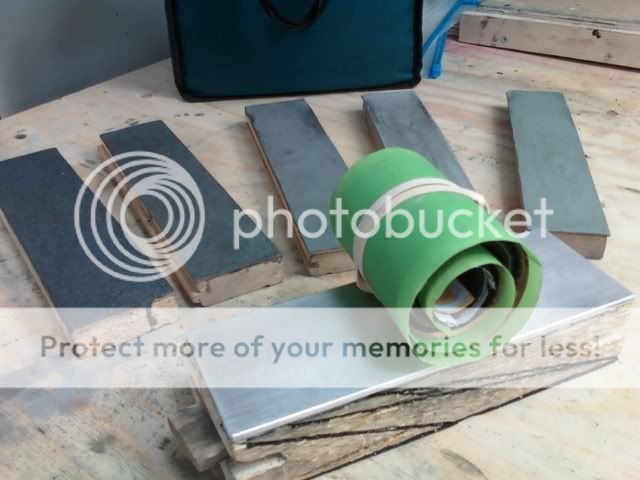
This is very interesting. I find as I continue with the sandpaper I'm using softer and softer backing (assuming I'm going for a healthy convex on the blade itself). My block has an aluminum plate to wrap the sandpaper over for doing V grinds, and I keep a number of leather and rubber sheets on hand for getting that "just right" angle and pressure on the more pronounced convex jobs. One thing I wish I'd learned a lot earlier on is how to maintain solid angle and pressure control with the lightest of feasible touches. On the downside, as I improve this aspect the number of passes required continues to climb even as my edge quality improves incrementally. Its all in the basics, but there's a unlimited amount of depth to these basic skills.


0510111857-2.jpg


Here's my current set-up. The gnarly strop on the end is the 60 grit. It's mostly for experimental purposes, but these days it gets some use sharpening my kitchen knives - its faster and easier than using paper or a stone, and on softer steels like my cheapo Chicago Chinese stainless it does a nice job.
 
I am using balsa because good leather is hard to find here and pretty expensive to buy online and ship here. I figured to try balsa first and if I wasn't satisfied with the results, I have to get good leather. It turns out that I'm pretty happy with the results of diamond paste on balsa.
 
Before I really get into the topic, I want to thank all the people on BF (especially Knifenut1013, ObsessedWithEdges and HeavyHanded) for sharing so much of their knowledge and skills and somehow giving me the final push towards freehand sharpening...I am at the very beginning of the learning curve and I already realized it's a long way to go but from what I've tried so far I'm more than sure that it's worth taking it.
Personally, polished edges are not my goal...at least yet. My target now is getting an edge that shaves hair on my arm. So far I have been practicing with the suggested steps 400/600/800/1000/1200/1500/2000 sandpaper on "soft" backing (mousepad) and waiting for my DMT continuous stones to arrive...and meanwhile I am trying to understand the faults in my technique. I have to say I got my knives (few cheap kitchen knives) almost sharp, took me alot of time working with very light pressure and concentrating on the angle and on where I put pressure as I handle the knife. I know I have to improve my technique, but my question is: do u think that stropping with some compound (or on bare leather) would help me somehow? I mean, at the point of the learning curve where I am now, u think it could help me to add stropping, or I should rather learn how to put a shaving edge on sandpaper (or on stones when I will receive them) and then eventually move to strops for refining later?
Thanks again
:cool:

First, thank you.

Like obsessed said the work on your "stones" is very important and will make or break your edge at high levels of refinement. 400 grit sandpaper is "coarse" but not really coarse enough to set your geometry, I'd probably add some 220. A combination of this and possibly too much pressure causing rounding of the edge would be my guess to why you can't get it Sharp. From 400 grit you should be shaving hair.

HH, also had wise advise about not jumping to far in the grit range with stropping compounds in relation to the last stone used. Consistency is the name of the game and jumping from 8k stone to 50,000 grit strop compound will not be consistent.

Not wanting a polished edge and using 2k sandpaper don't really go together. 2k paper is like a 8-10 stone depending on how much you let it break down and can, with some work, leave a nice mirror polish. This also leads me to believe you are progressing through the abrasives to quickly leaving behind coarser scratches that are distorting the final finish (and sharpness).
 
Thank u all guys for the feedbacks (as u can see, I thanked u for a reason and u just confirmed that u deserved the mention).
Actually I would like to get a polished edge, but that's no priority for me now...I will be happy when I can shave, then set the target higher.
Starting from what I read on this forum, so far I've just tried to follow a very gradual grit scale with sandpaper and get my technique decent, and of course I'm aware that I need further practice. So I thought I should first get "confident" with sandpaper/stones before I added stropping, but still the strop thing came into my mind and I wanted to hear ur suggestions on it. My guess is that the reason why I can't really get a shaving edge so far depends on inconsistency with the angle, cause I've been very careful and put every effort to apply a very light and delicate pressure at all stages of the process. I will also try to change the backing for the sandpaper, from what I've read it might be a kind of "personal" thing so maybe it's worth changing and see what happens.
I also believe that there is something I have to change on the mechanics of my freehand (maybe the position of my body, my hands, the sandpaper, etc) cause I noticed that my "reverse" moves (moving the blade relatively towards me - edge trailing) are way more accurate than the "outside" moves (edge trailing away from me).
I know I need time but I'm sure I can steep up my learning curve with ur help (and the help of everybody here on BF) so thank u.
:cool:
 
I usually do my sharpening on the kitchen counter with the stone slightly turned to my strong hand. Kinda like if you were looking at the strops to the far left in HH's picture. It's also good if the stone is level with your elbows when sharpening, you want to bend your arms at the elbow so your forearms are straight out from the side of your body. The closer the stone height is to this position the more angle control you will have because you move from your shoulder and elbow while keeping your wrist mostly locked. Also get a magnifying lens of some sort, it will answer many questions while sharpening and make you better at sharpening.

The away stroke is always difficult and can take a long time to get the feel for it. Often the main issue is that side will have a MUCH lower angle. We as humans are not good judges of small things like that and as a result can only guess. One thing I always notice when sharpening that side is that when you are at the correct angle it feels 5-10 degrees higher than the other side. Basically you need to first make sure you are holding the same angle then fight the feeling that you are too high on that side.
 
I admit other solutions came into my mind, like using a mirror in front of me (to compare te level of the back of the blade in the "fron stroke" to the level I see in the "back stroke"), or using a DMT aligner (but I'd like to learn pure freehand), or holding the blade with 2 hands and moving the handle from one side to the other of the stone (and basically doing 2 "back strokes", one for each side of the blade), but I will try ur solution first (and yes, I did regrind the "shoulder" of the edge alot on that side in my first attempts, the ,agnifying lens helped me understand that).
In my last try, I put the sandpaper/stone on a level that allowed me to keep my elbow on the table and my wrist more or less locked, and just sway my forearm, but I guess I have to get way better.
Thank u again
:cool:
 
Last edited:
A DMT aligner clamp used with my benchstones showed me the way ;)
 
Ya u beat me for a minute...guess I will have to find one and try...
About the position of the stones I was pretty surprised, but then the spark came into my mind, and I remembered that u are lefty, aren't u? Cause otherwise that seems like a very unnatural position for the stones...
:cool:
 
Last edited:
Back
Top