A thread about Milling Machines

Lorien

Nose to the Grindstone
Moderator
Knifemaker / Craftsman / Service Provider
Joined
Dec 5, 2005
Messages
28,693
The Underverse beckoned enchantingly- filling my heart with Hope and Joy, until I realized that I was being pulled under. Water boarded by the allure of efficiency and productivity of a cold, steel machine, I finally caved to the dreams that I knew would soon lay scattered among the shattered end mills and cutting fluid, and invited the Devil through the door.

So, yeah. Milling machines, they're pretty cool.
Anyone out there using a rotary table? Any thoughts about them?

For anyone else, this is a good thread to generally talk about milling machines.
 
IDK if it's the post Forged in Fire bust or just the general economy, but there seem to be more used mills on FB marketplace than there was a year ago. I personally have an early Harbor Freight Taiwain-made Rong Fu 31. It does a whole bunch of jobs well enough. If I had anything other than trial and error experience, I might think it was insufficient, but for me, it works.
 
I have a HF mini mill. I use a rotary table for milling Slipjoint liners. I installed the budget dro’s (not a true dro but gets the job done), on both the mini’s I have owned. Just be patient and work slow. Only end mill I have broken was a 1/16”. Now I go no smaller than 5/32” on the end mills. Far from being a good end mill it still gets the job done.
 
a rare Sixis 102
I had a yuasa rotary table which was very nice but sold it. Was useful for radius bolsters on slipjoints
man- Harbeer, that is a sweet machine! Hard to find anything like that in this part of the world. All the used machines around here are knee mills- way too big for the space I have available.

wrt your rotary table, have you ever used it to create any non circular shapes? Without ever having used a mill, I'm hoping that I can machine more complicated shapes than just circles
 
man- Harbeer, that is a sweet machine! Hard to find anything like that in this part of the world. All the used machines around here are knee mills- way too big for the space I have available.

wrt your rotary table, have you ever used it to create any non circular shapes? Without ever having used a mill, I'm hoping that I can machine more complicated shapes than just circles
no I used it strictly for radius bolsters on slipjoints.
 
My thoughts really only apply to making folders, you can cut fullers and fun stuff with almost any little mill.

I just bought mill #5, a Grizzly G0704. It has a spindle DRO which I find really useful for precise counterbore depths on folders. No xyz dro as I don't really find them that useful. These have enough weight to cut Titanium cleanly, most common mill ever sold so lots of info on cnc conversion/parts/good customer service. I consider this to be one of the cheapest mills you can get that will actually work well for knifemaking.

Don't get a mill that has a spindle that runs on the column, it should be part of the head. If it is on the column it needs to have a bit of play to gp up and down... this throws hole straightness off a lot. The two cheaper mills you see the most work this way. Stay away from tilting columns. These are all fine for engineeering projects, I'm just talking knives.

I'm about to get a rotary table, you probably want a pretty decent one. Palmgren, Phase Two... lot of old ones on ebay and sometimes for cheap. You can still do a ton with a cheaper one too especially if you set it up well, just expect a fair bit of backlash.

A 1-2-3 block and Albrecht style integral collet chuck will get a ton of use.

You can do a ton with blocks of aluminum, surface them to you mill and rotary table too.
 
Personally, I would buy a decent 40-year-old Bridgeport long before I ever bought one of those tabletop mills brand new. There just isn't a replacement for mass and cast iron, assuming you have the space. If I didn't have the space, I would go through lengths to make the space.

A good machinist with a good knee mill and the proper attachments/tools can make just about anything.
 
Personally, I would buy a decent 40-year-old Bridgeport long before I ever bought one of those tabletop mills brand new. There just isn't a replacement for mass and cast iron, assuming you have the space. If I didn't have the space, I would go through lengths to make the space.

A good machinist with a good knee mill and the proper attachments/tools can make just about anything.

They sound good but I think are sort of a fantasy. Yes nice for moving lots of metal but how accurate and easy to tram? I know a few people who have bought in and sold later for something easier to use. Yes maybe the best potential if you know what you are doing though.
 
one of the features that appealed to me the most about the machine I decided on was its weight. I want a super solid casting, especially with the tilting feature that pretty much all this class of machine comes standard with. This one is about 530lbs, so some good mass, plus I'll be building a skookum stand for it which will be ridiculously heavy

I agree that the ultimate machine would be a knee mill. I took a bike frame building course or two, and visited with a frame building friend from that school and built a frame in his shop, and in both cases used some beautiful old Bridgeports. That's what I'd really like to have, but in the meantime I'ma use this machine to help make me some money so I can eventually tool up in a more serious way. Might have to build a little stand alone building for a knee mill one of these days🤔
 
They sound good but I think are sort of a fantasy. Yes nice for moving lots of metal but how accurate and easy to tram? I know a few people who have bought in and sold later for something easier to use. Yes maybe the best potential if you know what you are doing though.
The accuracy is one of the main advantages of the weight. An increase in rigidity is an increase in accuracy. This is why small CNC mills still run around 14,000+ pounds. The more stable it is the more accurate it is.

I’ve always thought they were rather easy to tram, a few minutes if everything is in working order, and unless you crash it hard or deliberately take it out of tram to machine something there typically is never any reason to need to tram them.

You are spot on with that last statement. Any machine is only as accurate as the person using it.
 
This is definitely true. They tend to get scooped up quickly when they do pop up.
I saw an old Bridgeport on Craigslist a while back for 1500$. It was up in Michigan, where I was visiting the in-laws. I wanted it so bad it hurt my poor little soul...
Didn't have the money, a way to get it back to TX or the space... And my wife may have executed me on the spot.
But dang it, I WANT!
 
I have used a ~250lb benchtop mill for a couple of years in my old place, since I didn't get anything else in my price range back then. It did the 'job', though I wasn't really happy with it, and scrapped more than a few parts, until I learned to be extremely patient, even after dialing it in, a giving it a birthday. To be fair to the little thing, most of my grievances with it were probably just me, it being the first mill I ever used, and it did turn out a couple of acceptable parts, as long as I wasn't after any sort of precision. After moving shops, I didn't put it up again, and thankfully I found an old universal mill from the ~60s for a more than fair price a year or two later.
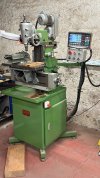
It is a Thiel duplex 159, that looked quite rough, but cleaned up nicely after a bit of restauration, and adding a few missing bits here and there, adding a dro, and giving it a general once over.
2eeP9TM.jpeg

dqEvwMa.jpeg

8OqLxBl.jpeg

As you can see, I keep it meticulously clean.
This one, I'm more than happy with, and I'm able to consistently make parts to about 5-30 microns, with a bit of forethought depending on the size.
One of these days, I will have to make new gibs for it, as the current ones are pushed in all the way, and especially the z axis has a little play, depending where the table is located.
It's still on the pallet it came on, as this is not it's final place (4-5 years on, I know, but in my defense, it does work like this :p), but I'm looking forward to the added rigidity, once I'm able to bolt it to the ground.
I currently don't have a rotary table, and I am looking for one, every now and then, though it's not high on my list.
I also added some light turning capabilites, as seen here, and here.

 
Having a high-quality knee mill would be nice, but for knife work, I have a hard time believing anyone needs one, compared to some of the better-quality bench-top mills available today.

PS. Dialing in a rotary table, and your work, ain't for kids. A boring head might get what you want a little easier?
 
Having a high-quality knee mill would be nice, but for knife work, I have a hard time believing anyone needs one, compared to some of the better-quality bench-top mills available today.

PS. Dialing in a rotary table, and your work, ain't for kids. A boring head might get what you want a little easier?
I need to learn more about boring for my folders.
 
Back
Top