Advice for rolled bowie.

How did you end up with 5 huge divots? One ding was enough to tell you there was a problem. That looks more like banging annealed steal on the edge of harder steel. Fix it. Grind off the handle, grind back the edge and re grind the main bevel. Then send out for heat treat. Just my 2 cents tho.

No, just knots. I had 3 before I even noticed them. The other two were on a different knot to make sure it wasn't just that spot.
I have to say that the first thought I had was that you were trying to chop nails in half. If that was caused by a knot, it was a pretty tiny...and extremely hard....knot. Could it have been a nail in the board?

Grind the edge back to the roll and then re-sharpen it. I bet it will be fine. Sounds like the edge was a bit thin for a bowie.

No, I examined the board very carefully afterwards and got the same results on a different knot.
 
When I saw this thread I immediately grabbed my first bowie I have attempted. Went out to my back building with 2x4 in tow and went to hacking on it. I kept checking on my blade about every 5th hit looking for damage. Considering how much work I put into mine this would have actually made physically sick if it would have happen to me.
I just got mine back from Peters back in Nov. with a target of 58-60 RC.

I sure hope there is a way you can salvage your hard work. :thumbup:
 
When I saw this thread I immediately grabbed my first bowie I have attempted. Went out to my back building with 2x4 in tow and went to hacking on it. I kept checking on my blade about every 5th hit looking for damage. Considering how much work I put into mine this would have actually made physically sick if it would have happen to me.
I just got mine back from Peters back in Nov. with a target of 58-60 RC.

I sure hope there is a way you can salvage your hard work. :thumbup:

Good, it should be able to do that and then some:thumbup:

This was also my first bowie so not exactly happy. First time I used handle material more than $10 to.
 
Have to wait for belts to get here. Ill make sure to update this thread when I try to fix it.
 
Mine was also a flat grind, only mine was 1095 your 52100 is plenty tough from what I have read. Forgot something so I had to edit this. My edge after HT started out about the thickness of a double thumbnail, and I remember thinking that little 320 1x30 will take for ever so I ran a couple of passes on my 2x48 with an 80 grit belt just to knock it down a little then I went to my 1x30 to finish the edge and started with 320 then 600, then to the trizact 1000, and finally leather belt with compound
 
Last edited:
I know its unlikely, but it looks like a HT issue to me, unless the steel was a mixup. Peters tests each blade AFAIK, so a problem should be unlikely. For reference, I did a 52100 bowie for my brother in law, Rc60 0.010" behind the edge and sharpened at 20deg/side. After 6 months of hard use, including going through a few nails, there were 2 small nicks in the blade. He used it to take apart an outhouse at his family cabin. He cut wire, and even hardened guitar strings. Like I said, 2 small nicks. Yours looks like the steel didn't harden properly. 52100 is quite tough, even at Rc60+. I would suggest testing the blade over a few different spots. I had one that deformed badly, but it was the only 52100 blade that I didn't thermal cycle, and the Rc#'s were between 60 and 35 when I tested. Even if the surface isn't parallel, you will know something is up if you get readings below 50, as I have found the #'s on bevels will be out compared to a ricasso, but I haven't ever seen one out more than 4 or 5 Rc points on some test blanks I did.
 
Thanks for your input with the one you did.

There was test marks on probably half of them out of the batch of 21 I sent in. New guy maybe:confused:, I dont know. I really cant remember if there was on on this bowie.
 
I don't see mention of the brass rod test, though I might have missed it. Did you check the sharpened edge with a brass rod? That will tell you a good deal about the heat treat rite there, and it's cheap and easy to do. If the edge flexes and stays flexed the edge is too soft, if it chips it's too hard, if it flexes and returns true it's about rite.
 
I don't see mention of the brass rod test, though I might have missed it. Did you check the sharpened edge with a brass rod? That will tell you a good deal about the heat treat rite there, and it's cheap and easy to do. If the edge flexes and stays flexed the edge is too soft, if it chips it's too hard, if it flexes and returns true it's about rite.

I just tried it to the best of my understanding. I was able to dent it but only slightly. I couldn't physically see it"flex" like people say they can.

Ive pounded the edge back fairly straight with a ball peen. I just have to wait until my belts get here to try and thicken it up.
 
Use a 5X or 10X magnifying visor you will see it then, I'm going to say if you pounded the dents back and they didn't chip out, then that blade is way soft

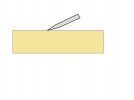
The proper angle for the brass rod test you want the tip of the primary angle to touch the brass not the entire edge

brass test.jpg
 
Thank you that helps a lot. I was doing it wrong. It still deformed but only slightly.
It was very easy to hammer the dents back.
 
The more I read on this thread the more I wonder what is going on.

It appears that the edge is very soft. It was either badly overheated in finishing, or has a bad HT. I am now starting to lean toward the bad ( or non-existent) HT.

At this point, I would start with some reasonable tests of the edge hardness. Try to file the edge....if it files, it is soft. Knock off the handle and try to drill a hole...if it drills it is soft. If any tests seem to imply a non-existent or insufficient HT, grind the edge back to about .020" thick and send the blade back to the HTer for testing and re-Thing.


Some funny stories to point out that s#!t happens even to the best of us;
I sent a large batch of blades to a famous knifemaker who also is a HTer about 10 years ago. It came back in a week with all the blades bundled together looking shiny. This fellow does the HT in a vacuum oven of some sort and the surface barely changes its look, so I wasn't immediately suspicious. I went to finish a blade, and it ground so easily I knew something was wrong. I checked all the blades, and none were HTed. I sent them back with a note and he re-did the HT. Actually, he did it for the first time. He had inadvertently set the blades down on the rolling cart that he puts blades on after HT and his assistant had just packed them up and shipped them back.

Another time I sent off 50 blades and received 50 blades back from HT from a well known and popular HTer. I had 10 damascus blades in the batch, and got ten back. There was a lovely big damascus bowie in the bundle. It was really nice, but not my bowie. I contacted the HTer and told him about it. He said they were tearing the place apart looking for that bowie blade, as it was for a well known maker. I express mailed it back and all was well. I asked about my other damascus blade, and they said there was no other blade fitting the description of mine in the shop. We worked it out and I forgot about it. About a year later I get a box with the blade in it. It had been in the bottom of the LN tank for a year. They had no idea who's it was at first until one of the guys remembered the Bowie incident.
 
^ I agree, I have taken quite a few 52100 blades plenty thin with no damage to the edge. My blades are harder but I don't think your RC was low enough to effect edge stability. I think it's a heat treat problem or cooked edge...

A few months ago I had ~62 RC 52100 Chef's knife with a near zero edge almost finished up... for some reason I decided to sail it through a 1" Oak branch right at a knot and it suffered almost no damage. High hardness, thin 52100 can do quite a lot!
 
I have to say that the first thought I had was that you were trying to chop nails in half. If that was caused by a knot, it was a pretty tiny...and extremely hard....knot. Could it have been a nail in the board?

Grind the edge back to the roll and then re-sharpen it. I bet it will be fine. Sounds like the edge was a bit thin for a bowie.

I was thinking on a flat grind that mighta been kinda thin. Softwood knots-especially hemlock-can be pretty brutal on thin edges. I blew a hunk out of the edge of a (well ht'd) bolo from the Philippines on a hemlock knot that was big enough that i heard the thing go by my head.
This all does sound like it got too hot or was tempered back past 59-52100 at 59-60 shouldn't be all that happy about being hammered straight.
I woul grind a convex edge on it and make it a user/learning experience-it's a very nice design, btw.
 
Some funny stories to point out that s#!t happens even to the best of us;
I sent a large batch of blades to a famous knifemaker who also is a HTer about 10 years ago. It came back in a week with all the blades bundled together looking shiny. This fellow does the HT in a vacuum oven of some sort and the surface barely changes its look, so I wasn't immediately suspicious. I went to finish a blade, and it ground so easily I knew something was wrong. I checked all the blades, and none were HTed. I sent them back with a note and he re-did the HT. Actually, he did it for the first time. He had inadvertently set the blades down on the rolling cart that he puts blades on after HT and his assistant had just packed them up and shipped them back.

Another time I sent off 50 blades and received 50 blades back from HT from a well known and popular HTer. I had 10 damascus blades in the batch, and got ten back. There was a lovely big damascus bowie in the bundle. It was really nice, but not my bowie. I contacted the HTer and told him about it. He said they were tearing the place apart looking for that bowie blade, as it was for a well known maker. I express mailed it back and all was well. I asked about my other damascus blade, and they said there was no other blade fitting the description of mine in the shop. We worked it out and I forgot about it. About a year later I get a box with the blade in it. It had been in the bottom of the LN tank for a year. They had no idea who's it was at first until one of the guys remembered the Bowie incident.
Are you sure it was 52100? I keep several different steels around-5160, 1084, 1075, 80CrV2, 52100...and 1018 for damascus. I made myself a nice old style winter war puukko last summer from a piece of (what I thought) was 80CrV2 scrap...NOT. Ht'd it aaaand...nothing, which was kinda comical. 1018. (Did a similar thing twenty years ago with a 35", 3" wide buggy-spring steel viking sword, which wasn't funny at all)
I know yours isn't mild but if it was another HC steel the heat treat might not be what it should, and all you hafta do is accidentally forge your blank from the end Aldo puts the paint on to be stuck wondering.
 
The more I read on this thread the more I wonder what is going on.

It appears that the edge is very soft. It was either badly overheated in finishing, or has a bad HT. I am now starting to lean toward the bad ( or non-existent) HT.

At this point, I would start with some reasonable tests of the edge hardness. Try to file the edge....if it files, it is soft. Knock off the handle and try to drill a hole...if it drills it is soft. If any tests seem to imply a non-existent or insufficient HT, grind the edge back to about .020" thick and send the blade back to the HTer for testing and re-Thing.

If this confuses YOU then it he to be bad!:D

Its definitely somewhat hard. I can file it though even on the spine. Relatable to my tram. One of my 1084 knives was clearly harder to file than this and they should be about the same.

Aww, I really dont want to rip the handle off of it:(

BTW, its from aldo.
 
I was thinking on a flat grind that mighta been kinda thin. Softwood knots-especially hemlock-can be pretty brutal on thin edges. I blew a hunk out of the edge of a (well ht'd) bolo from the Philippines on a hemlock knot that was big enough that i heard the thing go by my head.
This all does sound like it got too hot or was tempered back past 59-52100 at 59-60 shouldn't be all that happy about being hammered straight.
I woul grind a convex edge on it and make it a user/learning experience-it's a very nice design, btw.

I agree, I dont have too much experience with 52100 but ive put a couple through the paces enough to know it should NOT be doing this even this thin.

Thank you for the compliment on the design. This was the only one of the batch I was actually attached to.
 
So whats the consensus? Grind it back and sharpen it to test again or avoid the possible loss of even more width and grind the handle off to re-heat treat?
 
Back
Top