AEB-L & O1 Edge Retention

jeffbird

Gold Member
Joined
Feb 3, 2011
Messages
717
Why is AEB-L so popular with custom knife makers, especially for hunting knives where edge retention is the most important factor?

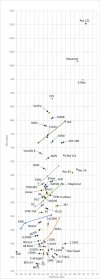
Larrin’s testing shows it has low edge retention when tested with his CATRA test cutting machine.

O1 is another steel that is easily bested by many other steels for hunting knives.


IMG_0560.jpeg
 
Aside from price, they are both easy to sharpen in the field if necessary, and AEB-L is tough, so it can take rough / hard usage.

My buddy, (maker), Jerry Halfrich would guide hunts in TX, AK, and the mountain west, and when some of his clients had high edge retention steel knives built by him in order to get their feedback, they complained about not being able to sharpen them after processing the animals harvested. (Or repair nicks and such from coming into contact with bone, sediment, etc). Something with more "balance" is often the better choice according to him and his clients.

Of course diamond hones help...but I remember having these conversations with Jerry who takes his craft seriously.
 
I think Horsewright Horsewright , David Mary David Mary , and Crag the Brewer Crag the Brewer can provide better insight.

In my experience, AEB-L stays very tough even at higher hardness. It can be ground thinner and cut well, be sufficiently hard for good edge retention (but by no means the "best" edge retention), and remain easy to sharpen when needed. I would say that makes it user friendly for most people who may struggle with sharpening "better" steels by hand, as well as for those of us who are just in a hurry.

It is also important to consider that toughness is a major factor in edge retention in that it helps prevent edge damage in use. An edge loses sharpness from abrasion, but it also loses sharpness from micro chips, cracks and edge deformation. A steel with higher toughness can avoid such damage better than a harder, more brittle steel that might technically rank higher for edge retention or abrasion resistance. Since it's very tough, an edge in AEB-L likely won't chip and fracture when you accidentally ding the edge against a plate, staples, work surfaces, rocks and sand, etc. So the end user gets a knife that seems to keep cutting forever and ever despite not having supersteel edge retention.

For my part, I typically clean game in the field and have to cut through thick hides and fur that is often saturated in dirt and sand, then cut and scrape against bone once the animal is opened up. All of that is torturous on a knife's edge. I have had edges in 154CM, S30V, 52100, O1, 1095, AUS-8, 12C27N, 14C28N, PM-A11 and others chip under those circumstances and struggle to finish the job. I have not had the same issue with my knives in AEB-L with hardnesses exceeding 61 RC.

 
AEB-L became more common in custom in the last 10-20 years (early 2000), despite it being way older than that. Before that, people cared more about edge retention than toughness, 440C and its mutations were the hot stuff for stainless, also the reason why there was so many fake 440 steel blade.
 
AEB-L is cheap and easy to work with. I do think it makes a great woods knife but definitely not on my list for a hunting knife. For people who have only used low alloy knives AEB-L can be a step up in performance for them.

What I have found personally through butchering a decent amount of animals since I started making knives a decade ago is I like a balance of strength and toughness with some vanadium carbides.

Last year I field butchered an elk deep in the mountains so I could pack it out and my 10v knife was fabulous. Magnacut and Cruwear are also favorites when they are 62-63 Rc.

Just for the fun of it I butchered to freezer a deer this year with a 2.75 inch Magnacut blade. Gutted, cut brisket cartilage, skinned, separated all leg joints and butchered all the meat and the little knife was still margiannly slicing news paper sharp but did need a sharpening at the end. You could not do this with AEB-L without having to sharpen it a time or two.
 
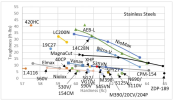
Wow, O1 is way down there in edge retention. Pretty much all simple carbon steels are down there at the bottom. I saw this chart in the sticky but was focused on the middle of the chart where the typical edc folding knife steels are.

When I get to forging my own blades I will have to work with the simpler carbon steels by necessity of home heat treatment.

I do see a LOT of AEBL in kitchen knives, likely for the cost of the extra wide bars and thr toughness with paper thin edges. Looking at the Steel cost AEBL is much more affordable than some of the higher alloys, which can provide more profit and/or more affordable finished product. I'll probably try some on my next order.

I made a handful of hunting knives in 154CM and most recently one in D2 hardened around 60hrc. The 154CM's typically needed a stropping or minor touch up after cleaning a deer, the D2 knife did 2 deer and still shaved arm hair afterwards. I am a believer in D2 in performance to cost ratio and will be buying more of it.
 
AEB-L is cheap and easy to work with. I do think it makes a great woods knife but definitely not on my list for a hunting knife. For people who have only used low alloy knives AEB-L can be a step up in performance for them.

What I have found personally through butchering a decent amount of animals since I started making knives a decade ago is I like a balance of strength and toughness with some vanadium carbides.

Last year I field butchered an elk deep in the mountains so I could pack it out and my 10v knife was fabulous. Magnacut and Cruwear are also favorites when they are 62-63 Rc.

Just for the fun of it I butchered to freezer a deer this year with a 2.75 inch Magnacut blade. Gutted, cut brisket cartilage, skinned, separated all leg joints and butchered all the meat and the little knife was still margiannly slicing news paper sharp but did need a sharpening at the end. You could not do this with AEB-L without having to sharpen it a time or two.


Much of this mirrors my own experience.

Perhaps one of the most overlooked factors in discussing this, though, involves more than alloy selection. If the heat treat isn’t optimized, and/or compromises in geometry are made, I don’t care what alloy it is, it won’t work the way it could.

It’s not just about hardness, it’s about how the maker got to that hardness. Not all 63RC is equal. It’s part of why there can be such sweeping disparities in people’s experiences with knives. Not everyone’s CPM-Cruwear at 63RC is going to be the same, because there’s a whole bunch of ways to get to that end result, and they will all have slightly different results in use.


Scott, it’s my guess that you’ll really appreciate Magnamax. Hoping they finally manage to release it, soon.
 
Why is AEB-L so popular with custom knife makers, especially for hunting knives where edge retention is the most important factor?

Larrin’s testing shows it has low edge retention when tested with his CATRA test cutting machine.

O1 is another steel that is easily bested by many other steels for hunting knives.


View attachment 3054630

For me, as a user, AEB-L gets really interesting 61 HRC and up. Toughness is important for a hunting (or cooking) knife, when you hit a bone, etc., and don't want the edge to chip. Also from Larrin:

1766170255124.png

You can see AEB-L is one of the toughest stainless steels available for higher HRC.
 
Why is AEB-L so popular with custom knife makers, especially for hunting knives where edge retention is the most important factor?

Larrin’s testing shows it has low edge retention when tested with his CATRA test cutting machine.

O1 is another steel that is easily bested by many other steels for hunting knives.


View attachment 3054630

The CATRA chart shows when variables are isolated to show what steels have more cutting edge retention which is extremely helpful to understand how things work.

In use outside of a controlled testing, geometry has a big effect and is a huge variable for cutting edge retention, cutting ability and durability.

Roman Landes and Cliff Stamp have argued and preached for over +20 years that the "geometry cuts"

Meaning you should technically be able to take a steel like AEB-L and maximize the HT to increase the edge stability and "cheat" by using a much thinner geometry then could be used with other steels.

However, where it gets lost in translation is people often use the AEB-L steel too soft to take advantage of this or only chase the maximum hardness at a consequence of poor microstructure making up that hardness.

We can use the CATRA equation Dr Larrin created using a regression formula based on years of data to see the effects of geometry.

TCC (mm) = -157 + 15.8*Hardness (Rc) – 17.8*EdgeAngle(°) + 11.2*CrC(%) + 14.6*CrVC(%) + 26.2*MC(%) + 9.5*M6C(%) + 20.9*MN(%) + 19.4*CrN(%)


Using the regression formula you can "sandbox" the relationships and behaviors of the different Steels.

You input the included edge angle, HRC, carbide type and carbide volume.

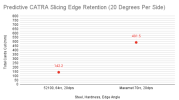
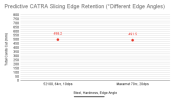
We can take two different steels at the opposite ends of the spectrum and see how they sperate and match each other.

Screenshot_20251219-104907.png


Screenshot_20251219-104837.png


That is the power of geometry.
 
Last edited:
The question for me would be why isn’t AEB-L (or 14C28N) More popular than 1095 in fixed blades?
They both have better edge retention and toughness over 1095, and they are stainless too. Yet Tops and Esse both stick to 1095 for most of their knives. The cost can’t be all that much different.
 
The question for me would be why isn’t AEB-L (or 14C28N) More popular than 1095 in fixed blades?
They both have better edge retention and toughness over 1095, and they are stainless too. Yet Tops and Esse both stick to 1095 for most of their knives. The cost can’t be all that much different.

AEB-L is a little more expensive and is a stainless steel.

1095 is high carbon, costs less, and that's always a big factor, for companies selling volume.

If I could get a Becker BK-9 in AEB-L... 😍
images (19).jpeg
 
The question for me would be why isn’t AEB-L (or 14C28N) More popular than 1095 in fixed blades?
They both have better edge retention and toughness over 1095, and they are stainless too. Yet Tops and Esse both stick to 1095 for most of their knives. The cost can’t be all that much different.
Cost per lbs, HT, grinding etc.

It may not seem like much, but when you scale it into the thousands, it shrinks the margin.
 
AEB-L is a steel that works great for both heavy choppers and fine cutting knives, heat treated well its an amazing steel and a wonderful choice for a custom piece. I know battle horse knives primarily used O1 steel and while its tough and is a decent cutter it needs more maintenance because it can stain or rust if moisture is left on it. I believe for that reason people may choose AEB-L over O1 and is why more custom knife makers prefer it over O1, if for no other reason being more popular. Example is LT Wright AEB-L knives sell out super fast while the A2 pieces may linger for a good while longer.
 
I think Horsewright Horsewright , David Mary David Mary , and Crag the Brewer Crag the Brewer can provide better insight.

In my experience, AEB-L stays very tough even at higher hardness. It can be ground thinner and cut well, be sufficiently hard for good edge retention (but by no means the "best" edge retention), and remain easy to sharpen when needed. I would say that makes it user friendly for most people who may struggle with sharpening "better" steels by hand, as well as for those of us who are just in a hurry.

It is also important to consider that toughness is a major factor in edge retention in that it helps prevent edge damage in use. An edge loses sharpness from abrasion, but it also loses sharpness from micro chips, cracks and edge deformation. A steel with higher toughness can avoid such damage better than a harder, more brittle steel that might technically rank higher for edge retention or abrasion resistance. Since it's very tough, an edge in AEB-L likely won't chip and fracture when you accidentally ding the edge against a plate, staples, work surfaces, rocks and sand, etc. So the end user gets a knife that seems to keep cutting forever and ever despite not having supersteel edge retention.

For my part, I typically clean game in the field and have to cut through thick hides and fur that is often saturated in dirt and sand, then cut and scrape against bone once the animal is opened up. All of that is torturous on a knife's edge. I have had edges in 154CM, S30V, 52100, O1, 1095, AUS-8, 12C27N, 14C28N, PM-A11 and others chip under those circumstances and struggle to finish the job. I have not had the same issue with my knives in AEB-L with hardnesses exceeding 61 RC.
That's interesting that 14c28n chipped when AEBL didnt. I thought they were essentially the same but 14c had additional corrosion resistance
 
That's interesting that 14c28n chipped when AEBL didnt. I thought they were essentially the same but 14c had additional corrosion resistance

I think this plays into what was said above by another (possibly smarter?) member:

Perhaps one of the most overlooked factors in discussing this, though, involves more than alloy selection. If the heat treat isn’t optimized, and/or compromises in geometry are made, I don’t care what alloy it is, it won’t work the way it could.

It’s not just about hardness, it’s about how the maker got to that hardness. Not all 63RC is equal. It’s part of why there can be such sweeping disparities in people’s experiences with knives. Not everyone’s CPM-Cruwear at 63RC is going to be the same, because there’s a whole bunch of ways to get to that end result, and they will all have slightly different results in use.

I had two Kershaw knives in 14C28N chip during use, one minor chipping along the edge and the other blowing a chunk out of the edge at the transition from straight edge to serrated edge (it was a combo edge blade). Both knives were manufactured in the early-mid 2000's, so heat treat has probably improved since then. I cannot speak to performance from other makers/manufacturers, although generally I hear good things.
 
I think this plays into what was said above by another (possibly smarter?) member:


I had two Kershaw knives in 14C28N chip during use, one minor chipping along the edge and the other blowing a chunk out of the edge at the transition from straight edge to serrated edge (it was a combo edge blade). Both knives were manufactured in the early-mid 2000's, so heat treat has probably improved since then. I cannot speak to performance from other makers/manufacturers, although generally I hear good things.
Very good point. Thank you
 
Greasy, gritty hide on moose and bear will take the edge off just about any steel, even high carbide super steels. Low carbide high carbon or stainless steels are easier to touch up in the field. D2 for some reason seems to hold up well when field dressing.
 
Back
Top