Aebl 64rc 4" paring/boning knife

BluntCut MetalWorks

Knifemaker / Craftsman / Service Provider
Joined
Apr 28, 2012
Messages
3,476
Imagine a wild-knife-nut commission you to make a paring/boning knife with a fixed-specs: AEB-L, 64rc, ~0.01" behind edge thickness, ~11dps bevel. i.e. 1K waterstone-grit edge capable of moderate whittling oak+ebony+buloke without visible roll/ding/chip.

Accepted as a fun challenge... What would you/I do to make one?

OK, actually nobody asking me to make one. Lately, I've tinker ht with medium to high (Cr+Mo) mass% steels. I float this tough specs here, looking for a already invented wheel/ht.

Any experiences & insight & foresight are very much appreciated :thumbup:
 
I run mine @ 62Rc. 64 would be an interesting experiment. Please post your results.
 
You need to answer these questions:


Is it a paring knife or a whittler? - They are very different things.

Metal choice is fine ... for a paring knife. - AEB-L is great for slicers, for a whittler, 1095 or W2 or Hitachi white/blue is better.

Hardness is too high for the metal choice. - AEB-L is maxed out at Rc61-62. The carbon steels listed are better for higher hardness. Rc64 is too high IMHO for any whittler.

Behind the edge thickness - .010" is OK for whittling, but go thinner for a slicer.

Edge angle too low for whittling hard wood - 11dps is OK for slicing, but try 15dps for whittling.

Waterstone sharpening is good. Be careful not to "round" the edge by being too aggressive. Keep the stones flat. That said, a 120 grit belt edge will cut just as well or better on a whittler.


The way to "design the perfect knife" is start with the task the knife will perform, and pick all the other aspects in the order above to fit. Remember that it won't be perfect for some other tasks, so be task specific.
 
I use Rc62 with AEB-L. No benefit going higher, and a more brittle blade.

For a very fine but tough blade, I use W2, 52100, or hitachi steels. I just did a small parer in O1, and I had to take the edge back a bit, as it rolled easier than the steels I listed above. I never saw a performance difference between O1 and the other steels at other geometries before. It might be my heat treat on O1 isn't as good as the other steels I have dialled in really well. I see some experimenting in my future. :thumbup:
 
I have not run it harder than 62, but my research indicated what Stacy and Warren mentioned. 64 AEBL is going to be too hard for anything but a dedicated protein slicer, IMHO.

Can you even get AEBL that hard?
 
Thanks. I've enough aebl to make around 30 test blades. In the quest of 64rc, many blades will end up in the metal recycling bin.
I run mine @ 62Rc. 64 would be an interesting experiment. Please post your results.

I've made over 10 kitchen(paring & petty) knives with aebl at 62rc. Although, they perform well in their function when properly use. However after seeing my thin paring knives being used as a boning & bbq knife. Moderate bone contacts messed up these edge. So, instead of giving a disappointed stare at the user for mis-use, I seek for stronger & tougher rendition of ht aebl + 52100 + a whole bunch more of steels :p
I use Rc62 with AEB-L. No benefit going higher, and a more brittle blade.

For a very fine but tough blade, I use W2, 52100, or hitachi steels. I just did a small parer in O1, and I had to take the edge back a bit, as it rolled easier than the steels I listed above. I never saw a performance difference between O1 and the other steels at other geometries before. It might be my heat treat on O1 isn't as good as the other steels I have dialled in really well. I see some experimenting in my future. :thumbup:

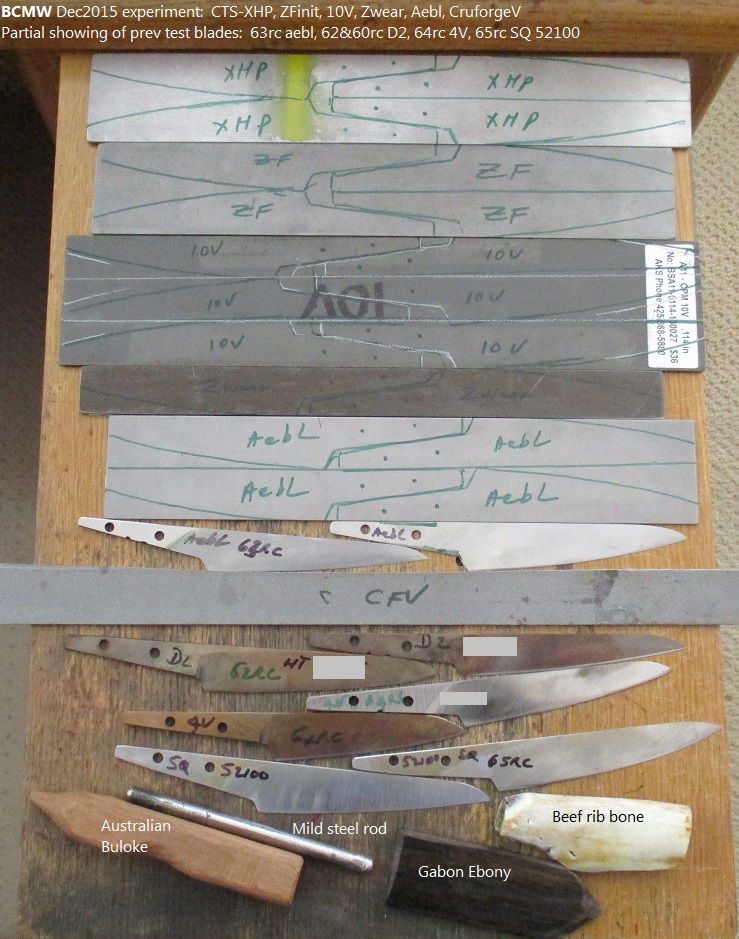
Last experiment(aebl; 52100; D2; 4V). I made 2 aebl at 63rc (pic - below) with edge capable of whittle hardwood. I had to use at least 0.015" edge thick to whittle that steel rod. I think, in order to achieve a stable 64rc with aebl, RA needs to be close to zero. My 63rc blades are close but going even higher temp to put all carbon in solution will (after cryo): increase RA and higher percent of plate martensite (thus more brittle & weaker than lath).
I have not run it harder than 62, but my research indicated what Stacy and Warren mentioned. 64 AEBL is going to be too hard for anything but a dedicated protein slicer, IMHO.

Can you even get AEBL that hard?

63rc aebl: 0.09" spine thick with drastic distal taper, zero grinded, 5.5dps - 0.003" BET cutting edge. Whittled pine w/o problem but not thick enough to whittle buloke. Did fine with 0.008" BET and 10dps.
v3hfJu8.jpg
 
Stacy - your questions and tips are appreciated. See inline answers...
You need to answer these questions:


Is it a paring knife or a whittler? - They are very different things.
It is a paring knife but can handle boning/moderate-impact-with-hard-material tasks. Whittling is my way of testing edge stability at an acute bevel angle

Metal choice is fine ... for a paring knife. - AEB-L is great for slicers, for a whittler, 1095 or W2 or Hitachi white/blue is better.
Aebl at 63+rc and a little bit of M7C3 and close to zero RA, could easily challenge low Cr high carbon steels at normal/good ht.

Hardness is too high for the metal choice. - AEB-L is maxed out at Rc61-62. The carbon steels listed are better for higher hardness. Rc64 is too high IMHO for any whittler.
Agree, 64rc is too high, especially when toughness is insufficient for withstanding lateral stresses. otoh, I enjoy to learn the hard-way:foot:

Behind the edge thickness - .010" is OK for whittling, but go thinner for a slicer.
Agree. I sort want to go for a hybrid paring+boning 0.007-0.008"BET, along with 10-15dps. Dps depend on cutting force involve. 0.004-0.005" 10dps for dedicated paring/slicer.

Edge angle too low for whittling hard wood - 11dps is OK for slicing, but try 15dps for whittling.
Agree.

Waterstone sharpening is good. Be careful not to "round" the edge by being too aggressive. Keep the stones flat. That said, a 120 grit belt edge will cut just as well or better on a whittler.
Good points. For kitchen a knife edge, I usually finish on 2K or 5K ceramic waterstone (Shapton Pro or Glass). I've 4 or 5 different brand & abrasive type of 1K stones, hahaha slowly they are dishing in the middle. I can live with flat or non-flat waterstones. I use low speed 120grit only when pre-sharpen thickness is more than 0.01", apexed it, then flatten apex radius to around 0.002" with SiC stone, hand sharpening to finish.

The way to "design the perfect knife" is start with the task the knife will perform, and pick all the other aspects in the order above to fit. Remember that it won't be perfect for some other tasks, so be task specific.
:thumbup: Bottom/Edge up is an excellent way to design a knife. My knife making is (trying) based on this philosophy and won't hesitate to build/throw in extra fire power (as a reserved after-burner).
 
Stacy - your questions and tips are appreciated. See inline answers...


Bluntcut, do you ever do things in a "normal" way?

I love your posts, as thinking outside the box requires understanding of what is in the box in the first place. :D :thumbup: :confused:
 
Bluntcut, you might want to look at 15N20. I have done a few skinners at Rc61/62, and they work well with a 0.010 or slightly narrower edge (o.oo5 is pushing it as bit too far), 15 dps, and they handle mild to moderate bone contact. One hunter split an elk rib cage with one of these knives and the edge survived no problem. The nickel gives the steel great toughness even with so few other alloying elements. Its not a sexy steel, but it performs very well. I plan to use it for my JS test knife.
 
Thanks Warren. I did tinkered around with 15N20 but couldn't get edge stable at 63+rc, so I found 52100/W2 works much better for my way of knife making. I am tinkering with aebl, traded in some toughness for corrosion resistant(stainless).

Don't forget to video a WIP & test on your JS knife. Best of lucks in advanced to you.

Bluntcut, you might want to look at 15N20. I have done a few skinners at Rc61/62, and they work well with a 0.010 or slightly narrower edge (o.oo5 is pushing it as bit too far), 15 dps, and they handle mild to moderate bone contact. One hunter split an elk rib cage with one of these knives and the edge survived no problem. The nickel gives the steel great toughness even with so few other alloying elements. Its not a sexy steel, but it performs very well. I plan to use it for my JS test knife.
 
Does a nut knows it is a nut! Nut, I am in a shell or Am I? :p:D:rolleyes::foot:
Bluntcut, do you ever do things in a "normal" way?

I love your posts, as thinking outside the box requires understanding of what is in the box in the first place. :D:thumbup: :confused:
 
Thanks Warren. I did tinkered around with 15N20 but couldn't get edge stable at 63+rc, so I found 52100/W2 works much better for my way of knife making. I am tinkering with aebl, traded in some toughness for corrosion resistant(stainless).

Don't forget to video a WIP & test on your JS knife. Best of lucks in advanced to you.

Rc60-62 seems to be the sweet spot with 15N20. Good edge holding at Rc62, great toughness at Rc60. I'll go down to Rc60 if needed, but if you need more toughness than that, just go to 5160, and give up a lot of edge holding stability.

Does a nut knows it is a nut! Nut, I am in a shell or Am I? :p:D:rolleyes::foot:

I do things the hard way, but nothing like you! :eek: :D
 
Toughness of 15N20 high however edge retention isn't there for my liking. I pushed for better retention with hardness > 62rc but failed. I will circle back to this steel once I get smarter or forgetful.

Rc60-62 seems to be the sweet spot with 15N20. Good edge holding at Rc62, great toughness at Rc60. I'll go down to Rc60 if needed, but if you need more toughness than that, just go to 5160, and give up a lot of edge holding stability.


I do things the hard way, but nothing like you! :eek: :D
 
Sharing something, I found very helpful, however you should look at it with critical eyes...

Larrin ran JMatPro simulations on a modified Aebl with Nb & Mo enhancement. Prefer not to cross-forum link, so here is a link to Larrin's jmatpro image.

Top line is raw/original aebl (0.68%C). As you can see aust at 1950F, only 0.45%C is in solution, the rest remain in M7C3 form.

Nb_alloyed_AEB_L.png


In the box problems: In addition to the 2 problems I mentioned(increase RA% & plate martensite%), high aust temp will lower carbide fraction and sub 450F temper will (my conjecture) precipitate Fe3C. If that so, it is bad to trade Cr7C3 for Fe3C.

My 63rc aebl aust at 2000F. This upcoming experiment will aust aebl at 2050F - 2150F. At 2100+F aust temperature, problems above will magnify with more carbon in solution (up to 0.68%C), unless I avoid/mitigate the root cause of those problems. Cryo can help some but too late because problems already manifested from aust cool to M(ambient temperature). Even at LN2 low temp (+temper mart conv), RA% will still be high (guessing > 5%).

Bottom line - whether edge of aebl at 64rc be stable enough for tasks mentioned in OP. How would you approach this quest/goal?
 
would love to hear how you can temper to 64 on aebl im workig with BDZ1 just testing stages and have shoot for 60-61 max
 
Butch, I was hoping to get ideas from our gracious BF contributors.

Last night, I looked at my lab/experiment-note, my 63rc blades were aust at 2100F. Thus, I will aust up to 2150-2200F burning temperature. Oh, I forgot to mentioned the obvious problem with high temperature soak, the fast growing aust grain size. I've ideas to deal with other problems. Currently, I don't know how to prevent aust grain growth at excessive aust temp for mid-hi Cr+Mo % steels yet. So far, 63rc fractured grain (from a coupon) still looks as fine as controlled/baseline(std ht) coupon.

BDZ1 composition look similar to Aebl. Except bdz1 extra 0.75%Mo could really help with my 64rc quest. At ultra high aust, aust-stabilizer is a friend preventing carbide precip from taken place at the wrong time(s).

would love to hear how you can temper to 64 on aebl im workig with BDZ1 just testing stages and have shoot for 60-61 max
 
There is a big difference between optimum heat treatment and highest attainable hardness. The higher the aus temp the less carbide volume you have. Part of what makes aeb-l cut is the m7c3 carbides. The higher the aus temp the more RA you have to deal with also.

You would be better off working on grain refinement rather than higher hardness. I recommend hrc of ~62 for aeb-l. This will give you high hardness with fair toughness.
Bdz-1 has additional moly which will give you more carbide volume with less attainable hardness.

Running the aus temp too high is not a good plan, you loose too much toughness.

Hoss
 
Hoss, you made big contribution to knife making world by being a pioneer pushed ht aebl to 62rc:thumbup:. Very cool to received your feedback/thoughts :thumbup:

From a std ht perspectives - I agree with all of your points. Since high aust temp lead to high RA + low carbide volume + etc.. even with high hardness, this would consider to be a sub-optimal ht outcome. This edge would not pass OP's stability test requirement.

I am fairly new at ht arena, so please humor my pseudo ht at 2150+F aust temp (with all 0.65%C in aust matrix). Dislocation will be very high, therefore undesirable transformation probably will taken place start from aust all the way until finish.

1. Cooling pre-PN: gotta be fast, otherwise precip will be a problem, especially nasty in GB. Pretend, perfect mitigation.

2. Mroom_temp: where alien/wishful-thinking transformation taken place -> RA less than 20%, mostly lath martensite, ~2.5% Cr7C3 appeared, hopefully fine grain too.

3. Mcryo(+ temper): RA less than 2%.

Soon, I will prepare 8 alien aebl blanks to toss into a 2150F - 2200F volcano. It wouldn't be respectful of your time if this ht is a jest. I've successfully done 63rc blade at 2100F, so pushing my luck for 64rc or even greedily 65rc.

Anyone - please don't hesitate to chime in with advices/wishes for these blades...

There is a big difference between optimum heat treatment and highest attainable hardness. The higher the aus temp the less carbide volume you have. Part of what makes aeb-l cut is the m7c3 carbides. The higher the aus temp the more RA you have to deal with also.

You would be better off working on grain refinement rather than higher hardness. I recommend hrc of ~62 for aeb-l. This will give you high hardness with fair toughness.
Bdz-1 has additional moly which will give you more carbide volume with less attainable hardness.

Running the aus temp too high is not a good plan, you loose too much toughness.

Hoss
 
BCMW 20151205 experiment

AEBL 2150F aust 5+ minutes = ran away grain growth. http://www.calphad.com/AEB-L.html predicted/calculated ~2100F of all aust matrix boundary:thumbup:.

1st set: 2x test blades(2150F) - 58RC, fracture grain > 250um (ugly, 15x larger than normal). GB seem to loaded with carbides and elements, guessing that all this deposited/diffused from cooling and tempering. Failed.

2nd set: 2x test blades(2150F) with grain size control - 58RC, fracture grain ~100um. GB looks clean. Much better than uglier 1st set. Failed.

** piggy ride with the 2nd set - a blade I can play around, while toasting more aebl blades **
CruforgeV (2000F) with grain control - 65.5RC, fracture grain ~20-30um (quite large), clean GB. Edge ~13dps, ~0.015" BET was able to whittle beef rib bone fine w/o deformation. Chipped (easy see with naked eyes) after whittle mild steel rod.

20151206 - drop aust temp to 2050F 10 minutes soak - putting a lot of carbon in solution but leaving sufficient M7C3 to pin grain.

Edit 09:50PST:
a. Thinned Cfv to 0.008" BET, 12dps, 1K waterstone finish. No problem whittle oak, ebony, buloke, beef rib bone.
b. ht-ing 2x aebl (2050F), 1x zwear (2050F) - post aust stage.

Edit 11:47PST:
partial tempered at designated temp
a. aebl 62rc & 64rc.
b. zwear 64rc.
c. straightened all 3 blades.
d. to be grind & test edges...
 
Last edited:
aebl 0.07" spine thick, 64rc, zero grinded, 4K waterstone finished, 7.5dps, ~0.005" BET.

Whittle test:
pine & oak & ebony & buloke => passed
beef rib bone => microchips. Will resharpen to 12dps and consequential increase BET to ~0.006" and retry this test. I guess, I will keep increase dps and BET until passed or max edge geometry reached.

**
Next - I will grind zwear 64rc and then 62rc aebl. 64rc & 62rc aebl were tempered at the same temperature. 62rc went different route than 64rc and I released too much carbon back into M7C3 form, ended up with only 62rc :(


edit 16:35PST: 64rc aebl, 13dps 0.007" BET, passed beef rib bone.

Edit 17:35PST: 64rc zwear, 12dps, 0.008" BET, passed hardwoods and bone tests.

Edit 22:20PST: 62rc aebl, 13 dps 0.007" BET, passed hardwoods and 3 of 4 tries/sections passed bone test. For the 1 time that failed, a chip is too small to see without a loupe. Peculiar, 64rc edge is more stable at same geometry. Also noticed - because of aebl fine carbide the edge barely bite into bone, while zwear and cruforgev can dig into bone easily - thanks VC.
 
Last edited:
Back
Top