Aldo's Blue steel grain test

Joined
Dec 21, 2006
Messages
3,158
I've been curious as to how one might approach the heat treat for the Blue #2 steel, as far as how the steel is when received vs grain size. Should I go through the usual normalize/thermal cycling as we do on 52100 and other steels, or should I just austenitize as is? It is Hitachi steel, after all. Made by naked virgins under the first blood moon, as the flames rise from the compass's cardinal points, quenched in sacred oil, anointed with ashes, etc. Fold, burn, centralize.

I made two test samples out of the 1/8" steel. Scored them to help when I try to break them. One was just austenitized at 1490F for 10 minutes into room temp Parks 50. The other received the following treatment: 1600F, 5 minutes, air cool. 1500F, 5 minutes, air cool. 1425F, 5 minutes, air cool. 1490F, 10 minutes, room temp Parks 50.

Both samples were harder to break than I thought. The normalized sample might have been slightly easier to break. Both samples did not break on my score line, but elsewhere after several good wacks. But the grain size of both samples was like that of a file...or better. There was visibly no difference in the grain size between the two samples. Maybe microscopically....maybe not. They looked identical, and a very smooth light gray silky surface.

So as far as heat treating this steel....it looks to be good to go as is. I don't think I will bother with the cycling on this stuff. Was going to take photos and post them....but honestly you couldn't tell the difference. And we know what really fine grain looks like....so.....
 
Stuart, thanks for testing. Possibly, this result is inconclusive because fine grain alone is not enough. Carbide size + distribution and all microstructure goodies need to taken into evaluation. E.g. it conceivable that grain of simple ht (extended soak at 1490F) 95% spherodized 52100 might look like a well-done-normalized+multi_thermal ht 52100.
 
I actually typed all of that out, Bluntcut. But deleted it. You are right...there is more to a steel than just fine grain. But the test validated what I was thinking. The steel from Hitachi has been normalized already, and spherodized on top of that.
 
Is there any other use for this steel besides cutting tools? If not, one could expect the condition from the mill to optimized for that purpose?
 
It comes ready to grind and HT for fine edged cutting tools. With a proper HT it will hit Rc66. At 390F temper it will be in the Rc62-63 range. The little bit of Cr and W make for a fairly tough edge.
 
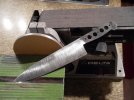
Thought I would snap a pic of the chef's knife. My very first knife in Blue Steel. Used the grinder on this one instead of the files!! At 60 grit right now. 007.jpg
 
Nice shape. Good use/placement of large holes and rivet holes.

I suggest Corby bolts for kitchen knives. Mosaic rivets and peened rivets work OK, but there are too many trips to the sink for a kitchen knife. After a couple hundred washings there may be a problem with the scales lifting a tad.
 
Stacy,
Are you not recommending the scales be glued on with epoxy? The epoxy should prevent the scales from lifting.

Tim
 
The epoxy is a seal...the fasteners are what prevents the scales from lifting. The best epoxy in the world won't survive regular kitchen use as a bonding agent alone. Good epoxy and large holes like that knife have definitely helps improve handle strength, but I want my kitchen knives with rock solid fasteners, so I use bolts.
 
Corby bolts are the top of the line in my opinion. I get them from several suppliers. USA Knifemaker, Pop's, Jantz, and TKS. You can get them in about five diameters, several lengths, and five materials. I like the brass and copper bolts for kitchen knives. I DO NOT like the stainless bolts at all, because the can easily scorch the handle by getting hot when grinding away the excess and in finishing. Nickel silver bolts are much better if you want a white metal. ( I haven't used the aluminum much) Copper gets hot, too, but does not seem as bad. When the epoxy is cured, I trim the excess from the copper bolts on the band saw first and file them flush by hand, as copper is pretty gummy in grinding. Copper really looks great on a Japanese blade.

Corby bolts are about $2 each, so a handle will have $4 to $6 in the fasteners. That is very well spent money if peace of mind and good looks count to you. Additionally, the price drops drastically with bulk purchase. Buy 20 or 100 and you can save a good bit.

In addition to strength in the finished handle, Corbys are really easy to use in assembly. Two old stubby screwdrivers, rubber gloves, and slow set epoxy make for a clamp free assembly process. Just snug them down lightly, wipe off the squeeze out, snug a bit more as needed, and set it aside. I can do ten or twenty knives at a sitting with no clamps needed.

SECRET TIP:
No matter how you assemble your handles, a great trick is to use a magnetic bar strip ( like you hang tools on) mounted over the bench and hang the knives tip upward as the resin dries ( put down newspaper to catch the drips). This keeps drips off the blade and prevents pooling on the handle front and ricasso. It also helps prevent things slipping or moving while drying because of the way it was set down. You can take one off the strip, wipe it down with alcohol/acetone, and put it back in line easily. :)
The same strips are great for working on blades in grinding and other steps, as you can do one task, set it back, repeat on the next, etc. and then switch belts and continue down the line. Every blade is easily accessible and easily examined...without taking up all you precious bench space. By hanging the blades from the tang in the finer sanding steps, you also prevent scratches caused by a pile of blades and some stray 50 grit dust on the bench. It helps to mount the magnetic strip a bit out from the wall, to allow room for handles and clamps. Placing a 4-6" shelf where you want the blades to hang and mounting the clamp on the edge is a win-win. It also can make finding a blade you are working on much easier. I am sure none of you have ever lost a blade, "somewhere in the shop."
 
Corby bolts are the top of the line in my opinion. I get them from several suppliers. USA Knifemaker, Pop's, Jantz, and TKS. You can get them in about five diameters, several lengths, and five materials. I like the brass and copper bolts for kitchen knives. I DO NOT like the stainless bolts at all, because the can easily scorch the handle by getting hot when grinding away the excess and in finishing. Nickel silver bolts are much better if you want a white metal. ( I haven't used the aluminum much) Copper gets hot, too, but does not seem as bad. When the epoxy is cured, I trim the excess from the copper bolts on the band saw first and file them flush by hand, as copper is pretty gummy in grinding. Copper really looks great on a Japanese blade.

Corby bolts are about $2 each, so a handle will have $4 to $6 in the fasteners. That is very well spent money if peace of mind and good looks count to you. Additionally, the price drops drastically with bulk purchase. Buy 20 or 100 and you can save a good bit.

In addition to strength in the finished handle, Corbys are really easy to use in assembly. Two old stubby screwdrivers, rubber gloves, and slow set epoxy make for a clamp free assembly process. Just snug them down lightly, wipe off the squeeze out, snug a bit more as needed, and set it aside. I can do ten or twenty knives at a sitting with no clamps needed.

SECRET TIP:
No matter how you assemble your handles, a great trick is to use a magnetic bar strip ( like you hang tools on) mounted over the bench and hang the knives tip upward as the resin dries ( put down newspaper to catch the drips). This keeps drips off the blade and prevents pooling on the handle front and ricasso. It also helps prevent things slipping or moving while drying because of the way it was set down. You can take one off the strip, wipe it down with alcohol/acetone, and put it back in line easily. :)
The same strips are great for working on blades in grinding and other steps, as you can do one task, set it back, repeat on the next, etc. and then switch belts and continue down the line. Every blade is easily accessible and easily examined...without taking up all you precious bench space. By hanging the blades from the tang in the finer sanding steps, you also prevent scratches caused by a pile of blades and some stray 50 grit dust on the bench. It helps to mount the magnetic strip a bit out from the wall, to allow room for handles and clamps. Placing a 4-6" shelf where you want the blades to hang and mounting the clamp on the edge is a win-win. It also can make finding a blade you are working on much easier. I am sure none of you have ever lost a blade, "somewhere in the shop."

I think I'll order some corby bolts. I have been using hardwood dowels on a lot of knives with great results. They expand as they absorb the epoxy, making a really secure fit. I've used rock maple and walnut. I have been considering the corny bolts, and I like the idea of a clampless process. At my current price point, corby bolts aren't a big deal, and would be another quality selling point.
 
Thanx for the corby tips and tricks. I'll be sure to order some and try them out. Funny you mention the magnetic bar. I have one to hold a few screwdrivers and the occasional knife during assembly. I also have one that holds my wife's kitchen knives. Speaking of which....a quick question....I may be crazy, ok I know I am, but it seems that I can sharpen a knife to a crazy hair splitting edge only to check it later and it doesn't seem near as sharp. Still crazy sharp....but not like it was. The knife wasn't used or anything....just sat on the magnetic bar. And I place the knife on its spine so the edge faces out toward you. Will a super fine edge lose that extreme keenness just sitting there.....or am I just perceiving it that way? Thanks for your help!
 
Maybe conjectures :p

1. fingers touch/feel highly dependent on skin condition ... sometime feel really sharp while sharpen with waterstone but then not so sharp when skin is hard & dry.

2. Sharpness testing itself could degrade the happy-crazy sharp you just achieved. i.e. the sharpened apex might not as strong or free of wire-edge.

3. sweaty or salty or moist environment could oxide the 330 degrees (or 360-minus whatever your sharpen bevel angle) of air exposed carbon steel surface.

Thanx for the corby tips and tricks. I'll be sure to order some and try them out. Funny you mention the magnetic bar. I have one to hold a few screwdrivers and the occasional knife during assembly. I also have one that holds my wife's kitchen knives. Speaking of which....a quick question....I may be crazy, ok I know I am, but it seems that I can sharpen a knife to a crazy hair splitting edge only to check it later and it doesn't seem near as sharp. Still crazy sharp....but not like it was. The knife wasn't used or anything....just sat on the magnetic bar. And I place the knife on its spine so the edge faces out toward you. Will a super fine edge lose that extreme keenness just sitting there.....or am I just perceiving it that way? Thanks for your help!
 
This is a common edge judgment error.
When you sharpen a knife and "feel" the edge, what you feel is the tiny wire edge. You make a few cuts, or give it a strop, and suddenly it doesn't "feel" as sharp...but it cuts better. That is because the wire has been removed or at least smoothed. I have had people pick up a Japanese knife at a show and run their finger along the edge. They don't feel it is all that sharp until they notice they are bleeding.
Guys who deal with sharp knives know how to test the edge with their fingers...but Roman Landes scares the heck out of me every time he runs his finger down one of his insanely sharp knives.
 
That's exactly what I do....run my fingertips down the razor blade edge! (After the fingernail test on both sides) Scares some people who aren't used to doing that! I think Bluntcut might have hit on something, at least it fits. Skin condition. I think that is EXACTLY what is going on. Damn fine answer, dude. Now to wipe up that blood.......! Thankx guys!!!!
 
Im just looking around for some performance reports on that blue#2 from aldo. stuart, how did that knife turn out for you performance wise if you dont mind me asking?
 
Thought I would snap a pic of the chef's knife. My very first knife in Blue Steel. Used the grinder on this one instead of the files!! At 60 grit right now. View attachment 476200

looks good stuart. helps destroy the myth that you need a 2x72 grinder to make a knife. where are you going to put the balance point? on anything other than a cleaver, i like mine where the handle and blade meet. I use my handle material to help, red cedar being the lightest, maple and walnut in the middle, oak, honey locust, and dogwood being the heaviest.
scott
 
Back
Top