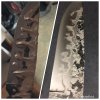
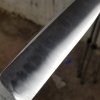
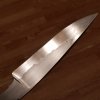
Alright boys, I want to join the Hamon club, help a brother out.

Yes, the satanite you mix yourself to make it thicker or thinner and the apg-36 comes pre mixed but is paintable.
I initially tried some Rutlands refractory cement and it was really coarse and thick and dried too fast to get it applied like I wanted.
 
Ok, just trying to help, not be critical.

Clay to thick
Clay not sufficiently dry or was boiled, so you lost a hunk on the left side and that's why it warped that way, steel cooled faster than the other and contracted.
Clay isn't tapered off, even without ashi, clay of uniform thickness in a straight line is going to look like an edge quench.
And I'm guessing you water or brine quenched as that crack appears to have propagated the same way all of my failures have.

I have a blade I will apply clay to this weekend and will get pictures of how I do it.

That looks like a brine quench. He got a pretty dramatic sori, so much so that it pulled the edge apart.

Watch this video. It’s the last few seconds that result in the ping we hate to hear, as the hardened edge is pulled back up as the spine cools.

 
Here’s one I recently did with satanite.
I’ve had better luck recently (after being chastised), I think that’s an appropriate description, by Matt Gregory, for letting the clay slowly dry rather than dry it quick with a heat gun.

He was correct, it stayed on the blade better during heating and quench.
0FBDD445-DF38-4207-83C0-0852892CFD9F.jpeg
 
Don Hanson told me that he goes no thicker than 1/8 inch with the clay to get those crazy hamons. i just HT'ed a big W2 chefs knife by doing a rather thin spider web/X pattern of Satanite with the Brownells liquid anti scale compound painted over it after it dried. Film at 11.
 
I like satanite because it is finer grained, and the wash coat covers like a whitewash. It can be built up very delicately, and ashi lines are easy with just a popsicle stick.

Also, W2 will crack in a brine/water quench most of the time. With Parks #50at room temp and very good HT control, it will attain a great hamon.

I would only water quench Hitachi White or tamahagane.
 
Don Hanson told me that he goes no thicker than 1/8 inch with the clay to get those crazy hamons. i just HT'ed a big W2 chefs knife by doing a rather thin spider web/X pattern of Satanite with the Brownells liquid anti scale compound painted over it after it dried. Film at 11.

I've been doing the anti scale after clay as well. Less disruption than another thin Satanite coat and dries faster. I flash it off with a torch before the liquid can infiltrate the dry Satanite.
 
I just let it dry for a second night. 320 grit EDM stone finish says that I got a hamon about 40-45% of the way out the blade which is 270mm and what appears to be some potentially cool activity. I see some chef knives where the hamon is just a black blob. I am not to fond of that.
I've been doing the anti scale after clay as well. Less disruption than another thin Satanite coat and dries faster. I flash it off with a torch before the liquid can infiltrate the dry Satanite.
 
Does heat treating at full thickness reduce the effect? I'm using 1/8 stock and just heat treating at full thickness to avoid warping, I got parks on the way and I have a single burner propane forge
 
Does heat treating at full thickness reduce the effect? I'm using 1/8 stock and just heat treating at full thickness to avoid warping, I got parks on the way and I have a single burner propane forge

Geometry plays a roll, as the thinner areas cool faster than thicker areas. You can force it with clay, but some of the nicest activity is geometry based.
 
Does heat treating at full thickness reduce the effect? I'm using 1/8 stock and just heat treating at full thickness to avoid warping, I got parks on the way and I have a single burner propane forge

A muffle in the forge and equal application of clay will do more to prevent warping. Heat evenly cool evenly reduce warp. But there is no way to absolutely eliminate it. Sometimes you get lucky but most knives not plate quenched need some tweaking post heat treat.
 
Ok, I start like this. Normalized and cycled, then clean 120 grit grind.

Cqj4o65.jpg


Any taint shaping already done because it's much easier before HT
Fl9EFiN.jpg


My tool of choice for application
ltp2nfS.jpg


I paint on any vertical pillars they may be thick or uneven at this point but will correct that later
679hA9R.jpg

bkXjEPa.jpg


Some light/thin detail at the ends
edPheem.jpg

B8uXf6o.jpg


Fill in the rest how I want, the bit between the colums is thicker at the spine than towards the edge
k54Mfyp.jpg

zz6Nee4.jpg


If you want any action on the spine
wF7AbsS.jpg

pAYBK45.jpg


And I set it aside until tomorrow. I'll paint over the dry satanite with ATP and quench. I don't know how much of this busy stuff will show up but I'm expecting the thinner stuff to give me that wispy clouds and the rest pearlite.
 
Kuraki,

Thanks man, amazing. I wouldn't have figured this out for years.

I'm learning the details are really important.
 
Here’s one I recently did with satanite.
I’ve had better luck recently (after being chastised), I think that’s an appropriate description, by Matt Gregory, for letting the clay slowly dry rather than dry it quick with a heat gun.

He was correct, it stayed on the blade better during heating and quench.
View attachment 853803

I've been meaning to ask - did you interrupt your quenching of this guy at all?
 
Ok that looked much nicer before etching and like hell when I did a test etch. So I did it again. My major mistake was not pre heating my parks up to 70 degrees. This one turned out more as I expected. Not much detail yet just a rough quick edm stone 220 and etch before tempering. There's activity in there that I think will develop out in the polish.
20180223_230827.jpg
 
Ok that looked much nicer before etching and like hell when I did a test etch. So I did it again. My major mistake was not pre heating my parks up to 70 degrees. This one turned out more as I expected. Not much detail yet just a rough quick edm stone 220 and etch before tempering. There's activity in there that I think will develop out in the polish.
View attachment 855004

Much better!
 
Ah to clarify- I meant heating my parks up to 75 degrees, from 25. Not higher than that
 
Great advice all around. Very similar to my process, with minor variations.

I agree, heat treat for a great performing blade, and you can still get a great hamon.

If you must use brine, (not you kuraki) 3 seconds in brine, then heated canola to prevent breaks. I’ve broken two blades this way in the past year, but I find the majority survive. A 2h 1200f subcritical anneal AFTER carefully removing all stress risers to 400grit abrasives helps. With p50 or DT-48, 120grit seems to be fine. 120 helps the clay stick. I tend to apply sairset thin like you, max 0.125”, let dry for an hour, and heat treat. I’ll be switching to satanite when this bucket is done.
Are you getting satanite somewhere up here, or bringing it up? I've been hard pressed to find anything other than the hardware store stuff, or Mizzou like castable.
 
Back
Top