- Joined
- Sep 29, 2015
- Messages
- 229
I have been in the unionized construction trades as a construction millwright for over 25 years. Im 55 years old I live in the Niagara region in Ontario Canada and I am eagerly anticipating my retirement in approximately 3 years.
Being in relatively good health I plan on supplementing my pension and keeping myself occupied by doing some type of work and I expect that hopefully will include knife making. I have been making knives for close to a year and the vast majority of the information I have found to help me has been from this site.
I have to thank everyone who has contributed to this wonderful site because it is a treasure trove of valuable information and without its help my knife making journey would have been much more frustrating and difficult. It seems like almost every time I googled an inquiry about knifemaking I was brought to this site; it really is the definitive online authority on knifemaking!
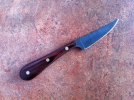
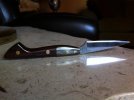
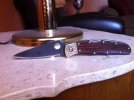
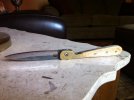
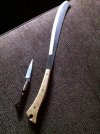
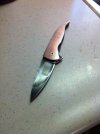
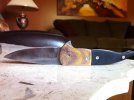
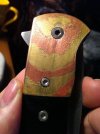
So I am taking this opportunity to introduce myself and to post some pictures of my methods and knives I have created hoping someone out there may find them interesting
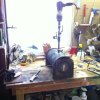
This is my homemade heat treating furnace. I tapped into my natural gas line that goes into my garage for my radiant heater. This is much more convenient I find than using propane bottles. Natural gas does not burn as hot as propane but I still manage to get it up to 2150°F for s90v. I have a baffle plate under the inlet hole to even out the temp and not create a hot spot.
I put a 3/8 needle valve on the natural gas inlet line to finely control my fuel and I have a hair dryer hooked up to a dimmer switch to finely control my air flow. Controlling the air with a very fine adjustment enables me to keep my temperatures once things have settled down to about a 10°F range.
The yellow digital box gives me an accurate readout of the inside temperatures from the pyrometer I have inside the oven. So far this method has worked great for me. I have done 01, 440C, CPM 154, and S90V. And I have purchased some S35V but havent had a chance yet to use it.
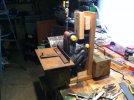
This ridiculous contraption was my first knife grinder which is obviously a belt sander in my homemade wooden rig with the jig I originally used. I quickly realized this was not the way to go and switched to a grinder in a box that I bought online and added a 3 hp three phase 220 V motor and variable speed controller. I am trying to keep my equipment to a min. to start but I see that as an essential piece and it sure made a difference, lol.
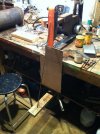
I understand I am a beginner and Im sure there are skills of members here beyond my comprehension but for the life of me I really cant see how anyone could get a true full flat grind on a knife without some sort of a jig? Obviously I say this expecting to be corrected but being a beginner I found it necessary to come up with my own version of a jig to get a true full flat grind.
But in my defense I was watching videos on grinding and a Japanese grinding master on a large round whetstone was using a jig so I would be interested in the input about this controversy, LOL.
But this is my method. I have a 2 x 4 which I have drilled numerous holes that I determined the angle that a 3/8 iron rod makes when put in various holes when leaned against my platen. I go to an online program where I can determine the angle necessary if I punch in the information for the thickness and width of my blade to get a full flat grind. Then I simply put my rod in the corresponding angle and Im off to the races.
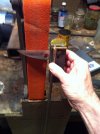
This is the jig that I use to hold my blade while grinding and all I have to do is make sure that I hold my blade jig flush against the rod that is in the hole on my 2 x 4 that determines the correct angle. It actually works surprisingly well and I have been getting nice flat grinds.
Being in relatively good health I plan on supplementing my pension and keeping myself occupied by doing some type of work and I expect that hopefully will include knife making. I have been making knives for close to a year and the vast majority of the information I have found to help me has been from this site.
I have to thank everyone who has contributed to this wonderful site because it is a treasure trove of valuable information and without its help my knife making journey would have been much more frustrating and difficult. It seems like almost every time I googled an inquiry about knifemaking I was brought to this site; it really is the definitive online authority on knifemaking!
So I am taking this opportunity to introduce myself and to post some pictures of my methods and knives I have created hoping someone out there may find them interesting
This is my homemade heat treating furnace. I tapped into my natural gas line that goes into my garage for my radiant heater. This is much more convenient I find than using propane bottles. Natural gas does not burn as hot as propane but I still manage to get it up to 2150°F for s90v. I have a baffle plate under the inlet hole to even out the temp and not create a hot spot.
I put a 3/8 needle valve on the natural gas inlet line to finely control my fuel and I have a hair dryer hooked up to a dimmer switch to finely control my air flow. Controlling the air with a very fine adjustment enables me to keep my temperatures once things have settled down to about a 10°F range.
The yellow digital box gives me an accurate readout of the inside temperatures from the pyrometer I have inside the oven. So far this method has worked great for me. I have done 01, 440C, CPM 154, and S90V. And I have purchased some S35V but havent had a chance yet to use it.
This ridiculous contraption was my first knife grinder which is obviously a belt sander in my homemade wooden rig with the jig I originally used. I quickly realized this was not the way to go and switched to a grinder in a box that I bought online and added a 3 hp three phase 220 V motor and variable speed controller. I am trying to keep my equipment to a min. to start but I see that as an essential piece and it sure made a difference, lol.
I understand I am a beginner and Im sure there are skills of members here beyond my comprehension but for the life of me I really cant see how anyone could get a true full flat grind on a knife without some sort of a jig? Obviously I say this expecting to be corrected but being a beginner I found it necessary to come up with my own version of a jig to get a true full flat grind.
But in my defense I was watching videos on grinding and a Japanese grinding master on a large round whetstone was using a jig so I would be interested in the input about this controversy, LOL.
But this is my method. I have a 2 x 4 which I have drilled numerous holes that I determined the angle that a 3/8 iron rod makes when put in various holes when leaned against my platen. I go to an online program where I can determine the angle necessary if I punch in the information for the thickness and width of my blade to get a full flat grind. Then I simply put my rod in the corresponding angle and Im off to the races.
This is the jig that I use to hold my blade while grinding and all I have to do is make sure that I hold my blade jig flush against the rod that is in the hole on my 2 x 4 that determines the correct angle. It actually works surprisingly well and I have been getting nice flat grinds.