I recently scored an old Rock Island fixed base Model 70 Vise fron a fellow at work. It was a rusty mess BUT the jaws still move pretty smoothly and the jaws (non removable) are pretty clean w/only one small chip in a corner. I wire wheeled it fairly clean but would like to get into the "guts" to clean and make it like new again? Is there anything I need to be careful of in dis-assembling? Anything that may go "Ping" and go flying across the room? Thanks for any advise! I am super excited to get this old piece of American steel mounted on my bench!! Don

-
The BladeForums.com 2024 Traditional Knife is available! Price is $250 ea (shipped within CONUS).
Order here: https://www.bladeforums.com/help/2024-traditional/
You are using an out of date browser. It may not display this or other websites correctly.
You should upgrade or use an alternative browser.
You should upgrade or use an alternative browser.
Another Vise Question-restoration
- Thread starter PaMtnBkr
- Start date

ron_m80
Tempered Member
- Joined
- Mar 1, 2009
- Messages
- 8,155
Make sure you clean it very well. I understand many people want to disassemble it to clean it, but if you don't get the pockets of dirt and grime out, you risk missing a roll stop pin, or some other easily cloaked retainer that will not likely shear off for you.
Other than that, bringing a vice back to life is on of the basic machine shop tasks. (Well, if the vice in a busy shop ever gets a second look).
The old tools tend to start to develop the same character of the user after some time. A rounded vice face may never see a second dressing in its lifetime if the user put them on it. However sharp clean corners, and well dressed hand tools will likely result in knives of equal or greater quality.
Other than that, bringing a vice back to life is on of the basic machine shop tasks. (Well, if the vice in a busy shop ever gets a second look).
The old tools tend to start to develop the same character of the user after some time. A rounded vice face may never see a second dressing in its lifetime if the user put them on it. However sharp clean corners, and well dressed hand tools will likely result in knives of equal or greater quality.
What I want to do, is clean it on the outside as best is possible using the wirewheel and then take it apart so I can access every nook and cranny inside as well? I am getting into it as best as possible using a toothbrush but I would like to get it into Pcs so I can bead blast non contact surfaces and then powder coat the unit to protect it from any more time damage in the future. I intend on making this a user! It is very heavy (90 Lbs?) and will make for a very solid tool to pass on to my son when he gets older. Thank you for all the advise! I guess what I want to know more than anything is are there internal parts that may fall out or spring out that I may not be able to get back in, once the vise is apart? Or can I start unscrewing things as I come across them? Thanks! Don
ron_m80
Tempered Member
- Joined
- Mar 1, 2009
- Messages
- 8,155
I wouldn't powder coat it. You need a couple of extra rags, and oiler can, and a 1 liter can of 30 weight motor oil.
While working on the underside of that vice, watch your fingers. Machined surfaces on the old stuff was ground down clean and sharp, it will cut you good at the 90° if you are in there just running your hands around with a scrubber pad.
While working on the underside of that vice, watch your fingers. Machined surfaces on the old stuff was ground down clean and sharp, it will cut you good at the 90° if you are in there just running your hands around with a scrubber pad.

- Joined
- Aug 13, 2002
- Messages
- 5,703
I am working on cleaning Dad's old bench vise. Have you considered using electrolytic rust removal? Works very well on paint and grime too. Once you try it, you will be looking for stuff to clean I assure you. 
Looking forward to pics.
Looking forward to pics.

- Joined
- Dec 3, 1999
- Messages
- 9,437
I'm a fan of the electrolytic method 
http://www.bladeforums.com/forums/showthread.php/800516-Electrolytic-rust-removal
I've restored several vises and have used this method on them. Sure, sometimes a wire brush and some WD-40 is plenty fine... But if it's something like this Wilton, then I felt like the tool deserved the best I could do.

http://www.bladeforums.com/forums/showthread.php/800516-Electrolytic-rust-removal
I've restored several vises and have used this method on them. Sure, sometimes a wire brush and some WD-40 is plenty fine... But if it's something like this Wilton, then I felt like the tool deserved the best I could do.

TLR
Gold Member
- Joined
- Oct 5, 1998
- Messages
- 1,576
I bought a used vice out of a metal fab shopped that literally had a half inch or more of caked metal dust and grease. Some of it was so hard you almost had to chisel it to deal with it. I tried carb cleaners which didn't put a dent in it. I finally took it to a local car wash and used the pressure washer on the bug and tar removal setting to power it off. It was a mess but was well worth it. Way better vise then the cheap vises most places sell now.


- Joined
- Aug 13, 2002
- Messages
- 5,703
I'll have to look that up Patrice! I will definitely post pics of this beast when finished! I was so excited to get it! My other vise is so small in comparison. BTW- Love your work!!
Thanks for the good words.
Those are two great looking vises. Restoring old tools is so much fun.
If you have any questions about the rust removal process, don't hesitate to email me.

Bill DeShivs
Knifemaker / Craftsman / Service Provider
- Joined
- Jun 6, 2000
- Messages
- 12,969
Nick- in the referenced thread, you state the work goes to the negative. Isn't this backwards? In electroplating, the work is on the negative, causing the anode to plate to the negative (cathode.)
- Joined
- Aug 13, 2002
- Messages
- 5,703
Bill, can't explain why but the negative does go to the piece and positive to the anodes. I remember cause I got tired of going back to the tutorial to check and made a big - scratch on the post the holds the clips for the piece.
Brian.Evans
Registered Member
- Joined
- Aug 20, 2011
- Messages
- 3,267
I will fourth the electrolytic rust removal. I'm restoring a lathe right now using it. It works GREAT!
The way I remember the orientation of the electrodes is "red gets rusty." Meaning, whichever side has the positive is where the rust goes.
My thread on my lathe resto:
http://www.chaski.org/homemachinist/viewtopic.php?f=42&t=94603
Now, I did my Wilton vise resto using vinegar because I didn't know about electrolysis. It works, but it takes a week and a half rather than an hour and a half.


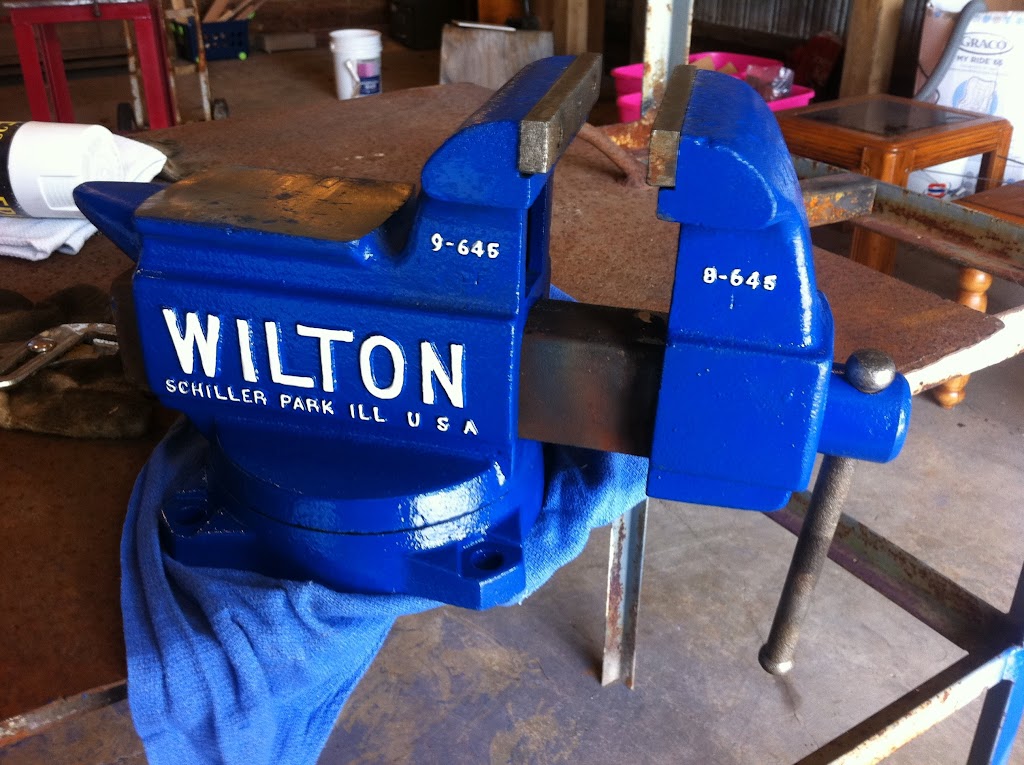
Like someone else said, restoring old iron is basic, but sooooooo very satisfying.
Take a look at my lathe thread. I have good pictures of my setup and videos of what it can accomplish.
The way I remember the orientation of the electrodes is "red gets rusty." Meaning, whichever side has the positive is where the rust goes.
My thread on my lathe resto:
http://www.chaski.org/homemachinist/viewtopic.php?f=42&t=94603
Now, I did my Wilton vise resto using vinegar because I didn't know about electrolysis. It works, but it takes a week and a half rather than an hour and a half.
Like someone else said, restoring old iron is basic, but sooooooo very satisfying.
Take a look at my lathe thread. I have good pictures of my setup and videos of what it can accomplish.
ron_m80
Tempered Member
- Joined
- Mar 1, 2009
- Messages
- 8,155
Nice work fella's.
In regard to continuing the "super electro-surface refinishing technique" talk; The base to my Anvil was cleaned up a bit last night I think I might try that method on it. Would there be a bad reaction if there were lead based paint on the metal? I suspect it may be old enough for that to be possible. Thank you for your feedback.
.........off to check my HAZMAT interaction guide to see if its listed there.
In regard to continuing the "super electro-surface refinishing technique" talk; The base to my Anvil was cleaned up a bit last night I think I might try that method on it. Would there be a bad reaction if there were lead based paint on the metal? I suspect it may be old enough for that to be possible. Thank you for your feedback.
.........off to check my HAZMAT interaction guide to see if its listed there.