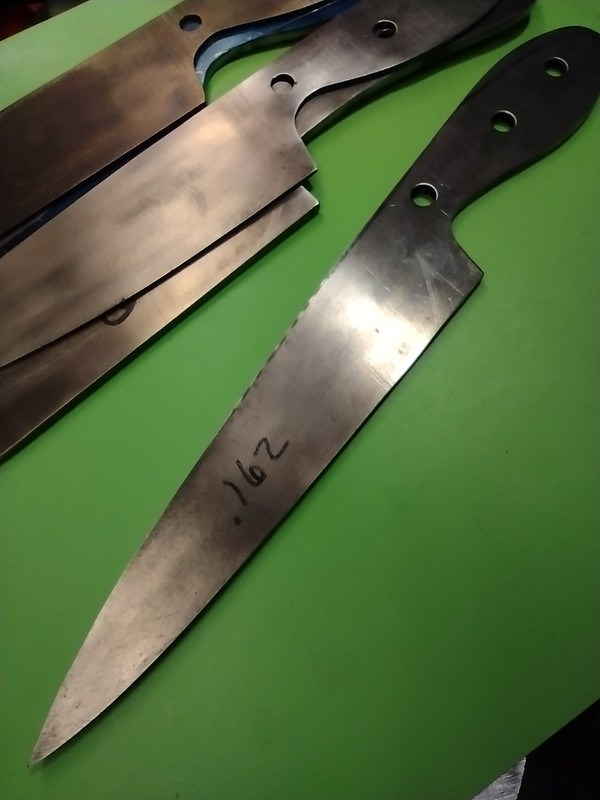
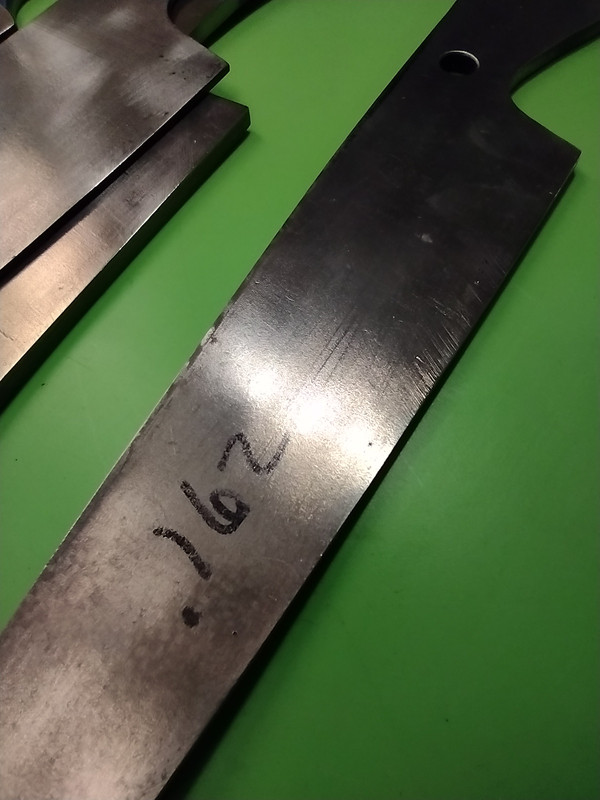
Any Pop's ProCut Dialogue?

Hey,

Ive made and sold 50+ knives with procut and had very very consistent results. Phenomenal edge retention and edge stability. 1550/cryo/300 comes to 66.5-67 every time, and for prybars (ive made 60 or so) 1700/cryo/ 400 comes to 61.5 every time. Just my guess, but delam and cracking comes from uneven temps when quenching not anything from the mill. My guess is they overheated the outside of the steel (probably using a forge) and didn't properly soak the steel and that caused the delam and cracking. Also why they poked it 20 times to get a hardness reading, they were probably getting numbers all over the place which is really unprofessional. Thats them trying to find one poke with a number that was acceptable so they could say it made spec. They knew something was wrong from the first 4 pokes, either they still have decarb or its under hardened.
I would think all the dimples would be from a carbide straightening hammer if I had to guess, not from so many Rockwell tests.
 
To my eyes, there only appears to be TWO hardness testing dimples, right between the two pin holes. I don't know what those dots scattered along the edge are, and they look different than the two dimples where people normally hardness hardness test, on the handle underneath where scales would be. If you blow the photo up, the two dimples between the pin holes have a brighter sort of "ring" around them, for lack of a better word.
 
I think the rest are hardness testing dimples as well. Maybe they had to heat treat multiple times or they’re still learning the new steel and trying to get a larger sample size of test results.?.? Looks like they were interested/concerned with edge hardness. I’ve got a few sticks under the bench I’m going to play with this winter. I’m going to do my own heat treat so I might dedicate a couple of coupons to destruction if we’re all still scratching our heads by then.
 
I think the rest are hardness testing dimples as well. Maybe they had to heat treat multiple times or they’re still learning the new steel and trying to get a larger sample size of test results.?.? Looks like they were interested/concerned with edge hardness. I’ve got a few sticks under the bench I’m going to play with this winter. I’m going to do my own heat treat so I might dedicate a couple of coupons to destruction if we’re all still scratching our heads by then.
The only reason to test hardness that many times is if the hardness readings were inconsistent. That typically happens from a heat treating issue. If the hardness values are consistent then testing 20 times on the same piece just tells you the same thing 20 times.
 
The only reason to test hardness that many times is if the hardness readings were inconsistent. That typically happens from a heat treating issue. If the hardness values are consistent then testing 20 times on the same piece just tells you the same thing 20 times.
I agree. That’s why I’m also curious how many times they actually cooked it. I would hope they wouldn’t use a customer’s stock to test different temp/hardness results but, if those are testing dimples, they were obviously chasing numbers for some reason. My initial thought was that they overheated it. I was trying to give them the benefit of the doubt though.

Like I said, I’m willing to abuse a few coupons if it helps figure it out. I personally don’t have any concerns about the steel and am looking forward to using it. Any steel will fail under the wrong conditions.
 
I think the rest are hardness testing dimples as well. Maybe they had to heat treat multiple times or they’re still learning the new steel and trying to get a larger sample size of test results.?.? Looks like they were interested/concerned with edge hardness. I’ve got a few sticks under the bench I’m going to play with this winter. I’m going to do my own heat treat so I might dedicate a couple of coupons to destruction if we’re all still scratching our heads by then.
If I was a betting man id wager they heat treated it using a forge (TOPS knives do this too). This would explain the cracking and delam(inconsistent heating prior to quenching caused stress cracks and delam) and why they were poking at the edge as thats where the blade would have been the hottest, where it would hit the oil the fastest and thus give the hardest readings.
 
To my eyes, there only appears to be TWO hardness testing dimples, right between the two pin holes. I don't know what those dots scattered along the edge are, and they look different than the two dimples where people normally hardness hardness test, on the handle underneath where scales would be. If you blow the photo up, the two dimples between the pin holes have a brighter sort of "ring" around them, for lack of a better word.
That ring is the steel "pushed" up. It happens when you poke very soft steel. They also would test at the edge if they used a forge to heat treat them because the edge would be the hottest and thus be the hardest readings.
 
I brought up the testing amount because it did seem like a bit much, but I know that Bos is known for doing it

Here is a old 8670 blank I dug out, I'm counting at least 13 test dimples. This batch is unbelievably tough, durable, holds an edge perfectly.


That ring is the steel "pushed" up. It happens when you poke very soft steel. They also would test at the edge if they used a forge to heat treat them because the edge would be the hottest and thus be the hardest readings.

I just noticed nobody Welcomed you, yet....?

You just signed up. Thanks for sharing your input on this post. Hopefully you stick around some. There's lots of great people Here on Bladeforums. You might make some friends, share some information, and maybe get to learn things too....

Thanks Again.... :)
 
Last edited:
If I was a betting man id wager they heat treated it using a forge (TOPS knives do this too). This would explain the cracking and delam(inconsistent heating prior to quenching caused stress cracks and delam) and why they were poking at the edge as thats where the blade would have been the hottest, where it would hit the oil the fastest and thus give the hardest readings.
I doubt Bos used a forge. They’re one of the most well known names in heat treating. From the pictures and videos I’ve seen of their shop they have some pretty high dollar equipment for handling batches of blanks. There’s no way they could heat treat so many different steels with any accuracy or consistency without good temp control.

Tops uses 1095 that is differentially hardened and they run it at a pretty low hardness at that. Heat treating any metal in a forge for a particular hardness is like throwing darts at a dart board. My guess is that whatever they use to heat their blades has pretty good temp control. 1095 is finicky to say the least when it comes to heat treating.
 
I doubt Bos used a forge. They’re one of the most well known names in heat treating. From the pictures and videos I’ve seen of their shop they have some pretty high dollar equipment for handling batches of blanks. There’s no way they could heat treat so many different steels with any accuracy or consistency without good temp control.

Tops uses 1095 that is differentially hardened and they run it at a pretty low hardness at that. Heat treating any metal in a forge for a particular hardness is like throwing darts at a dart board. My guess is that whatever they use to heat their blades has pretty good temp control. 1095 is finicky to say the least when it comes to heat treating.

Here is a video literally on YouTube of TOPS knives heat treating EDGE UP into the burner of a forge.

And i agree, its a piss poor way to heat treat knives, thats why TOPS has trash performance on their 1095.

Its absolutely possible, and id bet that BOS uses a forge to heat treat carbon steel blanks.
 
I stand corrected on Tops having temp control. I don’t see any obvious thermocouples or controls. There’s a reason no one uses them as a standard for much of anything. I have far better heat treating equipment in my garage.

From what I’ve seen of Bos their setup is much more professional.
 
From what I understand Bos heat treating uses the conveyer belt furnace and the steel falls into oil at the end.

For oil hardening steels, they have a max length of 12".....after 12" it doesn't get Hard
 
From what I understand Bos heat treating uses the conveyer belt furnace and the steel falls into oil at the end.
I always assumed that was just for the 420 stainless production stuff. The combination of cracking,majority of the Rockwell testing at the edge, and seeing another large manufacturer use a forge had me thinking it was forge treated.
 
Did you have any blades that exceeded 12”?

Not in this batch.

But years ago I made a longer Chef knife, and during handle shaping I noticed that and I cut into my pommel accidentally
 
Maybe we're looking at 2 different pictures. The one I'm talking about the one with 20+ Rockwell indentations. Carbide hammer marks are much wider and more shallow.
Yeah I couldn't get the right pic to load at first and made an assumption based on the written description. I can see the pic now and it's obviously not a carbide hammer. My bad.
 
Back
Top