Any way to expand upon my sharpening supplies?

Well I went ahead and ordered the Kitayama and Arashiyama stones. Grand total is about $150, which is about the price of a new knife. All-in-all, I think I'm going to enjoy it. It's not as though the other systems have failed to put on a sharp edge, I just think this would make for good relaxation without being an utter waste of time(like video games), in the sense that I will have a sharp and polished edge when I'm done(6 hours later).

IIRC, the DMT EF stone is 9 microns, and knifenut likes to put his knife on a 6 micron paste before moving onto the EEF stone at 3 microns. Not sure if it's absolutely necessary to do so given the extreme concentration of diamonds on the continuous plate and the cutting speed of the diamonds.

With the DMT stones I like to go from heel to tip and then back again, never lifting the blade off the stones. I personally think it helps to keep the angle consistent.
 
and they told you it made sense to progress from 12 microns to 3 then 6 then 3 then 1 ???

nice so.

i don't want to turn this into an argument too. it just doesn't make sense to me. i know the micron paste one hardwood won't exactly act like 6 micron as it's somewhat embeded in the wood but i still doubt.


and for the diamond vs waterstone thing for me it's more of personal preference issue. i've been using japanese waterstone for years as i've trained in a restaurant where my chef de partie was japanese. i learned a lot and sticked to this until now. this has probably alot to do with my preferences.

imo it's like some people sharpening back and forth, some edge first, some heel to tip or tip to heel. it doesn't matter that much as long as you use what works for you ... but to know what works best one has to try everything.

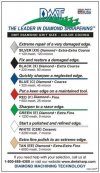
Here's the DMT chart, I have x-coarse, coarse, fine, x-fine, xx-fine and use them in that order - but usually only use the last 3. I then go to a 2 micron loaded strop, then one loaded with 1 micron and finish on a .5 micron.

I also added a cool chart that some may like. It has "some" of the details of sharpening materials and lists them. :)
 

Attachments

  • untitleddmt.jpg
    untitleddmt.jpg
    48.3 KB · Views: 25
  • gritsofstonesandrods.jpg
    gritsofstonesandrods.jpg
    51.8 KB · Views: 28
Proper use of DMT plates and compounds was shown in "the first sharpening" Using 6 micron after the 9 is best but you can go to the EEF after the EF without issue. It will take longer though.

99% of everyones issue with a sharpening system is not using it long enough before they end up switching out for something "better" ya gotta stick with something if you expect to get good. Me for example, I have been using diamond stones for 2 years and I'm JUST getting the hang of them. It take time to learn this stuff and if your always trying a different method your always learning a different way.
 
Proper use of DMT plates and compounds was shown in "the first sharpening" Using 6 micron after the 9 is best but you can go to the EEF after the EF without issue. It will take longer though.

99% of everyones issue with a sharpening system is not using it long enough before they end up switching out for something "better" ya gotta stick with something if you expect to get good. Me for example, I have been using diamond stones for 2 years and I'm JUST getting the hang of them. It take time to learn this stuff and if your always trying a different method your always learning a different way.

What DMT stone is 6 micron? :confused:
 
When using the pastes in conjunction with the plates its best to use a balsa strop. Its allows the abrasive to cut at its specific grit whereas using it on typical leather strops make the compound cut finer not making for a proper grit reduction when used with the plates.
 
When using the pastes in conjunction with the plates its best to use a balsa strop. Its allows the abrasive to cut at its specific grit whereas using it on typical leather strops make the compound cut finer not making for a proper grit reduction when used with the plates.

Could you explain this a bit more? How does putting a 6 micron compound vary its grit size from leather to balsa. I could almost understand it from something rock hard like MDF or glass to something soft as leather or balsa. The grits can sink down into a softer surface a bit. But not between leather and balsa...

Come to think of it, when we apply paste or wax based compounds, or even spray-on stuff, we aren't getting a single layer of abrasive particles. They are waaaay too small for that! Even if the lower level sinks in a bit, the upper levels are still 6 micron in size. What up, bro?

Stitchawl
 
Not sure the exact reason but when used with balsa I find the compounds to cut the most aggressive. Same story with hardwood or MDF. I should add that the balsa of the three does seem to be slightly better at creating a coarser scratch.

Leather seems to let the abrasive sink more making for a finer scratch pattern.

For example: 3 micron on balsa will leave a noticeable scratch pattern where if used on leather it will produce a clean mirror finish. Similar effects with as low as 1 micron too.
 
Last edited:
Proper use of DMT plates and compounds was shown in "the first sharpening" Using 6 micron after the 9 is best but you can go to the EEF after the EF without issue. It will take longer though.

99% of everyones issue with a sharpening system is not using it long enough before they end up switching out for something "better" ya gotta stick with something if you expect to get good. Me for example, I have been using diamond stones for 2 years and I'm JUST getting the hang of them. It take time to learn this stuff and if your always trying a different method your always learning a different way.
True, but I have an ugly tendency to get bored of something and move on before I "use" it much.

I did it with the EdgePro, the DMT Benchstones, and as well as various knives that no longer see much pocket carry(Spyderco Gayle Bradley, BM 943, Emerson CQC-7w, Emerson Super Karambit, CS Talwar, Spyderco Tasman Salt, Spyderhawk, ZT 0350CB, Manix 2, BM 755 MPR... to name a few).

I think the thing that gets me with the EdgePro is the length of time it typically takes me to sharpen a significantly dulled edge and take it to a mirror polish. It just seems that time could just as easily be spent on freehand, though getting the results will take some more practice in comparison. In any case, I'm hoping the waterstones will suck me in enough to get in some practice. I have a Buck Vantage Pro that's just waiting for some love.
 
Just like the others you will now need to learn the techniques of water stones or they will be no more effective than anything else you have.
 
Just like the others you will now need to learn the techniques of water stones or they will be no more effective than anything else you have.
Well I certainly hope I didn't spend $150 just to let the stones collect dust again or else I'll have to see a psychiatrist to see if I have ADHD or something:thumbdn:.
 
You didn't waste money on any of your sharpening tools, you just haven't taken the time to learn any of them yet.
 
Not sure the exact reason but when used with balsa I find the compounds to cut the most aggressive. Same story with hardwood or MDF. I should add that the balsa of the three does seem to be slightly better at creating a coarser scratch.

Leather seems to let the abrasive "sink" more making for a finer scratch pattern.

For example: 3 micron on balsa will leave a noticeable scratch pattern where if used on leather it will produce a clean mirror finish. Similar effects with as low as 1 micron too.
Logic suggests that because of the softer surface of leather, when the knife passes over the diamonds they have a little 'give' to them, like they are on a sponge, and therefore give a less deep scratch on the metal. (oh :) I see you posted that already )
 
Logic suggests that because of the softer surface of leather, when the knife passes over the diamonds they have a little 'give' to them, like they are on a sponge, and therefore give a less deep scratch on the metal. (oh :) I see you posted that already )

You made it crystal clear though - a worthwhile post! :)
 
Yes, good thread. Now I have to get balsa and DMT 6 mic paste to strop with before I hit my xx-fine stone. Then on to HA 1 mic, .5 mic and I'm going to order a peice of Keith's HA horse's butt strop leather. I guess that's the last one on the totem pole. My gosh - more stuff - more fun!! :D :D
 
Yes, good thread. Now I have to get balsa and DMT 6 mic paste to strop with before I hit my xx-fine stone. Then on to HA 1 mic, .5 mic and I'm going to order a peice of Keith's HA horse's butt strop leather. I guess that's the last one on the totem pole. My gosh - more stuff - more fun!! :D :D

Speaking of which, can 'stropping grade' balsa be found anywhere else other than HA? I know it's not stupid expensive (especially considering the level to which it is finished -- good size, almost flat, blemish-free surface, magnetic back for a base), but it is pricey for a piece of wood. And I know balsa is balsa, that there is no such thing as 'stropping grade'; I was just referring to the level of finish on the surface. Also, for those who might suggest DIY, I don't have the tools and skill to turn a piece of scrap balsa into something acceptable for stropping on.
 
All you really have to do is sand it flat. I can't imagine it would be much different from flattening a waterstone.
 
Back
Top