Anybody still quench with fat?

Most of us are making blades for sale and claiming that we do everything in our power to produce the very best blade with the very best metallurgical processes that's in our power to do.

There's a whole 'nother side to this knifemaking stuff, and it's called "having fun."
When someone comes to my table and sees a knife made out of a railroad spike and gets a thrill out of it, that's not a bad thing- it's right next to a properly treated folder made with powder steel, but lots of folks grab the spike knife- are they "wrong?"
No, they're having fun.
Of course I explain that even if I spark test every spike and pick the ones with some carbon in them, quench in Superquench, it's only so good- and they still want em.
If someone makes a knife and quenches it in lion fat and has a good time, who cares? As long as they don't present it as something it isn't.

If he does that and claims it's better, well, that's showbiz- having just watched the first presidential debate, I once again realize that there's nothing more powerful in this world than noise and enthusiasm without substance or honesty.

Andy
 
I did learn this summer that pig fat will put a nice bluish patina on a 1095 knife.
 
Somehow I now feel compelled to collect enough fresh manure to give it a try... I bet the smell would be memorable.
 
Many years ago Dick IIams had a steel box filled with ashes and vermiculite that he used to allow his forged blades to cool slowly.
There were many cats in his neighborhood, by the evidence many used his slow cool tank as a litter box.

When he sank his larger hot blades in the tank, there was a blue-green fog slowly rising from the hot blade in the cat litter, it really stank.

We used to laugh and wonder what influence it could have in his blades. (probably absolutely none) Actually jokingly thought about seeking a copy-rite on the "process"

Decided it best to keep it a secret!
 
Ed, I think you missed out on a marketing opportunity. Kopi Luwak sells for about $400/pound, thats coffee beans that have been eaten and expelled by a Civet cat in Indonesia, collected and roasted for your morning coffee. If it makes coffee that expensive, think what it can do for blades!
 
The first thing I thought when I read the first post was there would definitely be a market for bacon grease-quenched blades among some of the boys and girls battling extremists in the Middle East. :thumbup:
 
The first thing I thought when I read the first post was there would definitely be a market for bacon grease-quenched blades among some of the boys and girls battling extremists in the Middle East. :thumbup:
I like it....
If it were me in charge I would drop leaflets over the enemy stating that our military's bullets were swaged with pork grease...............
 
Remember the essence of the animal is transferred to the blade when that animals fat or blood is used in the quench, thus using lion fat will produce a good fighting knife while mouse fat besides being difficult to accumulate will produce a mousy blade that may even seem to avoid or veer away from the target. Shrews are notoriously violent and aggressive animals but getting enough shrew fat can take years due to their very rapid metabolism. The fat from a Pug dog will produce a very good chefs knife as it seems to be magically attracted to food. They tend to get lost though but can be found hiding below the table waiting for a food item to come close to their short stubby noses.
 
We're drifting folks....(some of it close to the political edge, which is for another forum).
 
I figured I would get pinged, but couldn't resist.....sorry....On a serious note I would be interested in what the old timers used as well as industry back in the days, say around or before WW 2.....any thoughts.....
 
Still picked up a good tip from the post on kitty-box blade box - going to mix vermiculite with my can of wood ash. In many areas, lard of some type was probably much more common than pressed vegetable oils, especially in frontier and pioneer type situations. Grain had high value for direct consumption, human or animal. I know that animal fat was the hub grease for carriages and wagons, there are also hammers with special compartments for lard to ease in a nail, and also little swing top containers for the same purpose, made to ride in toolbag or apron pouch. Wrought iron made up the vast majority of the standard forgings, steel often making up up only the cutting edge of many tools. Total mystery to me how the quench and temper were done on those types of blades or to what extent the carbon migrates into the iron and how far during a single heat forge-weld. Same sort of question on the early migration period to Viking period laminate blades.
 
When I first wrote about multiple quench I got a lot of phone calls from decedents of blacksmiths, I found that multiple quench, low temp forging were not new, they were just kids when they watched their grand fathers and they only remembered parts of what they saw, I do know various methods had been around for a long time but were secrets as black smiths who could sharpen a better plow or other agricultural cutting instrument were ahead of their competition and did not share. Nothing against them, it was another time and different sentiment. They were artists with what they had to work with.

Try bees wax on the surface of a screw or nail or hack saw and see what difference it makes, brings reason to lard or what ever. When Wellman wrote about the James Black Bowie, he talked about multiple quench "through the fire 7 times", I would love to be able to ask him where he got his information. Wellman also states that Black made the best agricultural cutting tools of any. I believe that Wellman had some good discussions with knowledgeable folks. Unfortunate as it is we may never know the whole story.

Matt: from what I read penetration at the critical point of most steel is very shallow, but surface hardening?? From what I read penetration at most could be about 0.01, but who knows with the steel they worked with? Cutting grain stalks by hand would be a very great test for cut.

My suggestion, try it, test the results and duck when the critics emerge.

If anyone comes across any information, please pass it on and maybe we can take it further.

Their science was much different than ours, how well it worked we may never know, we can only guess who the most knowledgeable were from literature - maybe.

About the kitty litter who knows, we did not witness any improvement in cut - but that does not rule it out as a workable variable.
 
Wrought iron made up the vast majority of the standard forgings, steel often making up up only the cutting edge of many tools. Total mystery to me how the quench and temper were done on those types of blades or to what extent the carbon migrates into the iron and how far during a single heat forge-weld. Same sort of question on the early migration period to Viking period laminate blades.

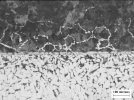
I make wrought/steel blades based on historic artifacts and archaeo-metallurgical research done by The Museum of London and others. I heat treat for the steel since there is no carbon in the wrought to form martensite. I have metallography I did of a wrought/1095 weld zone that clearly shows carbon migration across the weld zone as well as crystal growth across the weld. I will try to find them when I am not on a phone

-Page
 
This migration effect seems in my mind to be way in which the metal laminate or composite creates a gradual ramp effect from one material to another. Maybe incorrect on my part as the boundary may be sharp and well-defined instead of ramp-like. Still seems to me to represent the formation of a low carbon high tensile steel from the immediate and effected wrought iron. A possible question in such a case is the potential speed or aggressiveness of the quench as relates to the size and boundaries of the migration zone. Relating this back to the original topic of the thread, a consideration for quenching with fat is twofold - many customers in historical times probably had strong preference for toughness in their tools as a failure in the field could be disastrous. Most had good sharpening skill but poor sharpening stones or abrasives. The quality of the weld between wrought iron and the cutting steel may have been attacked by fast quenchants, with very few options other than water, brine, and fat. Quench preheating may have been uncommon within many skill sets. This is just random musings, I enjoy correction by superior scholars.
 
Last edited:
I have metallography I did of a wrought/1095 weld zone that clearly shows carbon migration across the weld zone as well as crystal growth across the weld. I will try to find them when I am not on a phone

The beautiful faux hamons that Ryan et al get from carbon/wrought San Mai are from the carbon migration. I'd imagine the longer/hotter you hold the billet at temperature, the more migration you'll get.
 
here is a 1095 (top)wrought weldzone 2%nitol etch. The dark is carbon steel, the black lines inside the grains are pearlite lamalae, the unreacted has no carbon content (wrought)

forgeweld1095-wrought2_100x.jpg

I have color ones somewhere
the white is
-Page
 
Thanks for the knowledge Page, nice job!

How hot and for how long did that take to form?
 
Thanks for the knowledge Page, nice job!

How hot and for how long did that take to form?

That was literally just forge welded (I do not know my welding temps because I do that by eye and my yellowish in shaded daylight may be different from everyone else's ) and air cooled then I took a slice from the end of the billet to take into the lab, so I would guess that from the time the weld set to black heat maybe 3 minutes. Interstitial diffusion is pretty startlingly quick!

-Page
 
Back
Top