Anybody still quench with fat?

The diffusion actually seems to be beyond the scope of what I was even thinking. An intermediate compound/alloy forming between two materials from a single heat is amazing. Considering the toughness of good wrought iron forged correctly, it makes the old cutting steel edge-wrought body tools like axes and chisels and plane blades seem pretty top of the line.
 
Guilty as charged on the initial question of quenching in (partial) fat goop. 12 years ago I started my bladesmith hobby. Used straight canola oil. Day job got hairy and I didn't get back to the shop for many months. Somewhere in there a squirrel jimmied the lid on the quench tank and took himself a final bath. Dis-guts-ting!

So after cleaning I went more the Goddard route and added just enough paraffin to make it solid at room temp. Turns liquid again well before it warms up to quench temp. And I have to admit I've added a fair amount of bacon grease to the mix over the years.

I'm semi-retiring in 1 week. Have told clients that they get me 1/2 time max. That leaves 1/2 time min for the knife shop. One of my 1st experiments will be testing my goop against Parks 50. I think I know what the result will be but I've been surprised before. Goddard's been getting Rc 63+ from his goop for decades.
 
Last edited:
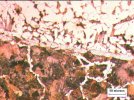
Here is the same weld one of the color images after we got the better microscope (I really miss that Zeiss scope more than anything else from that job) at 50x
looks like the decarb penetration is around 175-200 microns with carbon diffusion reaching almost 250 microns into the wrought iron. The fun thing with diffusion is that areas of highest concentration and areas of lowest concentration always will given long enough find equilibrium, and the carbon seems to move most easily along grain boundaries.

wroughtIron-1095_weldzone_50x.jpg

-Page
 
Thanks again Page!! For those who dare to dream beyond what is accepted as fact, I suggest working with wetter alloys and fine wire Damascus, these photomicrographs offer insight for some good times with knives.
 
Thats cool Page thanks for sharing.

I assume if you did more heats then you would to a point get more migration and more of say a equilization across the weld area.
 
Thats cool Page thanks for sharing.

I assume if you did more heats then you would to a point get more migration and more of say a equilization across the weld area.

I believe (and most metallurgical texts support this) that this is indeed the case

-Page
 
A question on the diffusion effect as relates to complex, multi-folded pattern weld and other equivalent processes is what the final effect may be on the actual steel in the blade. Carbon is well-known to migrate pretty much evenly through all of the materials after a very large number of welds. Other compounds do not seem to migrate at the same rate, and some seem to do so partially (chromium partial? migration in pattern welds, vanadium). This leads to the question, or idea, of controlling and forming very complex laminate alloys combining tool steels, stainless, and high strength alloys to create very customized blades. Adding in the ability to create high carbon cutting steels and other small run batches through processes like Wootz or melting and it seems that there is no limit to what even a very small shop can create in a custom ferrous material. Edge insertion and lamination predate steel materials, kind of funny that sanmei has become a sort of brand name while wumei means nothing at all.

 
Back
Top