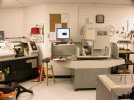
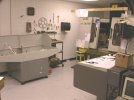
Anyone have one of those PCNC machines?.......

The good news is if your parts are relatively simple profiles cut from a flat material, like blade blanks from a plate of steel, you can hand write the code without having to buy and learn the CAM software. I hand write most of my code. I used to make tons of bike chainrings and cogs, all written by hand. It's not as bad as you might think. About 98% of the stuff you might want to do can be done with arcs and lines. As a matter of fact, all the fancy nurb contours just come down to a bunch of very short lines that CAM software writes for you. Something like a knife blade can possibly be drawn with 5 or 10 lines or arcs. In G-code, you simply give the X and Y coordinates of where you want the machine to go. A line is a G1 command, so a command of G1 x1.5 y1.2 tells the machine to make a straight line to those coordinates. An clockwise arc is a G2. For an arc, you tell the machine where to end and where the center of the arc is. It's pretty simple stuff once you break it down to the basics. Most of the rest has to do with turning on spindles, coolant, and other functions. I'd highly recommend to start like that to learn what the basics of G-code are. Once you know that, you can follow along with the code that an expensive CAM program writes and be able to change it around if necessary.

Once you go CNC, there's no going back. The leap in capability is unbelievable.
 
Nathan - I hope I don't come across as a prick...but your post makes it seems out-of-reach, if not impossible for a regular knifemaker to bother with a PCNC machine.

*shrug*


Fortunately, I am familiar with almost all of what you have written (terms as well as the software)...so it does not put me off...


Anyway...


I'm considering getting one and paying someone else to do the code for me (until I can learn it myself)...and then I'll run the machine myself.


Would this be something that average-joe-knifemaker would be able to learn/handle?


btboone - just saw your post...seems reasonable. what about handle slabs with contours? that would seem to be more complicated.
 
Doing 3D contours are definitely more complex. They also take a lot more machine time. Doing something like the wood handle of your avatar knife would be a lot more advanced than doing the 2D profile needed to do the blade part. You need to crawl before you run. Having someone else write the code is a great option.
 
Here's a pic of mine with the full sheetmetal, cabinet, 4th axis, and computer.
 

Attachments

  • rings 261.jpg
    rings 261.jpg
    72.3 KB · Views: 91
After Blade, my goal is to work on my drawing skills for engineering folders and to learn how to program my CNC. DO NOT get dependent on someone else programming your parts. There will be times when you will need to edit your code to make small changes.
Your programmer will not always be available.

Nice set up Bruce.

Bobby
 
Wow guys! Thank you! You have all given me a lot to think about. I don't think anyone was long winded...this is the kind of info I was looking for. I was thinking about this machine for doing small production runs of knives and whatever else I can think up. Will this cut the blade bevels...and if so will they have a decent finish? Can you use it manualy...like if you want to slot a guard or something?

Can an old bridgport be fitted with something to do this kind of work?

I know there is a lot to learn, but I am willing...if your not learning something in this business ie. study, reserch, and practice...you aint doin it right.;)
More info the better...keep it commin.:D:thumbup:

Hey, How far does that stick out from the wall?
Thanks a bunch guys.
Mace
 
Here's an oblique view when the machine was being installed. Note that the pegboard is 4' tall. I had to move the base out another couple inches to have some room to wire it, so the front face of the cabinet is now 47" from the wall. The drip pan is a full 80" side to side.

In order to run the machine manually, you get the jog pendant. It has options where you select the axis, and increment the axis by set amounts like .0001", .001" .01" or .1" per click on the handwheel. It also has an outer ring that jogs the axis slowly at a feedrate that you set.

The tooling package comes with a height gage, so you can preset all the tools and the machine will compensate for thier heights. Being that the R8 collet sytem has dual contact, you don't get the length variation that R8 collets usually have that depends on how tight they are. Pretty slick setup.

The control is fairly powerful, and it can do stuff like math functions and subroutines, coordinate shifts and a lot of other tricks that cost a bundle on more industry standard controls. I'm spoiled that way in that my first machine controller was the Anilam 1400, a PC based control from years back that even had boolean logic, loops, IF THEN, ENDIF statements, and GOTO statements right in the code, plenty of user defined variables, and a full range of math functions. I did some pretty cool stuff using those tricks.
 

Attachments

  • tormach2.jpg
    tormach2.jpg
    41.9 KB · Views: 46
I wouldn't want one of those small machines for knifemaking, particularly considering how expensive they are to buy.

I bought a Haas TM-1 almost 3 years ago and they don't cost all that much more than the Tormach and can take a table loading of almost 900 lbs and have working area of approx 300mmx700mm.

You say "But I don't need that big of a machine!" ... bet you're wrong! One of the main things I make are the tooling and fixtures to hold the parts, and those have be a lot bigger than the parts thenselves. I also doubt if the smaller machines can really cut steel as needed for profiling blades, making integral etc etc.

I have an analog benchtop mill and it does not have the mass or rigidity to effectively handle either task.

If you're making knives for fun or as a hobby and have and extra $10k+ to throw at it, then why not. BUT if you're making knives as a BUSINESS, don't invest your money in one of those machines, check out Haas first. Go see a demo at the nearest Haas dealership.

There is also a big difference in the controller software between any PC based system and an industrial controller like Haas, Fanuc, Heidenhein etc. Not to mention resale value, which on the Haas is substantial.

Also what type of after sale service do other companies have? Haas has very good service and spare parts are always there when needed. (I havent needed any but I did need a service call this year and Haas took care of the problem withing a day.)

As far as used, industrial machines go... that is a VERY BIG buyer beware. If you don't know much about CNC machinery, stay out of that game. $1000 doesnt go far when you need machine service... not far at all.
 
Can an old bridgport be fitted with something to do this kind of work?


Mace


Yes, and I even once considered doing that. It requires installing ball screws, servo mounting brackets and belts and pulleys etc.

I think it is better to get a minty old Bridgeport Boss 5 CNC

Bport_Boss5_Mine.jpg


for $2000 and get a $3500 servo based retrofit system. Look at lowcostcncretrofits.com . That way the mill comes with good quality ball screws already installed, and you can turn your spindle and coolant on and off with existing relay circuitry and other such niceties such as existing limit switches already installed etc.

Retrofitting an existing CNC is easier, works out nicer, and the base mill is often cheaper than a manual Bridgeport because it is otherwise useless. You end up with big ground zero backlash ballscrews and powerful servo control on a relatively heavy mill for five or six grand.

There are certain old CNC mills that had good iron, but useless crappy controls, so the iron got little use and can be found cheap and in good shape. Boss 5 and Dynamatronics come to mind.

The wiring and control setup is not a trivial undertaking. And getting an old machine whipped back into shape can require new bearings and cleaning sludge off ways etc. You need some mechanical and electrical and computer aptitude and plenty of time, but I think the average Joe can do it.

I have done one. I ended up with a good reliable CNC mill that I have just as much confidence in (and use more often) as my big modern industrial CNC mill sitting right next to it, and I saved a ton of money. There are certain down sides, the biggest being the thing is not a new turnkey ready to be put to work machine, you have to do it yourself. The upside is it costs less and *may* perform better than a new stepper based tool. Someone else paid for all that nice iron and has written it off, and you can get it for a song and a dance. I love ebay...
 
Nathan - ... your post makes it seems out-of-reach, if not impossible for a regular knifemaker to bother with a PCNC machine.


Daniel, Although I don't know all of the very long words many here have used to describe the set-up process' and descriptions of CAD/CAM I do have many years of actual experience programming, setting-up and running CNC. I assure you that for many of the CNC machining centers we're talking about here you are more than capable.

I've seen your work.

I think that if you had someone to show you the ropes for even 1 week you would be off and running. Get the friend you mentioned to help you write a few simple programs and guide you when you have a question. I guarantee you would be editing and even writing your own programs in less than a few weeks.

Start simple... 2D with the machining + drilling type cycles

I'll have to beg to differ on it being a necessity for having some type of CAD/CAM to create your programs. For 3D......definately. Anything else can be done at the machine quite fast depending on what type of control you're using and the complexity of the program.

I haven't seen anyone mention MAZAK. They have the most incredible conversational programming available "mazatrol " IMHO. The last control I used was a Mazak Fusion and after using many, many different controls this blows everything out of the water, hands down, nothing compares IMHO . You can upload or create any G-code program on the control. You can specifically use mazatrol or you can integrate both together into a program. I've been making knives for just over 3 yrs now and IMHO for a knifemaker, if you have the money, this is the control to get. I know I'm opening myself up to critism and flaming here with my opinion of mazak so I'll say it one more time. This is all my humble opinion ;)

Nathan, I thought you did an excellent job of explaining the process involved :thumbup: There were some pretty big words in there though, at least for me :D

Good luck Daniel, you'll do fine.

Bobby, it was great talking with you on the phone :thumbup: :thumbup: :thumbup:
 
I have a Mazak lathe. I love it. I would never even consider another brand of CNC lathe. Their machines are the real deal.
 
Will this cut the blade bevels...and if so will they have a decent finish?
Mace

Yes you can. I'll dust off this old example:

mill_grinding_blade.jpg


That was a milled 10" hollow "grind". The finish you get is largely a function of the machine and the size of the step over (the finer the step over, the longer the run time). That program used a fine step over between passes and probably required a full 1/2 hour of run time. Regardless, a milled finish on the bevels looks weird, so you'll probably sand it anyway.

I don't bother with milling the bevels to that degree anymore. I rough them to shape on the mill, but finish on the grinder because it is faster and I prefer the ground finish. I start with 120 belts, if that tells you anything.
 
Originally Posted by Daniel Koster
Nathan - ... your post makes it seems out-of-reach, if not impossible for a regular knifemaker to bother with a PCNC machine.

snip
very long words many here have used to describe the set-up process' and descriptions of CAD/CAM

snip


I'll have to beg to differ on it being a necessity for having some type of CAD/CAM to create your programs. For 3D......definately. Anything else can be done at the machine quite fast depending on what type of control you're using and the complexity of the program.

snip

Nathan, I thought you did an excellent job of explaining the process involved :thumbup: There were some pretty big words in there though, at least for me :D

:

Apparently I came across as a know-it-all talking over folks heads. That's not what I set out to do at all. I was trying to outline a map for folks and give a peek under the hood. I was trying to put down a lot of thoughts, typing perhaps a bit too fast. I should have made more of an attempt to be understandable and use less jargon. Sorry, not trying to make this seem inaccessible.:foot:
 
Nicely cut blade! How is it that you tilt the blade to get the angle? Does the whole fixture (or vise if that's what that is) tilt, or is there a taper ground in your cutter?
 
Greetings,
Great post. I've been researching a PCNC for a couple months. It's between the Tormach, IH or the Syil X7 (don't ask me much about this mill but I heard it will have servos, ATC and over 3000 pds). Check out his PCNC: http://www.industrialhobbies.com/

The best place to research this is cnczone.com.

Dennis
 
Interesting looking blade Nathan...I'm curious...Were you surfacing that blade? The code in the pic seems to support this.


Bill
 
Back
Top