Are Folders Locking Mechanisms Safe?

Joined
Mar 2, 2008
Messages
371
Forgive this question if it has been beat to death. I cannot use the search function so couldn't find any threads.

I have a small Browning gents folder that recently had the lock back fail and I cut my finger. Not bad but enough to make me question how dependable locking funtions actually are. I just received a Kershaw today with my first liner lock and also question how much this mechanism can be relied upon to keep the blade open?

My second question would be which is stronger, Lock back or Liner Lock?

I thought I would ask those who have infinitely more knowledge.

Thanks

Bill
 
It really depends on the model. Spyderco's Military knife has a liner lock engineered to hold over 100lbs per inch of blade. Their MBC rated knives (compression or back lock) go even further.

I wouldn't be scared of any lock made by a reputable maker.
 
It also depends on the use. I agree that you should make sure to buy from a reputable maker/manufacturer, but you need to make sure that you're using the knife with a certain amount of reason. Assuming that you've got the 2 criteria covered, the answer is yes, locking knives are safe.
 
It really depends on the model. Spyderco's Military knife has a liner lock engineered to hold over 100lbs per inch of blade. Their MBC rated knives (compression or back lock) go even further.

I wouldn't be scared of any lock made by a reputable maker.

Only 100 lbs? Boo! You can generate an instantaneous 100 lbs. by a tap on the spine.
 
I've only had a lock fail on me once and it was because I was doing something incredibly stupid. So the question that needs to be asked here is, what were you doing when the lock on your knife failed?
 
I've only had a lock fail on me once and it was because I was doing something incredibly stupid. So the question that needs to be asked here is, what were you doing when the lock on your knife failed?

Reasonable question.

I was cutting the tabs on the top of a 5 gallon pale lid. You have to cut all of the tabs along the side in order to remove the lid. I was applying a slight downward pressure on the blade. As the knife cut through the plastic the back of the blade would hit the side of the pale. This is when it closed up on me. I didn't think it was enough force to bypass the lock but of course I was wrong.

Hind sight being 20 / 20 I probably should have been using something a little heavier duty than a gents knife.

Bill
 
Last edited:
It really depends on the model. Spyderco's Military knife has a liner lock engineered to hold over 100lbs per inch of blade. Their MBC rated knives (compression or back lock) go even further.

I wouldn't be scared of any lock made by a reputable maker.

Only 100 lbs? Boo! You can generate an instantaneous 100 lbs. by a tap on the spine.

I believe that means an additional 100lbs per inch. The blade is 4". ;)

I believe my Manix is supposed to hold 800 lbs.;) I have all the faith in the world that my Sebenza lock won't fail.The only Browning knife I ever held wasn't very high quality.A good quality knife with a good lock is pretty safe.That said,if the pressure is on the cutting edge you really shouldn't have any problems.
 
I like lockback designs and think that they can be as strong or stronger than liner or frame locks. However, parts do wear out with age, or there could have been some lint in the lock that prevented it from closing completely, or the palm of your hand might have pressed down on the lock bar release as you were cutting thereby releasing the blade. The Boye cutout you see on some lockbacks such as Spydercos was designed to prevent the user's hand from pressing down on the lock and releasing the blade during use. Glad you weren't hurt bad.
 
Reasonable question.

I was cutting the tabs on the top of a 5 gallon pale lid. You have to cut all of the tabs along the side in order to remove the lid. I was applying a slight downward pressure on the blade. As the knife cut through the plastic it would hit the side of the pale. This is when it closed up on me. I didn't think it was enough force to bypass the lock but of course I was wrong.

Hind sight being 20 / 20 I probably should have been using something a little heavier duty than a gents knife.

Bill

The lock broke backwards? What kind of knife was it?
 
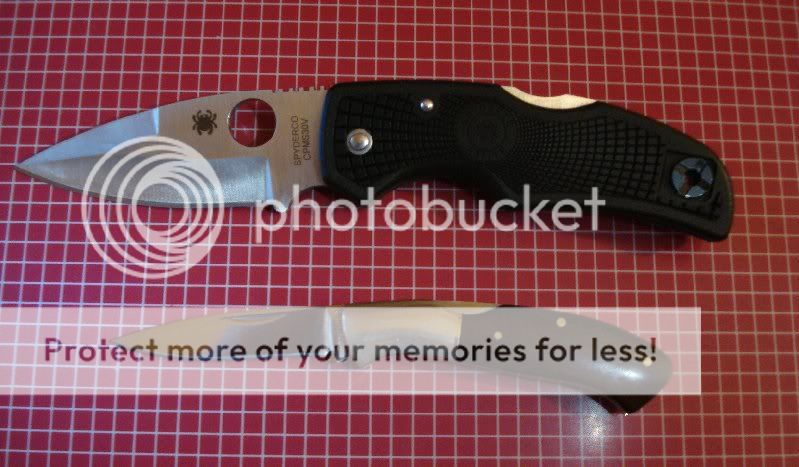
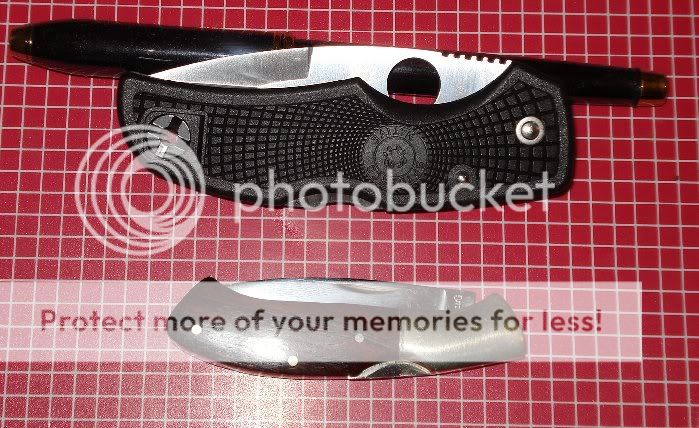
Was your knife like this one?

Browning1.jpg


Browning2.jpg


In the photos I've paired it up with a Native for size comparison.

If your knife is like the one above then it is a little smaller than I would normally choose for any serious chore, but having said that I tried to make the lock fail on the one in the picture and it held strong under any reasonable pressure I could apply to it by hand.
 
Only 100 lbs? Boo! You can generate an instantaneous 100 lbs. by a tap on the spine.

That statement doesn't make any sense. It shows a very basic misunderstanding of the concept of force on a given object. It also appears your converting strength under a static load to strength under striking force without using any sort of conversion multiplier. This is poor Physics logic and shows your statement to be essentially meaningless.

I think any rating you find by a knife manufacturer is going to be given under a static load. Dynamic loading is going to be harder to test and much harder to establish a reliable, consistent number given the increased variables that come with motion.

Static loading may not be the best method of testing but it does give a good baseline to make judgments from.
 
That statement doesn't make any sense. It shows a very basic misunderstanding of the concept of force on a given object. It also appears your converting strength under a static load to strength under striking force without using any sort of conversion multiplier. This is poor Physics logic and shows your statement to be essentially meaningless.

I think any rating you find by a knife manufacturer is going to be given under a static load. Dynamic loading is going to be harder to test and much harder to establish a reliable, consistent number given the increased variables that come with motion.

Static loading may not be the best method of testing but it does give a good baseline to make judgments from.

You shouldn't be whacking away at the spine of a folding knife anyway, unless you really want stitches and a busted knife.
 
Was your knife like this one?

Browning1.jpg


Browning2.jpg


In the photos I've paired it up with a Native for size comparison.

If your knife is like the one above then it is a little smaller than I would normally choose for any serious chore, but having said that I tried to make the lock fail on the one in the picture and it held strong under any reasonable pressure I could apply to it by hand.

It was the small browing knife on the bottom. I can fold it up easily now even with the lock engaged. I will no longer use this knife for anything since it is now very defective. I wish I could tell what is causing the lock to fail since it is engaging, but I think one would have to disassemble it which is beyond my capabilities.

Bill
 
I don't know if anyone suggested this already, but did you try clean the locking mechanism? I've heard just a little crud can stop a lockback from engaging.
 
My second question would be which is stronger, Lock back or Liner Lock?

Just to clarify, it's best to take two specific locks as examples when asking this question. Lock designs are only lock designs, and even an excellent design can lead to a bad lock with poor machining and materials.


SO! A better question is; which is better, the lockback on this one Browning knife, or the liner lock on X knife? If X knife is a 99c gas station special, I'd vote for the Browning. If it's a Zero Tolerance or Black Class Benchmade, then the Browning would loose. Hope that helps.

As to the general question on lock safety, I only buy knives from manufacturers I trust and I only use them in reasonable ways. For me, locks are absolutely safe.
 
SO! A better question is; which is better, the lockback on this one Browning knife, or the liner lock on X knife? If X knife is a 99c gas station special, I'd vote for the Browning. If it's a Zero Tolerance or Black Class Benchmade, then the Browning would loose. Hope that helps.

sorry, this is kind of off-topic, but do the black class Benchmade knives typically have a stronger locking mechanism when compared to the blue class?
 
With high quality knives generally yes they are.....

BUT

Remember folding knives are not fixed blades so the lock CAN fail if you really push it.
 
I don't know if anyone suggested this already, but did you try clean the locking mechanism? I've heard just a little crud can stop a lockback from engaging.

This is a good suggestion. Lint and dirt can get into the lock mechanism on the lockbacks, causing failure. If you see a little lint in the lock, try using some tweezers to pull it out.
 
Back
Top