
-
The BladeForums.com 2024 Traditional Knife is available! Price is $250 ea (shipped within CONUS).
Order here: https://www.bladeforums.com/help/2024-traditional/
You are using an out of date browser. It may not display this or other websites correctly.
You should upgrade or use an alternative browser.
You should upgrade or use an alternative browser.
As a tool, how highly do you rate knots.
- Thread starter hushnel
- Start date

As one who has spent a lifetime studying knots, as a boy scout, a Sea Cadet, and boater and rock climber, I agree that the knowledge and proper use of knots is often overlooked.
The proper use of knots is empowering in any survival/wilderness situation.
Study and practice the knots you know, and work to understand and use those that you do not.
Like a good knife, and an understanding of knots can save your life.
The proper use of knots is empowering in any survival/wilderness situation.
Study and practice the knots you know, and work to understand and use those that you do not.
Like a good knife, and an understanding of knots can save your life.
Last edited:
to be quite honest, i do a LOT of high angle rope work, both cliffs using SRT and in the tree using DRT. The amount of knots i use is TWO. A Blakes hitch when tree climbing/working for ascending and descending (when footlocking) with my tree ropes (they are designed for this) , and for SRT i use a Prussick once in a while. Reason for only two knots? i have honed my skills and gear to the point that those two are all i need. K.I.S.S. !!!!!! my ropes have eyelets for quick biner attachment, and i use D ring anchor straps when SRT'ting, again, quick biner attachment. This way I know that there is ONLY one knot in my system to worry about.
Too many schools teach a gazzilion knots to climbers (high angle and tree), and when the newbs go out they make mistakes trying to remember which knot to use when or how to tie it under duress..... . When on rope mistakes cost you, often your life. I buy gear that eliminates knots.
as for the woods...... could'nt be bothered to hitch this , sheet bend that, bla bla bla. Not saying knots are not needed, just not for me. I'd rather notch a pole and pin it with a small stick than futz around with knots.
YMMV
Too many schools teach a gazzilion knots to climbers (high angle and tree), and when the newbs go out they make mistakes trying to remember which knot to use when or how to tie it under duress..... . When on rope mistakes cost you, often your life. I buy gear that eliminates knots.
as for the woods...... could'nt be bothered to hitch this , sheet bend that, bla bla bla. Not saying knots are not needed, just not for me. I'd rather notch a pole and pin it with a small stick than futz around with knots.
YMMV

- Joined
- Feb 3, 2009
- Messages
- 727
I agree Big Mike, A little preparation and practice can go a long way in providing shelter and security.

Though a fair argument can be made for a handful of knots in bushcraft my experience under sail is pretty much all about knots.
I am being a little conservative in my opinion of the importance of knots because I know how strongly I feel about them.
Most of us will know all we can about our knifes and techniques for safety and bushcraft when using them. My fire arms I can strip down to the smallest spring and screw, same with pretty much all of my equipment, including rope and line, as a tool my rope takes on many functions and tasks all according to my ability to contrive rigs utilizing various knots. When you get right down to it rope is crucial to comfort and even survival and of course knots are a big part of that, and rope is the one tool, with a bit of understanding, that we can manufacture in field on our own.
I was camping a few years back in my wall tent. A strong down shear hit the camp and tents came down, my upright poles, 2, 4X4s cut into octagons, split where the pins intersected the ridge pole. This was about 10 years ago. I pulled out my fid and some manila rope and tied a 3 course Turks Head at the split ends, I used the fid to exert as much tension as I could as I tightened up the lashing, of course the cool thing about the Turks Head is it captured the ends under itself, which made me think it would be suitable for this application. It was a permanent repair and is still holding strong.
I know, Im a little over the top but I can make a sweater out of a sheep and make a sail out of flax, rope is actually pretty easy to make if you can identify the best fiber at hand.
Some fun with rope.


My point exactly, you place a lot of faith in your two knots, your life hangs in their ability to preform the task at hand. I understand your point concerning confusion too, better one or two knots than a dozen that serve to confuse. Neither one of these knots will secure your valuable knife to a shaft, though I understand that you may never need to lash a blade to a pole. Most likely half of the knots I know will never be needed, sure, it just overkill on my partWhen on rope mistakes cost you, often your life
Though a fair argument can be made for a handful of knots in bushcraft my experience under sail is pretty much all about knots.
I am being a little conservative in my opinion of the importance of knots because I know how strongly I feel about them.
Most of us will know all we can about our knifes and techniques for safety and bushcraft when using them. My fire arms I can strip down to the smallest spring and screw, same with pretty much all of my equipment, including rope and line, as a tool my rope takes on many functions and tasks all according to my ability to contrive rigs utilizing various knots. When you get right down to it rope is crucial to comfort and even survival and of course knots are a big part of that, and rope is the one tool, with a bit of understanding, that we can manufacture in field on our own.
I was camping a few years back in my wall tent. A strong down shear hit the camp and tents came down, my upright poles, 2, 4X4s cut into octagons, split where the pins intersected the ridge pole. This was about 10 years ago. I pulled out my fid and some manila rope and tied a 3 course Turks Head at the split ends, I used the fid to exert as much tension as I could as I tightened up the lashing, of course the cool thing about the Turks Head is it captured the ends under itself, which made me think it would be suitable for this application. It was a permanent repair and is still holding strong.
I know, Im a little over the top but I can make a sweater out of a sheep and make a sail out of flax, rope is actually pretty easy to make if you can identify the best fiber at hand.
Some fun with rope.
Last edited:
I run a survival/Bushcraft course for 15-18 yr old Army cadets.
I tell them that tying knots is the same as cooking it is a life skill. I don't have time within in the course to teach either ( The unit has me running a cooking segment at one of the other camps)
The quote I use on knots is
" At some point in the next few years everything you own will be on a ute( pick-up) or trailer if you can't tie it on properly it isn't all gunna arrive"
I picked up the constrictor from one of Ray Mears shows and now use it instead of the clove hitch.
So list of knots I recommend for the cadets
Constrictor ( tie rope to stick)
reef ( tie two ropes together)
square lashing ( tie two sticks together)
Bowline ( put a loop in a rope)
rolling hitch ( tauntline for tightening a guy)
round turn two half hitches ( tieing rope to stick while under tension)
Truckers hitch (to tension a rope)
There are other knots I use but it is hard to think of a situation you can't solve with one of these.
Carl
I tell them that tying knots is the same as cooking it is a life skill. I don't have time within in the course to teach either ( The unit has me running a cooking segment at one of the other camps)
The quote I use on knots is
" At some point in the next few years everything you own will be on a ute( pick-up) or trailer if you can't tie it on properly it isn't all gunna arrive"
I picked up the constrictor from one of Ray Mears shows and now use it instead of the clove hitch.
So list of knots I recommend for the cadets
Constrictor ( tie rope to stick)
reef ( tie two ropes together)
square lashing ( tie two sticks together)
Bowline ( put a loop in a rope)
rolling hitch ( tauntline for tightening a guy)
round turn two half hitches ( tieing rope to stick while under tension)
Truckers hitch (to tension a rope)
There are other knots I use but it is hard to think of a situation you can't solve with one of these.
Carl
- Joined
- Feb 3, 2009
- Messages
- 727
Carl, the reef knot is fine until it is under a lot of stress. It can capsize or at least be very difficult to untie, this jamming of the line significantly reduces the strength of the line. The sheet bend is very similar to the reef knot and superior in tying lines together particularly lines of different diameters. A quick look at this knot and you will know it and even see its merits.


- Joined
- Jan 28, 2007
- Messages
- 1,236
Our knot stuff on this forum goes in cycles, kind of like our axe stuff. Sometimes we talk about it a lot for a couple of weeks, then we talk about other stuff for a few months until somebody has knot questions, then there's a big surge again.
Personally I know about a dozen knots and I can tie them all behind my back. But that's all I know.
But I think that if you know a dozen good knots you are capable of doing MOST of what you'd ever need. Beyond that and I really think you're getting in to specialty stuff where it is cool, but not vital for even most survivalists or bushcrafters or whatever. But you need to be able to join ropes, ropes of similar and dissimilar diameters, ropes of different twists, to make good fixed loops like bowlines, or end loops like eye splices, to make a good hitch like a clove, to make a solid sliding loop...loops in the middle of a rope is useful, like an artillery knot...
Anyway about a dozen of the right knots will cover the vast majority of situations, but I have a ton of respect (as everybody knows) for guys like DOC who, rather than accept the limits of their brain, have managed to accrue the entire Ashley book in their heads and use the whole damn thing. I just haven't got enough spare brain cells to do this myself.
I think my favourite knot is the carrick bend, just because I like the way it looks. I never trust the sheet bend unless I put another loop around the standing bight even though it's probably fine, I am just paranoid.
I love the knot threads.
Personally I know about a dozen knots and I can tie them all behind my back. But that's all I know.
But I think that if you know a dozen good knots you are capable of doing MOST of what you'd ever need. Beyond that and I really think you're getting in to specialty stuff where it is cool, but not vital for even most survivalists or bushcrafters or whatever. But you need to be able to join ropes, ropes of similar and dissimilar diameters, ropes of different twists, to make good fixed loops like bowlines, or end loops like eye splices, to make a good hitch like a clove, to make a solid sliding loop...loops in the middle of a rope is useful, like an artillery knot...
Anyway about a dozen of the right knots will cover the vast majority of situations, but I have a ton of respect (as everybody knows) for guys like DOC who, rather than accept the limits of their brain, have managed to accrue the entire Ashley book in their heads and use the whole damn thing. I just haven't got enough spare brain cells to do this myself.
I think my favourite knot is the carrick bend, just because I like the way it looks. I never trust the sheet bend unless I put another loop around the standing bight even though it's probably fine, I am just paranoid.
I love the knot threads.
One factor that I don't think a lot of people put much thought into is that any knot weakens your rope, some considerably, some not so much. Definitely something to be aware of when your life is on the line, such as climbing, or tying a litter, or even when using a marginal rope for shelter building since it is all that you have. This is an area where I think it's important to not only study knots but ropework in general.
Not saying you should be some ropes guru, just have an understanding of it same as most of us here have a basic understanding that certain types of knife shapes do some activities better than others.
Charlie
Not saying you should be some ropes guru, just have an understanding of it same as most of us here have a basic understanding that certain types of knife shapes do some activities better than others.
Charlie
- Joined
- Apr 14, 2006
- Messages
- 7,021
Anyway about a dozen of the right knots will cover the vast majority of situations, but I have a ton of respect (as everybody knows) for guys like DOC who, rather than accept the limits of their brain, have managed to accrue the entire Ashley book in their heads and use the whole damn thing. I just haven't got enough spare brain cells to do this myself.
I wish!!!

Mis, what's your thoughts on becoming my press agent????

Anyway, my personal choice for joining lines of equal diameter is the straight bend, seen here, with it's strengths and weaknesses:
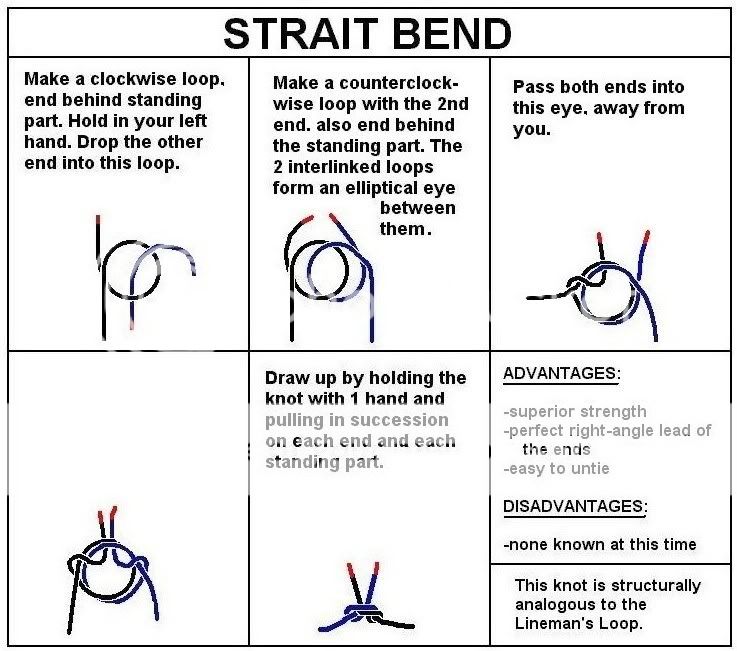
It's (k)not that I don't like the Sheet Bend
 - I use a ton of them when making nets, but Sheet Bends can spill and they also be more of a problem if tied tightly. The Straight Bend unties very easily, and, of course, you can always make it 'slippery'.
 Doc

C Bryant
Gold Member
- Joined
- Jul 12, 2008
- Messages
- 3,153
I quite frequently need to tie knots, lashings, and splices at work, though unless I'm doing a certain knot very often I'm terrible at remembering how to do them. I often use this site, it is a great tool
http://www.animatedknots.com/
http://www.animatedknots.com/
Hushnell your dead right. But this is for joining cord not for life risking activities. Normaly for a better hitch I'll use a double fishermens or for life risking double figure eight.
Double sheet bends or double bowlines. Get used by me quiet offten.
If the kids do a high ropes course then they will be taught the correct knots.
Carl
Double sheet bends or double bowlines. Get used by me quiet offten.
If the kids do a high ropes course then they will be taught the correct knots.
Carl
- Joined
- Feb 3, 2009
- Messages
- 727
Cool, thanks, Doc. I don't know as many as I would like either and there are always new ones I haven't come across the Strait Bend but its easy to see that it cusions the shock on the line better than the Sheet Bend. I going to have to play around with it.
You can't go wrong with a bowline, that is one useful knot, ever notice when you look at just the knot that it's a sheet bend
You can't go wrong with a bowline, that is one useful knot, ever notice when you look at just the knot that it's a sheet bend
Personally, I know 5 maybe 10 knots by heart but, if I need a knot that I can't remember, I have a set of knot cards that stay with me pretty much all the time and I can just flip through them to find what I'm looking for. Those cards have maybe 20 knots on them but one of those 20 knots will work for any situation I've been in. So, like any other skill, it's nice to know but it's available in written packable form as well.
David
David
- Joined
- Jun 11, 2006
- Messages
- 958
I used to be pretty good with knots...in boy scouts there was a challenge to tie a knot each day that one of the instructors tied. You had to look at the knot to see how it was tied and figure it out. I enjoyed it and got them all.
Now I remember maybe 2 dozen and only use maybe half of them. The good thing is that it's like riding a bike you never quite loose it if you did it before(at least for me).
Now I remember maybe 2 dozen and only use maybe half of them. The good thing is that it's like riding a bike you never quite loose it if you did it before(at least for me).
You can't go wrong with a bowline, that is one useful knot, ever notice when you look at just the knot that it's a sheet bend
See, this is what I wish some knot books would do. Instead of showing a bunch of knots, show the basic knots and from there show how if you expand further it becomes another. I used to get confused tying between the Constrictor and the Clove Hitch. Then I came across a site that showed how you can tie the Constrictor from the Clove. Now they both are easy for me to remember because I really only need to remember the Clove.
And similarly I learned the Rolling Hitch by seeing how it's just a Clove with an extra turn in the beginning. And learned the Munter because to my mind it was sort of like half of a Cow Hitch.
I never noticed that it was the Sheet Bend that's the knot part of the Bowline. Thanks for that.
- Joined
- Feb 3, 2009
- Messages
- 727
Yeah, many knots are forms of another, a lot of them are named for their use so when a sailor ties it or a circus riger uses it the name is different though it's the same knot.
The specialized knots interest me, like the highwaymans hitch, a great knot for robbing banks on horse back, not a lot of use for it now a days but an interesting knot, I've used it to tie the boat up while taking on fuel
The specialized knots interest me, like the highwaymans hitch, a great knot for robbing banks on horse back, not a lot of use for it now a days but an interesting knot, I've used it to tie the boat up while taking on fuel
- Joined
- Apr 14, 2006
- Messages
- 7,021
See, this is what I wish some knot books would do. Instead of showing a bunch of knots, show the basic knots and from there show how if you expand further it becomes another.
A buntline hitch is really a Clove Hitch on the standing part.

Doc
BTW, hushnel, I just realized you called all of us tools.

Doc