As a tool, how highly do you rate knots.

I wish!!! :D

Mis, what's your thoughts on becoming my press agent???? :confused:

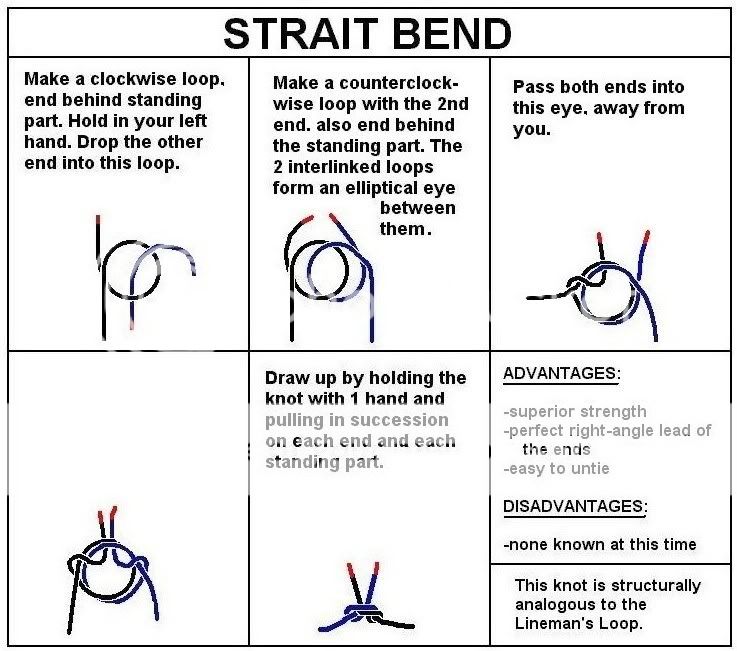
Anyway, my personal choice for joining lines of equal diameter is the straight bend, seen here, with it's strengths and weaknesses:

StraitBend.jpg


It's (k)not that I don't like the Sheet Bend :rolleyes: - I use a ton of them when making nets, but Sheet Bends can spill and they also be more of a problem if tied tightly. The Straight Bend unties very easily, and, of course, you can always make it 'slippery'.

Doc

An even easier to tie this is treat it as a butterfly knot and tie it as the fellow in post #15 talks about.
 
As a mechanic, millwright and outdoor nut I find knots to be a much needed skill more than a tool, the sisal, twine, cordage are all readily made in the field but without a workin' knowledge of knots and braiding, it's just a piece of rope.
 
BTW, hushnel, I just realized you called all of us tools.

Well, ain't it what we humans excell at, being tools or is that making tools, anyhow it's better to be usefull than not, right? :)
 
No diagram, but here is a link to how I tie a butterfly:

http://www.chockstone.org/TechTips/Butterfly.htm

As it relates to the straight bend...

If you look at the last pic in the diagram you posted, it looks a whole lot like a butterfly with the top of the loop chopped off. So, take the ends of the two ropes you are trying to join together and imagine that they are actually the spot in your butterfly where you want to attach your carabiner and tie it as in the link above.

Hopefully this is not too confusing.

BTW, I use the following chant when I teach this knot: "One, two, over and through"
 
Thanks dcf, I got it. I don't find it nearly as easy to tie that way as the way it is in my picture, although, to be fair, I've been tying it that way a long time, so I will give this new method a chance.

Actually, with separate ends, all you have to do is cross the working parts and then twist once and then down and around.

This is the way I tie the Alpine Butterfly:

SingleLinemansLoop.jpg


Thanks for getting back to me.

Doc
 
Hey Grapevine,

Another one:

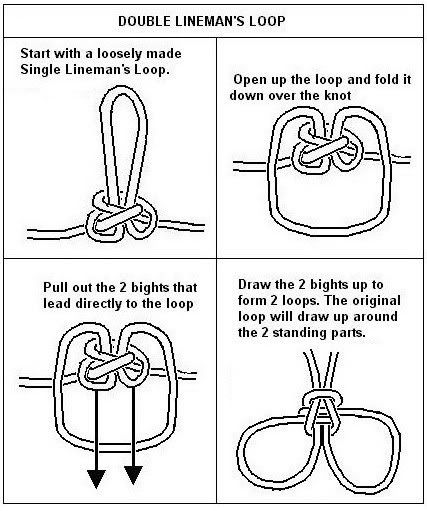
Once you tie the Alpine Butterfly (Lineman's Loop) for a little bit extra, you end up with 2 loops instead of one (please ignore the proof that I can't draw :o):

DoubleLinemansLoop.jpg


Doc
 
Dang Doc. that's pretty cool. I play around with that in the morning. I'm working with candle light tonight, using the screen of my net book to light up the keyboard :)
 
No diagram, but here is a link to how I tie a butterfly:

http://www.chockstone.org/TechTips/Butterfly.htm

As it relates to the straight bend...

If you look at the last pic in the diagram you posted, it looks a whole lot like a butterfly with the top of the loop chopped off. So, take the ends of the two ropes you are trying to join together and imagine that they are actually the spot in your butterfly where you want to attach your carabiner and tie it as in the link above.

Hopefully this is not too confusing.

BTW, I use the following chant when I teach this knot: "One, two, over and through"

That is how I learned to tie it.
 
Interesting all the variations on how to tie the butterfly. Since being introduced to it I think I've seen 3 slight variations on doing it around your hand, and though all three are easy to do I have to admit that I'm getting them confused with each other. I like the method shown in dcfirman's link because it seems easier for me to adapt that to tying a larger loop. Like if you have rope instead of cord, and you need to lay the line down on the ground to tie the knot because 3 turns of it doesn't fit on your hand.

And Doc, that's really cool that it can turn into two loops.
 
Interesting all the variations on how to tie the butterfly. Since being introduced to it I think I've seen 3 slight variations on doing it around your hand, and though all three are easy to do I have to admit that I'm getting them confused with each other. I like the method shown in dcfirman's link because it seems easier for me to adapt that to tying a larger loop. Like if you have rope instead of cord, and you need to lay the line down on the ground to tie the knot because 3 turns of it doesn't fit on your hand.

And Doc, that's really cool that it can turn into two loops.

In addition to being able to tie a bigger loop, you can also use this method to isolate a section of damaged rope. The damaged section would be where you would grab to start twisting it. When you are finished tying it, the damaged section is in the loop and is out of the line of pull.


Of course, if you insist on wrapping the rope around your hand to tie it, you can still isolate the damaged section if you make sure it is the middle wrap of the three when you initially wrap it around your hand.
 
The bad thing about knowing a few knots, is that other people expect you to do all the knot tying, and that can get old pretty fast.

I know a few basic knots, and they get me through pretty well, the biggest advantage to knowing a few knots, is you don't keep cutting your line shorter and shorter.
 
Ability with knots and rope mean you need fewer tools to survive. I've learned that from a friend with the knot-mojo!
 
Great thread, as were the other three that Doc linked to (thanks, Doc)!

Personally, I rank knots pretty high. I work for a company that does high ropes courses for corporate and school groups, and when I am there to photograph the courses I help run up the ropes. Only two knots are needed, but they are very important. We use a hitch that is almost like a whipping to pull the ropes up through the pulleys with paracord (which is always strung up), where the starting end of the whipping is to the end of the larger rope. The knot is placed about eight inches from the end of the rope, then half hitches are tied around the rope, much like when tying a timber hitch.

For the ends of the ropes that attach to the climbers' harnesses via carabiners, we use a double figure eight on-a-bight with the loose end tied off with a stevedore or stopper knot. As someone mentioned in this thread or one of the other threads, knots do weaken the rope. This particular knot weakens it less than most others of a similar nature, and is incredibly strong yet easy to untie.

My internal library of knots is something I'm always trying to expand. I'm a big fan of using the right knot for the job. I finally got around to learning the Siberian hitch today, and went out and set up a tarp with that, the tarp taut hitch, a couple Penburthy (I think I got that right) Prussiks, and adjustable grip hitches for the guy lines. I've got the Budworth book, as my neighbour had it and recommended it to me, as well as Handbook of Knots Expanded Edition by Des Pawson. I've found a few of the illustrations in the Budworth book to be incorrect, so beware of that. Not a big deal, though.

Great illustrations, both in this thread and the others, Doc! I've learned from them. I'll especially be playing around with the strait bend.

A couple I've learned in the past few days are the bowstring knot, which is an interesting adjustable loop, and the angler's loop, which for some reason I'd never picked up before. I like to make lanyards in my spare time, as well, which is great for keeping up my decorative knot-tying skills. Oh, and I tie the Alpine Butterfly on my hand as well.

Here's a site I like for a nice collection of useful knots: http://www.layhands.com/Knots/
 
Last edited:
Some folks seem to live a perfectly happy life without knowing much about knots, but knots are very important to me.

I spend a lot of time in the outdoors.... on a boat, on farms, fishing, hunting, trapping, trimming trees, tying loads etc etc.

Here's a partial list, in no particular order, of how I've used, or might use, a knot:

Mooring a boat
guy roping a tent
making repairs to a backpack
making a makeshift backpack from a sack and some rope
temporary horse halter
stringing a bow
restraining an animal
safety line when working on a steep slope or topping a tree
making snares
tethering traps
various fishing line and tackle applications
repairing and setting a net
securing a load
hanging a lantern
erecting a radio aerial
making a ladder secure
building a shelter
hoisting objects on a building site
lifting engines etc
ensuring my boot laces stay tied properly
miscellaneous emergency repairs to fences and a multitude of other things
attaching a safety lanyard to tools where they might be lost or do damage if dropped
holding scaffolding in place
making a makeshift spear
hauling logs
hanging a game animal for skinning
towing or salvaging a vehicle
plus tying knots for practice and amusement. The list goes on.

Knots I use:

-clove hitch
-round turn and two half hitches
-Double fisherman's bend (or half of it tied back to itself for a very secure sliding loop)
-bowline
-timber hitch
-constrictor knot
-figure eight loop
-midshipman's hitch or rolling hitch or tautline hitch
-prusik loop
-zepplin bend
-trucker's hitch
-alpine butterfly or linemans loop (this is about the only knot I have trouble remembering in an emergency for some reason, so I often fall back on a simple figure eight loop).
-various fishing line knots that I can't be sure of the names of.
-buntline hitch

Interesting story about the buntline hitch. I started using a 'slipped' version of the buntline hitch to fix my trapline flags into place a couple of years ago. I thought I came up with the knot myself. I drew a picture of it and sent it to Doc. Doc sent me back a picture of a buntline hitch and asked me how to spell 'plagiarist'. I then realized that Doc had sent me the picture much earlier.... and I must have memorised the knot and forgotten about seeing Doc's picture because we'd exchanged a lot of knot pictures. Anyway, a slipped version of the buntline hitch is a very good knot if you tie it right. It holds securely, and it virtually disappears when you pull the 'slip cord' (shown below labelled 'slip knot').

SecureSlipKnot.jpg


Double fisherman's bend:
DoubleFishermansKnot.jpg


Knots.jpg


RndTnTwoHfHitches.jpg


ZeppelinBend.jpg
 
Some folks seem to live a perfectly happy life without knowing much about knots, but knots are very important to me.

I spend a lot of time in the outdoors.... on a boat, on farms, fishing, hunting, trapping, trimming trees, tying loads etc etc.

Here's a partial list, in no particular order, of how I've used, or might use, a knot:

Mooring a boat
guy roping a tent
making repairs to a backpack
making a makeshift backpack from a sack and some rope
temporary horse halter
stringing a bow
restraining an animal
safety line when working on a steep slope or topping a tree
making snares
tethering traps
various fishing line and tackle applications
repairing and setting a net
securing a load
hanging a lantern
erecting a radio aerial
making a ladder secure
building a shelter
hoisting objects on a building site
lifting engines etc
ensuring my boot laces stay tied properly
miscellaneous emergency repairs to fences and a multitude of other things
attaching a safety lanyard to tools where they might be lost or do damage if dropped
holding scaffolding in place
making a makeshift spear
hauling logs
hanging a game animal for skinning
towing or salvaging a vehicle
plus tying knots for practice and amusement. The list goes on.

Knots I use:

-clove hitch
-round turn and two half hitches
-Double fisherman's bend (or half of it tied back to itself for a very secure sliding loop)
-bowline
-timber hitch
-constrictor knot
-figure eight loop
-midshipman's hitch or rolling hitch or tautline hitch
-prusik loop
-zepplin bend
-trucker's hitch
-alpine butterfly or linemans loop (this is about the only knot I have trouble remembering in an emergency for some reason, so I often fall back on a simple figure eight loop).
-various fishing line knots that I can't be sure of the names of.
-buntline hitch

Interesting story about the buntline hitch. I started using a 'slipped' version of the buntline hitch to fix my trapline flags into place a couple of years ago. I thought I came up with the knot myself. I drew a picture of it and sent it to Doc. Doc sent me back a picture of a buntline hitch and asked me how to spell 'plagiarist'. I then realized that Doc had sent me the picture much earlier.... and I must have memorised the knot and forgotten about seeing Doc's picture because we'd exchanged a lot of knot pictures. Anyway, a slipped version of the buntline hitch is a very good knot if you tie it right. It holds securely, and it virtually disappears when you pull the 'slip cord' (shown below labelled 'slip knot').

SecureSlipKnot.jpg


Double fisherman's bend:
DoubleFishermansKnot.jpg


Knots.jpg


RndTnTwoHfHitches.jpg


ZeppelinBend.jpg

Ah, there you are with that damn Zeppelin knot. :rolleyes: I did find an easier way to tie it though. :D

Doc
 
Yeah. The zeppelin knot is one of my favorites, but I find that I have to think about it and it isn't one I can tie in a hurry when both bits of rope have strain on them.

It would be great if you could describe how you tie it, but I realize that is hard to do. It would be good to get it as 'automatic' to tie as a clove hitch or reef knot.
 
Back
Top