Bad Heat Treat Day

Joined
Aug 30, 2007
Messages
509
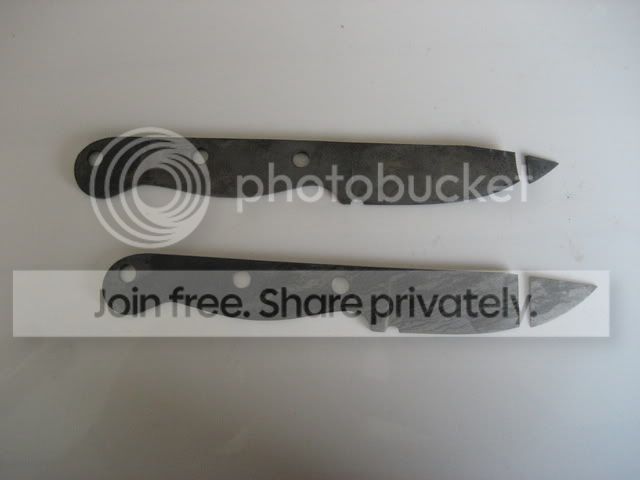
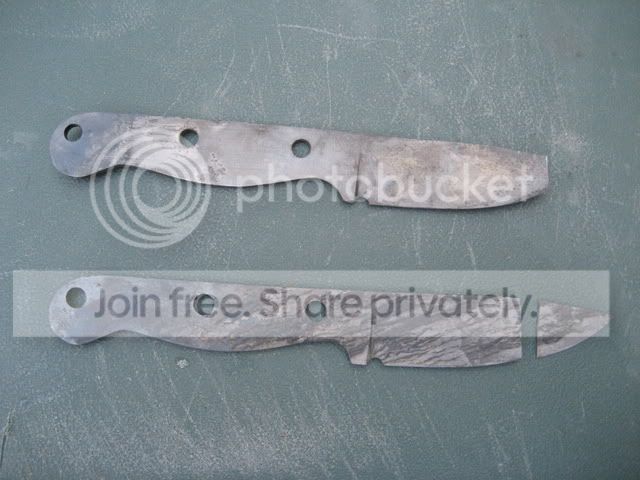
I read about quenching O1 in salt water and talked to someone who has done it. It did not work out for me. Bad decision. Had 2 tips break off blades (pictures) and had 2 nice kitchen blades end up looking like a snake. If anyone can give me some tips on straightening them please chime in. Lesson learned is to use oil on a oil hardening steel, DUUUH!

IMG_1887.jpg

IMG_1884.jpg
 
its not 01 that did it to me .but it still looked like a snake.
i re-quench and took the blade after i puled it out and put it between to irons and clamped it and let it cool that way.
not saying this will work on 01 but it worked for me.
i to would like to know the right way
Vern
 
Where in the HECK did you read about quenching O1 in salt water? Whoever said that should be beaten with a stick.
 
There's a good chance there are other cracks you just not seeing yet. I'd bet there not worth trying to salvage. Never heard of using a brine quench for O-1.
 
Why did you quench O1 in brine?

There are most likely micro cracks throughout those blades, and unfortunately a re-heat treat can't fix that. They might be worth salvaging for personal use (with the understanding they won't be very tough), but I wouldn't let O1 subjected to a brine quench out the door.
 
Man I got bad advise and took it hook line and sinker. The suspision of additional cracks is right. The 4 blades are toast. Alot of hard work down the drain. I have always used ATF and had good results. Back to what I know best with some new steel.
 
Big Smitty. This is not directed at you personally, but since you are making the post I am addressing this to you. Please don't get upset at the post. It is informative, not criticism. It is a general statement toward experimenting with HT.

I'm going to play Kevin for a minute here (So if I pi$$ you off, get mad at him :D ).

Why would you do something like quench O-1 in brine :eek:. It is called O-1 because it is an oil quench steel. The makers have $500,000,000 steel mills. They spend millions on research and development, they provide all this information free to the ASM and to you so you can nail the HT every time :thumbup:. BUT Nooooooo, someone says, "Hey, I did it and it worked. for me." So you tried it and it didn't work :( . Go figure, those steel suppliers actually knew something about their product :confused:.

Now, lets go a step farther. Suppose it did work? What would be the point? You could not gain anything more than over doing the HT with the proper rates and quencahant. Is a brine HT with micro-fractures BETTER than a HT at the prescribed cooling rate? Or will the brine quench give the blade some mystic quality known only to a hermit in Tibet, allowing it to cut anvils in half? If any of the above are true please send the blade to Kevin so he can photo-micrograph the structures so the new metallurgy books can be written (since the old ones are clearly useless).


All this rant aside. It is never a good idea to vary the HT from the steel makers specs. They made it....they know it better than anybody. Follow their guidance and you can get all that is possible from the steel.

Again, please this is not a personal attack. You were just standing in the line of fire :D:D:D
Stacy
 
Easy Guys...:D We all make mistakes :rolleyes:...Smitty, They're right though only quench simple 10xx steels W1/W2 in brine. Those blades are unsalvageable.
Lesson learned is to use oil on a oil hardening steel, DUUUH!
At least you learned something!
If your on a budget, and in a pinch, you can use Auto Trans Fluid. but it's for amatuers. and may not work too well... So if you want to do it right get ya some McMaster-Carr 28-second quench 1-gal. Container item# 3202K5 $17.52. or if you got the money find ya some Heatbath AAA. Nice lookin blades though bro. To minimise warpage make sure you plunge at a straight 90º perpendicular to the bath. The tip should be down about 30º. After intial plunge wait COUNT OF 5-6 then begin moveing front and back, not side to side. Pre heat oil to about 120ºF
 
Last edited:
0-1 Tool Steel -

Preheat thoroughly at 1200ºF. Then heat to 1450ºF and hold until heated through.

Quench in 125ºF quenching oil..

Tempering: Temper at 400ºF.
 
All this rant aside. It is never a good idea to vary the HT from the steel makers specs. They made it....they know it better than anybody. Follow their guidance and you can get all that is possible from the steel.

Stacy is right - about almost everything - but I'm not so sure here. You have to be open to trying new things - and open to the idea that a failed blade can be a successful experiment. I'm pretty sure that neither Crucible nor Hitachi came up with the idea of plate quenching. We all tried it just because someone said it worked - and it does!!!

If you want to make a knife to go out the door - or that you might have to bet your life on - then stick to what you know will work. If you want to be a knifemaker, then go ahead. See what works, and what doesn't.

I respect you for trying - for recognizing the results and for adjusting. Without people like you there'd be no innovation at all.

Rob!
 
Thanks for the input guys, I have thick skin and can laugh at myself as needed. I got bad info and trusted an individual that I thought was on the ball. Bad judgement on my part. Soooo, those blades go onto the oooops section of the wall of fame, I buy some more steel and make another knife.:eek:
 
..... You have to be open to trying new things - and open to the idea that a failed blade can be a successful experiment. ......
Rob!

You are very correct that a negative result can be a successful experiment, provided the experimenter can properly conclude why.

Experimentation produces better results when based on a firm foundation of knowledge that lets one not only create good ideas and experiments to test them, but the ability to properly interpret the results.
 
Stacy is right - about almost everything - but I'm not so sure here. You have to be open to trying new things - and open to the idea that a failed blade can be a successful experiment. I'm pretty sure that neither Crucible nor Hitachi came up with the idea of plate quenching. We all tried it just because someone said it worked - and it does!!!

If you want to make a knife to go out the door - or that you might have to bet your life on - then stick to what you know will work. If you want to be a knifemaker, then go ahead. See what works, and what doesn't.

I respect you for trying - for recognizing the results and for adjusting. Without people like you there'd be no innovation at all.

Rob!

Actually, plate quenching has been around for a long time. They used to use large water cooled plates to quench circular saw blades to minimize distortion.
 
Thanks for the input guys, I have thick skin and can laugh at myself as needed. I got bad info and trusted an individual that I thought was on the ball. Bad judgement on my part. Soooo, those blades go onto the oooops section of the wall of fame, I buy some more steel and make another knife.:eek:

Hey, if you have the opportunity

Ron Clairbourne in Knoxville Tn is hosting a Hammerin this weekend,

I'm not sure where you are in KY but if you can get there I'll guarantee a good time

;):thumbup::cool::)
 
Good experiment Smitty. I bet you wont do that again. Hey thats how we learn. I'm proud of ya for showing it here because that took some guts!
 
Back
Top