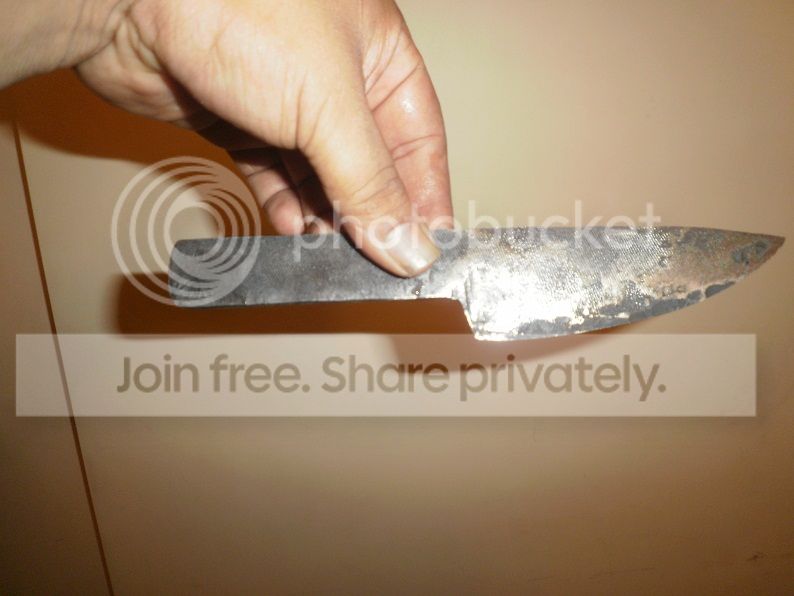
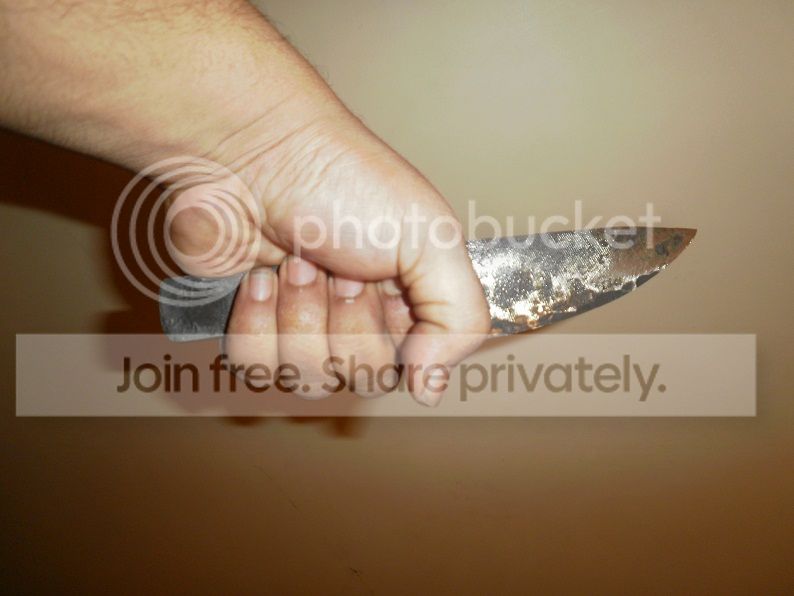
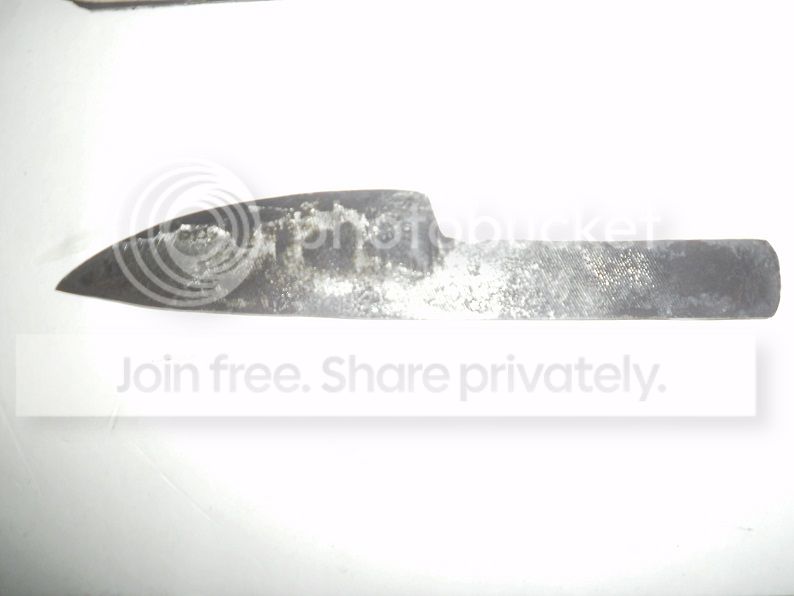
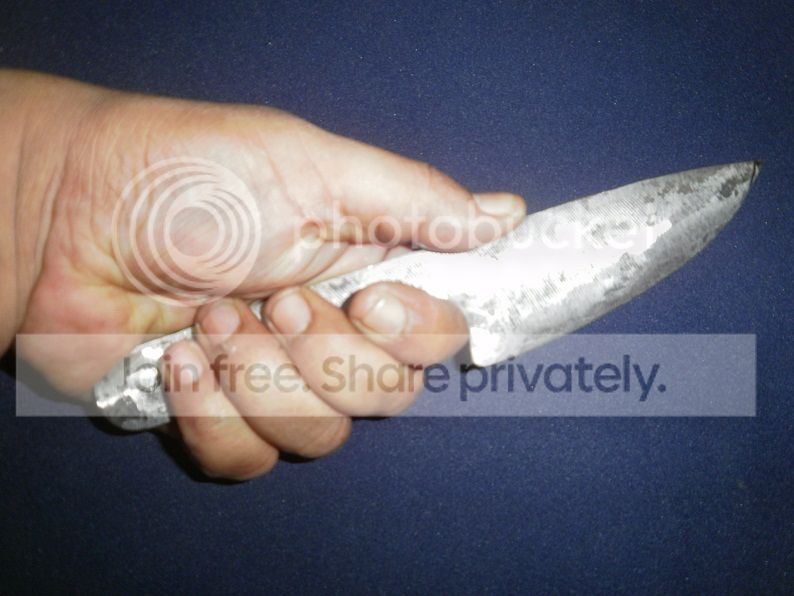
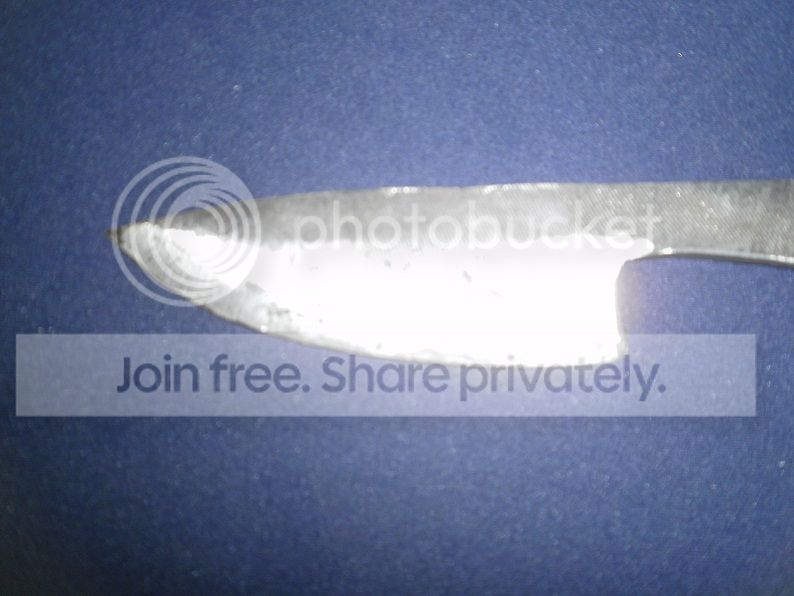
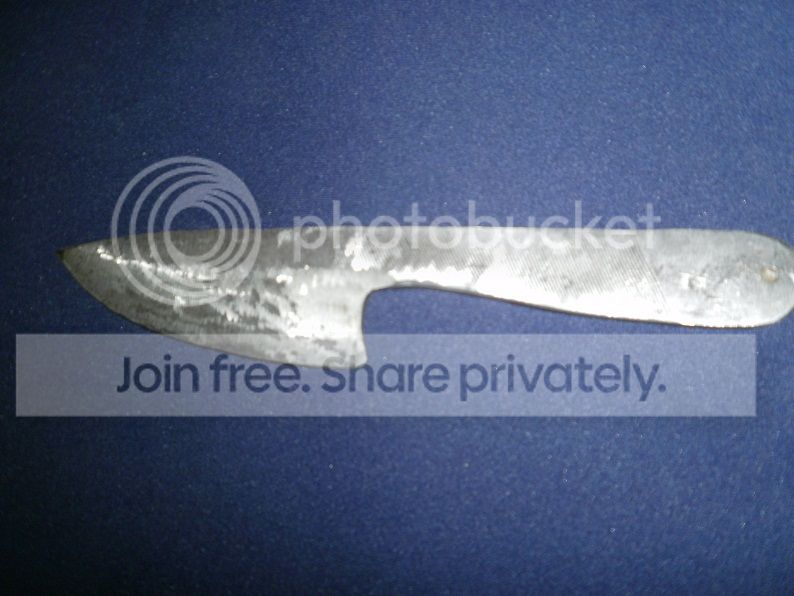
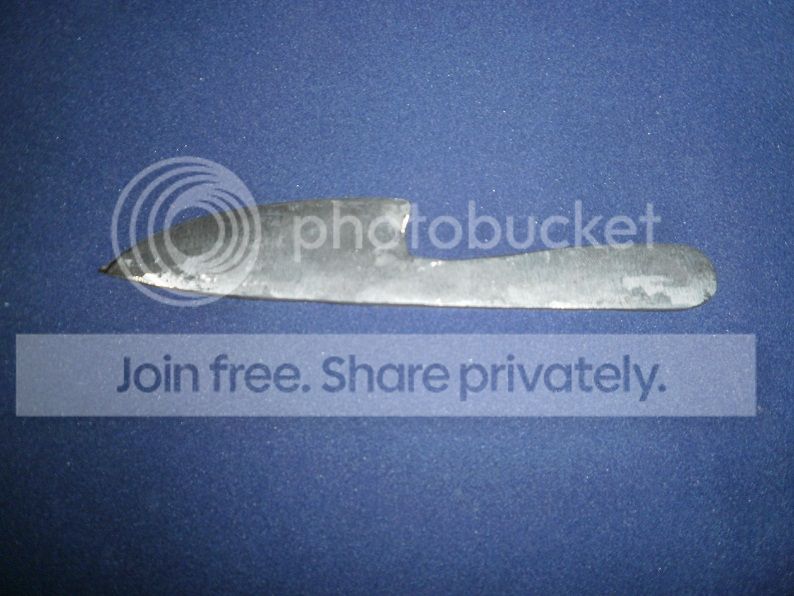
Begining WIP my own knife.

Joined
Feb 8, 2012
Messages
598
I dont know if this should be here but its probably not worth putting up on the knifemaker's pages yet :D.
Started with an old file that I had of unknown steel. Its a standard metal file used by automotive shops to shape sheet steel. Sat with a local smithy and had him soften it and beat out the general shape and now I am refining it on Carborundum universal sanding cloth at 80grit.
Need advice on a few things.
When I heat treat, should I simply go to bright orange color/non magnetic and then quench.
I don't know whether I should use oil or water. I was thinking peanut oil heated to about 175degC.
I need advice on tempering/annealing. What temperature should I temper at, for how long? And then how should it cool and for how long?
I have also read somewhere that it should lie on another heated piece of steel on its spine to "drain" the temper. I did not understand what that meant. Any advice on this from the Gurus would be much appreciated.
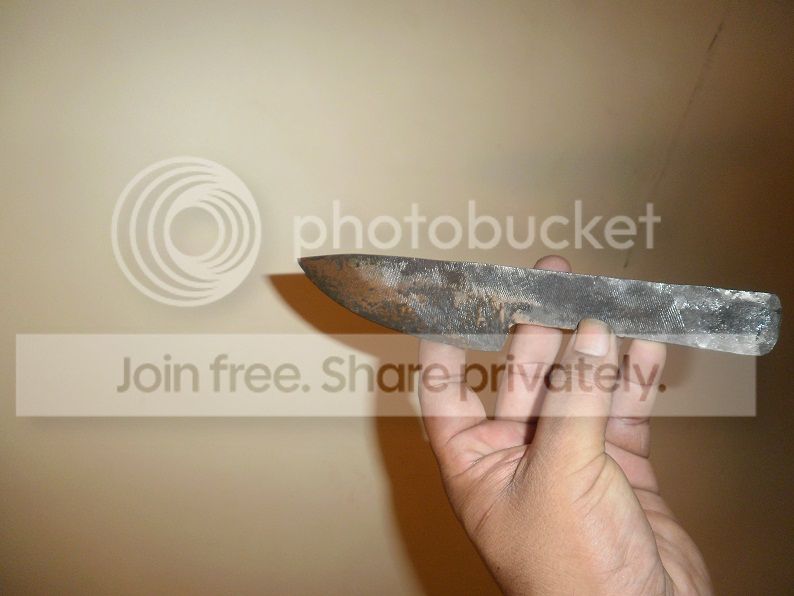
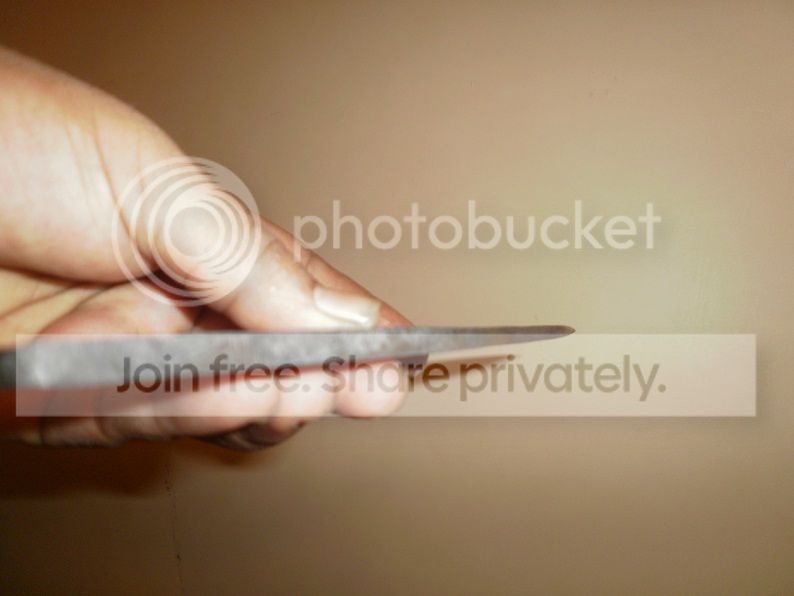
P9280189.jpg

P9280188.jpg

P9280187.jpg

P9280186.jpg

P9280185.jpg


Goddamn this is hard work!
 
If you can control the heat of your furnace, keep it at hardening temperature for a couple minutes to ensure that the steel is uniform temperature throughout. If you cannot control your furnace closely, then take it out of the fire as soon as the entire surface is non-magnetic.

Chisels usually have a high carbon content, and there is a risk of them breaking if they are quenched too fast.

If you have access to something like compressor oil, and can heat it to 150 degrees Fahrenheit, that is your safest route. I have quenched using motor oil, and it works, but it gets a little smoky.

Have something ready to cover your oil drum. A little flame is okay when you first submerge the blade, but you want to be able to smother the fire if it gets out of control. Never had it happen, but it can!

There are two ways that come to mind to differential temper your blade. The first, and easier method, is to get the blade to tempering heat, let it soak, then take it out of the fire with a long-handled tongs, and submerge only enough of the blade to cover the bevels. Hold it until the entire piece has lost all it's color, then let it cool in still air.

The second option is to cover the entire piece in fire clay, except the bevels. Then go through your temper heat, but this time fully submerge the piece, and let it submerged until it cools to the oil temperature. This is roughly what the Japanese did/do for their katanas and so forth.

Neither method is perfect, but they are two of the easier ways to get a good heat treat and temper cycle. I'm certainly not going to try and describe how to use an oxy torch to differential temper!
 
Shorttime[/QUOTE said:
Thanks for the advice.

My "furnace" is a few bricks and a lot of charcoal :). So I test for non-mag or go by a colour chart I found here. http://www.m4040.com/Knifemaking/Steel2.htm I should have thought of mag testing the whole surface.

From your second comment I gather oil would be better. I was afraid of the oil flashing and read somewhere that peanut oil doesn't flash. Finding compressor oil would be difficult but I will try. 20w/40 or similar motor oil is easier to find. Will used oil (drained from a car) be ok or should I buy a few litres fresh? ? The smithy close by uses it for any steel other than the leaf spring bits he has. Its out in the open so there is no worry of smoke and the drum he uses has a heavy enough lid.

I never even thought about differential tempering for this blade. But I think I will try it. What is fire-clay? Is it the same clay used in kilns? Will regular terracotta clay do for the second method? If I require any special kind of clay I might go with the simpler first method.

Thanks again.
 
If this is your first knife I'd try to keep it simple and try and more intricate workings like differential hardening and such for a later date, but that's just me.
 
If this is your first knife I'd try to keep it simple and try and more intricate workings like differential hardening and such for a later date, but that's just me.
I did think so but shorttime made it seem simple.
What are the potential screw ups in differential tempering?
And mea culpa for a little cheating. I had the smithy forge the shape for me :D
 
The potential screw-ups are the risk of cracking the knife.

It's been a while, and I want to get this right.

When you quench a knife, you are "freezing" the steel, by dropping the temperature very fast. I know it sounds strange to use the word freezing, but that's what you're doing.

The problem comes when the blade is not evenly quenched. The stress set up between the hardened zone and the softer zone is what leads to stress fractures. It has to do with the crystal structure of the metal, and I am not going there because I really don't remember any of it!

That is why you need to quench the knife fast enough to set the hardness, but not so quickly that you stress the structure of the steel beyond it's ability to hold together. There are stories of knives actually self-destructing because of the stress from a too-fast quench.

Likewise, quench it too slowly, and you don't get full hardness.

Yeah, sometimes blades, especially thin ones, will crack under the stress of tempering. That's why you need to have even heat, and quench at the right speed.

If you're reluctant to try a differential temper, I admit I went overboard a little. A small knife, say, under 14" or so, does not need a differential temper. You can use it after a good heat-treat cycle.

Does your smithy friend do heat treat? I would ask him to teach you.

There are many resources around the internet. Check around. I may have made a couple mistakes in the above, and I don't want to be the one to steer you wrong.
 
When you quench a knife, you are "freezing" the steel, by dropping the temperature very fast. I know it sounds strange to use the word freezing, but that's what you're doing.
Not strange at all. It explains it better than most. Picture in my head of the molecular structure changing rapidly and glass shattering with very (relatively) small but drastic changes in temperature.

The problem comes when the blade is not evenly quenched. The stress set up between the hardened zone and the softer zone is what leads to stress fractures. It has to do with the crystal structure of the metal, and I am not going there because I really don't remember any of it!

I do have a rudimentary understanding of crystal structures and see why the "joint" between the hard and soft parts would be the weak link.

That is why you need to quench the knife fast enough to set the hardness, but not so quickly that you stress the structure of the steel beyond it's ability to hold together. There are stories of knives actually self-destructing because of the stress from a too-fast quench.

Likewise, quench it too slowly, and you don't get full hardness.

Yeah, sometimes blades, especially thin ones, will crack under the stress of tempering. That's why you need to have even heat, and quench at the right speed.

This a file used to reshape metal, albeit soft(er) metal (automotive applications). I did read on another post that rapid cooling can even crack the harder high carbon steels. This makes me think an oil quench would be better. I'm thinking used motor oil or peanut. Both are easily obtained at seriously low cost. Advice?

If you're reluctant to try a differential temper, I admit I went overboard a little. A small knife, say, under 14" or so, does not need a differential temper. You can use it after a good heat-treat cycle.

Considering the risk of damage, the nature of the metal (hard high carbon) and other factors I am going to forgo differential hardening on this knife. I will probably try it on the bigger knife I am planning with spring steel.

Does your smithy friend do heat treat? I would ask him to teach you.
He does HT the knives in a fairly rudimentary manner. This is a barely literate person but he's been making knives and tools for a few decades now. He makes cheap cleavers and axeheads and hardens crowbar tips and stuff. Lots of experience but not a lot of codification to his knowledge. However, I do find him a great resource because it fits with my personality trait of "doing to learn". I have read a little on the basics of HT etc but having little reference points from my life I sort of decided to try one and make the mistakes to learn. :)

There are many resources around the internet. Check around. I may have made a couple mistakes in the above, and I don't want to be the one to steer you wrong.
Don't worry about this. See above :D
 
Used motor oil for the quench. Cheap and easy to find, gives you the right "quench speed" for the higher carbon steels. There is some discussion that the carbon content of the oil actually enhances the surface hardness of a blade so quenched. I have not done any research, so consider that hearsay. It certainly does not damage the knife, although it is going to come out of the quench with deposits on it that wipe off with an old rag.

If you've done it right, the piece will be a dark gray all over, that resembles the patina you would see on an old cutting tool. You'll know when you've got it.
 
Honestly, I would recommend canola oil for the quench. Its cheap, it smells a hell of a lot better than used motor oil and disposal is much easier. Heat your oil to 120-150F. Often a piece of rebar that's been heated to a low red and quenched then stirred around will be sufficient to heat the oil. I use canola oil and so do many other makers here.

Make sure the edge is a little less than the thickness of a dime, about .025", before quench. The steel should be normalized before heat treat. Search on here for a basic triple quench schedule in reducing heats to relieve the stresses from forging.

After heat treat there will be a thin layer of steel that is soft, this is decarb. It will need to be ground off. Tempering should be done as soon after the quench as possible. I would start at 375F and see how the edge holds up. If it chips out easily, I would retemper at 400F, but I wouldn't go any higher than 450F at the max. Your kitchen oven will be fine for this.


-Xander
 
Honestly, I would recommend canola oil for the quench. Its cheap, it smells a hell of a lot better than used motor oil and disposal is much easier. Heat your oil to 120-150F. Often a piece of rebar that's been heated to a low red and quenched then stirred around will be sufficient to heat the oil. I use canola oil and so do many other makers here.

Make sure the edge is a little less than the thickness of a dime, about .025", before quench. The steel should be normalized before heat treat. Search on here for a basic triple quench schedule in reducing heats to relieve the stresses from forging.

After heat treat there will be a thin layer of steel that is soft, this is decarb. It will need to be ground off. Tempering should be done as soon after the quench as possible. I would start at 375F and see how the edge holds up. If it chips out easily, I would retemper at 400F, but I wouldn't go any higher than 450F at the max. Your kitchen oven will be fine for this.


-Xander

It's also non toxic, which is a big plus.
 
Never thought about using canola oil....

Having your shop smell like popcorn. Nice.
 
Oh and BTW Canola is not a commonly used cooking medium here.
Sunflower oil is more available. But I do believe the smithy uses motor oil.
So motor oil it is......
 
Indian,
Filling out your profile would help us know where "here" is.

Used motor oil is a poor quenchant. That does not mean that it does nothing, just that it is severely limed ( as well as not very safe to breathe the fumes).
Peanut oil or canola oil would be better. I have no experience with sunflower oil, so I can't comment on it's usability.

Unless you are in some really remote corner of Nowhereistan, canola should be available at most any grocery.
 
Indian,
Filling out your profile would help us know where "here" is.

Used motor oil is a poor quenchant. That does not mean that it does nothing, just that it is severely limed ( as well as not very safe to breathe the fumes).
Peanut oil or canola oil would be better. I have no experience with sunflower oil, so I can't comment on it's usability.

Unless you are in some really remote corner of Nowhereistan, canola should be available at most any grocery.

Yes I should do that. "Here" is Mumbai, India.
Nowhereistan is our neighbor that lives off US aid. :D. Just kidding.
I'm from the south of India where this http://en.wikipedia.org/wiki/Wootz_steel originated.:jerkit: I just like saying that.

Canola (Rapeseed or Field Mustard) is not a commonly used cooking medium in India let alone its use as biodiesel. And mustard oil is used but its rare.
Peanut oil however is cheap and widely available. Guess I will go with that.

Thanks for the "gentle" reminder to complete my profile :thumbup: and the advice. I intend to follow it.
 
Sounds Good.

BTW, there are hundreds of small foundries and forge shops in Mumbai. Might be a good idea to drop by one.

Maybe you could give Mr. Raunak a call at Ancient Arms 91-22-66311986
 
Sounds Good.

BTW, there are hundreds of small foundries and forge shops in Mumbai. Might be a good idea to drop by one.

Maybe you could give Mr. Raunak a call at Ancient Arms 91-22-66311986
:D you know him :D
HE is not a smalltime. The place I am doing this knife is a small foundry.
Raunak Rochlani is an exporter and his forge is not in Mumbai.

There's a lot of Sikligars and sword-makers in many parts of India. But I NEED to do this myself to understand it better before I "Outsource".
 
Last edited:
After a little handheld disc sander action.
P9300193.jpg

P9300192.jpg

P9300191.jpg

P9300190.jpg

Did this to remove the blackened parts and get a usable shape. Have a feeling I might have made the neck too narrow. Doesn't seem to be weaker or anything. I tried to break it :D
 
Back
Top