Benchmade Axis Lock and Spyderco Cage Ball Lock, opinions wanted

Haha, well I might have weak hands, but the lock troubles I experienced were because the if I tried to slide the bolt from only one side, it would bind up, maybe there was some slight cocking that caused the bind up. I might try to find a second sample to try out.

I had a bad experience with the first Axis I had. A full sized D2 bladed Grip. When you tried to use it the finger on each side is the only way it would function. When you tried with one side only or one finger it would cock the mechanism to one size and get in a bind and it would not function. I got ride of it. I did not like it at that point. From what I could see the one end of the slot it slides in was cut a hair wider than the other. The second one I bought did not have this problem. It functions perfect and I love it. I wish I had bought the second one alot sooner.
I also own the Manix 2 and it is two fingers only. CBL is inconvienent to operate compared to the Axis but it does seem just as strong. I can't imagine how I could break either one without really trying to.
 
Last edited:
I love how people always jump up and down about how terrible the AXIS lock is because of the weak omega spring. But if you search for "broken omega spring" there are only about 94 threads that contains that phrase going back as far as this website searches. Very few of the threads were started specifically to address a broken spring. Browsing most of those threads there are about 30 people that have reported a broken spring. Out of how many (hundreds of?) Thousands of AXIS locks in service? I think the broken spring is hyped out of control by knife knut hysteria on this website. There are not many reports other than the same few people who repeatedly tell of their past problem.

I also think the AXIS lock is slightly stronger because it is a more simple design. The CBBL has a bushing and multiple pivot screws and more parts to keep adjusted and aligned. But if the pivot screws have lots of loc tite and aren't allowed to come loose then it is a very strong and sturdy design.

Just my opinions.
 
I've been chronically flipping Axis locks for years and I've never had an omega spring break.
 
LOL, it sounds like an oxymoron in my post huh? I meant that because of the difficulty to disengage the lock easily (with one finger even) one would think the cage ball is stronger. I can't say which is actually stronger.

That was the other possibility lol

The reason why you see more breakages in axis lock knives is because of the number of axis lock knives in production and on the market.

That's also true. I wouldn't say that "that's the reason," but it could possibly be a factor.

Well, THG, I am inclined to agree with you. I have numerous Axis lock knives, which are dependable as sin, but when you compare the feel and mechanics of the CBBL, I think it is no contest. I would pick the CBBL every time.

Well of course there's the fact that the CBBL has less surface contact with the blade tang than the Axis Lock. This could mean more ease in deforming (I think this might have been what happened in ankerson's tests.) So like Nikkogi, I can't say myself which is actually the stronger lock (although again, the Omega Spring reduces the reliability of the lock, strong or not.)
 
I've had a couple of BM Omega springs break on me. However, I've had a 530 for a while now without any problems so far. I've got friends with BM Axis for over 6 years, and they still function nicely. So I guess it depends on how luck you are or something.
I really want to believe the CBBL is as strong and even more reliable than the Axis. Though to be honest, after watching Ankerson's hard use tests of the Grip and Manix 2, I kind of started leaning towards the Axis for strength. And I do think that the CBBL is just a more complex design overall, which in most cases means that it is more likely to fail.
 
I also think the AXIS lock is slightly stronger because it is a more simple design. The CBBL has a bushing and multiple pivot screws and more parts to keep adjusted and aligned. But if the pivot screws have lots of loc tite and aren't allowed to come loose then it is a very strong and sturdy design.

The pivot screws and bushings aren't even part of the lock mechanism, man :confused:... Saying the CBBL is a poor design because of the pivot used on the Manix 2 is like saying the Axis lock is weak lock because the Griptillian has plastic handles, or uses bronze washers.

It would be interesting to see how many thousands of omega springs Benchmade's warranty dept. has had to replace over the years. I wonder if they keep track of that information...

This site's membership represents only a tiny fraction of knife users and buyers out there - those '30 people' on bladeforums who have experienced broken omega springs are likely only a tiny fraction of the people across the world who have experienced such problems.
 
Not to mention the fact that the cageball uses plastic which is strong enough for a great lockup but how will it last with a decade of everyday usage? Just my two cents

Seriously? The ball is steel. The cage is a Polymer.

. Also the plastic cover does not scream quality or cool...it seems "cheap" to me.


You too? You think the cage is plastic? As for the manix2 seeming "cheap" due to the use of a polymer cage, there are knives which use the axis lock that cost as much or more than a manix2 and they lack full steel liners and have a hollow feeling plastic handle.
 
Last edited:
The ball always rolled on the ball locks I tested. I had to use a thumb and a finger to work the lock. My Benchmades (940/43 & 710) work well with a thumb only. My Kulgera lacks adequate projection of the bar slide through the handle. I can't work it with my thumb alone.
 
FWIW Spyderco has fixed the CBBL lock problem with the Manix 2 on the new Orange FFG model. Not sure when/if the changes will take place on the regular models, but any future sprint run will most likely also have this updated CBBL design/fix.
 
A sphere will always be more structurally stable than a cylinder at all angles and material.

Is that right? I'm not 100% sure. If you think about a ball on a table, it has 360° of possible motion. A cylinder only has 2 directions that it can move.

In the case of these two locks, the CBBL has minimal contact with the blade tang. Impact can more easily cause deformity on this compared to the Axis Lock where there is more contact with the blade tang. I think ankerson's tests kind of prove that.
 
I've had a couple of BM Omega springs break on me. However, I've had a 530 for a while now without any problems so far. I've got friends with BM Axis for over 6 years, and they still function nicely. So I guess it depends on how luck you are or something.
I really want to believe the CBBL is as strong and even more reliable than the Axis. Though to be honest, after watching Ankerson's hard use tests of the Grip and Manix 2, I kind of started leaning towards the Axis for strength. And I do think that the CBBL is just a more complex design overall, which in most cases means that it is more likely to fail.

The axis lock has five parts including 2TWO2 springS

The CBBL has three parts including 1ONE1 spring

Dont change your views after one example or anything.
 
Lets just take Ankersons tests for truth and law from now on. Its all anyone can say. I like the guy, but I wont just jump on the bandwagon. PROOF? You have none. Results from few test is all you have.

Minimal contact? Both locks work on compresion. Not friction like liners and R.I.L.s. Getting back to my point on structural strength.

And both locks move in line with the tang and handle. So balls on a table dont mean anything.
 
I have not tried the ball lock on the Spydercos just yet. There may be a Manix 2 in my future at some point though. I will say that the Axis lock has "cured" me of my "auto fascination". I really think that the axis lock is as fast as a double action auto. When you get them in harmony with a little oil and strategic loctite/oiling a simple wrist flick and it is open or closed. I love the one handed operation. I have 5 axis lock knives and have not experienced a problem with any of them. I won't say one is superior to another, but I will say that everytime I find myself carrying a liner or frame lock, my thumb instinctively looks for the axis slide to open the knife. Can't wait to try the Manix, but that is probably a couple months out.
 
A sphere will always be more structurally stable than a cylinder at all angles and material.

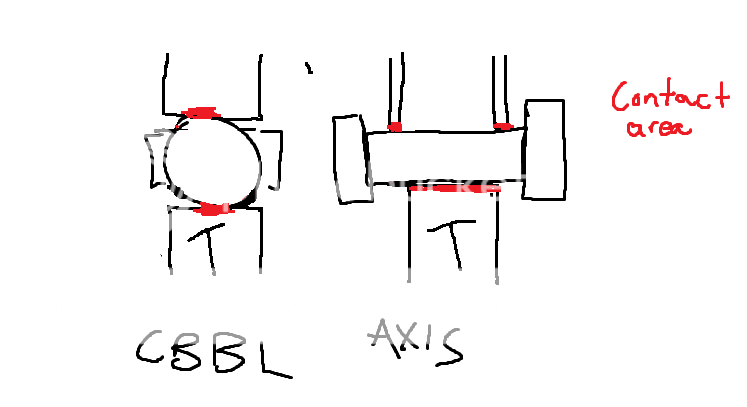
Sure, but the contact surface is also less; If I'm not mistaken, it'd be something like this ?
axiscbbl.png


The axis lock has five parts including 2TWO2 springS

The CBBL has three parts including 1ONE1 spring

Dont change your views after one example or anything.

Axis lock has 2 omega springs and the axis bar. 3 parts. it will also function with only 1 omega spring as well, so only 2 are really needed to function.
 
Lets just take Ankersons tests for truth and law from now on. Its all anyone can say. I like the guy, but I wont just jump on the bandwagon. PROOF? You have none. Results from few test is all you have.

Actually, Sal stated that the failure was due to a deformity. Proof? Maybe not, but it's an example. And like I said, there is only one example of CBBL failure out there so far.

Minimal contact? Both locks work on compresion. Not friction like liners and R.I.L.s.

So? What is more easy to deform? A ball that contacts the tang and backspacer at a single point (higher pressure for the same force due to less area), or a cylinder that contacts the tang along a line?

So balls on a table dont mean anything.

No, they don't. Which is why I'm wondering why you brought up "structural stability." Maybe in outer space, which is why you don't see square planets and stars, but we're not talking about gravitational pull here, are we?

In the case of knives and locks, a block (square, rectangle) would probably be the best and most "structurally stable," as you call it.

Sure, but the contact surface is also less; If I'm not mistaken, it'd be something like this ?
axiscbbl.png

The CBBL would be between the blade tang and a solid backspacer. The Axis lock is between the blade tang and liners.
 
So? What is more easy to deform? A ball that contacts the tang and backspacer at a single point (higher pressure for the same force due to less area), or a cylinder that contacts the tang along a line?

Actually, the cylinder would be much easier to deform than the ball. jay2pointoh was quite correct when he said that a sphere is more structurally stable than a cylinder. That high school physics lesson stuck with me. ;)

tmyk.gif
 
Sure, but the contact surface is also less; If I'm not mistaken, it'd be something like this ?
axiscbbl.png

It would end up looking more like this:

axiscbbl.png


The bits marked with a 'T' are the blade tangs. The ball bearing on the CBBL is sandwiched between the blade tang and the steel back spacer in the open pisition. The axis lock bar is sandwiched between the blade tang and the steel liners.
 
But I saw it on youtube........


Amazing how one video can sway so many opinions.
 
Back
Top