Best steel AUS6 or 440C

Cliff Stamp said:
CRK&T mainly argue for the durability aspect for people who need higher toughness and I can understand this after lending knives to carpenters who easily tear up S30V class steels. They are not chopping or prying (well they are, but those are not the problems I am speaking of here) just cutting materials with inclusions like nails or just contaminated with debris.
Well, as long as CRKT is doing us all favors by downgrading their steels, I wish they'd at least "cut" the price a wee bit. And are we to reevaluate Smith & Wesson knives in light of this move to AUS 4 and 420j2 steels on the part of CRKT and Gerber?

I'd like to see some reviews of the new knives and see how they hold up. What would really be nice is to compare the new knives with the older ones made with higher-grade steels. If the new ones hold up better I'll never criticize those companies again.

.
 
ahhha all these numbers are making my head hurt. Still trying to learn about different metals
 
KFLEISIG said:
I have a Kershaw Vapor II in AUS-6 that simply will not take or hold an edge.

I had the same problems with the same knife. It went away after the edge was extensively sharpened. One thing to note with the less expensive steels is that generally the manufacturers do not optomize them as heavily so comparisons are heavily biased. How many people using AUS-6A have tight quality control, have really looked at the heat treatment in detail, use cold treatements, etc. .

Confederate said:
And are we to reevaluate Smith & Wesson knives in light of this move to AUS 4 and 420j2 steels on the part of CRKT and Gerber?

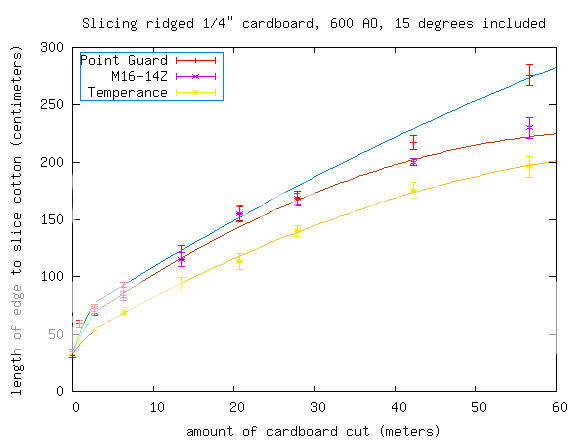
That is an excellent point and one of the problems I always had with people willing to write off steels like 440A, AUS-6A but hype Buck's 420HC readily. These are all in the same class, in fact the first two are superior from a hardness/wear resistance perspective. There is more to the knives than the steel, often the performance is more influenced by geometry and other factors of general construction. There are differences in the steels, but even in the extremes such as 420J2 the edge retention isn't as bad as often implied :

card_pg_m16_tm.png


That is 420J2, AUS-4A and VG-10. Yes the Temperance has an advantage how much so depends on how you look at sharpness. But it isn't like you can not do significant work with the 420J2 blade. I also doubt that CRK&T has it at optimal performance either. To clearify this cardboard comparison doesn't cover all aspects of edge retention, it is a low angle check of slicing edge retention on abrasive media, there are other types of cutting and the relative performance will change. I am curious about wood cutting due to comments made by Landes about the drawback of large primary carbides in steels like 440C so the steels with a lower Cr/C ratio can do better, not worse. The main reason I have not done it is that it is annoying to measure push cutting sharpness in comparison to slicing aggression.

STR said:
I know people also that don't deserve a good blade in their hands.

This wasn't my point but rather what is a good knife means different things to differnet people. It would be hard to argue a carpenter doesn't need a good knife simply because he needs more toughness than wear resistance. Fisk as noted he draws his personal knives very soft, are they really not "good" knives simply because they are softer than even 420J2.

-Cliff
 
Again you misread my point Cliff. I said good blade not good knife. I'm referring to one of the better blade steels here vs one of the 400 series or AUS 4 or 6 series steels. Not what you are referring to. For example, a carpenter could have a good knife with a good blade, (ie higher quality blade steel) or a good knife with a lesser quality blade steel. I thought I was clear covering how it would not really benefit my neighbor to have say an S30V blade over one of the 420 ones he carries..

STR
 
STR said:
I'm referring to one of the better blade steels here vs one of the 400 series or AUS 4 or 6 series steels. Not what you are referring to.

That was exactly what I was referring to in general, my point was that different steels have different properties and you can't just uniformly label the steels as "good" and "bad". The same reasoning would have you degrade Fisk's knife because of the low hardness and wear resistance and that should be obviously problematic - he doesn't deserve a "good blade"? Carpenters need good steels in good knives just like a chef does, however they don't need the same steels and the same blade types. And even people doing the exact same tasks don't always want the exact same performance attributes so what is good for one isn't going to be for another.

For example, a carpenter could have a good knife with a good blade, (ie higher quality blade steel) or a good knife with a lesser quality blade steel.

AUS-6A isn't a lesser quality steel than S30V any more so than S7 is a lesser quality steel than D2 (the same relationship exists for those pairs). As I noted in the above you can show that 440A is a more optimal steel than 440C for some knives, see the references I noted origionally. The same arguements hold for many of the steels called "low quality", see the references provided for details.

-Cliff
 
Jerry Fisk tempers his personal knives to 52 HRC

Do you know why he does this?

Why do carpenters use stainless steel? Assuming it is a Aus6A mutlipurpose knife, after they tear through wood/cardboard with metal inclusions, how can well can you expect it to perform the tasks which actually need/want a stainless steel, like cutting food? Wouldn't more specialized blades be more important?

And how far are you willing to support the increase in toughness argument?

The only confirmed 420J2 knife I tried is a CRKT F4 neckknife. I think the implementation is truely horrible. I didn't independently test the steel, but either the steel is very bad, or the plastic sheath degrades the steel really rapidly.
 
kel_aa said:
Do you know why he does this?

"I personally prefer a softer draw on my knives for several reasons. On my personal knife I draw the temper back to about a 52. I like the more aggressive edge and it holds for me longer. It is also tougher and will take more abuse. When I go off hunting for a week at a time I do not want to carry a bunch of stones to sharpen it with nor do I want to worry about what ever I put it through. This just holds up better in the way I personally use a knife. I sure would not have to worry about stresses from bends. To me toughness is more important than hardness."

Why do carpenters use stainless steel?

There are a few reasons why in general they will look to it mainly because of the perception that it is directly better and 440 stainless is really good. In particular to the above I was speaking more of a choice between the more brittle high carbon stainless vs the tougher medium carbon stainless. However, construction workers are in the rain a lot, so rust is a real concern.
Finish carpenters who work inside have very different tools and have far less demands on toughness. They can prefer the japanese style chisels for example but they are very rare for framing.

Assuming it is a Aus6A mutlipurpose knife, after they tear through wood/cardboard with metal inclusions, how can well can you expect it to perform the tasks which actually need/want a stainless steel, like cutting food?

They have little fine cutting ability until it is sharpened, but generally they are more utility tools and don't see tasks which demand the ability to push cut fine paper for example. When fine cutting is required the knife is just resharpened. The softer blades can readily be filed which allows for aggressive sharpening rapidly, on a shingle for example.

Wouldn't more specialized blades be more important?

Yeah, in general shingles are far more readily cut with small hook knives and fibreglass insulation with a very long and very thin blade, however in small construction companies it is common for people to move around a lot because you don't have enough people to independently run each job. My brother used to carry standard carpentry knives, and he still does, a extra heavy duty Olfa, but it gets a lot less use due to the Pacific and Alantic Salt. You also are not going back to the tool back every time you need to cut something just like the claws on the hammer get a lot more use than pulling nails because often it is much faster to use them than to actually get the right tool.

And how far are you willing to support the increase in toughness argument?

Again in the above I was speaking more of a choice between two steels rather than saying it was an optimal steel in general. But I think the arguement Fisk outlined in the above would have value for many.

meshmdz said:
so AUS6m high carbon blades are not durable?

They are more resistant to impacts and can bend more but are not as strong or as wear resistant than the higher carbon stainless steels.

-Cliff

 
Hi,
I would like to get an assited opener like a Phantom Reflex or Camillus Heat 2334b. I'm new @ this. What would ya'll recommend?
Thanks,
Chris
 
Sorry, cant comment on the last post, since I have not used either knife. I do have a Benchmade TSEK in 440C and a Vapor II in AUS-6. Both are sharpened at a pretty low angle, and both will take a razor edge, fine enough to whittle hair held between my fingers. The Vapor had replaced my TSEK as my work knife until I started testing the edge holding ability of a knife I made vs. the Vapor. The Vapor so far has cut about 700 inches of moving boxes and still shaves hair from my hand. I havent tested the TSEK, but in daily carry, alternating between the 2 for the last few months, the Vapor seems to hold its razor edge longer. I may be seeing the effects of lower angle on 440C's structure, as both knives are sharpened to around 15 degrees, maybe a little lower. The Vapor gets touched up w/ a Sharpmaker, and the TSEK gets touched up w/ a fine India stone. However, both get their initial edges from a 1x30 sander w/ a 320 grit belt, followed by a leather belt w/ white compound. This is the edge that seems to last longer on the Vapor. Of course, its a smaller knife, so I could just not use it for heavy tasks, but the TSEK is out of production, so the reverse could apply as well.

Regarding the Sog Seal tests, the test was of knives, not steel. The geometry could account for much of the way the tests went. Not all the tests, but a heavier geometry could be an advantage for many.
 
For a survival knife, you don't want a steel that is too hard. For example, D2 or 154CM or even 440C are great when you can go home and get out the Sharpmaker but in a true survival situation, a knife needs to be able to be sharpened easily and quickly with just a hard stone. AUS-6 and 440A satisfy this need. True, edge holding is not as good but just try sharpening your Benchmade AFCK of D2 on a rock from your backyard. I suspect you would be praying for something softer.
 
You can sharpen even the hard and high alloy steels on rocks, try carving up a rock see what gets worn more the rock or the knife. Even the hardest and most abrasion resistant knives I own don't work well on rocks I can commonly find on the ground. I would agree though in general that the low alloy steels have advantages for survivial situations as they are generally more durable.

-Cliff
 
Clif, I agree with your statements. Just digging up a few weeds even in plain soil will dull my AFCK in no time. But for the sake of time spent and energy used in sharpening, I'd rather have a softer steel in a survival situation.

I did not say that a harder steels could not be sharpened at all. I just said that a survival knife needs to be able to be sharpened easily and quickly.

Regards
 
As far as the SOG ad campaign goes, back when they initially announced the test results and came out with the Seal knife they were using 440A, and highlighted it's performance on cutting ropes, and corrosion resistance. They even moved their Tigershark to 440A for a while from SK-5. ( the carbon steel versions are now sought after ) I seem to recall the knife was then made in AUS 6A after that. I think it's back to 440A now but I can't swear on that. I believe the Seal knife has stayed 440A, though I'm not sure there either.

I'd take the Benchmade 440C as used in the Griptillian over any AUS 6A knife I've ever tried. I despise the CRKT AUS 6A knives. I won't buy a AUS6/4 or 420/420HC knife. AUS 8A/10A have worked out better for me. I don't think much of 440A either. Joe L.
 
The Mastiff said:
As far as the SOG ad campaign goes, back when they initially announced the test results and came out with the Seal knife they were using 440A, and highlighted it's performance on cutting ropes, and corrosion resistance. They even moved their Tigershark to 440A for a while from SK-5. ( the carbon steel versions are now sought after ) I seem to recall the knife was then made in AUS 6A after that. I think it's back to 440A now but I can't swear on that. I believe the Seal knife has stayed 440A, though I'm not sure there either.

For some reason I'm always embarassed talking about this. But, it was actually widely reported at the time that the SOG test knife was made from 440C. They changed to 440A for production, but there was a bit of a howl that it wasn't the same steel as the test knife. I can't vouch for the veracity of the 440C claim, but it was reported from multiple different sources.

Joe
 
Confederate said:
Smith & Wesson claims to use 440C a lot in their knives, but no one seems to like them.

I've already noticed that Smith&Wesson knives don't have a good reputation at BladeForums,
even when using 440C as blade steel.

But....are there any known facts or infos why the S&W 440C steel and the heat treatment
is supposed to be inferior :confused:
 
Irezumi said:
I thought AUS 6 was just the japanese version of 440A while AUS is equal to 440B, and finally AUS 10 is equal to 440c..so AUS 6 could only only be rated as a competitor to 440A, which is not as good a 440C.

As Joe pointed out, they're not the same. They are, however, so similar that you'll barely notice a difference between the respective "equivalents" (6&A, 8&B, 10&C). Some find the AUS steels easier to get a keen edge on than their counterparts, and the latter are reputed to be slightly better in the edge-holding department.

Also, "good" depends on what you want to use it for. For example, in a beater that doesn't see a lot of maintenance, I'd prefer AUS-6. Also it is more resistant to corrosion than 440C, it's the bead blast finish often found in lower-end AUS-6 blades that give the steel a bad reputation in that regard.
But yes, for most purposes, 440C is "better".
 
Back
Top