Best tasks for each steel attribute?

Mr. Ankerson,

Like you, I use a knife for cutting thngs. Not for an axe, prybar, wood splitter or because it looks "cool."

I love a steel that will hold an edge very well, at a very obtuse angle, and a Rockwell hardness of C-64 or greater. I suppose that's why I have become such an outspoken advocate of B-U K390.:thumbup:


To paraphrase an old slogan, I wish to go where cutlery steel has never gone before!:p

K390 is an upgrade fron K294 to add some toughness, but K294 is more than tough enough from what I have experienced even at 64 HRC and ground very thin.
 
Due to the discussion here on K390 I thought maybe this would add some perspective:


I may be the first maker to work with K390. I got a small sample to try from Alpha Knife supply and here is the report I sent back to Chuck and will put up on my website:
I can give some feedback on K390 based on one finished knife that I now have in my kit. This is a trailing point based on the Bow River design. I took it on a recent Mule deer hunt in Utah and it saw most of the duty from field dressing to cutting and trimming to vac pack in the freezer on two Mule deer. This is a FFG 4.5 inch blade ground to about .008 behind the sharpened edge. Hardness is RC 64. The heat treat was done based on the Bohler data sheet with the exception of an overnight subzero in LN2. I would say that edge holding in not an issue. After the use described it will still cut ¾ inch rope with less than 20 lbs on the scale. Due to the thin grind I do not pry apart joints or do any chopping so bending toughness and impact resistance still needs to be evaluated. I have not done a direct comparison of K390, K294, CPM 10V for edge holding but will say based on use in the field with all of these steels at the same hardness they are all in the same category. 10V has always been the standard that I use to compare edge holding on other grades. K390 compared to the other A11’s has less chrome and Vanadium but has added tungsten and cobalt according to the data sheet. The ideas is to improve the matrix, add hot hardness and give it better impact and bending toughness. It will take some more work, heat treating and different hardness targets to evaluate all this. Also hopefully other makers will try it and chime in as time goes on. I was concerned about corrosion resistance. So far the blade has a slight patina and no rust or pits. I left it “as is” after field dressing the last deer on the trip home just to see what would happen. Normally with these non stainless grades a good cleaning is recommended and then some mineral oil applied before it goes back in the sheath. With wet conditions then there is going to be some more serious corrosion. This is not a grade to be used in very wet conditions or around salt water. I would go to CPM S110V, CPM S90V or M390 for that application. Sharpened with a fine SC Norton stone it is a very aggressive cutter. No need for a polished edge here with this one. It also responds to a loaded strop to tune up when it loses the bite. The other thing I noted is that it “pops” nice in heat treat. This will allow the possibility of a higher finished hardness and with a little more toughness, a finer edge. Grinding and finish based on one blade is a challenge. Each maker will have to work out his techniques here. I will say use new belts and maybe stop at 220 and call it good. I hand rubbed this one to 400 satin finish and probably will not do that again. Phil
 
Thank you, Mr. Wilson.

I just wish there were many more highly intelligent people like yourself in the field with your dedication to progess, experimentation and the advancement of technological knowledge.

Please continue to share your results with us. You are truly an inspiration to those of us who seek to make tomorrow better than today. :thumbup:


@
Mr. Ankerson, I would be quite content with a Spydercdo Military in K294, at Rockwell "C" 64. (at least until someone discovers a process for manufacturing them from CPM Rex 121 at 70!) :p:p
 
Last edited:
@
Mr. Ankerson, I would be quite content with a Spydercdo Military in K294, at Rockwell "C" 64. (at least until someone discovers a process for manufacturing them from CPM Rex 121 at 70!) :p:p

I think it would be an interesting knife if they could get it hard enough, K294/CPM 10V would make for a really nice work knife that would cut for a VERY long time.
 
I think it would be an interesting knife if they could get it hard enough, K294/CPM 10V would make for a really nice work knife that would cut for a VERY long time.


10V, K294, K390 (my favorite) CPM 125V, etc. All good! Now how do we talk SaL Glesser into making them?? :confused::confused::confused:
 
10V, K294, K390 (my favorite) CPM 125V, etc. All good! Now how do we talk SaL Glesser into making them?? :confused::confused::confused:

Begging, lots of begging.....

Then He has to find someone that can and will work with those steels and do the heat treating correctly to provide a good balance for a production knife or knives.

We ain't talking about S90V here you know...... ;)
 
Begging, lots of begging.....

Then He has to find someone that can and will work with those steels and do the heat treating correctly to provide a good balance for a production knife or knives.

We ain't talking about S90V here you know...... ;)

And that, sir, is why I'm so excited by it! :thumbup::p:thumbup:
 
And that, sir, is why I'm so excited by it! :thumbup::p:thumbup:

The wear resistance AND the HIGH HARDNESS could to be an issue I think equipment wise.

Only time will tell if anything happens. :)
 
there's a french knifemaker who forges (:confused::eek::confused:) K390pm into san mai damascus blades. try googling pierre Reverdy to see his work, most of his knives are more art work and presentation pieces but he can make very utilitarian designs too iirc.

an exemple here http://www.reverdy.com/pages/detail_couteau.php?id_folder=13

not sure if there's any practical advantage in forging a such a steel, especially a PM steel ... i doubt ...
 
not sure if there's any practical advantage in forging a such a steel, especially a PM steel ... i doubt ...

I'd bet he is actually getting less performance with it. I can't imagine a home or shop forging process or equipment that could match the accuracy of modern electronic furnaces.
 
that's my thoughts about this too ...

anyway this guy can make some gorgeous knives.

IMG_0118c.jpg


IMG_0116c.jpg


stunning pics courtesy of "elegil" @ neoczen.org.

this just to show that it's not someone making knives in his garage but a very skilled bladesmith.

imho someone getting to this level of craftmanship must at least produce something that works correctly, i'm pretty sure he has a precise enough furnace as this is pretty much mandatory for heat treating those steels. this man was among the first in france to use this kind of steel, he used K190PM years ago and i think he only works with bohler steels, he must have learned a thing or two about heat treating them.

i've read very good review about one of his forged K190PM knife from someone who actualy uses his knives in the woods, someone that used a lot of diferent knives and who doesn't baby any of his knives ... so i'm pretty sure that the steel has lost some of its properties but still working pretty damn good.


not to derail the thread nor start a controversy but i think this is an interesting addition to the subject. those pictures are here to show that the guy isn't the average joe, he has years of work behind him it doesn't mean that what he does is any good performance wise ....
 
Last edited:
there's a french knifemaker who forges (:confused::eek::confused:) K390pm into san mai damascus blades. try googling pierre Reverdy to see his work, most of his knives are more art work and presentation pieces but he can make very utilitarian designs too iirc.

an exemple here http://www.reverdy.com/pages/detail_couteau.php?id_folder=13

not sure if there's any practical advantage in forging a such a steel, especially a PM steel ... i doubt ...

He is doing it for the damascus blades, the forging is part of the process of making the damascus.
 
Hi all...


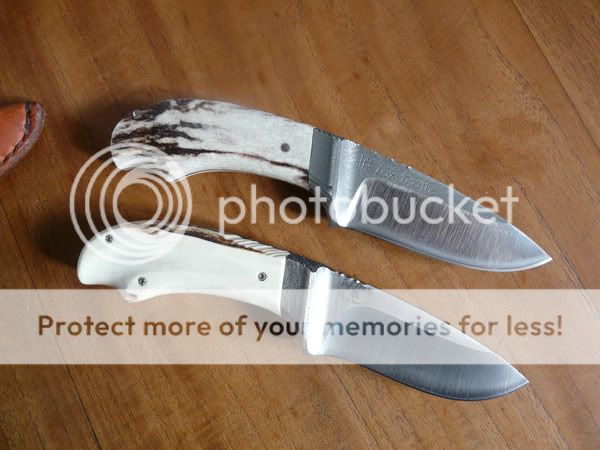
This one is a skinner, made by Pierre reverdy as pwet said. It is not forged but machine cutted. Hardness for K190PM is -if you use the heat treatment Boehler recommend for it- of 63,5- 64 HRC. Pierre Reverdy used another heating process, and the hardness is of 60 HRC.

A very nice knife, big cutting performances, easy to maintain. Only one thing is to notice: the patina wich is long to come is very hard to clean.

The first skinner of this model was made by pierre reverdy in 1993, almost 20 years ago, designed for hunters. He uses to produce 4 or 5 of these knives each year. 3 years on his waiting list :-).

Pics:

Pierre Reverdy , Fox-Trotte.

p1000904k.jpg


7,5 inches overall

p1000910a.jpg


p1000905r.jpg


p1000990s.jpg


p1000912u.jpg


p1000968c.jpg


p1000971c.jpg


A full tang, but a nice work to get it so thin at the end...

p1000970l.jpg


p1040436y.jpg


Mine, with a 1998 model:

Comp_Fox_Trotte3.jpg


design and cutting process in 1994 :D

DSC00109800x600.jpg


DSC00110800x600.jpg
 
If he is only hardening to RC 60, why not use a far cheaper steel? :confused:

One of the points of using good steel is the ability to harden it properly.:p
 
The wear resistance AND the HIGH HARDNESS could to be an issue I think equipment wise.

Only time will tell if anything happens. :)

Farid made a couple of competition cutters in CPM REX 121. The belt costs worked out to over twice the steel costs.

there's a french knifemaker who forges (:confused::eek::confused:) K390pm into san mai damascus blades. try googling pierre Reverdy to see his work, most of his knives are more art work and presentation pieces but he can make very utilitarian designs too iirc.

an exemple here http://www.reverdy.com/pages/detail_couteau.php?id_folder=13

not sure if there's any practical advantage in forging a such a steel, especially a PM steel ... i doubt ...

Must be one of the few crucible steels that you can actually forge. I agree with you regarding the practical advantages.
 
reverdy choosed to modify The original heat treatment to lower The hardeness at RC 60. 64 is maybe much too high for a knife you will have to resharpen on the field. The interest to use this steel is not only to have a very hard blade but one of the most performant cutting steel. Precisely, I love the knife for it's cutting power, very impressive. Fir me it is more or less like a "super D2".
As a matter of fact, it is not cheap at all.
 
If he is only hardening to RC 60, why not use a far cheaper steel? :confused:

One of the points of using good steel is the ability to harden it properly.:p

sure, 440a and S30v both at 58 hrc perform the same.
 
Farid made a couple of competition cutters in CPM REX 121. The belt costs worked out to over twice the steel costs.


Must be one of the few crucible steels that you can actually forge. I agree with you regarding the practical advantages.


REX 121 is a carbide replacement steel or to bridge the gap if you will.
 
sure, 440a and S30v both at 58 hrc perform the same.

I think you completely missed my point, old boy.

If a steel is capable of easily handlng a hardness of 64-65, you're simply wasting good premium quality steel by only hardening it to 60.

Would you buy a Lambhorgini and fuel it with a bargain basement low octane gasoline instead of Premiium?
 
Back
Top