Best tasks for each steel attribute?

I do not agree: the quality of a steel is not only its capabilitie to be hardened at 64 HRC. I think that pwet post was humoristic: it means that with a same hardeness two steels could be very different. 64 is much too high in my sense for a field knife. But this steel in particular is better than D2, or others, when treated to 60 HRC. It was a real choice of the maker to lower the hardeness. And I can insure you you still ride a lambo... :-)
 
Reporting back on my light use results.

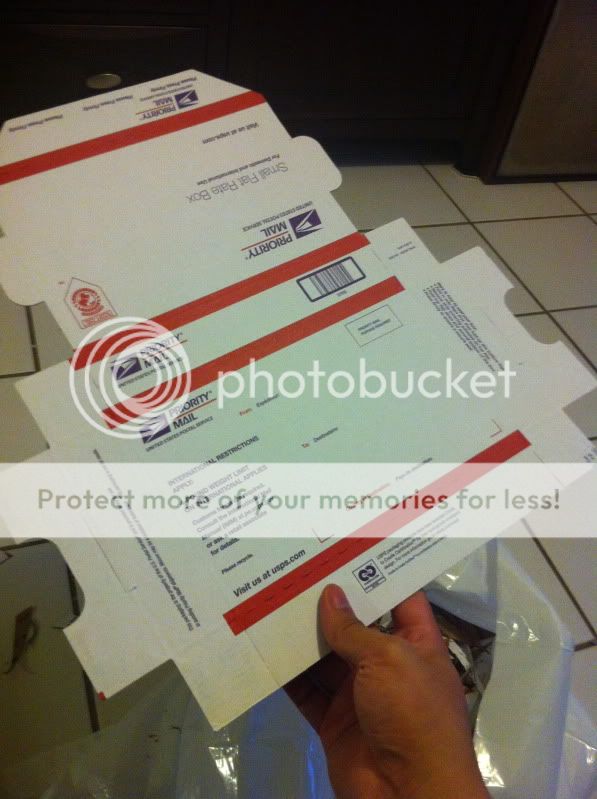
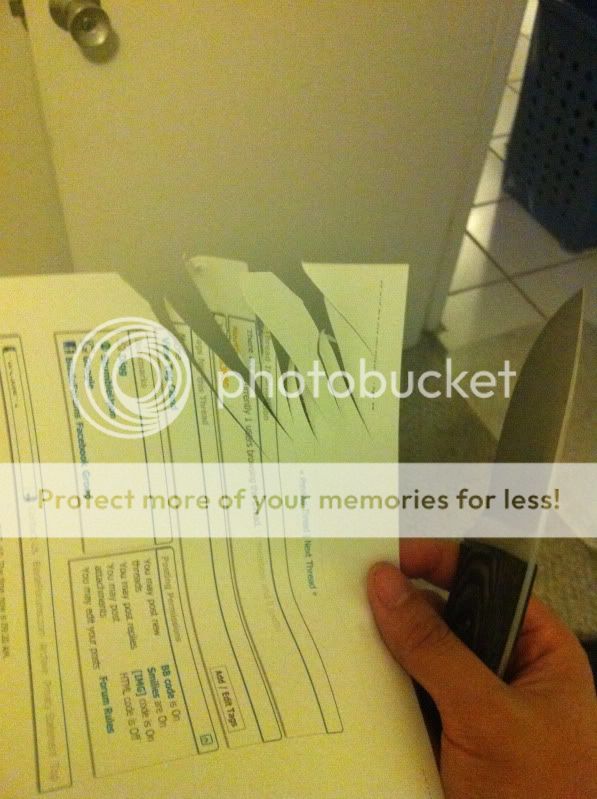
I cut up a couple of Small Flat Rate USPS Priority Mail boxes into little ribbons. Would've done more, but my arms got tired:D.
IMG_0226.jpg

IMG_0225.jpg


IMG_0227.jpg

Edge was still paper slicing sharp afterwards, though it won't shave.

I noted some tiny glints along the edge, but most were gone with a quick run on my polishing belt, so I assume it was just rolled(weird?). Damage was less than expected, probably on par with ZDP-189. I don't think I'll have to baby the knife. Just so long as I beware of staples and bone.
IMO to get the most out of the big V steels in Customs at high hardness use a semi polished edge at low angle.

In my Phil Wilson Customs I typically use around 24 degrees inclusive and that semi polished edge that gives a nice balance of edge refinement and aggressiveness taking advantage of the vanadium carbides.

They are all Flat Ground and very thin in the .006" to .010" range behind the edge and 62-64 HRC depending on the knife.

But then they are not for chopping, batoning, making twisting cuts or hitting with a hammer... ;)

They ARE extremely high performance cutters and slicers. :)
I don't think a semi-polished edge is necessary, as the steel seems to develop a toothy edge on its own. Though I suppose it would save some effort in sharpening, I don't think I spent more than 5 minutes on the thing(didn't reprofile).

10V, K294, K390 (my favorite) CPM 125V, etc. All good! Now how do we talk SaL Glesser into making them?? :confused::confused::confused:
Sal gave up on S125V. Making one doesn't sound all that bad. Making more than 5 would be a mechanical nightmare:thumbdn:. I suspect the carbon versions would be more appealing due to the lower overall wear resistance.
 
sure, 440a and S30v both at 58 hrc perform the same.
sure, S30V at 54 hrc and S30V and 58 hrc perform the same.

besides, some of the steels mentioned in this thread are more wear resistant than fully hardened D2 when at their softest level of full anneal
 
that was my point sorry for being ironic i thought it was obvious . There are some drawbacks producing à 64 grc thin edged skinner, just because some ppl will actuel skin game with them instead of just testing and whatever. That's the maker's choice and my guess is that he did this because at this hardness this steel is still ductile enough to handle bone contact and light joint prying and still has more carbide volume than any "simple" high carbon steel ..... Compromises .....


Posting from my phone, if there are French words in the text it's the f$*@#ing correction software sorry guys
 
Yes, I was a bit skeptical about steels like S125V, S110V, and S90V used as a skinning knife. Mostly because I've chipped many knife edges on chicken bone, so I wasn't sure deer bone would be much of an improvement unless you're skilled enough to never touch the bone. But then, I've never skinned a deer before, so that might not mean much:thumbdn:.
 
I've dressed and skinned two elk in one day with a D-2 Dozier, and it would still slice paper. The dressing, skinning and boning process should be performed in a manner similar to a necropsy. That is say, simply take it apart, where the parts come together. It really isn't difficult. It simply demands that you pay a bit of attention to what you're about. :thumbup:

Use your knife properly, and even a Buck or Gerber will get through an elk unscathed.:p

As posted in another thread, I well soon be receiving a knife in 440V/S60V. The manufacturer has advised me that his knives are heat treated to 55-56 HRC. Since S60V is world renowned for abrasion resistance, it will be interesting indeed to use the knife as a "test mule" for determination of how much degradion of abrasion resistance occurs at such a low hardness.

It should certainly prove to be a "learning experience." :p
 
Last edited:
sure, S30V at 54 hrc and S30V and 58 hrc perform the same.

besides, some of the steels mentioned in this thread are more wear resistant than fully hardened D2 when at their softest level of full anneal

Yep, there are a few of them. :D
 
There are some drawbacks producing à 64 grc thin edged skinner, just because some ppl will actuel skin game with them instead of just testing and whatever. That's the maker's choice and my guess is that he did this because at this hardness this steel is still ductile enough to handle bone contact and light joint prying and still has more carbide volume than any "simple" high carbon steel ..... Compromises .....
The only drawbacks come from using a steel that shouldn't be used at 64 Rc at all. Light bone contact is not the same as high speed cutting of metals, and that's what some of these steels were made for at this hardness. And you also don't want a lot of ductility, another reason to go for higher hardness while still having reasonable impact resistance. Ductility/plasticity is how easily you can permanently deform the metal, which we don't want to do. Higher hardness is also better for prying, because you don't want to exceed the elastic range of the steel and end up with a pretzel instead of a knife. Of course the better option for pure prying is a thicker piece of metal, but we still want to cut stuff.
 
The only drawbacks come from using a steel that shouldn't be used at 64 Rc at all. Light bone contact is not the same as high speed cutting of metals, and that's what some of these steels were made for at this hardness.

true, but not with an edge geometry optimised for cutting flesh.

don't get me wrong, in fact completely agree with you, if i ordered the knife i would request it as hard as possible, but i still understand the logic of the knifemaker who caters to the "average" hunter willing to spend some bucks on a good knife but not necessarily very informed about the best way to use and sharpen it.

and on the other hand for this very purpose i'll also pick the thinner edged knife available and if a given steel at full hardness is to brittle for the occasional bone/projectile/whatever, you know it happens ... contact at the thinnest edge geometry i'll gladly go for a tougher one or downgrade hardness at the loss of edge retention but that's me.


Mr wilson has his niche for very top of the edge high perf steel and he informs the buyers, and obviously it works as he has about 12 months backlog (iirc). but i understand perfectly someone looking for compromises.
 
true, but not with an edge geometry optimised for cutting flesh.

don't get me wrong, in fact completely agree with you, if i ordered the knife i would request it as hard as possible, but i still understand the logic of the knifemaker who caters to the "average" hunter willing to spend some bucks on a good knife but not necessarily very informed about the best way to use and sharpen it.

and on the other hand for this very purpose i'll also pick the thinner edged knife available and if a given steel at full hardness is to brittle for the occasional bone/projectile/whatever, you know it happens ... contact at the thinnest edge geometry i'll gladly go for a tougher one or downgrade hardness at the loss of edge retention but that's me.


Mr wilson has his niche for very top of the edge high perf steel and he informs the buyers, and obviously it works as he has about 12 months backlog (iirc). but i understand perfectly someone looking for compromises.

His knives are tougher than you would think being as thin as they are. :)

Very high hardness and thin are good with the way he does his HT and tempering.
 
Back
Top