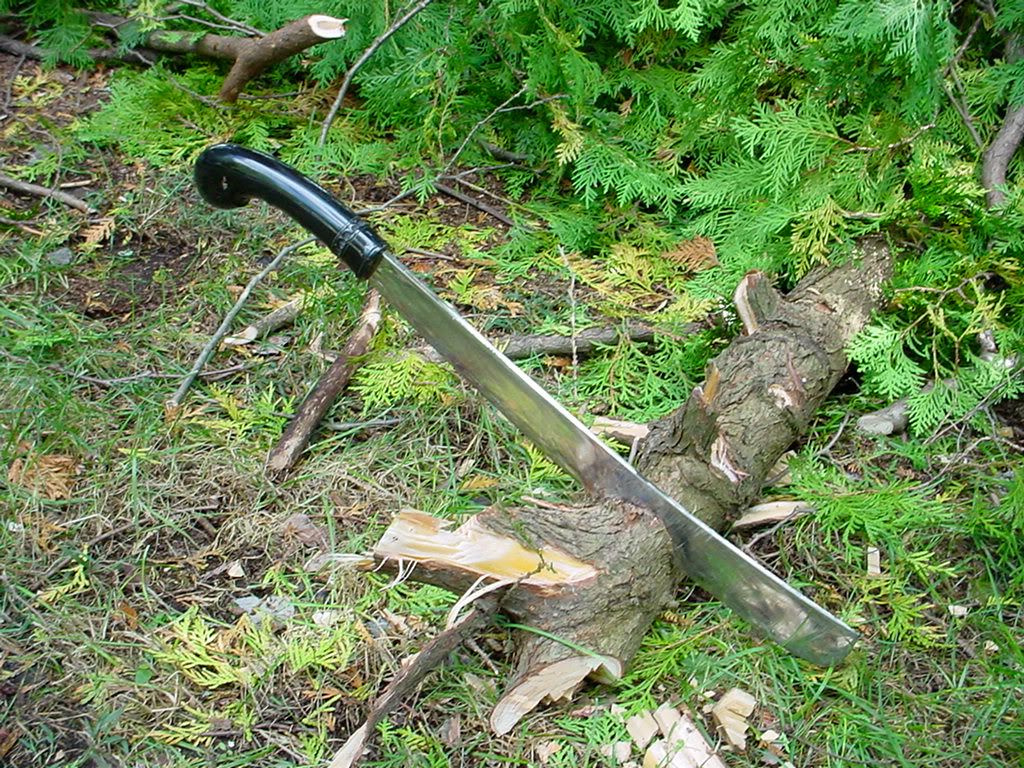
Best tool for cutting small branches

Many prunning saws are made to cut on the pull only. Trying to push AND pull results in a bent saw. Mighty hard to bend on the pull only.

Saws can also fall victim to too much effort vs. smoothness.

I have used the same folding prunning saw for nine years now - at least monthly. It's spot was formerly held by another that still works - just wanted something new. :o

Totally agree. He was applying too much force to the saw trying to muscle it through.
 
Skam- what are the specs on your edge geometry with that thing? Did you just sharpen the existing factory bevel or what? I can see it not taking a deep bite on big logs of firewood, since so much edge length comes in contact. But on 3/4" sticks, there's no excuse.
 
I know it is not a knife, but for small branches a pair of ratcheting shears are excellent.
 
I agree-- use the leverage of the branch to work for you, cut some of the outer layers to get a split started and snap it off. Vine maple can be a pain-- it will peel for a foot or more.
...

Here's how to prevent the bark peeling problem when you saw a branch.

When sawing a horizontal branch, make the first few strokes underneath the branch (saw upside down) to cut the bark. Then, move your saw to the top of the branch an inch beyond where you made the bottom cut, and finish sawing all the way through the branch.

As you cut through from the top, gravity will break the branch and the bottom cut you made initially will prevent the bark from peeling.
 
For efficiency a saw works best.

For enjoyment.... how do you like that Kershaw outcast?
 
Sweedish Axe.
ed701s2b.jpg


Was just out in the bush doing some prospecting; cleaning up the claim lines, lots of fir trees grow and block the path with their branches. One good overhead swing to chop off all the branches on one side of the tree.

The design keeps it from slipping off the branch your hitting, but obviously it isnt good for thick branches.
 
For now, this is my choice of choppers, a Valiant Large Survival Golok:

golok_biting.jpg


It works well on wood, as shown in the pic above.
 
Dang...that golok has penetrated to an impressive depth....especially seeing that the cut is virtually at right angles to the grain.

Here's the latest thing I'm playing with for light chopping. So far I've been impressed. It is only 12" overall length. Handy and effective. Himalayan Imports 12" Ang Khola khukuri.

12AngKhola.jpg
 
My favorite tool for limbing 1 or 2" diameter branches is the Gransfors Bruks Small Forest Axe. I keep it razor sharp on a Tri-Angle Sharpmaker, and merely choke up on the handle to make it into a handier light chopper.

Takes off all 1" branches at a stroke with only a mild hit. Two inch branches come off in 1 or 2 medium power hits.

Money spent on an SFA is money well spent. After a couple of years of use, I couldn't even live without one.
 
The ax would be my first choice followed by the saw and A knife or Machete if nothing else is available.
 
I keep reading about people using machette or big knife to make paths in the bush.
Now I live in a completely different country, but I don't understand the necessity to cut a path when I can, say, walk around it, or push my way through.
Can someone explain please?
appologies if this is offtopic.
 
For efficiency a saw works best.

For enjoyment.... how do you like that Kershaw outcast?

The Outcast filled all my "Big Chopper" lust for $50 (used). I spent some time convexing the edge and got it nice and sharp. Like all the big blades, it is too heavy to be practical for hiking, but it fills the niche. I like the handle and the balance is good for me. I wouldn't be afraid to baton or otherwise beat it up. I did notice that the false edge was very asymmetrical (read "uneven")-- a quality control issue I guess. It makes no difference in the cutting ability. The tip was quite blunt and much too thick to get any kind of decent edge on it and I spent most of my efforts convexing the edge there. There have been some discussions on the appropriateness of using D2 for this blade and it seems to work just fine for me. I wailed on a bunch of branches and there were no problems with edge retention, chipping, rounding, etc. All said, I'd rather use a hachet for chopping and a 14" Fiskars is about the same weight and costs a lot less.
 
The same question occurs to me Beef.

Around here you can find thick patches of scrub, but generally there is a way to walk around them.

I have used a machete or 'slasher' to try to get access through some areas, particularly where there are prickly gorse bushes or blackberry vines, but this isn't something folks around here would do often.

I associate machetes for path clearing with movies or tv documentaries about places like the Amazon rainforest.
 
I keep reading about people using machette or big knife to make paths in the bush.
Now I live in a completely different country, but I don't understand the necessity to cut a path when I can, say, walk around it, or push my way through.
Can someone explain please?
appologies if this is offtopic.

In my case the claim line needs to be clear enough to look straight down it for several hundered feet.
I wouldnt use my energy chopping unless I had to make a path, like you said, its easier and faster to go around most obstacles.
 
I keep reading about people using machette or big knife to make paths in the bush.
Now I live in a completely different country, but I don't understand the necessity to cut a path when I can, say, walk around it, or push my way through.
Can someone explain please?
appologies if this is offtopic.

Sounds like a perfectly valid question.

I don't really do much trail blazing either, but there are times when it's simply handier to whack through a piece of greenbriar than back out & go around 20 or 30 yards. Especially in the case of carrying an awkward load, like a deer stand. I suppose much of my path cutting would be related to hunting in some way... When the squirrels are hitting a couple favorite trees, I may return to that spot every day to snipe at 'em. So I may clear a few limbs out of my way to sneak in undetected, or out of a favored shooting position, etc. Likewise if I plan to sneak in to my deer stand the same way pretty much every morning, I may clear some stuff out of the path so I don't catch a branch in the eye in the dark (that one sucks), and also so I can move in quieter. A few rustling branches may not cause much disturbance in the woods, but when they scratch against a synthetic rain coat, or other piece of gear, they make an unnatural sound that can alert game. Of course, actually crashing through thick brush would probably do the same...

Like the poster above, we've also cleared a lot of "paths" for the purpose of marking property lines this past year.
 
So I'm headed out and want some CYA, but I don't plan on using it unless I'm in trouble. I can't justify hauling a pound or more of steel when 6 ounces will do the job. Keep in mind I'm talking about a tool in addition to a good knife in the 4" range and some small tools like an SAK Classic and razors blades in my PSK. Other than weight, I do have misgivings of using a chopping tool when I'm already up against a hard spot. Imagine you are tired, dehydrated, hypothermic and scared beanless-- my coordination would be doubtful and I'd rather not be barking my shins with some sharp steel!

Now I know I'm replying to this guys quote about a month after he put it in, but I figured that those of you out there just might care to read this. I have a CRKT M16-14 (columbia river knife and tool - crkt). This is a great knife for any general and hard use purpose. It falls under the 4'' range (I believe the blade is exactly 3.85") and has a thick blade stock. The knife has a little serration with a lot of hollow ground straight edge which meets up with a flat ground tanto tip. The cut on the blade took me some getting used to (it is flat on one side of the edge and looks like half of a "v" when you look at it from the front), but it actually makes the blade last longer than most knives of the same blade steel (AUS 8 to be exact). This also makes it easier to sharpen. I used the knife to do some utility work (I do general and electrical maintenance when I'm not living in the woods) and the blade got pretty banged up, I figured, "this sucks, there goes about 60 bucks." Then when I got in my car after work all I did was a two to one stroke with my diamond sharpener and the blade was back to touch up shaving again. This type of blade would be able to easily hack through small brush and 1" to 2" branches. Since AUS 8 is a softer steel than the higher end stuff, ex. ATS 34 and 154 CM (I know they are the same thing but some people might not), this knife will be able to absorb the impact of chopping through brush a lot better than the brittle harder knives out there. I hope this helps and I can't wait to go camping again!

I almost forgot, the knife weighs 5.4 ounces so that falls short of the 6 ounce range that Dale was talking about.
 
You can't go out in the wilderness and not tear the shit out of some brush. Beef...If I knew you personally I would be ashamed to hear you say that, "you can simply go around it." That is crazy talk, when man wants meat, he GETS HIS MEAT, not chicken. So you can't expect to go out in the wilderness with brand new equipment and not use it, come on, that is just about the one or two times a year that poor tool (knife, saw, etc...) will ever get to be used. It can't get used by going around the damn brush. I won't have that, when man built the rail road did he go around the mountains because it was easier?....HELL NO!!! He blasted a Fuc***g hole in it and went through the damn mountain just so he could play with his brand new dynamite! So go around the brush? I don't think so and neither does my machette or camping axe!


(I'm not really angry, just put some stuff in for special effects, but you get my point)
 
I'm sorry batosai117, I was forgetting the inherrent manliness of tearing the shit out of stuff :)
I guess it was just my leave no trace side coming out!
Yeah yeah... I love using my axes too.
Thanks all for the replies.
 
Back
Top