Big learning curve on stamping?

Daniel Fairly Knives

Full Time Knifemaker
Moderator
Joined
Jan 9, 2011
Messages
16,397
OK... :( :grumpy: :mad: :o

I have been out in the shop all day trying to get my new makers mark stamp to look good with no luck. I even bought an arbor press to try to help and it isn't doing much for me either. The stamp is FAIRLY in block caps, bigger F, 3/32" tall if that helps.

I have read a bunch of threads on this and the stamp companies tips but need more help. :o

I'm getting a decent impression (not passable though) on bars of mild steel but when I tried a knife it looked awful, ruined the knife I think. (smart huh) I tried it on O1 flat stock and 5160 also and it isn't working as evenly. I'm trying this before heat treat, not trying to stamp hardened steel.

1. What kind and size of hammer should I be using? I started with a tiny ball peen hammer and worked my way up to a 22 oz framers hammer.

2. Are you guys using the arbor press as a jig or to press the stamp in? How do you keep it even? Eyeing it isnt working, do I need a bubble level or a square?

3. Maybe I'm impatient, I probably tried 100 times, not sure if I should keep repeating my errors until they improve or change my whole approach?

Thanks!
 
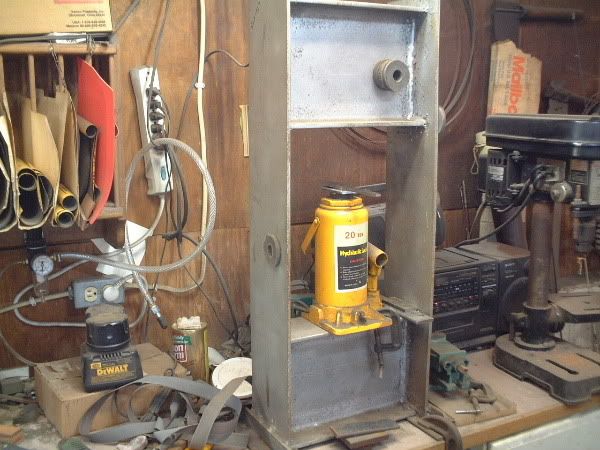
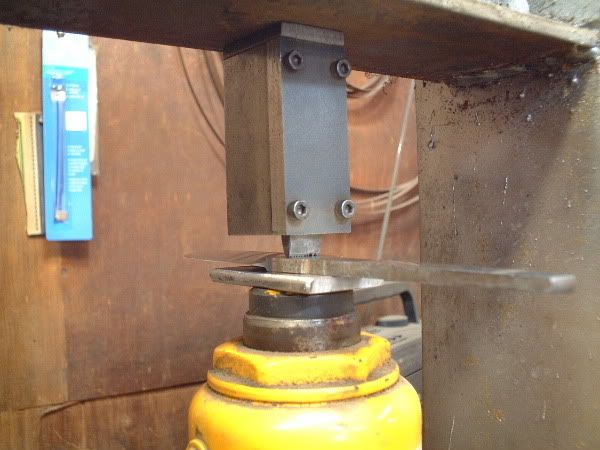
I dont know about hot stamping but you'll never get an nice even stamp with a hammer. I'll go take a pic of my press in a few minutes and post it here. Since I built it I get nice even impressions. I find I also have much more control over where the stamp goes also.
 
I dont know about hot stamping but you'll never get an nice even stamp with a hammer. I'll go take a pic of my press in a few minutes and post it here. Since I built it I get nice even impressions. I find I also have much more control over where the stamp goes also.

Thanks Darrin. I got the stamp from Buckeye, you mentioned them and they did a great job on the stamp, thanks! I bet I need a jig. I can't even write well, lol.
 
I think you need a bigger hammer if using without a press. I use a 3 lb hammer on annealed 52100 and it marks well and marks deep. Now it does displace some material and occassionally you will have to restraighten the blank. Give it a good whack!.....one only.
 
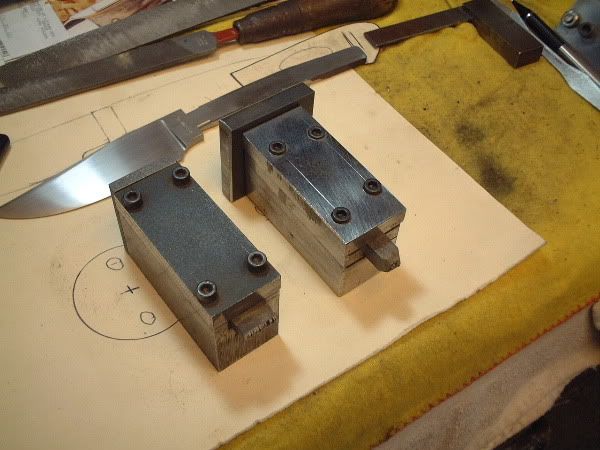
I threw together some tooling to help that may work for you.
I milled out a couple slots in a block of steel to hold the stamps and press them in:
stamp3.jpg


stamp5.jpg


stamp6.jpg


stamps-1.jpg
 
Your stamp will start to mushroom if you hit cold steel with it when hammering, and after a few times it will become ruined. I learned that the hard way with an Evers stamp back in the beginning in the 1980's.

Do your stamping when you are alert, calm and in no hurry. Lay the blade blank flat on an anvil that is flat and even. Using a torch heat the spot on the knife blank to a dull cherry red, then moderately strike the stamp and the result should be a good sharp impression into the steel.

Before striking the stamp be sure that it rests evenly on your work. Practice a few times, and like riding a bike you will not forget.

Stamping each blank takes less than a minute, and with care your stamp will last many years.
 
I think you need a bigger hammer if using without a press. I use a 3 lb hammer on annealed 52100 and it marks well and marks deep. Now it does displace some material and occassionally you will have to restraighten the blank. Give it a good whack!.....one only.

I have a bigger hammer, I'll try that on some mild steel and see what it does. Thanks!

I threw together some tooling to help that may work for you.
I milled out a couple slots in a block of steel to hold the stamps and press them in:


I will try that if it comes down to it. Thanks for the great photos! I have never tapped anything so I was hoping to hold off on building a fixture but I will do whatever it takes to get this right.

Your stamp will start to mushroom if you hit cold steel with it when hammering, and after a few times it will become ruined. I learned that the hard way with an Evers stamp back in the beginning in the 1980's.

Do your stamping when you are alert, calm and in no hurry. Lay the blade blank flat on an anvil that is flat and even. Using a torch heat the spot on the knife blank to a dull cherry red, then moderately strike the stamp and the result should be a good sharp impression into the steel.

Before striking the stamp be sure that it rests evenly on your work. Practice a few times, and like riding a bike you will not forget.

Stamping each blank takes less than a minute, and with care your stamp will last many years.

I'll try getting it hotter, I used a hand held torch but was casual about the effort, next time cherry red. I wish the stamp company mentioned stuff like this.

The anvil thing gets me thinking, I was trying to do this on a heavy duty workbench, I must need something 100% solid. I bet that was the problem. I stamped up a big bar of mild steel and they were decent, it must have been more stable than the knife because it was bigger. Thanks!


Thank you everyone for the help!

Now I need to go tell my wife I need an anvil, tap and die set, mill, welder and a few other things I can't think of yet. ;) :D
 
Oh yeah, Daniel... a workbench won't cut it... I can't even stamp my leather on a workbench without a granite slab.

I found that you don't need it to be red hot. Just heat it to when all the tempering colours fade away to that flat grey(probably 900-1000F. I find I get even better stamps than when red. It is scary at first... practice on heated mild steel... but my stamping improved once I stopped thinking about it and trusted myself to do it in one fluid motion. When you are thinking "keep it straight, line it up, hit it even, hit it hard enough, don't miss, etc..." you lose that instinctive hand-eye coordination. Do you still think as hard about grindlines?

"It ain't no thing but a chicken wing."

Rick
 
Oh yeah, Daniel... a workbench won't cut it... I can't even stamp my leather on a workbench without a granite slab.

I found that you don't need it to be red hot. Just heat it to when all the tempering colours fade away to that flat grey(probably 900-1000F. I find I get even better stamps than when red. It is scary at first... practice on heated mild steel... but my stamping improved once I stopped thinking about it and trusted myself to do it in one fluid motion. When you are thinking "keep it straight, line it up, hit it even, hit it hard enough, don't miss, etc..." you lose that instinctive hand-eye coordination. Do you still think as hard about grindlines?

"It ain't no thing but a chicken wing."

Rick

Those thoughts ran through my head as I tried stamping last night, I was getting tense for a while there, lol. I never get anything done that way!

I now know I need a better backing, I'm going to try to figure that out and get back on it.

Thanks!
 
Aw heck, Dan

You don't need to build anything. Just back your car up to the wall, stick a jack in the space, insert knife and jack away. Alright, just kidding! My opinion is you will rarely get a perfect stamp, few makers do unless they go Karl's way, which I've been intending to do for some time.

Dave
 
I stamp with an anvil for backing. I stamp cold with an Evers stamp and have used it for about 400 knives and no mushrooming at all.
 
I have a piece of railroad and a grinder, lol. I might go to the scrapyard and look around also. I've been needing some 2" pipe for a tuyere and maybe they will have it also.
 
That Riverside Stampmaster looks like a 1/2 or 1 ton arbor press. I'm using a 1 ton cold on stainless. I've only stamped a dozen, but no failures yet.

Edited to report that I have had several issues after the original post and have moved to a 12 ton press
 
Last edited:
Cement floor?.... at least the blade would fly far when you miss and catapult it away..... lol.


Rixk

You laugh, but... That sucker will fly if you hit it just right! Had to go searching under the tool benches for 10 minutes to find one once. I'm about tired of stamping :)
 
Dave been there... had to dump a bucket of water behind my bench when a hot blade flew and slid between it and the wall. Since then, I afford no blade a hiding spot.


Rick
 
Back
Top