Blade choils. Please make me get it.. (and please read my whole post.)

Joined
Jul 24, 2007
Messages
3,285
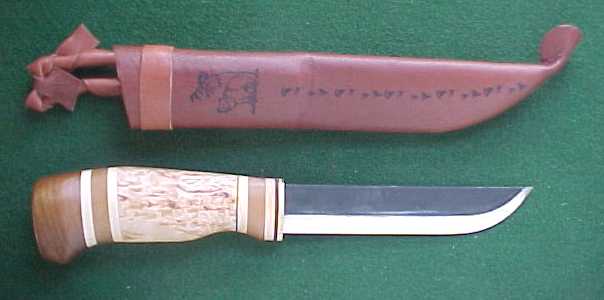
On many bigger, bowie style knives you have an, often quite big, part of the edge missing near the handle, commonly referred to as a choil. I don't quite understand the purpose of this. I'm from Scandinavia and on Scandinavian knives, you rarely ever see any "choils" on knives at all. IMO, all you're doing is removing the part of the edge, where you get the most power for cutting. People usually come up with two reasons for this:

1.) First is the idea that you can use the choil to "choke up" on the blade to get closer to the edge. It's just that while you do that, you need to keep the "guard" of the knife between your middle and index finger, which often can be pretty uncomfortable, since the guard is prying your fingers apart. This problem can be solved if you have a fairly thin, moderate guard, which doesn't take much space between the fingers (like on the esee 6 for an examle: http://www3.telus.net/tejones/ESEE6_AR.jpg). It's just that, in that case your hand is very close to the blade in a regular grip as it is, meaning that there wouldn't have been any real need to choke up on the blade in the first place, had the edge gone all the way down to the handle. Now I'm not even mentioning the fact that being forced to move your grip up onto the blade compromises ergos and seems also fairly impossible to do if you have a double guard on the knife (which is common on Bowie knives).


2.) Another common answer is that if the edge goes all the way down to the handle, it becomes hard to sharpen that part of the edge and therefore you facilitate sharpening by removing that part of the edge and putting a choil there. That sounds to me a little bit like killing the patient to cure the disease. If you don't like sharpening the edge all the way down to the handle, you can just leave the bottom part of the edge unsharpened. Nothing will get better from removing it all together.

Is there anything I'm missing here? Are there any other benefits or special purposes/uses of the choil that I'm unaware of or anything that I've misunderstood completely? If you guys know of any, I'm very interested in hearing about them. Apart from the idea of "parrying or disarming" with the choil, which I certainly have no interest in, I haven't heard of any others. I'm very curious, because I have recently acquired a Scrapyard Knife Company 711, wich I absolutely love and it'd be great if I could find a good use on the big fat choil which is on it.
 
Last edited:
Only reasons I ever think of -

1. a way of getting reach + tip control (they may or may not also use a pinch grip or scalpel grip which helps with knives that have a choil and those that don't). Alternative to a lengthened handle and edge that comes right down to the handle.

2. way of giving you more real estate on short handled folders, sub 4 1/2" for me personally is short. Spyderco Native for example would be very strange in the hand without it's choil and in response need to be enlarged.
 
It also changes the balance of the knife in the hand. On some knives it makes a pretty good difference in comfort and controllability while still leaving you a nicely forward weighted blade for chopping when you move back on the handle. Basically just gives you more options on how to hold and use a particular blade. Of course there's no free lunch, so you give up some things to gain others. Personal preference.

I don't usually care much for the flat, squared off choils on the Scrapyard knives compared to the rounder ones on the equivalent SwampRats, say the RMD vs. the 511 or DogFather vs. the BattleRat. The Swampers are much more comfortable to use IMO.
 
the answer depends on whether your talking about fixed blades or folders. I'll do my best to show my reasoning for both.

1A. Fixed Blades

No idea, All of my fixed blades have an edge all the way to the grip, I guess if the blade is larger you might be able to get more tip control for a more precise cut, but by allowing for a choil it'll take away one of the most heavily controlled cutting surfaces which is problematic for high pressure, controlled cuts.

1B. Small choils are used for this not necessarily finger choils. I find that if you use a circular motion when sharpening on a stone it will sharpening the bottom edge near the kick, however I cant keep a steady hand this way and the angle varies too much for my liking so I use straight line sharpening pulls. this leaves a section that doesn't get sharpened and after lots of usage, the blade will slowly become recurved, a feature not many are fond of. Because of this, most find it aesthetically pleasing to take that little bit out and keep the sharpened edge, retaining the original lines as it were.

2A. Folders

Because there is a pivot pin, most makers will beef up/retain the lines of that area and most of the time designers put the blade near to the pivot area, but under the retaining handle scales, because of this increased mass cutting in this area with regards to "grippy/rigid" materials makes it nigh impossible to use this section of blade. With a choil added, yes you sacrifice cutting surface, but you can now use all of the edge without material binding up underneath the handles. I also found (this specific example is with my JYD with a finger choil pictured below) that because the edge is now naturally farther away from the hand, control decreases, so a finger choil in this spot allows for the gain of that lost control. I hope that makes sense, it doesnt seem worded very well.

2B. ditto 1B
 
Last edited:
I just don't understand them either Doc
In all my years of professional knife use and being raised by trappers/hunters I have never known anyone that even had them on their knives before.
My esee's were my first choiled knives.......and my last. If it were not for their great design, ergo's, grinds and awesome sheath sytems I would have sold them but they have grown on me......despite the hated choil's.
I was so looking forward to the Becker tweener magnum camp figuring that they would not choil a smaller version....SIGH.....how wrong I was. I love the looks and design of the bk-5, perfect for most of my knife usage.....BUT for the choil which is just wasted edge space in the region of the knife that I prefer to start my cuts or carving.

I have said it before on the forums and should make this my sig line

"A KNIFE CHOILED IS A KNIFE SPOILED"
 
From The Knife Glossary- www.agrussell.com...

"Choil

The cut away area between the edge and the tang of a pocket knife blade and between the edge and the guard of a straight knife. The choil may or may not have enough space for a finger, it's true purpose is to allow the edge to be sharpened all the way to the tang in a pocket knife and to the end of the edge in others. Any reference of choil and finger space or choil and handle is improper."

This is a much discussed and debated topic. Many like to have a "finger-choil" because they say it aids in the control of a longer blade because they can "choke up" on the blade. To me, this makes no sense as a handle is much more comfortable to hold onto than bare metal (and thus, gives finer control), and having the edge all the way back to the guard/handle has the same effect as choking up on a "finger-choil" with the added benefit of having a real handle.

The real purpose of a choil is cosmetic. A blade with a small choil can be sharpened all the way to the ricasso without the danger of marring the ricasso with the sharpening media/device. Also, a blade with a small choil looks more professionally crafted than a blade with a small unsharpened/unfinished area near the ricasso. In addition, some manufacturers have a large choil as a design element (Busse) and those knives don't look like knives from that manufacturer without the choil.

While I do own several knives (several Busses) with large "finger choils" that are very visually appealing, if given the choice between a large choil and between 3/4 and 1" more blade, I will take more blade (or a smaller overall package without the choil) every time. I suspect that many people that profess to prefer a choil for choking up, actually prefer the large choil for asthetic reasons and are repeating the "choking up" mantra they have learned from others.
 
On many bigger, bowie style knives you have an, often quite big, part of the edge missing near the handle, commonly referred to as a choil. I don't quite understand the purpose of this. I'm from Scandinavia and on Scandinavian knives, you rarely ever see any "choils" on knives at all. IMO, all you're doing is removing the part of the edge, where you get the most power for cutting.

Are there any traditional Scandinavian knives as big as a Bowie? Bowies have plenty of edge length, I don't think the choil brings it below optimal functional edge length. Designed as a fighting knife the length to the tip is important and the choil does not diminish this while bringing a little versatility in usage. Seems like a good idea to me. If I was an old time frontiersman and it was the only knife I carried it would seem like a great idea.
 
I am completely clueless as to why knives are made with massive choils. They reduce the cutting edge and the strength of the knife to very barely do something a properly shaped tang and handle would accomplish.

MountainBilly - http://en.wikipedia.org/wiki/Sami_knife

machetes, cane knives, etc also don't often have choils
 
I've both gripped the spine of the blade and used the choil on fixed blades. On a long blade I like it. On a short blade I don't.
 
I personally see finger choils as wasted space where more cutting edge could be, especially on folders.

On fixed blades, it's the same story, I've never had a need for anything more than a very small sharpening choil, I have added a sharpening choil to two blades with a dremel and thin cutting disc.
 
On large bowie sized knives I personally love a good finger sized choil.

Part of the reason is for aesthetic visual appeal, but also because generally I honestly find it to be MORE comfortable and ergonomic in most cases. As well as ease of propper sharpening.

Now, maybe someone could post a pic of a "propper" choiless bowie, because I can't think of any off the top of my head.
I mean when talking about waisted space, you look at most of the common readily available bowies out there, and there is typically more wasted space WITHOUT a choil than with one.

...And by this I mean take a look at the ESEE Junglas for instance, as is, when you hold it there is quite a bit of space from where your finger ends to where the useable cutting edge begins. There is the guard area, the ricasso area, and the dificult to sharpen beginning of the edge.
You have all that wasted space which makes it harder to get close to the edge for finer work... So with mine I chose to turn the unused ricasso into a useable finger sized choil, this resulted in losing maybe 1/8" of edge, that was basically unusable before anyway, and now allows me to yes "choke up" on the blade so that the edge is right there next to my finger.
No more wasted space.
It is now more versital to use.
It feels great in my hand.
It's easier to sharpen.
And it looks much better, IMO.


Edit.... As far as smaller knives, I don't need any more than the smallest of choils for ease of sharpening, and to provide a more finished look. -That being said, I think I only have maybe one smaller knife out of my whole collection that has an actual finger sized choil. ...so I guess I didn't know they were that common??


.
 
Last edited:
I hoped someone would make a topic about it. :D I don't like them. They make a blade look long at the cost of cutting edge length.
 
I was going to make a post similar to this, but no need now. To me choils take away the piece of blade that I use the most, and the piece of blade that you can have the most control over. There are several knives at the minute that I would love, but the choil keeps me from buying them.
 
Are there any traditional Scandinavian knives as big as a Bowie? Bowies have plenty of edge length, I don't think the choil brings it below optimal functional edge length. Designed as a fighting knife the length to the tip is important and the choil does not diminish this while bringing a little versatility in usage. Seems like a good idea to me. If I was an old time frontiersman and it was the only knife I carried it would seem like a great idea.

Leukus are the scandi version of the bowie. Essentially a big puukko. But the top priority for these knives is working wood, it's not a fighting knife. The first inch or two next to where you are gripping is where you have the most control and power in wood cutting (not chopping), and you tend to apply a lot more force than in most other kinds of cutting. It is far preferable to have a full-width handle to grip here, and not a thin flat steel choil. The same goes for the reverse/chest-lever grip, and some choil shapes almost prevent this grip entirely.

The logical reason for choils on fixed blades is to extend the OAL while maintaining cutting edge length. I think I'd rather have an extended handle that allowed you to grip farther back, versus a choil as the only option to grip up close. The up-close grip is much more useful to me than the "fighting" grip.

I do like well thought out choils on folders, however. The handles are already thin, so gripping the steel is not a big deal. It is also a nice safety feature to keep the blade from ever closing on your fingers. But the choil should be subtle. The PM2 is a great example of a well done choil (except for over-use of jimping).
 
the answer depends on whether your talking about fixed blades or folders. I'll do my best to show my reasoning for both.

1A. Fixed Blades

No idea, All of my fixed blades have an edge all the way to the grip, I guess if the blade is larger you might be able to get more tip control for a more precise cut, but by allowing for a choil it'll take away one of the most heavily controlled cutting surfaces which is problematic for high pressure, controlled cuts.

1B. Small choils are used for this not necessarily finger choils. I find that if you use a circular motion when sharpening on a stone it will sharpening the bottom edge near the kick, however I cant keep a steady hand this way and the angle varies too much for my liking so I use straight line sharpening pulls. this leaves a section that doesn't get sharpened and after lots of usage, the blade will slowly become recurved, a feature not many are fond of. Because of this, most find it aesthetically pleasing to take that little bit out and keep the sharpened edge, retaining the original lines as it were.

2A. Folders

Because there is a pivot pin, most makers will beef up/retain the lines of that area and most of the time designers put the blade near to the pivot area, but under the retaining handle scales, because of this increased mass cutting in this area with regards to "grippy/rigid" materials makes it nigh impossible to use this section of blade. With a choil added, yes you sacrifice cutting surface, but you can now use all of the edge without material binding up underneath the handles. I also found (this specific example is with my JYD with a finger choil pictured below) that because the edge is now naturally farther away from the hand, control decreases, so a finger choil in this spot allows for the gain of that lost control. I hope that makes sense, it doesnt seem worded very well.

2B. ditto 1B

Yeah, I was talking about fixed blades, that's why I wanted you to read my whole post :-). On folders I'm fully aware of the function, one of the many reasons I love Spyderco folders. And yes, after reading this thread I can imagine the increased difficulty of sharpening, unless you use something like the Spyderco Sharpmaker. I also do appreciate the aesthetic properties of the choil, it does indeed look cool.
Thanks for the replies everyone.
 
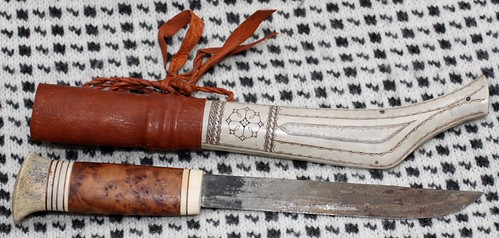
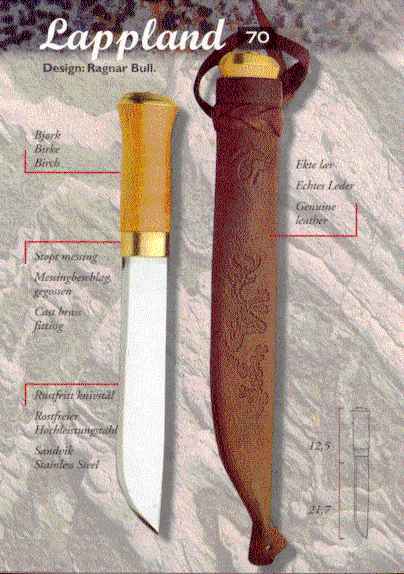
Are there any traditional Scandinavian knives as big as a Bowie? Bowies have plenty of edge length, I don't think the choil brings it below optimal functional edge length. Designed as a fighting knife the length to the tip is important and the choil does not diminish this while bringing a little versatility in usage. Seems like a good idea to me. If I was an old time frontiersman and it was the only knife I carried it would seem like a great idea.

Here are a couple of bigger Lappi knives:

0.jpg

5158764377_dd19413bda.jpg

lappland.jpg

comp.jpg

xl_p_080107140751.jpg

wj-eb.jpg
 
First off, the Spyderco Paramilitary 2 does NOT have a "choil" at all. It has a finger-groove in the ricasso ahead of the handle, with the blade ground back so far from the edge of the ricasso that it forms a guard for the finger-groove - among the ugliest designs I've encountered, I just don't get the point and am very glad I chose the BM745 Mini Dejavoo (for more reasons than just that). But that is another thread.

Second, hasn't this topic been done to death?


Regarding large finger-sized choils on large bowie-style knives:

1) The SRKW RatManDu is among the most comfortable knives I've ever handled, certainly the most comfortable at that size, largely due to that finger-groove choil. No, there is no "mantra" associated with this, and I really don't see how a large choil makes a knife look any "cooler" than one with a small choil. The finger-groove does indeed turn this single knife into two knives, both with exactly the ergonomics I desire and able to be used with or without gloves - a longer reaching bowie knife with forward-weighted blade and also a choil-less mid-sized hunting knife with perfect balance. The choil doesn't remove ANY useful edge-space, it instead increases the reach of a smaller knife. Without that finger-groove, the balance would be off on the choked grip and also there would be a guard and fat-handle between my hand and the material being cut - I like that tactility with edge close to my finger, there is no concern of my finger sliding onto the edge (unlike many Scandinavian knives or choking-up on knives with an enlarged ricasso but no groove, e.g. Cattaraugus 225Q), and I find the grip perfectly comfortable for my finger as the pressure is really being exerted on my thumb (which wouldn't change if the blade reached to the handle). I don't find myself commonly employing the reverse-grip another poster mentioned as I find that method more awkward, less energy-efficient, and less easily controlled, but to each his own.

Now, if your large knife has a double guard or overly-wide guard such that the ergonomics are shot, I assume the over-sized choil is for twisting an opponents blade or for a "trigger-finger" grip or something like that, not for delicate carving or whittling - you carry a different tool for that.

2) As a sharpening aid (the original purpose of the choil as far as I know), the choil provides an amazing advantage where the blade does not extend beyond the ricasso (e.g. Scrapivore, Busse Hog Muk). For those where the blade comes down to the handle/ricasso, choil-less knives leave an unsharpened portion which is both useless and ugly - by removing it you improve long-term sharpening uniformity (e.g. check out the recurve on old Buck 110s), you can actually provide a little bit more edge to work with, and you give the knife an aesthetically pleasing appearance which endures through many sharpenings.

My $0.02
 
Beeing a scandinavian and finnish knives user myself I can tell I've only seen ricassos and/or tiny unsharpened section just before the cutting edge, mostly on swedish, danish and norvegian blades. Personally I'm fine both with or without ricassos, if not too large, but I don't like choils or ever felt the need of.

Leukus are used for anything from raw carving to medium chopping to skinning. The blade portion near the handle is the carving one. To carve efficiently and have the greatest controll blade and handle should be about the same width.
Leukus were born during early middle age and at that time usefulness was the first thing on tools, experience and practice would have been the guard. Same now, but knives has moved a bit aside from that.

By the way choils on bowies were added by Sheffied (England) craftmen after the increasing of request of "bowie knives" from the States following the fame of Bowie brothers. So the current bowie style was created in England around 1830s-1840s and american smiths followed the trail.

Among my memories the very first blade "heels" that could remember actual bowie choils were from few saxon seax blades found in mounds. Those weren't choils anyway, just larger heels that served like guards.
This feature was also rather common on butcher knives and american long hunters in the 1800s.
 
Choils: on some knives I don't mind 'em and on others, not so much. I can certainly appreciate why some might not like them at all, though.

I like 'em on non-locking folders for the added bit o' security (fantastic on friction-folders and Spyderco SLIPITS) and I can see how they'd be handy on very large choppers for a little more control/versatility.

I don't think something like my ESEE 4 really needed one but it's pretty unobtrusive, imo...
 
I agree. Only thing I can think of is if you wanted a mini knife, and lose a bit of blade so you can have more handle, allowing a more compact shape when folded.
 
Back
Top