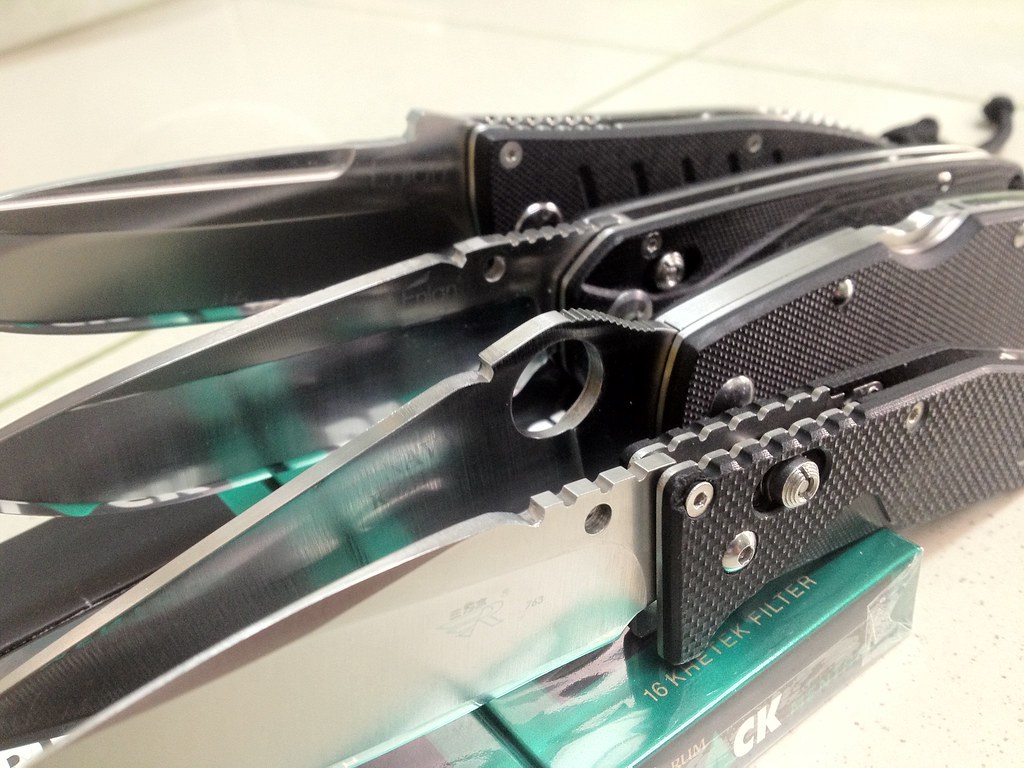
Blade choils. Please make me get it.. (and please read my whole post.)

I think that in order to answer this question you need to look at historical examples and consider them individually, in their original context. The recessed ricasso first appears in common use on swords, during the period when complex guards came into widespread use. In that case it was to facilitate wrapping the index finger over the quillon, which is illustrated and referenced in fencing manuals of the time. This style of grip is uncomfortable when the finger has to stretch around a wide blade in doing so. This is also the period when the true ricasso came into widespread use, and probably for the same reason, it is uncomfortable at best to wrap your finger around a sharpened edge. Before this period, a knife, dagger, or sword blade with thickened edges or a narrowed section just in front of the hilt is conspicously atypical, if you can find any examples at all.
Why these features were carried over to later styles of blades is a topic worthy of research, but mostly subject to speculation since that takes less work. No doubt these features have been added to some designs for some percieved purpose, on others I suspect it is more a product of tradition, personal preference, and " monkey see, monkey do".
 
As with everything, there are all kinds of varying opinions on choils. Right off the bat I'll let you know that I love having a small sharpening choil or at least recessed area at the base of a blade to facilitate easy sharpening. I really appreciate blade designs like these, because to me, that little tiny notch at the base of the blade doesn't have any adverse effects whatsoever.

http://img339.imageshack.us/img339/5651/dscf0234w.jpg

http://img371.imageshack.us/img371/9724/skyline014ae2.jpg

Now, you've said that there is no disadvantage to knives that do not have choils. For those of us who sharpen with benchstones, the little ridge at the base of the edge can be a substantial pain in the balls when it knocks the corners off your benchstones. This really sucks if you use expensive benchstones and end up gouging them all to hell for the sake of one of your knives. Hell it sucks if you use cheap benchstones, too. On knives that have this, I've taken to carving my own little sharpening choil into the blade. Again, this probably won't be an issue for people who use other sharpening methods (diamond stones, ceramics, sandpaper, fancy sharpening systems, whatever), and will probably be less of an issue for folks who aren't picky about their edges. Pictured: a pain in the balls to sharpen.

http://customtacticals.com/wp-content/uploads/2008/03/spyderco_black_ed_03.jpg

Now, I agree with you where you say that the 'finger choil' type choils are pointless. I'm mostly neutral towards them, but I honestly don't find that they lend anything positive to a knife's function. Much as I love these two knives, the Manix 2 and the Para 2 both have a big ol' finger choil with no sharpening choil - IMHO the very worst of both 'choil' styles.

http://paulberetta.com/manix2s/images/manix2_19.jpg


So yeah, in a nutshell: I love to have a small (1/8"-1/4" diameter) sharpening choil of some kind on my knives. I don't like finger choils, but they don't bother me much either.

It seems we're making a difference between a choil and a finger groove here now, so I guess I'll do the same. :)

Yeah, personally I'm actually all for the 50/50 finger groove of the Spyderco Manix2 and Para2, when it comes to folders. The reason is that I prefer to have space for a kick between the edge and my index finger, so that I can safely catch the blade on my finger while closing the knife + as a minor extra safety in case the lock were ever to fail on me during use. If I have that, I might as well make it into a 50/50 finger groove, because it really doesn't cost me that much additional edge length anyway (at most a few millimeters) and it is of course usable for "choking up" if I want that. I'm a bit more sceptic to a finger groove on a fixed blade, for the reasons I mentioned before.

I realize that a choil can facilitate sharpening if you don't have a Spyderco Sharpmaker or similar tool at hand. I don't really have anything against a smaller sharpening choil, except possibly for the fact that it sometimes can hook onto the material that you're cutting, when you're cutting through cloth or plastic sheet material that hangs freely.
 
Last edited:
It seems we're making a difference between a choil and a finger groove here now, so I guess I'll do the same. :)

Yeah, personally I'm actually all for the 50/50 finger groove of the Spyderco Manix2 and Para2, when it comes to folders. The reason is that I prefer to have space for a kick between the edge and my index finger, so that I can safely catch the blade on my finger while closing the knife + as a minor extra safety in case the lock were ever to fail on me during use. If I have that, I might as well make it into a 50/50 finger groove, because it really doesn't cost me that much additional edge length anyway (at most a few millimeters) and it is of course usable for "choking up" if I want that. I'm a bit more sceptic to a finger groove on a fixed blade, for the reasons I mentioned before.

I realize that a choil can facilitate sharpening if you don't have a Spyderco Sharpmaker or similar tool at hand. I don't really have anything against a smaller sharpening choil, except possibly for the fact that it sometimes can hook onto the material that you're cutting, when you're cutting through cloth or plastic sheet material that hangs freely.
The distinction between a choil and a finger-groove is that a "choil" is located immediately below the heel of the blade edge, i.e. precisely where the edge ceases to be sharpened, and this is commonly indented or recessed from the edge just above the "ricasso" which is the unsharpened portion (usually stock-thickness) ahead of the guard and handle. A "finger-groove" is simply a groove of appropriate size & placement so as to accommodate a finger - it can be located almost anywhere.
To my eyes, the Spyderco Manix2 and PM2 feature finger-grooves in the ricasso, along with a guard integral to the ricasso, and neither sports a "choil" proper. Do others see differently?

As to choils hooking on loose material, I've never had this happen but can point to examples of poorly-designed vs well-designed choils. Poor design: BRKT Bravo 1 or Kershaw 1745 - the choil is indented perpendicular to the edge of the blade. Good design: Benchmade 740 & 745 - the choil is indented at angle such that material falling into the choil will simply slide out onto the blade edge. :thumbup: Also good design: finger-choil - user's finger occupies the choil and does not provide a place for material to hang up.
 
I dont like choils, and most of them are too big!!!Finger choils on folders just take away too much of a cutting edge ...........wish spydercos finger choils were smaller or non existant!
 
The distinction between a choil and a finger-groove is that a "choil" is located immediately below the heel of the blade edge, i.e. precisely where the edge ceases to be sharpened, and this is commonly indented or recessed from the edge just above the "ricasso" which is the unsharpened portion (usually stock-thickness) ahead of the guard and handle. A "finger-groove" is simply a groove of appropriate size & placement so as to accommodate a finger - it can be located almost anywhere.
To my eyes, the Spyderco Manix2 and PM2 feature finger-grooves in the ricasso, along with a guard integral to the ricasso, and neither sports a "choil" proper. Do others see differently?
I really don't think anyone sees it differently.


As to choils hooking on loose material, I've never had this happen but can point to examples of poorly-designed vs well-designed choils. Poor design: BRKT Bravo 1 or Kershaw 1745 - the choil is indented perpendicular to the edge of the blade. Good design: Benchmade 740 & 745 - the choil is indented at angle such that material falling into the choil will simply slide out onto the blade edge. :thumbup: Also good design: finger-choil - user's finger occupies the choil and does not provide a place for material to hang up.
Yeah, that seems like it would help to some extent. It's usually not a big problem though.
 
To my eyes, the Spyderco Manix2 and PM2 feature finger-grooves in the ricasso, along with a guard integral to the ricasso, and neither sports a "choil" proper. Do others see differently?
Anyone discussing Spyderco knives like the Paramilitary, Manix, Native, Dragonfly, etc. will be referring to the finger cutout as the 'finger choil'. Particulalrly since that is how Spyderco design staff refers to the feature. To me, as long as it occurs ahead of a full handle and in the ricasso area, the curved indentation is choil-like enough for the moniker, but this has been contended many times before. At least for the one brand, 'finger choil' has received enough adoption that it is commonly seen. In both instances, it is an area that could be sharpened or could not be indented without having to alter the handle to do so. I would like to turn my PM2 choil into a true choil by grinding away about 10mm and increasing the length of the edge.

I should also mention that knives like Striders also have the cutouts referred to as choils at times.
 
Last edited:
... that is how Spyderco design staff refers to the feature. To me, as long as it occurs ahead of a full handle and in the ricasso area, the curved indentation is choil-like enough for the moniker, but this has been contended many times before. At least for the one brand, 'finger choil' has received enough adoption that it is commonly seen. In both instances, it is an area that could be sharpened or could not be indented without having to alter the handle to do so. I would like to turn my PM2 choil into a true choil by grinding away about 10mm and increasing the length of the edge.

I should also mention that knives like Striders also have the cutouts referred to as choils at times.
What bugs me about the Spyderco design is that the sharpening advantage of an actual choil, ostensibly the original intent, is lost entirely. On Striders, at least those I've seen, there is a true choil as well as a finger-groove in the ricasso beneath. And while individuals may certainly use the term to designate a feature, that doesn't make their use (or that of their followers) accurate or correct, and the confusion builds so that people will then criticize "choils" from experience with a knife that actually sports a different design entirely. Maybe a distinction should be made between "blade-choil" (at base of blade) and "handle-choil" (within or beneath ricasso)? This same issue commonly occurs with the term "full tang". Alas.


I would like to see that modified PM2. :thumbup:
 
I like a choil, but only a tiny one. For me it is purely functional, so that I can sharpen the full length of the edge. By small choil, I mean something like less than 1/4 inch. I still want to maximize as much edge real estate as possible while still having a tiny choil. It's just my preference.
 
I have tried to like them because there are some knives that are otherwise very good for their use. I just don't like choils so will be selling off most of my knives that have them. I guess I just don't get it either. If I have to choke up on a knife, it is the wrong one for the job.
 
This discussion of choils is a little confused, but that is OK.

Considering the choil as a nick at the proximal end of the blade, I find them nothing more than an inconvenience and a stress raiser that will insure future replacement sales when the blade breaks.

I find the dropped edge one of the greatest foes of a truly functional blade.

I would ask "Why does a knife have to be sharpened to the exact proximal end of the blade? I rarely cut there and when looking at old well used knives never see one that is worn out from use near the handle, most of the cutting is done with the front third of the blade.
 
Considering the choil as a nick at the proximal end of the blade, I find them nothing more than an inconvenience and a stress raiser that will insure future replacement sales when the blade breaks.

I find the dropped edge one of the greatest foes of a truly functional blade.

How many blades exactly have you or your customers had THAT problem with? :eek: :confused:
 
I find the dropped edge one of the greatest foes of a truly functional blade.

I would ask "Why does a knife have to be sharpened to the exact proximal end of the blade? I rarely cut there and when looking at old well used knives never see one that is worn out from use near the handle, most of the cutting is done with the front third of the blade.

I really, really, really gotta disagree with you there. I won't say the opposite either because those will both be general statements. I use the portion of the blade near the heel much more than anywhere else when (kitchen) chopping, paring, carving, anywhere I want really good control, and that's most of the time for me. I would prefer no return on almost all my knives. Not necessarily having to do with choils, but i like to have the heel of the blade useful all the way to the end. Choils are one way to do this, but I prefer a dropped heel with no return instead.
 
Last edited:
Dorito: We test a lot of knives to destruction, both factory and custom. Blades with the nick for a choil always break with the fracture starting at the nick. These are tests for lateral strength, some of them requiring force that could only be measured using an inch-pound torque wrench. When testing our blades, we can cut a shallow nick in the blade and without exception always predict where the break will start. Vertical stress will usually be much greater, but the nick is still where the fracture starts. Even a vertical scratch in a blade can be a stress raiser. When you find used folders with the blade broken it is usually where the nick was. Naturally many break at the tip also, but there is a lot more force at the tip when being used hard. My discussion is aimed at times when force is applied to the entire blade, not just the tip.

Take a look at hobbyist wood carving knives, none of the good ones will have a nick at the proximal end of the blade, I believe this is the reason why.

uyog: I am not suggesting a distance much greater than 1/32nd of an inch, hand sharpening I can easily avoid digging into the side of my stone. The knife community is one of freedom and we can chose what we like, this is how it should be.

It is too bad we cannot be having this discussion with a blackboard for examples, I have never been able to figure out how to do it with my computer in conjunction with the forms.
 
uyog: I am not suggesting a distance much greater than 1/32nd of an inch, hand sharpening I can easily avoid digging into the side of my stone. The knife community is one of freedom and we can chose what we like, this is how it should be.

It is too bad we cannot be having this discussion with a blackboard for examples, I have never been able to figure out how to do it with my computer in conjunction with the forms.

Sorry, I was mobile earlier and didn't really type out everything I wanted as clearly as I could... I agree with you that there isn't much need to sharpen all the way to the return on knives. Honestly, what are you planning to cut with that tiny unsharpened 1-1/32" of the edge? Whatever you're cutting can just roll onto the sharpened edge instead. But this argument is only relevant to no-choil knives that have a return, i.e., that have a bolster at the end of the heel rather than an edge. I think this is where the argument of sharpening and usage of a choil vs. a no-choil knife becomes too ambiguous. If the knife has no choil, does the heel end with blade?
detail_2210_4996_20_Kopie.jpg


Or does the heel end with the bolster?
detail_2145_4582_23_Kopie.jpg


It goes back to what I said earlier about how one shouldn't consider a knife with a choil as a "lesser" version of its no-choil version. It doesn't have less cutting edge. It's a different knife altogether, as there are variables that make that comparison unfair. That first knife up there doesn't technically have a choil, but it has the advantage of sharpening of a choiled knife as well as the disadvantage of getting snagged on something.

Anyway, I was rather contending to the claim that most people cut with the front third of the blade. I do that when I want to chop wildly with a long blade, but that's less than 1% of all the cutting I get to do. I'm always using the heel rather than the tip.
 
Dorito: We test a lot of knives to destruction, both factory and custom. Blades with the nick for a choil always break with the fracture starting at the nick. These are tests for lateral strength, some of them requiring force that could only be measured using an inch-pound torque wrench. When testing our blades, we can cut a shallow nick in the blade and without exception always predict where the break will start. Vertical stress will usually be much greater, but the nick is still where the fracture starts. Even a vertical scratch in a blade can be a stress raiser. When you find used folders with the blade broken it is usually where the nick was. Naturally many break at the tip also, but there is a lot more force at the tip when being used hard. My discussion is aimed at times when force is applied to the entire blade, not just the tip.

So, the main point I took away from that is that if you are TRYING to break your knife, you will succeed. I would suggest that if folks don't go full-retard with their knives, they would likely experience very few failures of this type. :p

All silliness aside, it would seem to me that your testing proved that when blades are subjected to extreme lateral forces, they will tend to fail around the tip or the nick. In a real life context, this would indicate that customers would need to apply great lateral forces to their knives (probably through prying, batoning, and other really stupid things that the knives weren't designed for in the first place) to reproduce the conditions seen in your tests. Furthermore, can I infer that when you tested knives that did NOT have choils, you also succeeded in getting some or all of these knives to fail? If so, it would seem to me that the issue isn't so much "Knives with choils break but knives without choils don't" as it is "All knives fail if you beat on them hard enough, but knives with choils happen to fail at or near the choil". In any case, regardless of your testing, we can see from other examples of destruction testing that knives without choils can be made to fail just about as readily as knives with choils. Just look at noss4's destruction tests - regardless of the presence of choils, he managed to break knives.

So, in a nutshell: Yes, knives will fail if you abuse them thoroughly enough (ie: go full retard). Knives with choils or thin tips will fail at the choil or the thin tip. That does not indicate that knives with thin tips or choils are bad, it merely indicates that a determined enough individual can break a knife if he feels like it, and that failures will occur where there happens to be a weaker point.
 
These are tests for lateral strength, some of them requiring force that could only be measured using an inch-pound torque wrench.

All silliness aside, it would seem to me that your testing proved that when blades are subjected to extreme lateral forces, they will tend to fail around the tip or the nick.
Mr. Fowler can clarify if I am incorrect, but he has posted before about testing blades with torque wrenches of the ft-lb variety, so I believe his point is more that the choil'd blades break with such little force that he cannot measure it with the same tools he uses for the other knives. Having to measure forces at 1/12th the level you usually do doesn't seem to be tending to the extreme end of things, unless we mean extremely fragile.
 
Gary you use of knives and mine are entirely different. I don't do much kitchen work, still I can see the knives you pictured are perfect for your needs. I have a family "French Cheff's Knife" that is a cross between the two you have photos of in your post the bolster is integral and protects the wood scales, been in the family since the early 40,s, cut up many turkey, hams and roasts and is a wonderful knife for what it was made for. Most of this knife's history looks to be in the center of the blade.

Dorito: Two similar blades, one with a chiol or nick, the other without were tested, the one with the choil did not make it past 12 degrees of flex before it broke into two pieces, the force was so light the torque wrench did not register and force, the fracture line started at the deepest part of the nick and ran straight up to the spine.

The one I had ground the choil out, reducing the volume of steel in the blade made it to 90 degrees with 10 lbs of torque and did not break on the first bend..

These were cheap factory knives - same model - and due to finances were not a representative sample of their knives, but I feel significant indicators of a stress raiser by design.

Yes any knife will break. Some are much more fragile than others, you can chose the knife that pleases you, just do so with the knowledge of what you are buying. knives with choils have served man for a long time and continue to do so well.

I find it is easier to teach an employee how to sharpen a knife with a choil and will be fewer cosmetic errors than to teach how to sharpen one without a choil.
 
Mr. Fowler,

The one I had ground the choil out, reducing the volume of steel in the blade made it to 90 degrees with 10 lbs of torque and did not break on the first bend..
Does it mean that having 'wave' feature by cutting notch into the blade spine like this:
7075383467_51205d9c2c_b.jpg

will result in early breakage compared to not having the notch? Assumption is lateral stress applied, and no other failures on the steel (micro fracture, factory defect, etc.). Also, it's common knowledge not to use knife for prying, so this is more on the geometry vs force applied discussion. I won't be prying with these knives.

Comparing these to original Emerson wave (and Endura factory wave), it seems that the wave is an 'extra' protrusion against the whole blade design, so that it should not affect the lateral stress handling.

If this is true, it means:
* The blade at the back of my photo above should be the one least affected by being 'waved', as the spine goes on straight, and the 'wave' is a protrusion above the overall blade shape flow
* Bringing down the spine of the rest of the blade to match or almost match (by having large diameter curvature) the deepest part of the notch will help improving blade's limit against lateral stress
* Having a mirror polished blade is stronger against lateral stress based on
Even a vertical scratch in a blade can be a stress raiser.

Are these assumption correct?

It is too bad we cannot be having this discussion with a blackboard for examples, I have never been able to figure out how to do it with my computer in conjunction with the forms
How about taking photo of your notes on the blackboard? It'll be educational for us. ;)

Sorry to be Off Topic, but this understanding helps in the issue on 'sharpening choil' benefit against negative aspect as lateral stress inducer.
 
Last edited:
I lean heavily toward a small sharpening choil on folders, nothing more than 1/8" in diameter. I have knives without them, such as my Delica and Buck Scoutlite, and have added them to knives that didn't have them, such as my Cara Cara and some kitchen knives. I also added one to a large chopper I use a lot. I'm confindent the blade will bend before it breaks at the notch. And, if I may offer my opinion, I think the type of failure described by Ed goes beyond simply the absence or presence of a notch at the base of the blade. In the end, some like choils and some don't, and we have knives to fit both tastes.

Edited to add: I'd look just as suspiciously at the holes in the blades on 3 of the 4 of those knives.
 
Thanks for feedback. Yes the hole would also be the suspect so to speak.

Perhaps the question should be how much the stress inducer factor be with the notch vs without the notch .. ;)
 
Back
Top