Blade choils. Please make me get it.. (and please read my whole post.)

Frederick brings up a good point, Bowie knives were not designed or built with choils or finger cutouts when made for Rezin or Jim Bowie. Theclassic Kabar, the infamous smatchet, the barong, all the trench knives, daggers, and bayonets you're likely to run across, all the knives in the butcher shop, the saughterhouse, the commercial kitchen... choils are going to be hard to find. The knives of combat, the knives used hours a day and sharpened constantly, kinda missing this critical advancement in blade design :p :)
 
I use them because they look better. If you have a 12 inch bowie with a 1.75 inch wide blade, you have a couple of choices. You can either make the handle by the guard and the blade at the guard the same width so you get a nice flow, or not. If you choose to do the first, you can either have a 1 to 1.25 inch wide choil and handle or you can have a handle that is 1.75 inches tall and nobody can use the knife other than Magilla Gorilla. By the way, the knives that we think were made for the Bowie brothers did, in fact have dropped heels.
 
I offer choils as an option. I always make sure the person knows they will lose and inch of cutting edge with an added choil. Threads like this show there is a love/hate relationship with choils.
Scott
 
Here are a couple of bigger Lappi knives:

0.jpg


etc.

The one very obvious thing I see here for choils and choking up on the grip is that they reduce the chance of your finger slipping over the edge.

Come to think of it, there are many no-choil knives like these that don't have something to prevent the fingers from slipping over the edge, such as a guard, heel, or contours in the handle. Of course there are many that do, but for knives like these without much variation in the width throughout the whole steel, this choil is really helpful to have a safe, secure gripping point when choking up. And it's more than just putting your index finger into the choil--think of how chef's hold their knives:
back0.jpg

That's how I use choils sometimes. Just imagine the middle finger in a choil. It lets me get so much more close to the cutting edge and, as you can imagine, is really helpful with indexing to have the edge practically right there where my thumb and index fingertips are.

I'm against the idea that choils "take away from the cutting edge." It's sort of like how we take off corn kernels from its home and call that corn, but if we keep it whole we call it corn on the cob (props to Mitch Hedberg). A knife with a choil is a knife with a choil--it's not a shadow of its "greater," non-choil version.

 
I'm a folder guy and I don't use or like choils at all. I haven't bought several nice folders bc of the choil. I would Much rather have the extra cutting edge instead of a choil.
One of the best examples I can think of is the Spyderco Superleaf. I really liked the knife but the big choil wasted a lot of cutting edge IMO.
 
The one very obvious thing I see here for choils and choking up on the grip is that they reduce the chance of your finger slipping over the edge.

Come to think of it, there are many no-choil knives like these that don't have something to prevent the fingers from slipping over the edge, such as a guard, heel, or contours in the handle. Of course there are many that do, but for knives like these without much variation in the width throughout the whole steel, this choil is really helpful to have a safe, secure gripping point when choking up. And it's more than just putting your index finger into the choil--think of how chef's hold their knives:

That's how I use choils sometimes. Just imagine the middle finger in a choil. It lets me get so much more close to the cutting edge and, as you can imagine, is really helpful with indexing to have the edge practically right there where my thumb and index fingertips are.

I'm against the idea that choils "take away from the cutting edge." It's sort of like how we take off corn kernels from its home and call that corn, but if we keep it whole we call it corn on the cob (props to Mitch Hedberg). A knife with a choil is a knife with a choil--it's not a shadow of its "greater," non-choil version.

There are scandinavian knives with guards. They are made for kids...
 
2.) Another common answer is that if the edge goes all the way down to the handle, it becomes hard to sharpen that part of the edge and therefore you facilitate sharpening by removing that part of the edge and putting a choil there. That sounds to me a little bit like killing the patient to cure the disease. If you don't like sharpening the edge all the way down to the handle, you can just leave the bottom part of the edge unsharpened. Nothing will get better from removing it all together. .

As with everything, there are all kinds of varying opinions on choils. Right off the bat I'll let you know that I love having a small sharpening choil or at least recessed area at the base of a blade to facilitate easy sharpening. I really appreciate blade designs like these, because to me, that little tiny notch at the base of the blade doesn't have any adverse effects whatsoever.

dscf0234w.jpg


skyline014ae2.jpg


Now, you've said that there is no disadvantage to knives that do not have choils. For those of us who sharpen with benchstones, the little ridge at the base of the edge can be a substantial pain in the balls when it knocks the corners off your benchstones. This really sucks if you use expensive benchstones and end up gouging them all to hell for the sake of one of your knives. Hell it sucks if you use cheap benchstones, too. On knives that have this, I've taken to carving my own little sharpening choil into the blade. Again, this probably won't be an issue for people who use other sharpening methods (diamond stones, ceramics, sandpaper, fancy sharpening systems, whatever), and will probably be less of an issue for folks who aren't picky about their edges. Pictured: a pain in the balls to sharpen.

spyderco_black_ed_03.jpg


Now, I agree with you where you say that the 'finger choil' type choils are pointless. I'm mostly neutral towards them, but I honestly don't find that they lend anything positive to a knife's function. Much as I love these two knives, the Manix 2 and the Para 2 both have a big ol' finger choil with no sharpening choil - IMHO the very worst of both 'choil' styles.

manix2_19.jpg


So yeah, in a nutshell: I love to have a small (1/8"-1/4" diameter) sharpening choil of some kind on my knives. I don't like finger choils, but they don't bother me much either.
 
...Bowie knives were not designed or built with choils or finger cutouts when made for Rezin or Jim Bowie. Theclassic Kabar, the infamous smatchet, the barong, all the trench knives, daggers, and bayonets you're likely to run across, all the knives in the butcher shop, the saughterhouse, the commercial kitchen... choils are going to be hard to find. The knives of combat, the knives used hours a day and sharpened constantly, kinda missing this critical advancement in blade design :p :)
Didn't "original" Bowie-knives have a large recessed ricasso above the guard? A recessed ricasso (i.e. an indentation between the heel of the blade and the guard/handle) functions as a choil. Most of the daggers, trench-knives, fighting knives, and even bayonets that I've come across have a rather large ricasso where one could hook a finger above the guard (like my Catt 225Q). But again, looking at images of well-used and repeatedly sharpened knives without a choil separating the blade from the ricasso/handle, a significant recurve develops in the blade and a much LARGER area of edge is left dull and useless. Add a choil or recess that ricasso and the issue does not appear until much much later - that's a pretty big advancement, extending the life of the entire length of your blade.*shrug*

All of the commercial kitchen and slaughter-house knives I've come across have a blade profile in which the blade expands well beyond the belly of the handle and forms a guard much like the finger choil of the RatManDu, and that recession from the blade edge functions just like a choil provided that there isn't a blunt ricasso at the base of the edge. Again, a preference for the Busse Hog Muk and SAR5 blade-style is preferred. I wish I could afford a Hog Muk, but I'm holding out for a similarly patterned Swamp Muk in SR101! (I guy can dream;))
 
For me it really depends on the design and intended use of the knife.
 
...Now, I agree with you where you say that the 'finger choil' type choils are pointless. I'm mostly neutral towards them, but I honestly don't find that they lend anything positive to a knife's function. Much as I love these two knives, the Manix 2 and the Para 2 both have a big ol' finger choil with no sharpening choil - IMHO the very worst of both 'choil' styles.

manix2_19.jpg


So yeah, in a nutshell: I love to have a small (1/8"-1/4" diameter) sharpening choil of some kind on my knives. I don't like finger choils, but they don't bother me much either.
Again, NOT a "choil" in the original sense in regard to knives, that's a finger-groove cut into the ricasso where the ricasso functions as an integral guard. I really don't understand that design and agree that it is the worst style.
 
The one very obvious thing I see here for choils and choking up on the grip is that they reduce the chance of your finger slipping over the edge.

Come to think of it, there are many no-choil knives like these that don't have something to prevent the fingers from slipping over the edge, such as a guard, heel, or contours in the handle. Of course there are many that do, but for knives like these without much variation in the width throughout the whole steel, this choil is really helpful to have a safe, secure gripping point when choking up. And it's more than just putting your index finger into the choil--think of how chef's hold their knives:
back0.jpg

That's how I use choils sometimes. Just imagine the middle finger in a choil. It lets me get so much more close to the cutting edge and, as you can imagine, is really helpful with indexing to have the edge practically right there where my thumb and index fingertips are.

I'm against the idea that choils "take away from the cutting edge." It's sort of like how we take off corn kernels from its home and call that corn, but if we keep it whole we call it corn on the cob (props to Mitch Hedberg). A knife with a choil is a knife with a choil--it's not a shadow of its "greater," non-choil version.

A simple guard will work to prevent your fingers slipping onto the blade. Scandi knives normally don't have a guard because the makers appreciate the extra controlled power you get by gripping as close as possible to the blade. In reality, a small well-done guard doesn't hinder this, but most choils I've used do. The "chef's grip" can be done on a choil-less knife quite easily, especially if the blade is a bit wider than the handle, like a chef's knife.

Of course a choil does not make a knife useless. I think it will be great for low-force, high-precision work like dressing game or food prep, although not necessarily better than a non-choil knife. If you need to cut with a lot of force for a prolonged period (mainly thinking of wood cutting), they get annoying. If you don't do much wood cutting then you probably won't have any issues. I can appreciate the aesthetic value of them on some knives, too. They just seem too ubiquitous on knives over 5" long.
 
I think the Old School choil has faded in it's popularity.


As a case study I give you Bark River's Gameskeeper and Bravo-1.


BRK Gameskeeper


BRK Bravo 1


The Gameskeeper has been a mainstream model in the BR line-up since the beginning,

...with the changes made to that design requested by some Force Recon folks (incl. removing the choil) the the Bravo-1 has become their best selling knife.


I think many of us have little use for the classic choil.


Big Mike
 
Actually I like the way that Spyderco has the "choil" setup, because it is really just a way to let you grip up by the blade. It works because the choil is half in the handle, half on the blade. Compare it to the two Benchmades in an above post. On those you can't grip any closer than maybe 3/8" or 1/2" from the blade (I'm not sure of the scale size). On the Spyderco, you can hold it in a fist grip with your index finger in the choil, and the crotch between your thumb and index finger (where most of the cutting power is applied) rests on the very forward part of the scales. The flesh of your fingers will actually overlap the cutting edge. If it weren't for the jimping on the tops of the liners it would be a nearly ideal 'bushcraft' grip for a folding knife. I could also lose the hump that seperates the choil from the rest of the grip.

On most fixed blades with choils, the choils are bigger and are entirely on the blade, so when you use a fist grip the pressure from your palm goes onto the spine of the blade (that's if a guard or ramp does not prevent this grip entirely).
 
The gameskeeper doesn't have a choil. It has a dropped heal and a monstrous ricasso (like many hammer forged knives- including "bowie knives" made 150+ years ago). The Bravo 1 has what most would call a choil, although I would suggest that it has more of a dropped heal and integral guard.

As a mostly unrelated aside, Ed Fowler makes forged knives with giant ricassos, but intentionally forges them without the dropped heal. It is easier to hammer out a blade with a flat ricasso and a dropped heal than without the dropped heal. However, he feels that a knife performs better without it than with it, so he leaves he heal off...http://www.edfowler.com/index.php?option=com_phocagallery&view=category&id=1&Itemid=73
 
I am completely clueless as to why knives are made with massive choils. They reduce the cutting edge and the strength of the knife to very barely do something a properly shaped tang and handle would accomplish.

MountainBilly - http://en.wikipedia.org/wiki/Sami_knife

machetes, cane knives, etc also don't often have choils

First, it doesn't reduce the strength of the blade. There's actually more steel in that area because it's full thickness where a blade in that area would be beveled and have less steel. Second, I've seen more machetes with that portion of the blade left unsharpened then not. It's not a cutout but the main idea is the same.

To the OP: I generally hate choils but I was using my Scrapyard 711 last night to do some fuzz sticks and I now see the benefit of them. To me it's a matter of weight mostly. A large bowie knife is about a pound or more and blade heavy. On a large heavy knife with a forward center of gravity, being able to choke up is nice. It allows the knife to be used with a neutral balance and fatigues your hand less. It also lets your hand get right up to the edge which is nice. Still not convinced I like it but it's growing on me. On small or light weight knives I'm still convinced they're useless.
 
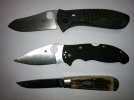
Not everyone will agree with my definitions, but here they are with pictures...

IMG_0309.jpg

1. Large Benchmade Bone Collector- Dropped heal

2. Spyderco Mini Manix- Large ricasso with finger groove.

3. Great Eastern Cutlery #73- Choil

IMG_0310.jpg

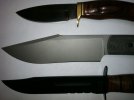
4. Buck Vanguard- Dropped heal, large ricasso, guard

5. Guardless Model 2 by our own LongRifle- Dropped heal, no guard. Except for the slight recurve, this is my ideal large blade.

6. Kabar COmbat Utility knife- No choil.

IMG_0312.jpg

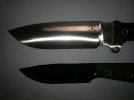
7. Busse Special Forces Natural Outlaw- Large (useless) choil. This knife is inarguably the most collectible of the knives in my accumulation. However, it could be a full 1" shorter- while maintaining the same blade length and handle length- without the choil. The ability to "choke up" would be undiminished as the edge would run right up to the meager guard. It is sexy, however, and defines all of the design elements of Busse Combat.

8. Busse Sar5- Dropped heal, no guard. This defines everything that I want in a knife. Compact package. Blade acts as a guard of sorts. No need to choke up. Stupid sharp. However, this knife was discontinued by Jerry Busse before it was produced (He says their existence is an accident) because they do not "Look" like Busse knives. I bought 2 of these, and they are the last Busse Knives I have bought. Except for the bone collector pictured above, they are the last knives that I have bought.
 
The gameskeeper doesn't have a choil. It has a dropped heal and a monstrous ricasso...


Call it what you like, :eek:

...but the designer (Mike Stewart) says it's designed for choking up on the blade. :rolleyes:


Not everyone will agree with my definitions, but here they are with pictures...


Not sure where you're going with this,

...but I think most of us know what the OP is talking about.


Just sayin'.


Big Mike
 
Last edited:
Didn't "original" Bowie-knives have a large recessed ricasso above the guard? A recessed ricasso (i.e. an indentation between the heel of the blade and the guard/handle) functions as a choil. Most of the daggers, trench-knives, fighting knives, and even bayonets that I've come across have a rather large ricasso where one could hook a finger above the guard (like my Catt 225Q). But again, looking at images of well-used and repeatedly sharpened knives without a choil separating the blade from the ricasso/handle, a significant recurve develops in the blade and a much LARGER area of edge is left dull and useless. Add a choil or recess that ricasso and the issue does not appear until much much later - that's a pretty big advancement, extending the life of the entire length of your blade.*shrug*

All of the commercial kitchen and slaughter-house knives I've come across have a blade profile in which the blade expands well beyond the belly of the handle and forms a guard much like the finger choil of the RatManDu, and that recession from the blade edge functions just like a choil provided that there isn't a blunt ricasso at the base of the edge. Again, a preference for the Busse Hog Muk and SAR5 blade-style is preferred. I wish I could afford a Hog Muk, but I'm holding out for a similarly patterned Swamp Muk in SR101! (I guy can dream;))
The Black Bowie #1 and the Searles Bowies do not have recessed ricassos. The Searles look very much like kitchen knives with an oval guard that does not extend below the cutting edge. The Bowie #1 has no guard. Most peopl say the actual Bowie knives were designed and built on butcher knife profiles. The huge doube guard clip point knives with large ricassos were fabrications made by English cutlers capitalizing on the popularity of Bowie.
 
First, it doesn't reduce the strength of the blade. There's actually more steel in that area because it's full thickness where a blade in that area would be beveled and have less steel. Second, I've seen more machetes with that portion of the blade left unsharpened then not. It's not a cutout but the main idea is the same.

To the OP: I generally hate choils but I was using my Scrapyard 711 last night to do some fuzz sticks and I now see the benefit of them. To me it's a matter of weight mostly. A large bowie knife is about a pound or more and blade heavy. On a large heavy knife with a forward center of gravity, being able to choke up is nice. It allows the knife to be used with a neutral balance and fatigues your hand less. It also lets your hand get right up to the edge which is nice. Still not convinced I like it but it's growing on me. On small or light weight knives I'm still convinced they're useless.

It does, I am referring to something like hlee's Natural Outlaw. There is a half circle of blade profile removed in both the ricasso and the ground bevel. Any time steel is removed strength is reduced. Holes, fullers, choils, tapers, bevels, swedges, etc. I just find the choil/finger cutout to be the most pointless reason to remove steel.
 
Not everyone will agree with my definitions, but here they are with pictures...
Well, I think that you are limiting things a bit. Any time that I see an indentation at the heel of the blade (where blade meets ricasso), regardless of whether or not the ricasso is recessed or "dropped", I consider that to be a "choil" or at least fulfilling the purpose thereof. Similarly, whenever i see an extension belly-ward from the handle, particularly between the handle and blade edge (e.g. at the ricasso), I call that a "guard" or at least fulfilling the purpose thereof., so...
(bolded what I would say)
View attachment 273540
1. Large Benchmade Bone Collector- choil transitioning into Dropped heal (ricasso)

2. Spyderco Mini Manix- Large ricasso with finger groove and integral guard, No choil.

3. Great Eastern Cutlery #73- Choil with large, slightly extended ricasso.

View attachment 273541

4. Buck Vanguard- Dropped heal (functioning as choil), large ricasso, guard

5. Guardless Model 2 by our own LongRifle- Large choil with Dropped heal functioning as integral guard. (I also like this design:thumbup:)

6. Kabar Combat Utility knife- No choil, large ricasso, double-guard

View attachment 273542

7. Busse Special Forces Natural Outlaw- Large choil finger groove, integral guard (another design I like)

8. Busse Sar5- Large choil with Dropped heal, functioning as integral guard.
I hope that wasn't too confusing.
As a side-note, the Sar5 was discontinued for quite a few design reasons, none of which I ever read about included mention of how it looked... :confused: How does a Busse knife look? I really like the Hog Muk (and suspect that you do as well) and never heard anyone mention it as a mistake... of course, it doesn't have the design flaws present in the Sar5. *shrug*

Reasons I like the Hog Muk and such designs, as well as the finger-choil on the RMD - it puts my fingers immediately against the blade, wasting no edge-space with a large blunt ricasso or extending guard, while still offering a guard to protect my fingers, and it's easy to maintain uniform sharpening along the blade edge long into the life of the knife. :thumbup:
 
Back
Top