
Blower forge build WIP

Joined
Feb 12, 2014
Messages
34
I have been working on stock removal knives for a few months. I am still learning a ton about geometry and balance but I am having fun. I would like to do my own heat treating. It is my understanding a blown forge is a lot more controllable so it is better for heat treating and welding than a Venturi forge. I have read a lot of the stickies. I am really a hands on learner so I decided to just start piecing one together with the information I have gained from the stickies. I have two extra cylinders laying around one is a propane cylinder measuring 12" diameter by 16" long. The other is a broken air compressor measuring 8" x 18". I am asking advice on which one I should use? I would like to do small hatchets so I am leaning towards the larger diameter cylinder. I would also like to do some Damascus and San Mai. I also have a blower that is rather large but that would be what a valve is for right? I am also wanting to put a dimmer switch on the blower. I want to make it digitally controlled with a PID. I will probably just drill a hole and leave a sheath so I can add one at a later time. I drew up a small diagram of what I think the burner should look like. I was planning on splitting the burner, do you think this will be the best way of plumbing the burner? I am planning on using an 1/8" hole in the gas line is that to big? Obviously I will have a needle valve at the gas inlet. Should I put a ball valve at each pipe before it goes into the forge body.
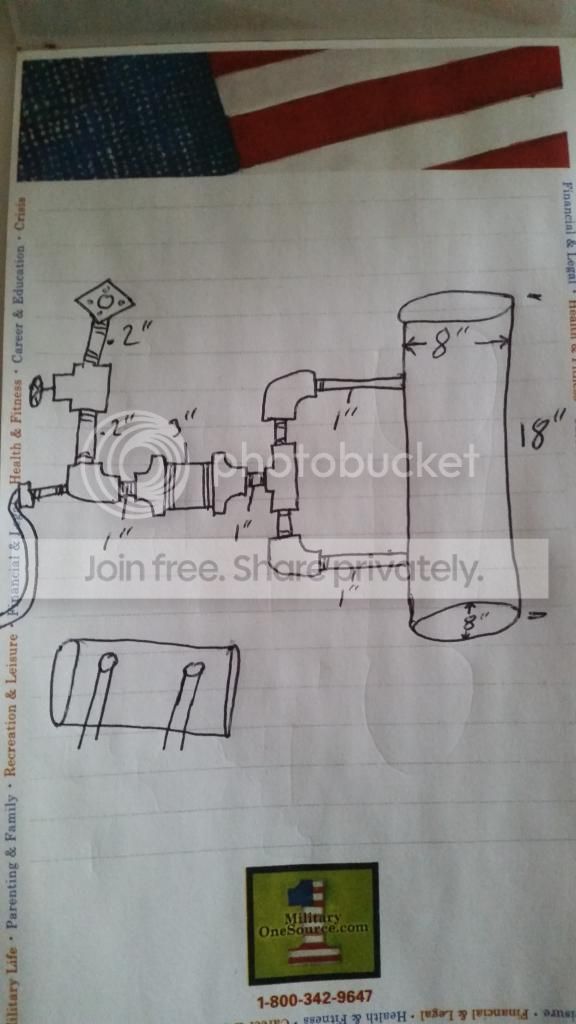
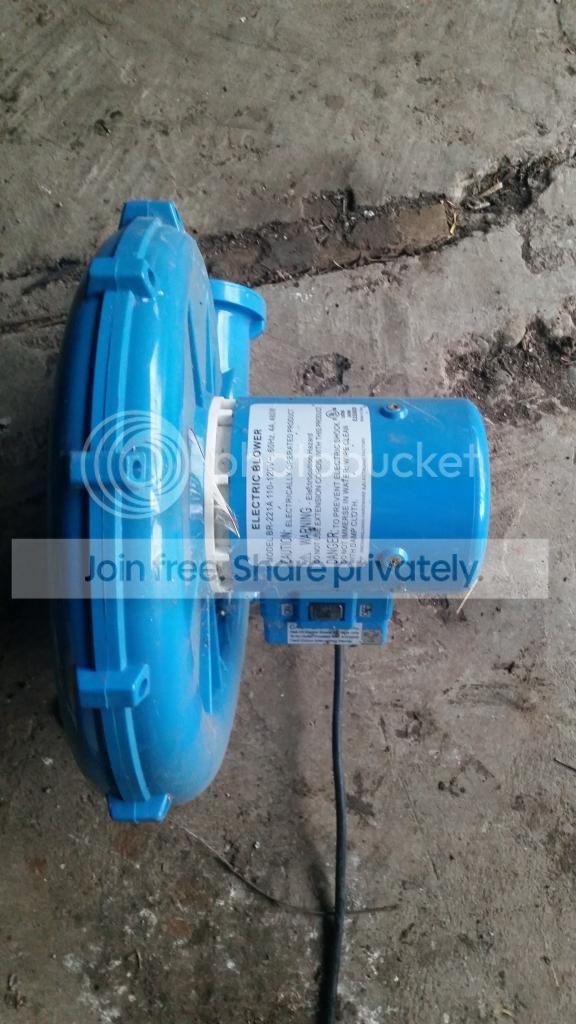
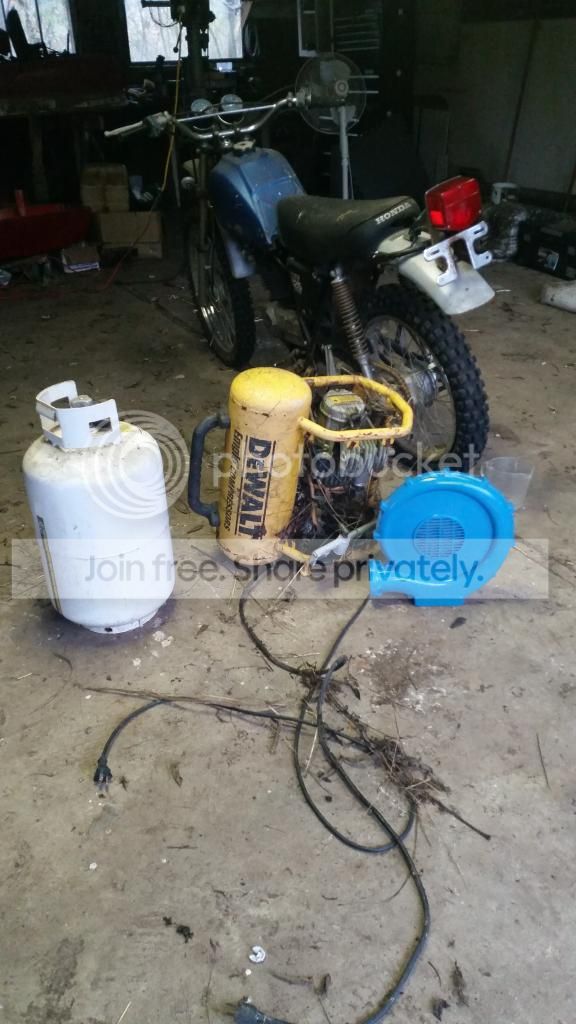

 
Well I went and bought a bunch of fittings. They were expensive! It was like 200 bucks just for the plumbing... I loosely put them together and I think I need to buy longer pipes after the T so that my burner pipes going into the forge are spaced out just a tad more. I have drilled into the 90 degree elbow and stuck my 1/4 pipe through it I will weld it in place tomorrow. Now I am still trying to figure out if I need to drill an 1/8 hole into the cap or smaller. I am also unsure of how long I should shove the pipe into the 90. Maybe I am just over thinking things and it the long run it wont effect the operation of the forge. Now I just need figure out how to hook the propane tank to the inlet pipe. can I just use a normal propane hook up for a BBQ as long as I get a decent regulator?
Screenshot_2014-12-01-16-58-411_zps363e5991.png
[/URL][/IMG]
Screenshot_2014-12-01-17-36-351_zps89e834ae.png
[/URL][/IMG]
 
Hi Travis, Since nobody has commented on your design I will. I have built a few forges over the years. Do not take this the wrong way but your burner design will not work as you hoped it would. There is no reason for you to have two burner tubes going in to the forge of that size or for most forges for that matter. Second the tubes are to small to work properly in my opinion. If you would like some help Im up in Beaverton and would be willing to share some design thoughts.Fyi its much easier then your making and can be done much cheaper.

Brett Mathews
Esteem Grinders
Well I went and bought a bunch of fittings. They were expensive! It was like 200 bucks just for the plumbing... I loosely put them together and I think I need to buy longer pipes after the T so that my burner pipes going into the forge are spaced out just a tad more. I have drilled into the 90 degree elbow and stuck my 1/4 pipe through it I will weld it in place tomorrow. Now I am still trying to figure out if I need to drill an 1/8 hole into the cap or smaller. I am also unsure of how long I should shove the pipe into the 90. Maybe I am just over thinking things and it the long run it wont effect the operation of the forge. Now I just need figure out how to hook the propane tank to the inlet pipe. can I just use a normal propane hook up for a BBQ as long as I get a decent regulator?
Screenshot_2014-12-01-16-58-411_zps363e5991.png
[/URL][/IMG]
Screenshot_2014-12-01-17-36-351_zps89e834ae.png
[/URL][/IMG]
 
I mainly agree with Bret. This is a really good example of why posting the plans first can save time and money, as well as heartache.

Some critical things I spotted right at a glance:
The 1" pieces of pipe in and out of the mixing chamber need to be 1.5" or 2" pipe. This is a critical flaw and needs to be corrected.
The burners can stay as they are or change to a 1.25" or 1.5" single burner.
I would suggest "swinging" things around so the blower is under the table/cart the forge is on and the whole assembly is a "U".

A really good way to build a forge is to build it on a rolling welding cart from Harbor Freight. The various components can be bolted on to make it stable and the whole thing can roll out of the way when not in use. The propane tank can even sit on the back with a bungee or clip added.
 
Thank you both so much! I can easily return what I don't need. I will change it so that I have 1 pipe going into the forge and make the pipes 1.5". I definitely want to build it on a cart and can easily set it up in a "U" fashion. I had read a lot of stickies and thought I was doing it right so I appreciate the correction! I want to eventually make it controlled with an SSR, Thermal coupler and everything else involved with that. I have read a lot of what you have posted on that Stacy and I believe I understand how it works, but that will be at a later time when I have a little more excess income. Oh and for the burner orientation, should I place it a little towards the front of the forge at about the 3 o clock position and angled towards the back a little bit? I think I read that was a good way to orient the burner.
 
I would use a 1.25" burner pipe. 1.5" is a large burner for any but a damascus welding forge.

Some place the burner at the front facing back, others at the back facing forward. I like to place the burner about 1/3 the way forward from the back. If you wish, just reverse that and put it 1/3 back from the front. The theory is that it makes less "dragon's breath" in your face when forging. I guess that may be so, but if the burner is properly adjusted, it isn't really a problem for me. The choice is yours.

The burner should be at a tangent ( actually a chord) to the chamber, coming in near the top. It should be angled about 15 degrees forward.

BTW, it is a thermocouple (TC)- the bi-metal device that reads the temperature and sends it to the PID as a voltage.

The basic theory of a PID controlled forge is quite simple;
TC>PID>SSR>solenoid
The TC creates a voltage determined by how hot it is, and sends it to the PID. The PID is set to a "set point" and when the forge is below that temperature it send a DC voltage to the SSR, which opens the solenoid. The solenoid opens and closes as the temperature falls and rises below/above the set point of the PID. On a single stage PID burner control this would cycle the burner on and off. That would be like trying to drive a car with the gas pedal pressed to the floor and turning the key off to try and do exactly 60MPH. Every time the forge burner cycles back on, there will be a "woof" as the incoming gas suddenly ignites from the hot chamber. This isn't dangerous, but can be startling. Certainly, such a control system isn't optimal. The forge atmosphere varies a lot during these cycles.
On a two-stage burner, there is a by-pass gas line around the solenoid that is always sending gas to the burner. It is simply a second line with a needle valve. The valve is adjusted to make the forge run at a desired low level. Normally about 50 degrees below the set point. The needle valve on the solenoid side of the control is adjusted to heat the forge to about 50 degrees above the set point when running without the PID turning it off. Thus the "swing" can not rise or fall more than the 100 degree range. It actually never rises or falls that much, because the PID will regulate the temperature within the hysteresis setting (usually +/- 5 degrees). The LO-HI settings are to make the chamber atmosphere stay even during the cycling of the solenoid.
 
Also:
Cut the end of the burner tube flush ( no threads), and slightly chamfer it from the inside. If you use a piece of stainless pipe for the burner tube you will greatly extend the burner life.

The forge body has a tube welded to it that is called the "burner port". It is a 3-4" long piece of regular pipe that the burner tube slips into. It is angled at the proper direction so the burner tube will fit at the right position.
For a 1.25"burner, use 2" pipe for the port and put three 1/4" bolts threaded the trough it to lock the burner in. A 2" port with 1.25" pipe will have only about 1/8" clearance around the burner. You can seal up the port with satanite or pack in kao-wool once the forge is completely adjusted and has been run for a while ( and no more adjustments will be made to the burner).
 
Here is a very basic two stage forge diagram:
Updated with better info. v4 is best.

Added to PID sticky.
 

Attachments

Last edited:
Stacy those are fantastic! That helps out so much. I was anxious to see how it worked put together so I pieced it together and did a quick burn video. I am not really sure if I have it operating correctly. maybe I need a smaller "pilot" hole for my gas line.][video]http://vid1174.photobucket.com/albums/r611/trav551/20141202_152117_zpsyhvmnvcr.mp4[/video]
 
I am no help on a pid/temp controlled forge, as I use a kiln for heat treating. But for a blown burner, I took a pic of mine and it could not be simpler and it works fantastic.


simple as that and at welding heat in minutes. This is not my design.
 
Something to think about and I've seen sketches where Stacy's includes a two stage blower by having two fan controls wired to the relay so as to adjust the air flow down as you reduce the gas. If I run across the diagram I'll post.
 
The two stage diagram should be in the stickys. IIRC, it has the two fan controls in it. ( I'll check later)

Travis,
On a blown burner, you don't have any orifice for the gas....just a place it comes in. This is normally a 1/4" pipe fitting. The gas supply is controlled by a needle valve. Look at JMJones photo.

Also, I noticed the regulator size you listed. A 0-30PSI unit is more than enough. 0-15PSI is more than you will use for a blown burner. 3-5PSI is about as high as most folks will ever run a blown burner.
 
I was just going off of what other people had done. I read the Indian George tutorial and he talked about putting a cap on the 1/4" pipe with an 1/8" hole in it. I also looked at a few others that were blown burner forges and they talked about putting an even smaller hole in the cap. So I had tried that but and the burner didn't really seem to "Roar" After what you posted Stacy I took the cap off and it seems to do a ton better. I couldn't even get the blower to work with the 1/16" inch cap here is a picture. Why would they put a cap on it if it seems to minimize the power of the burner?
Screenshot_2014-12-03-12-10-231_zps3375c9db.png
[/URL][/IMG]

Now that I think I have the burner working good I am ready to start on the forge body. I want to use the propane tank because it is a bit larger in diameter. I will remove the valve and fill it up with soapy water a few times before I do any cutting.

Thanks for all the help. I know its not to difficult but I want to ensure it is done safely and efficiently.
 
Many people seem to think that the gas needs to be injected into a blown burner. Actually, the less restriction the better as it enters and mixes with the flowing air. The mixing chamber will also greatly increase the mixing, thus making the air/gas mix that enters the forge chamber ready to burn efficiently. I have found a 1/4" hose, needle valve, and entry pipe works perfect.
 
Separate info;
Once the blower is running, choke it back about 75%. Open the gate valve on the manifold about half way. Stick a plumbers torch in the front of the forge and open the gas needle valve. The forge should light. Adjust the gas and air to get a nice smooth burn with no yellow dragon's breath or sputtering. There should be just a tad of blue dragon's breath. This is the sweet spot. From here you can raise the gas and air to make things hotter, or lower them to make the forge less hot. You can run a blown burner much lower than a venturi.
 
Well I had a little more time to work on my forge. I need to do a little overtime to buy the Inswool, refactory and a few other things from High temp tools before I can totally finish my forge..... but until then here are some update pictures.

forge023_zps523a8697.jpg
[/URL][/IMG]
forge030_zpsfd4de16f.jpg
[/URL][/IMG]
forge031_zps29772d81.jpg
[/URL][/IMG]
forge032_zps092f7f23.jpg
[/URL][/IMG]
forge033_zps48df5994.jpg
[/URL][/IMG]
forge034_zps850ec626.jpg
[/URL][/IMG]
 
I had to wait untill pay day to order the inswool and refractory supplies. I ordered what I needed last night and did some more work on the forge. I want to ad a hole for a TC sheath but I might do that at a later time when I am ready to spent the money to make it digitally controlled. Here are some pictures of where I am at. I built a little shelf with some junk I had lying around the shop. Its way to tall but I can cut the feet down at any time.
nwestofnew002_zps1264b59e.jpg
[/URL][/IMG]
nwestofnew008_zps296b7c61.jpg
[/URL][/IMG]
nwestofnew006_zps56e3c76c.jpg
[/URL][/IMG]

Let me know what you think, any critiques or suggestions
 
I like the railroad spike legs :)
How long is the cylinder/body?
Think the door will hold up? 😜
 
I have a 5 gallon bucket full of those dumb rail road spikes...

it will be a little less than 14" front to back once the inswool and refractory is in. ( I am going to cut out a pass through door on the back side. I am just not sure how to insulate it? I don't think I can glue the inswool on a little hinged door. Maybe I will scrap the idea of having a little door and just use a fire brick. )

The door stays open perfectly. In my genius laziness the "hinges aren't straight so it swings open smoothly till its a little past 90 deg then it sort of binds up and stays. I think with the concave of the door and I plan on putting small 1/2" tabs to hold up the inswool and refractory when the door is open I should be fine. I am trying to figure out how other people get the inswool and refractory to stay on the door when its open. Not that I plan on heating any larger stock than the small opening.

Also I want to sand it down and paint it black with that rust-oleum BBQ paint
 
Travis, you will really save yourself a lot of frustration by welding in a nozzle for your TC sheath prior to insulating your chamber. My tank already had a 3/4" half coupling welded into the top of the tank. The sheath drops right in and is held in place with a hose clamp around the sheath that keeps it at whatever depth I want it.

tc.png
 
Back
Top