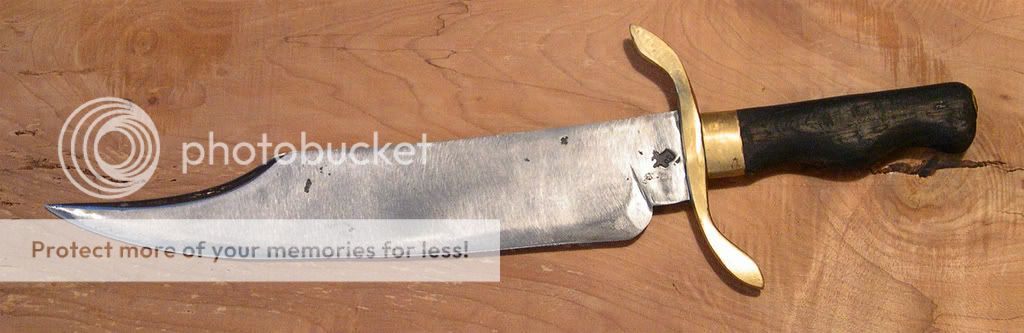
"Bowie" with brass strip along back spine

Highly reputable museums have been fooled many times with fakes. Texas museums are no exception. You can dig in your heels or take Cougar's suggestion. Don't make no never mind to me -- or anyone else here, I suspect.

Hey, I'm not trying to cause trouble but it is ridiculous to claim that the knife wasn't around during the 1830s. Okay, here is the only fact I can prove. That knife is on display at the Texas History Museum and they claim they know who it belonged to and where he was at a given point and time. One thing I can't prove is that it is a fake or not. I have no reason to think it is a fake just because people are claiming it can't be real. I'm no expert but it doesn't take an expert to read the documentation of a museum exhibit two blocks from the Texas State Capitol Building. Anyway, I sent an email to the museum asking them for the information on the knife. I'll post it when they reply. Then we can decide if the best Texas historians right across the street from the University of Texas could have been fooled into thinking this knife wasn't around during the 1830s. Christ on a cracker!:)
 
Forgery Texas Style

Texas Monthly, March 1989

The Dealers Who Buy and Sell Historic Texas Documents Move In A World Of Big Money, Big Egos, and Big Mistakes.

IN MARCH 1836 the Alamo had fallen and the Texas Revolution was in danger of collapsing. To bolster flagging spirits, the new Texas government commissioned the printers Baker and Bordens of San Felipe to print one thousand copies of the recently signed Texas Declaration of Independence and one thousand copies of William Barret Travis' Victory or Death letter from the Alamo. Texas patriots posted them in public places across the country, and then most of those broadsides, like political ephemera today, disappeared forever.

One hundred and fifty-one years later in Austin Dorothy Sloan opened a package sent to her from Dallas and removed a copy of the old declaration broadside. A dealer in rare books and manuscripts and a native Texan who had studied the history of the West at the University of Texas, she had been anticipating something like this practically all of her professional life. Here was a true piece of history that would be a coup for any dealer to sell. It would be profitable too. The collector offering her the declaration to sell had bought it for $21,500. Now the price should be even higher.

Instead of exhilaration, though, Sloan felt odd; rather, she felt that something was odd about the document she held in her hands. She could not say exactly what. Perhaps it just didn't look old enough to her practiced eye.

She called her friend Bill Holman, a librarian and master printer, and the two of them went to the Barker Texas History Center at the University of Texas, where there was another copy of the declaration broadside. At first glance Sloan's copy and the library's copy looked identical. But after a more careful examination, Holman discovered that the dimensions of the type were different on the two copies. The type on Sloan's copy was narrower than that on the library's copy. The difference was slight but crucial. Lead type, the only kind of type in Texas in 1836, does not change. The difference in size meant that the two documents must have been printed at different times. That led to only one conclusion: One of the documents had to be a forgery, and it could not be the Barker library copy. Its provenance -- or history of ownership -- was known and proved it was genuine.

Sloan went home to call the collector, while Holman met another bookseller named Tom Taylor for lunch. Taylor was a master printer who produced fine editions for collectors and also dealt in rare books. Holman told him about the two versions of the declaration. Although Taylor didn't say so at the time, Holman's story bothered him. He brooded on it all that afternoon, for he had sold copies of the declaration himself, one to the Dallas Public Library for $20,000, one to the museum at the San Jacinto Battleground for $30,000, and a third to a collector in Austin. Taylor knew Governor Bill Clements also had bought a copy. The news forced Taylor to consider a question that had occurred to him while he was selling his declarations but that he had put out of his mind. The declaration broadside was one of the rarest items of Texas history. Before 1970 only five copies were known to exist. Now there were at least twenty. Where had the new copies come from?

ANSWERING THAT question became an obsession for Taylor. He borrowed several copies of the declaration broadside and studied them letter by letter. He found that the copies either were identical to the copy in the Barker Texas History Center and thus were genuine or shared identical differences from the Barker copy and thus were forgeries. Taylor was even able to identify the specific genuine copy that had been used as a model for the forgeries. He began examining printed documents in libraries, museums, and private collections. By the end of 1988 he had identified more than fifty forgeries of thirteen original documents. All of the fakes had appeared in the marketplace after 1970, and none had clear provenance. Almost every one of the major libraries, historical museums, and leading private collectors in Texas found that they had been stung. The declarations Taylor himself had sold to the Dallas Public Library and to the San Jacinto museum were forgeries, and he had to return their purchase price. There were forged declarations at the University of Houston, the University of Texas at San Antonio, and the Star of the Republic Museum at Washington-on-the-Brazos. The libraries at Baylor, the University of Texas at Austin, UT -Arlington, and Yale all had one or more forged documents. Fakes were also in private collections, like those of Governor Clements and J. P. Bryan, a Houston oilman who is a descendant of Moses Austin and a former president of the Texas State Historical Association.

Altogether there were at least nine forged copies of the declaration. But the most common forgeries, even more numerous than those of the declaration, were of the broadside of Travis' Victory or Death letter. There are only two known genuine copies, one at Yale and one that seems to have been stolen from the Texas Archives sometime in the sixties. Presumably, the stolen copy was used to make the forged copies. Ross Perot almost bought a Travis letter forgery but sent it back to the dealer when it was determined to be fake. Others were not based on historical documents, but were complete fabrications. Although they were purported to be from 1835 or 1836, they were set in typefaces that Taylor knew had not been designed until around 1900. Undoubtedly, more forgeries than the fifty-some Taylor found will be discovered in time. It is no secret who made the fakes or who sold them, but a successful prosecution of anyone is unlikely. All in all, forging documents can be a highly profitable, successful, even gentlemanly business.
 
Troublemaker!

ALL I WANT IS A NICE BIG KNIFE! LIKE THE ONE I SAW AT THE MUSEUM! WITH THE BRASS ON THE BACK OF THE KNIFE!:grumpy:

"WHY IS EVERYBODY AGAINST ME!"
 
attachment.php

There's nothing wrong with wanting a big honkin' knife with a brass strip on the back if that's what you want. There are plenty of "reproductions" around, and if they're not really reproductions of anything authentic, well, they are big honkin' knives and some of them even have a strip of brass on the back.
 
I'm with you Culpeper, I'm getting a Damascus and Mokume version, like I said before and I like 'em. Plus it's got a 14 inch blade so it's intimidating :D
 
Case made a big Bowie with a brass strip on the back, about the size of the Western W-49.
 
Hey, Culpeper! If you aren't totally turned off on the idea of a big bowie with brass back, do a google on "dan brock plowshare" and see what you end up with.

I know he has made these kinds of things in the past, and is very reasonable.

Andy
 
Hey, Culpeper! If you aren't totally turned off on the idea of a big bowie with brass back, do a google on "dan brock plowshare" and see what you end up with.

I know he has made these kinds of things in the past, and is very reasonable.

Andy


That guy can make a blued tool steel version of the cheap pakistan one. I'm going to give him a holler!
 
Mr. Brock says he can make me a "Musso" Bowie no problem and with the brass strip.

The following information is what I received from the museum...

Dear Mr. Bellicini:

Thank you for contacting the museum. I have included the text from the label:


"Bowie knife, ca. 1830s

This knife is attributed to Jesse Robinson, who served in Capt. William Jones Heard's Company F at the Battle of San Jacinto. The Kentucky native emigrated to Texas in 1822 and was one of the first 10 Texas Rangers appointed by Stephen F. Austin in 1823. The knife blade is made of steel and has a brass cross guard and oak handle. During the Battle of San Jacinto, Robinson was part of a Texian line that overran and captured the Mexican army's cannons."


The lender is anonymous. We do not have photos that we can share. I hope you enjoyed your visit to the Museum and will return to see us again. Please let me know if you have any questions or need additional information about our exhibits.


Sincerely,


Shoshanna Lansberg

Exhibit Content Coordinator

Bob Bullock Texas State History Museum

P.O. Box 12874

Austin, TX 78711

Ph. (512) 936-2309

Fx. (512) 936-4699

email: s.lansberg@thestoryoftexas.com

"It is never too late to be what you might have been." - George Eliot
 
Mr. Brock says he can make me a "Musso" Bowie no problem and with the brass strip.

The following information is what I received from the museum...

Dear Mr. Bellicini:

Thank you for contacting the museum. I have included the text from the label:

"Bowie knife, ca. 1830s

This knife is attributed to Jesse Robinson, who served in Capt. William Jones Heard's Company F at the Battle of San Jacinto. The Kentucky native emigrated to Texas in 1822 and was one of the first 10 Texas Rangers appointed by Stephen F. Austin in 1823. The knife blade is made of steel and has a brass cross guard and oak handle. During the Battle of San Jacinto, Robinson was part of a Texian line that overran and captured the Mexican army's cannons."

The lender is anonymous. We do not have photos that we can share. I hope you enjoyed your visit to the Museum and will return to see us again. Please let me know if you have any questions or need additional information about our exhibits.

Sincerely,

Shoshanna Lansberg
Exhibit Content Coordinator

Bob Bullock Texas State History Museum
Austin, TX 78711


"attributed to"
"lender is anonymous"
:rolleyes:
 
The following information is what I received from the museum...

. . .
"Bowie knife, ca. 1830s

This knife is attributed to Jesse Robinson, who served in Capt. William Jones Heard's Company F at the Battle of San Jacinto. The Kentucky native emigrated to Texas in 1822 and was one of the first 10 Texas Rangers appointed by Stephen F. Austin in 1823. . . .
(emphasis added)
Or, perhaps, not:

From www.sanjacinto.org:

ROBINSON, JESSE

Born in Kentucky, February 11, 1800, a son of Charles Michael Robinson. His father was a soldier in the Revolutionary War.

In the Headright Certificate issued to Mr. Robinson, January 13, 1838 for three-fourths of a league and one labor of land by the Colorado County Board, it is stated that he came to Texas in 1827, but had since married. On May 5, 1831 he received title to one-fourth of a league of land in De Witt's Colony situated in Gonzales County.

Mr. Robinson was a member of Captain William J. E. Heard's Company of "Citizen Soldiers" at San Jacinto and on June 24, 1839 he received Donation Certificate No. 915 for 640 acres of land for having participated in the battle. He was issued Bounty Certificate No. 3086 for 320 acres of land, April 13, 1838 for having served in the army from March to June 1, 1836. He was discharged at Camp Victoria. He sold his certificate for $50 to Francis W. White, May 5, 1838, while living in Jackson County.

Mr. Robinson moved to the present Live Oak County before it was organized and settled on Ramirena Creek. There he died December 27, 1882, and was buried in the Latham Cemetery near his home. He was married March 31, 1838 in Colorado County to Sarah Jane Newman, who was born in Pennsylvania in about 1820 and was murdered in 1866.
. . .

Mr. Dudley R. Dobie, in an article published in the San Antonio Express November 18, 1934, had this to say about Mr. Robinson:

"Jesse Robinson was the first husband of Sally Scull, a woman who was as dexterous as any man in wielding a six-shooter, riding a horse and throwing the lasso. Her maiden name was Sarah Jane Newman. An excerpt from the Memoirs of Col. John S. Ford gives an accurate description of the woman --

'The last incident attracting the writer's attention occurred while he was at Kinney's Tank, wending his way homewards (from Corpus Christi Fair, 1852). He heard the report of a pistol, raised his eyes, saw a man falling to the ground and a woman not far from him in the act of lowering a six-shooter. She was a noted character named Sally Scull. She was famed as a rough fighter, and prudent men did not willingly provoke her into a row. It was understood that she was justifiable in what she did on this occasion, having acted in self defense.'"

Not a lady to mess with! :eek:
 
SCULL, SARAH JANE NEWMAN (1817-?). Sally Scull (Skull), the daughter of Rachel (Rabb) and Joseph Newman,qv was born in 1817 and arrived in Texas with the first settlers in Stephen F. Austin'sqv colony. She was noted for her husbands, her horse trading, her aim with the two pistols she wore, her forceful language, and for hauling cotton and critical supplies for the Confederacy. On October 13, 1833, she married Jesse Robinson, who was twice her age. He had served in the first Texas Ranger company ten years earlier and in several Indian campaigns. They moved to Jesse's land grant, twelve miles north of Gonzales, where in March 1836 Sally in all probability was caught in the Runaway Scrapeqv with her two-year-old daughter, while Jesse fought at San Jacinto. He divorced her on March 6, 1843, in Colorado County, where she was living on her inherited land. She married George H. Scull eleven days later. In December 1844 they sold 400 acres of her land and their livestock. Legend is that she spent the next several years contesting with Jesse the custody and education of their children, Nancy and Alfred. In 1849 she declared that Scull was dead. In 1852 she attended Henry L. Kinney'sqv fair in Corpus Christi, and John S. Fordqv later wrote that he saw her shoot a man there. She took up residence at Banquete, twenty-five miles west of Corpus Christi, and later purchased 150 acres there. In the mid-1850s a European tourist recorded her activities and reputation...

http://www.tsha.utexas.edu/handbook/online/articles/SS/fsc33.html
 
Yeah, thanks for the heads up on this guy, Andy! I love his set up on his place. If this was the year 1835 that knife would look just like that!
 
I have one of those - with a copper guard and strip.

In 1972, I ordered a Hospital Bolo out of an Ad in American Rifleman, and they sent me that "bowie" instread. I complained, but they were gone - one step ahead of the Postal Inspectors.

ED: If this was 1972, that knife would look just like that - sorta.
 
I've got one of those inexpensive Condor Jungle Bowies. I'm toying with the idea of shaping a fighting guard out of brass or copper and using JB Weld to attach it. After looking a the pictures on this thread I'm now thinking about putting on a back strip as well.
 
Back
Top