
broke the Wakizashi in HT... WHY?!

Joined
Jan 2, 2006
Messages
1,073
hey everybody...

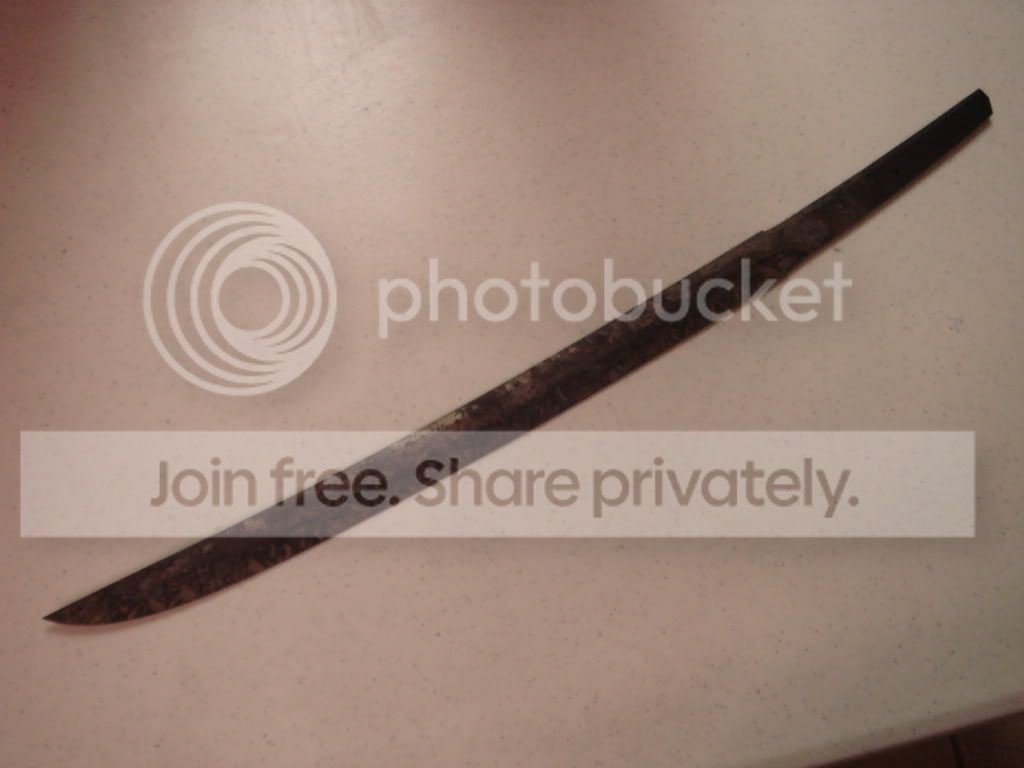
well i cracked the wak in HT... :( yeah.... 20 hours down the tubes as well as my last bar of 7/8" W2

did an interupted quench in water (water was at about 130 degrees before quench) and the steel was the right temperature (or pretty darn close)
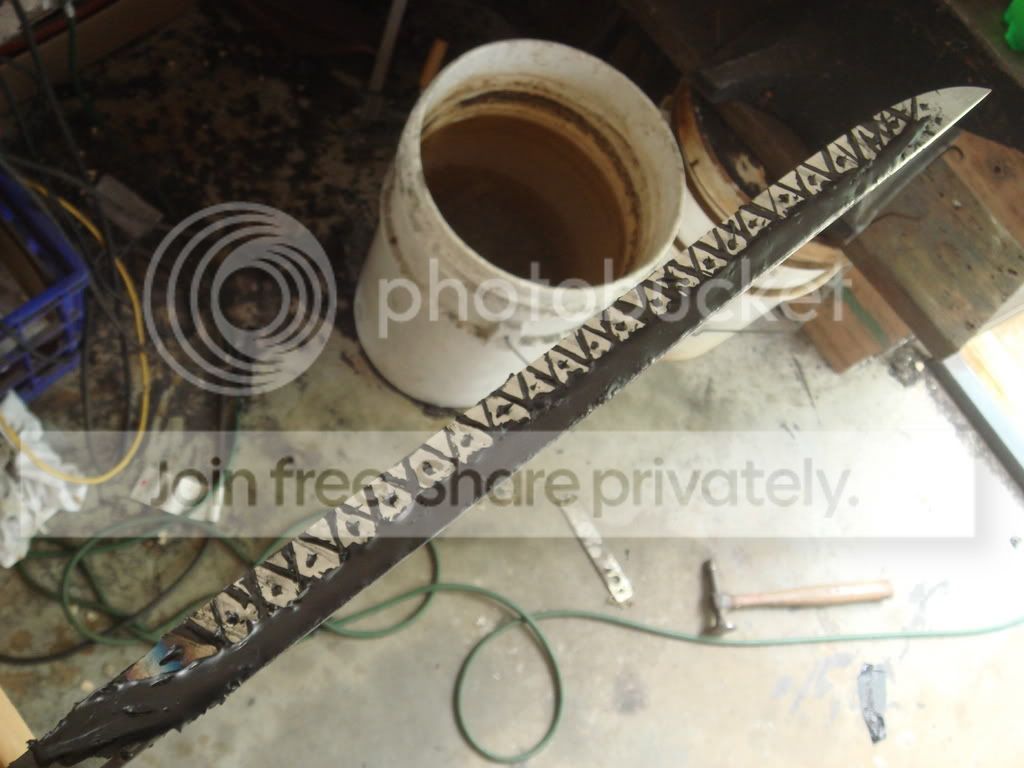
DSC01745.jpg

DSC01746.jpg


WHY DID IT CRACK?! it cracked along the edge about every 2 inches. got some nice sori on it though. it would be really pretty if it wernt cracked. sigh. any idea how i can do it right next time? can i get sori in Parks 50? the only reason i quenched in water was so as to get some nice sori.

i am needing help. oh and could it be how i am applying the clay? i was trying to get a choji hamon.. did i clay it wrong? i used Black furnace cement (recomended by Rick Barrett)

thanks for your help... God knows i need it
~Chris
 
I feel you. The last knife I tried with water...well let's just say I'm still bitter (never with water again). I was holding my breath to see the end of your sword project. The wait was killing me. Oh well. You do good work. Just get back in there. Sorry about the blade.

-Mike Sheffield
 
Just out of curiosity, Did you quench edge first, or point first. I haven't made a blade quite that long. An 11" blade Tanto was as close as I have come but I remember having a problem with a blade cracking when I tried to quench edge first and let the quench set the sori. I have had a bit more success at entering the quench point first edge down with the sori already set.
 
The problem with interrupted quench is that timing is critical. If you pull it out too fast it won't be hard enough , if you don't pull it out fast enough it will crack.Trial and error ,and cracked baldes and eventually your timing will be correct !!
 
Chris,
Welcome to the sword makers club. Water quenching steel is tricky. Water quenching a 24-40" long piece of steel is really tricky. The final result is stunning......if it doesn't crack,....or twist,....or warp,or......
I don't remember who it was, but there was a new maker a couple of years back who jumped right into swords (most hold back for a long time,if ever) and he broke his first 7 blades before getting it down. That sound in the quench trough is really gut wrenching.

The only way to guarantee you won't crack a sword blade is to never make a sword.

All I can see in the photo is that you might not have brought the clay far enough down the blade toward the edge. Might not have made any difference, just an observation.

As far as reducing the risk goes:
Make sure there is plenty of meat in a water quenched sword blade. Thin blades can't take the stress as well.
Temperature should be right on, and definitely avoid over heating. It is easier to re-HT a blade that did not get hard enough than to make a new blade if it cracked.
Experiment ( I know, It is really hard to experiment with blades that take days/weeks to make, but that is the only way) with your quench timing. My 1-2-3 may be slower than your 1-2-3. The whole precess must be tailored to your specific set of parameters. Your forge heat, quenchant, tank size/type, blade shape/thickness, .....etc. To be a swordsmith is not for those who falter at failure. Great sword blades are hardened in a mixture of tears and sweat. Both of those are available in great quantity in a sword smithy.
Normalize two or three times prior to the clay coat. This will also give you a couple of dry runs at getting the quench temp right.
Quenching in parks #50 will slow things down a bit. You can get some sori and a hamon with an interrupted oil quench, but it will take a bit of experimentation to find the magic In-Out timing. Or you can forge in the sori and do a single quench in #50.

Tell us about how you did your blade. Sometimes there is a clue in the story. If nothing else it is therapeutic to talk about it.

Stacy
 
First of all, I am sorry to hear that the blade didn't make it....That is indeed, the swordsmith's path....

Based on what the japanese smiths do, I would offer the following....

Your blade needs to have at least a 1 mm thick edge.

Your coating would be better if more uniform in thickness. About 2-3 mm thick everywhere.

The japanese smiths I have observed do not do a quick in and out of the trough. They place the blade in for at least 30 seconds to a few minutes before removing it.

They place the blade in almost parallel to the water's surface.

Please remember that even the most skilled, veteran japanese smiths, with 30+ years experience, suffer a cracked blade from time to time....

Keep at it!
 
:( jeez... That would have been a sweet sword. I'm sure that #2 will be awesome. Hope you keep at it, Chris!
 
Why? Because you went and quenched it water :D

Sorry Chris, I couldn't resist :o

Clean it up, etch a little and check out the hamon. You can still learn more from this.
 
hey everybody!
thanks for all the kind words!
i totally plan on doing another sword. it will just take longer to make. i am thinking of buying bigger stock to make it from rather than making it out of the the W2 i have. i will check out the diehl steel place. if i cant do it in W2 what is the best alternative?

okay... blow by blow. i clayed up the blade like you saw hoping to get a choji hamon, and waited for it get dusk so i could see the color better. so i boiled all this water so that i could add it to the quench bath to get it to 130. so i had everything in place. heated up the forge.. my HT forge was shorter thant he blade so i have to move it in and out to get the who thing treated... so it was harder to keep track of the heat. i had my pyrometer going and i tried to keep it about 1400-1450 ... anyway... got it all up to heat kept it there for about 5 min. and then i took it out hold with Visegrips. and put it in the water edge first. in for the seconds out for thre.. i counted out loud. it was awesome to watch the curvature form... kinda funky. so it ended up with that beautiful sori and it didnt warp at all. so i took it in and immediatly tempered it at 400 for an hour... and then checked it for cracks... yeah... there were alot of them.

well i am going to clean it up if i can... but i am looking to forge it out of larger stock so i dont have to draw it all out. you know? so is W1 aqs good a sword steel? or what is good?

thanks yall i shall try again!
~Chris
 
Well, you seem to have done it as good as possible.
You can sometimes shorten the sword and/or grind back the edge if the cracks don't go far. You may not get a great blade this way, but you can often finish it and make a wall hanger sword or tanto . If the cracks are very small and fine, you might want to try and finish it to see what you get. ( ? new Ebay ad - 1000 years old samurai sword, slight age cracking.)

1080/1084 will make a good sword and is much less likely to crack. AND, it comes in flat bar !

Stacy
 
HAHA!
new old sword!
the problem is the cracks are really deep.. however i am prolly going to clean it up and etch it when i get a chance. i love Hamon. they are so awesome.. even if it is cracked.

where can i get 1080/1084 flat bar? i was looking at about 3/8 thick stuff. or there abouts.. does it give a good hamon?

thanks!
~chris
 
You might try using a straight medium to high carbon steel that is closer to what the japanese smiths use (and is relatively cheap) until you get a good handle on all the variables.
 
a good straight high carbon like... 1085? 1050? Don Fogg used 1050 in his swrd forging class... but i cant find it in the size i want.
what resourses to yall use?
thanks
~chris
 
1080/1084 will work but is high in manganese, which makes it deeper hardening. It will harden up under the clay a bit and produce a less active hamon.

I started with 1084 when I got the hamon bug and tried all the simple carbon steels. I got the best results with 1086m(low mn), 1095, W1 and W2. I finally settled on W2 as my favorite.

The ideal steel would be a 1070/1080 with low manganese, below .40% and as far as I know, it's not made.
 
so will 1050 give a good hamon?
what about 1045?
or should i worry about that?
i can get W1... in square stock... is it worth the little bit more money? ir should i do the 10XX steel for learning?
thanks
~Chris
 
1050 should give you a decent hamon if the heat treat is right....1045 is on the low side and might not work too well....

Why do you need it is a certain thickness? Can't you forge it to shape???

I would use the cheapest material possible until the bugs are worked out...
 
i need it thick so that i can forge it to shape with enough material to grind away the imperfections
so can i use 1070/1084?
thanks
~Chris
 
Back
Top