Bug out backpacks!

dont really have a bug out bag, but saw you are interested in the alpha pack. i got one a couple months ago. much larger than i expected, so i dont carry it often, but when i do can put alot inside. i find the exterior pockets oddly placed, and i would prefer more zippered pockets like my bfm. also, it doesnt come with lanyards (or strap type things) on the zippers, so i attached my own having been used to camelbaks.

overall, a nice pack, good quality and durable.

Thanks! A good review.:thumbup:
 
I have seen some awsome things I never thought of whils reading this thread. I have a bug-out bag for me and one for my wife. She works for the county and demands we have them preped and ready always. Both are ballistic nylon three pocket with draw strings no zippers. Both have waist belts and padded shoulder straps as well as handles on top. I have put a 72 hour program together. That give me 3 days to gather more supplies by hook or by crook!!! Here is the list.
Meds for 3 days each bag
Large Ontario Rat side slung outside of bag...
American Tomohawk outside wifes bag. Wood splitting/contructing/breaching..
Small Cal. pistol in access pocket w/ammo (50rnds)
compass and state map (topo)
Flashlites and batteries each bag
chemlite sticks each bag
para cord 100ft each bag
firstaide kit each bag
fire starting supplies (bic matches wetwood starter packets)
cable-saw Flint small single mirror whistle several cord-flares
water in sealed bottles as well as purifier tablets
3MRE in each bag sealed & resealed bags w/jerky & dried fruits Rotated every 60days with the water and meds.
poly pro light wgt. fly (tarp) each bag
net pockets hold individual clothing for each. 1 change.
undisclosed amount of singles each bag.
keys and some copies of important documents.
several med size folding knives and a smiths 2 sided diamond hone.
throw away camera each bag.
Can of Mace on shoulder strap of each bag.
Glo-Tubes and spare batteries.
Crank Charge Radio w/light and Cell phone charger adaptor.
Nylon wire ties and small tool kit.
Leatherman super tool each bag.
Most all of the items are sealed in some sort of water tight bag (Zip-lock) or pelican. Both bags have a heft to them but we are healthy and I intend on driving away before running away.... Things in the bags are forever being altered or upgraded or rotated. L8R... ~baba~
 
Well it just so happens I have a Aussie ALICE frame kicking around and Alan got me thinking.Yep,just a shade over 3lbs.

Sorry Tiki,buts that's too much of a handicap to kick off with.

dscn5376hp7.jpg
 
Chosen packs are Berghaus Antaeus 60 Atrek and Globe Trotter 35 litres.
Cannot find any pictures of them on the web.
I chose Globe Trotter because of long warranty - at that time it was not clear if I would stay in the UK for long, I might have to go back to Kyrgyzstan so I wanted something what would be strong enough to take a lot of beating and abuse. I use it also for storing hiking/camping equipment: I felt that assembling things before I go hiking was annoying, so I started assembling my backpack immediately after I come back from my trips. Now, if I have some spare time to walk on countryside, I can always grab my ready rucksack and "bug out". Whether you are in emergency leaving your accomodation, or going for hiking for a while, the thing in common is that you need to have all necessary things with you.
I got Berghaus for my hiking trip along Hadrian's Wall. I chose such a large volume because I planned to walk Santiago Path in Spain later with it as well, and felt I would need more space for that trip. Also, I use it to store my camping/hiking equipment, but for longer time - army rations, water bottles, socks, warm underwear, hat, batteries, compass etc.
Is weight vs comfort vs capacity an issue? - Globe Trotter is light, but uncomfortable. No wonder because the company seased to exist about 10 years ago and then the technology was not as good as now. The volume is acceptible for long trips to countryside as long as you put some gear (tent and mat) outside of the bag.
I find Berghaus a bit heavy and too big for the vast majority of my trips. However, it is very comfortable to carry and now I carry my wife's stuff in it while hiking, so it is useful.
What do you propose to carry in it realistically? - a fixed blade knife, Victorinox, army rations (usually 2 -4 + deserts in Globe Trotter, and upto 30 in Berghaus), water (1 litre in Globe Trotter and 6 litres in Berghaus), survival kit with fishing, signalling kit etc, firesteel and firestarters, compass, emergency clothing, medical kit, including a lot of things for my feet in case I need to walk a lot, water purification kit (tablets and filter), torch, brewing kit and fuel, sleeping bag. Tent goes separately.
No weapons since it is illegal to store them outside the gun-safe. Though for survival I often think airguns might be an excellent choice - there planty of small animals around, like birds, which can be hunted for food.
After I travelled back to Kyrgyzstan my attitute changed again, and considerably - there are many people who live in real wilderness and get along without a high-tech gear that I started relying less on my gear, but more on my skills of creating things using materials available around me. And it is more fun because I carry less things!

 
As far as the chest thumping over escape and evasion, it's not the size of the load, it's how it's carried.

I totally agree ... where as some people may start by carrying an ultralight pack and carrying heavier contents some start with a heavier pack and go lighter with their own contents.
 
Well it just so happens I have a Aussie ALICE frame kicking around and Alan got me thinking.Yep,just a shade over 3lbs.

Sorry Tiki,buts that's too much of a handicap to kick off with.

dscn5376hp7.jpg

For you mate ... not for me. As I said earlier I have done plenty of miles with my Alice over large mountain systems both here and in Europe + overland on foot moving fast! ... the Alice worked a treat for me and I am a staunch supporter. Pack choice is a personal thing obviously but I compensate by content! - I'm not alone in favouring an alice but I hardly care if there are people who don't like it either. ;)

The Alice frame has many uses on it's own in a survival situation when removed from the pack - It can be a valuable sled for dragging materials for one! If somebody is injured the Alice Frame can be made into the main base for a hand carried stretcher and the list goes on from there ... I have many such extra curricular uses for that frame in the wild.

On the straw man point about "no-one is invincible" -- I never stated otherwise, hence it's a straw man argument - but there's nothing to stop a person being followed from dropping their pack, hiding it in scrub, returning to it later or setting up an ambush for those in pursuit either. I mean any number of options are possible if you're being pursued and your pack starts to slow you down. I have no such problems allowing for such situations carrying an alice.

Here are some quotes supporting my choice ...

If you've been a Survivalist for very long, you probably have a substantial stock of gear and things to carry it in: BOB/BOG packs, webgear and so on... Alice Packs and LBV's are very popular among survivalists

From ... LIGHT LOAD WALKING AROUND GEAR - http://www.alpharubicon.com/prepinfo/liteloadgeargoshin.htm

Here are some comments that quite agree with below - highlighted and italic'd parts of particular importance given my personal stance on carrying an Alice.

Weight of the rucksack and personal gear. from http://www.survivalblog.com/field_gear/

This is an individual matter, but generally the entire weight of your equipment should not exceed one fourth to one third of your total body weight. With practice you will probably find yourself exceeding these weights, but be careful. With much training, specialized soldiers often carry from one half to more than their own body weight, but this is not recommended for the average mortal. Once you have become fully infected by the “ruckers disease” you must be careful as you may become exposed to and infected by “The Crazy B**tard’s Disease“, also known as the “Ultra light or minimalist backpackers infection” ( I don't have this! )

I used to have the disease and felt I had recovered from it by getting old. Worked really good for a while! You have all seen these lunatics, usually running up mountain trails half naked, cursing the old folks (anyone over 35) for not getting out of their way fast enough, bota bag slung over their shoulder now only about 1/2 full and carrying what you would think was only a day pack. Actually they have everything needed (except enough wine) for at least a few days while usually keeping the weight to about 20 pounds or so. I ran across one of these nut jobs recently; turns out he’s on my county SAR team. I thought I had fully recovered from the disease but it seams it lays dormant in the host until the death of said host. After only one evening with this guy, I found I had been hopelessly reinfected by the “Crazy Bastard’s Disease” and have not been right since. I realized the severity of the reinfection a couple weeks ago when I was cutting and trimming all the extra weight off my ALICE Pack and web gear. That was not the scary part, the scary part was when I found myself running into the kitchen and weighing all the stuff I had just cut off; all 5 1/2 ounces.

Yeah, I have never suffered from that disease - I have my Alice set up right for my height, weight and conditioning. I have made sure that I can move at speed if needs be by planning the contents of my pack properly. I may want to carry a little extra when going bush if I feel it's required but my choice of pack has a purpose for me and many uses and I am fit enough ( I run an average of 16ks a week ) to carry half or more than my own body weight ... IF I ever needed to. The key to packing and weight also is knowing your own limitations, this is always personal. My comments regarding my own system was about redundancy in carrying weight - not the starting weight of your pack! For instance, if I can carry an object that does the same job at half the size then this is what is mean't by reduncancy and utility - I will carry the smaller item. This system of selection and compensation is what allows me to happily carry an Alice system and knowing my own physical condition and the miles I have done already in Spain nobody can tell me I ought to rethink my choice - only their own.

Now I will concede, if somebody goes ultralight generally with a pack and has the weight concession to carry that heavier implement then that ofcourse is their own choice - my own system requires something else of me due to my own system and choices made. Once again I have friends and family who serve in the ADF and served in the ADF and Special Forces and those people use the same packs as I do in their training and deployment. They are not short of speed or options when in the field and I have not heard any speak anything but glowingly about their issued packs. I'll always be an Alice user ... no apologies.
 
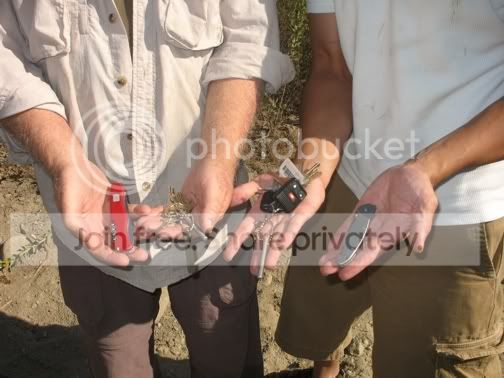
I do not want thirty pounds of crap on my back when I am bugging out. let me put it to you this way, if I needed to I can bugout with just my keys.
pockets.jpg

The photo above is what Halcon (the guy on the right) had with him when he hit the woods with what he had in his pockets. I'll let Alan add more if he cares to.

Maybe it's a difference in terminology, but I've always thought of a BOB as something you grab on your way out the door when you need to move fast. 72 hours is stretching it for a BOB. Three days is what your 72 hour kit is for. A BOB may be a subset of a 72 hr kit, but it won't replace the kit. A BOB is not a 50# rucksack set up to hike the Pyrenees or the Appalachian Trail.

The term Bugging Out is an action to escape something and that action may result in an extended stay or a short overnight. The BOB is a thing, not an action. The BOB may take you through the entire Bug-Out if it's short or it may only get you through the initial phase of an extended Bug-Out. A Bug-Out-Bag allows you to bug-out to someplace, preferably someplace where you have additional supplies, maybe to a cache carefully concealed in the woods, maybe to a friend's home and a warm bed, but you've got to go somewhere. If your idea is to take a 50# rucksack and go into the outback for an extended stay, you're hiking and camping. I guess that could be a plan for bugging-out, hit the trees and camp, but it wouldn't be my first choice.
 
Here were some further comments from the same Blog as above and again I concur with the gents findings regarding civvy vs military packs.

Commercial or Military surplus packs, a dilemma.

U.S. Military (surplus, but in new or excellent condition).
Civilian
Foreign Military

Civilian or Military equipment: Pros and Cons of each

Civilian, Pros:
Usually more advanced
Usually very comfortable
Lighter than military

Cons:
Usually not as rugged as military
Usually much more expensive
Fewer places to hang gear on outside of pack
Often times available only in bright colors (do you want to be seen)

Military, Pros:
Much less expensive than civilian
Widely available
Very rugged
Subdued colors
More places to hang equipment on outside of pack Generally more pockets for storing gear, easier to access more items of equipment Some packs can be made quite comfortable with certain after market modifications

Cons:
Often times not as comfortable as civilian packs Usually heavier than civilian packs Often not as well designed as civilian packs

For the money, I generally prefer the military pack over the civilian pack if it meets my criteria, but do not misunderstand, money is not the most important issue. If a military pack has the comfort and versatility or can be modified to that end to perform adequately, I will almost always go with the military over the civilian pack.

I did the same ...
 
Maybe it's a difference in terminology, but I've always thought of a BOB as something you grab on your way out the door when you need to move fast. 72 hours is stretching it for a BOB. Three days is what your 72 hour kit is for. A BOB may be a subset of a 72 hr kit, but it won't replace the kit. A BOB is not a 50# rucksack set up to hike the Pyrenees or the Appalachian Trail.

G'day Ras,

Thanks for that expansion mate. You may well be correct that this is an issue of semantics as much as anything else. I have loosely used the term Bug Out because I know it's a common term for the North American crowd but we/I don't use this term in my part of the world and so when I use it for the purpose of making the right connect with a forum where the majority are probably North Amercians, my own personal understanding of it may well be different from the common useage in your neck of the woods.

Perhaps I should explain my own idea of going bush which is equal perhaps to your bugging out. Everybody will have a different idea of what they require when going bush - it will depend on what you expect and where you suspect you might be going + the circumstances. Generally I have tried to expect the worst when planning my own bush survival kit and pack. In that sense I plan for a lengthy period and not a short 72 hour period - essentially I am planning to hit the bush and last indefinately. I have no interest in hitting the bush and being short of essential tools or items either so my "going bush" kit allows for a permanent decamp.

So while a North American BOB may not be 50# rucksack it's a personal thing and different for each person given their own plans and expectations. In my neck of the woods going bush requires of me the pack I have put together and I feel very well prepared and capable with my choice.

Another key point which was proven out on my Spain trip was this reasoning below ... again from the same blog.

External Frame Pack: Just as the name implies, it has the frame on the outside of the pack. I prefer the external frame pack as my Survival Rucksack of choice. They are usually more comfortable and the frame makes it easy to attach extra needed equipment. Additionally, the external frame holds the Rucksack away from your back, providing cooling to your body.
 
If I decided to go on an extended hiking trip up the Pacific Crest Trail I'd take a whole lot more than a BOB. My pack would look a lot like the Gregory Baltoro. But this is not the pack I'd choose for bugging out. For bugging out on foot I'd take a Camelback Mule with an extra liter of water. My preferred method of bugging out though is to take my truck (with its 96 hour kit). It goes back to why you or I need to bug-out. I'll be evading a wildfire.
 
My initial take on going bush always assumes that roads will be jammed and impassable - as I said I assume the worst scenario first and assume nothing of luxury - being able to use my car would be a luxury. My Bush Kit always assumes I will be on foot and needing to escape or evade ... something. By the way, I live in the Mountains in world heritage national parkland that spans hundreds of miles ... in 2003 we had bushfires here that made worldwide news - a house was taken by fire in my street and all our small mountains towns have community bush fire brigades run by volunteers, of which I am one.
 
I've been doing a lot of walking this year (end to ended the Larapinta in the N.T. and WA's Cape to cape) 30 days + in the bush has certainly refined my gear right down and I just might have the minimalist lightweight affliction referred to above. My main gear is about 12kg - which puts me under 20kg with 5 days of food and 6 litres of water. I have the capacity to lug up to 15litres of water if necessary (those that have been in the Aussie bush will understand:) )

Like OmegaA, I keep my gear packed and ready to go; mainly because I like to take off for an overnighter at the spur of the moment, diverting only via the supermarket for a few fresh things, but I suppose this could double as a BOB. Without dupicating points made already I can add;

1) We talk a lot about ruggedness in a back pack -yet a cheap, nylon pack I bought in Nepal 15 years ago and has been used on countless trips has never had a tear in it. This is despite pushing through scrub, jammed full of gear and beng set down on rocks countless times. Personally I'd favour lightweight over ruggedness (to a point) as I'm yet to wear a pack out.

2) Another aspect of preparedness that we don't talk about enough is physical fitness. I've learned that carying a pack is such a superb conditioning tool that I normally do a 1-2 hour stomp through the bush with an overloaded pack (30kg) once per week just for the fitness benefits. I'd challenge anybody who is in running/weighlifting kind of shape to walk more than a few hours with a heavy pack. I've learned that load carrying fitness is quite specific and if you haven't been doing the work then you aren't going to bug out very far.

My pack (I bought a new one because I can:) ) is a Lowe Cerro Torre - a commercial pack but with quite subdued colours.

Here's a tale of two packs - my new one fully packed (with some laundry on the outside) and my brother in the distance with the aforementioned 15 year old cheap nylon one - still in use and still going strong.

ataleoftwopacks.jpg
 
2) Another aspect of preparedness that we don't talk about enough is physical fitness. I've learned that carying a pack is such a superb conditioning tool that I normally do a 1-2 hour stomp through the bush with an overloaded pack (30kg) once per week just for the fitness benefits. I'd challenge anybody who is in running/weighlifting kind of shape to walk more than a few hours with a heavy pack. I've learned that load carrying fitness is quite specific and if you haven't been doing the work then you aren't going to bug out very far.

This is key and while others may not speak of it or consider it important I can vouch for it's vital importance when weighing ( no pun intended ) up your kit based on a realistic assessment of your personal fitness. Living where I do I spend much of my time hiking in and out of canyons carrying heavy photographic gear - part of my work as a landscape photographer. Conditioning and load carrying efficiency and fitness are certainly different to weight lifting and strength training fitness levels - though I would disagree with saying those who run may not be up to carrying packs for a few hours because it all depends on the individual and the pack.

Overall if you have ...

1 - Running or Jogging fitness
2 - Some weights/resistance or physical conditioning

You should be right for hiking and load bearing resistance activity and generally after a few days your body quickly adjusts to the new strain and you quickly find yourself getting stronger.
 
I just came back from a vacation in the Florida Keys. There are stretches of US1 South that I would not want to be stranded on. Especially with all those "Crocodile Crossing" signs! What would you all put together as a kit for traveling/living in the Keys?
 
I just came back from a vacation in the Florida Keys. There are stretches of US1 South that I would not want to be stranded on. Especially with all those "Crocodile Crossing" signs! What would you all put together as a kit for traveling/living in the Keys?

Bug Spray
30.06
Good knife
Firestarter

and a kite to fly my a$$ outta there when the winds pick up.:D
 
I just came back from a vacation in the Florida Keys. There are stretches of US1 South that I would not want to be stranded on. Especially with all those "Crocodile Crossing" signs! What would you all put together as a kit for traveling/living in the Keys?

Water
Firestarter
Bug Spray
Suntan Lotion
Satelite phone or Radio
pocket fishing kit
Tarp and 100' of paracord
big knife

FYI you have a better chance of getting killed by a speeding car in front of one of those Crocadile Crossing signs than you do of actually getting attacked by a croc:)

If it is in the winter I would also suggest warm clothes and a Bivy sack.

If you really need to be rescued just start catching over the limit on any number of fish and the Fish and Game :D Wardens will find you
 
I'm not really worried about bugging out, but I'll try to take a pic of my pack and stuff I carry when I'm fooling around in my woods here at home and post it later:thumbup:
 
Back
Top