Bushcraft showdown SS4 vs Skookum

Unsub, Good job of laying out your observations here.

Few things can create controversy like politics, religion, and knives. Not a wonder that the most highly experienced outdoorsmen that I know - people who generate a living with their outdoors skills - avoid the "knife subject" altogether. Me, I figure that if the subject is not politely breached in conversation, nothing is learned.
Much confusion can be cleared up with regards to choosing the proper cutlery for the task if proper definitions are used. If a term like "bushcraft" is used in the conversation, I am thinking one thing, the other guy may be thinking something else altogether different. Without getting into what "bushcraft" actually means, just let me say that the guys over on British Blades use the term correctly. We, on the other side of the pond, use the term very, very loosely. Sometimes, completely out of context.
"Correctly"? If you mean that they have their definition and you agree with it, I guess that's "correct." However, there's "bush" in the western hemisphere, not to mention Oz, and the craft of those who go in the "bush" there does not, in all respects meet the definition at BushcraftUK or BritishBlades.

1). I own a Skookum. Have used other Skookum's. I have also used the Scrapyard. These are very, very different knives that could never blend well on the same task.
Yet the OP did so. If he had not redone the Scrapyard . . . . . .

2). Like bench planes, wood chisels, spokeshaves, drawknives, chip knives, woodturning tools (a host of others); the Scandinavian ground knives are optimized and designed for *woodcarving*. One does not chop or pound with his woodworking planes anymore than he should with his Scandinavian ground knives (silly to think so). They are not designed for this sort of activity or abuse. There are better choices for hacking, pounding, and chopping. The Scandinavian grind should be maintained like any other fine woodworking tool found).
. . .
In my experience with woodcarving and woodworking (not talking about the category of timber and log tools here); nothing compares with the efficiency of the Scandinavian ground knives on wood. Doesn't take an engineer to figure out why this is true. "Bushcraft" incorporates a tremendous amount of woodcarving in its practice in any woodworkers shop (where have we gone wrong with this idea??).
Again, my wife's grandfather was a professional woodcarver who made wood art for Pullman Corp. Lots of fine inlay work and detail carving. I have a bunch of his knives. All are flat ground with convex edges, the natural result of freehand sharpening. Seems he got along OK. But, then, he was German.

Again, by actual experience, very few knives made in Scandinavia have a "scandi" (that is, UK) grind. They come mostly with secondary bevels. I've seen more with convex grinds or slight hollow grinds than "Scandi" grinds. So either they are not intended for "bushcraft," which is possible, or they just don't get it. I admit that the only custom Scandinavian knives I have are by "Trond," the former mod of the Scandi forum at BB. So I am willing to learn more.


I don't care for choils either. But TEHO; I guess; if I have to.
 
"Correctly"? If you mean that they have their definition and you agree with it, I guess that's "correct." However, there's "bush" in the western hemisphere, not to mention Oz, and the craft of those who go in the "bush" there does not, in all respects meet the definition at BushcraftUK or BritishBlades.

One certainly does not need to be in a specific geographic location to practice "bushcraft." I hope that wasn't the discussion. The term "bushcraft", in this country, seems to be evolving to the point that any activity outside of ones back door is now being considered "bushcraft." Hopefully, we here on the forums can be more specific as to what sort of activity or task we are engaged in so people like me can understand and evaluate. BTW, Thomas, I live in the bush. I also "craft" in the bush. Not sure what that means but that is what I now do. ;) I also teach primitive and wilderness survival skills (at the college and in private). Most of my students have never heard of "bushcraft", nor do they really care. They simply want "survival skills" that work and not the detailed skills of what we call "bushcraft" or "woodcraft." I guess one can either resist the evolution of the word bushcraft, or one can allow it to incorporate all and any. Being an engineer, I just hate loose ends. :)

Again, my wife's grandfather was a professional woodcarver who made wood art for Pullman Corp. Lots of fine inlay work and detail carving. I have a bunch of his knives. All are flat ground with convex edges, the natural result of freehand sharpening. Seems he got along OK. But, then, he was German.

Again, by actual experience, very few knives made in Scandinavia have a "scandi" (that is, UK) grind. They come mostly with secondary bevels. I've seen more with convex grinds or slight hollow grinds than "Scandi" grinds. So either they are not intended for "bushcraft," which is possible, or they just don't get it. I admit that the only custom Scandinavian knives I have are by "Trond," the former mod of the Scandi forum at BB. So I am willing to learn more.

No argument from me here (I'm a German too). I have dozens of custom and semi-custom Scandinavian knives (a couple from Trond, too) with convexed or secondary edges. And, yes, a few with hollow grinds. Generally speaking, most of my Scandinavian knives have a sabre grind (flats) with some sort of an edge. :)

Here is a hollow-ground Trond blade that I put a kingwood handle on. The hollows are so shallow that wood cutting or carving efficiency is not an issue (no sticking). BTW, I often install slight convexed edges on some of my Scandi blades to better support the edge on hard materials or woods.
trondknifesheathmi7.jpg


The bottom Trond blade is also slightly hollow-ground. The upper blade is convexed.
trond3mm5.jpg
 
Perhaps we can agree on a forum definition.

From Wiki:
Bushcraft is a long-term extension of survival skills. A popular term for wilderness skills in Australia, New Zealand and South Africa, the term was popularised in the southern hemisphere by Les Hiddins (The Bush Tucker Man) in Australia as well as in the northern hemisphere by Mors Kochanski and recently gained considerable currency in the United Kingdom due to the popularity of Ray Mears and his bushcraft and survival television programmes. Bushcraft is about surviving and thriving in the natural environment, and the acquisition of skills and knowledge to do so. Bushcraft skills include; firecraft, tracking, hunting, shelter building, the use of tools such as knives and axes, foraging, hand-carving wood, container construction from natural materials, rope and twine-making, and many others.

Sounds fairly broad. In fact, they also discuss first aid at BushcraftUK.

But if we do agree, then the next batch of new members comes along or Google brings someone here for info.

Might it be better to be specific, as the OP was, about the tasks for which a knife works than to use, in effect, a code?

(My two Tronds came, wonder of it all, from eBay for a fraction of their usual going rate. :))
 
I have a hollow ground scandi also.

It also has a rather narrow handle and is made of stainless.

It's a work of art but doesn't cut as well as my "scandi" scandis.

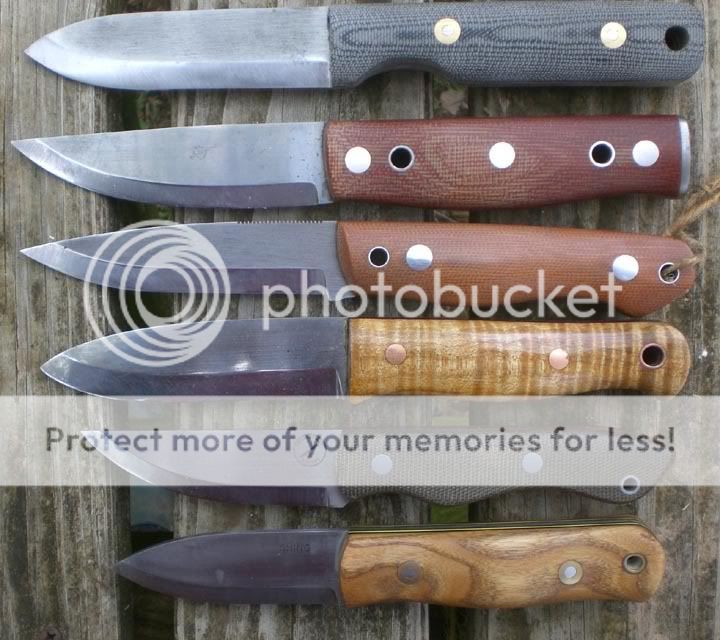
Hey earlier today we were talking about the profile from the top of the Skookum Bush tool. it's second from the left.
now some of my bark river convex ones cut as well though.:thumbup:
lineup3.jpg

lineup.jpg

lineup2.jpg
 
Wow I am really happy with the response guys.

Remember though I modded the SS4 with a MUCH thinner zero(I don't really like the term skandi) edge that is quite similar to the edge on the Skookum other than it is higher and flatter. Busse knives generally come with awful edges.

I am definitly not trashing the Skookum. I actually gave it a higher mark than the SS4.
The only real advantage the SS4 has(once you put a good edge on it) is the nice comfy
handle and very good steel that can take lots of abuse.

I do know that that most people consider bushcraft skills mostly wood working and that might be true in the little parks in Europe but here in real wilderness where we still have people eaten by wolves(there was just an inquest about that a couple months ago in my town) they also get used as hunting and skinning knives and even put to work fixing skidoos. The Skookum is actually very good for those types of jobs as well and both knives work great with lighter weight leather gloves.


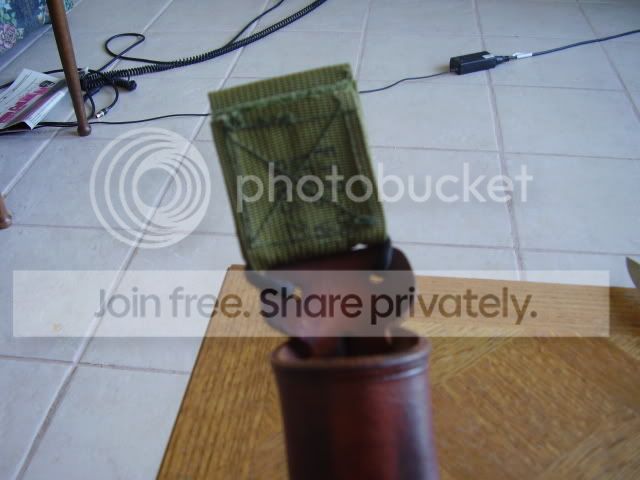
While I found the Skookums sheath strange I rather like it and it works well.
I am looking forward to seeing how well it handles snow and melting snow with that coating. I am even coming around to the tongue now that I rigged up a belt loop.
P8050019.jpg


I don't mind the no guard or choil at all. A little bump to let your hand feel where the edge starts is nice but i like being able to use the edge like it is meant to be.

The point on the Skookum is fantastic. I can't say enough good things about it.

I love the Pilots survival knife. Mine has a really good zero edge HornDog put on though.
It also has a pommel like the Skookum and decent edge geometry. Remember the Skookum costs 5 rimes as much.
 
I had JRE make me a regular sheath for mine cause I like something that it is real easy to get the knife out of.
 
I am paranoid about losing my knife especially on the quad or snowmobile.

That is a beautiful collection of knives Hollowdweller.I especially like the one below the Skookum. It looks like it has everything I would want in a hard user skandi.
I also like anything done by Shing. He has a great style.

I should have used my Rosarms Companion2 as well in this test but it is a little smaller
than the SS4 or Skookum and has a secondary edge.

I would love to see a review of a 3V skookum if anyone has one?
 
Back
Top