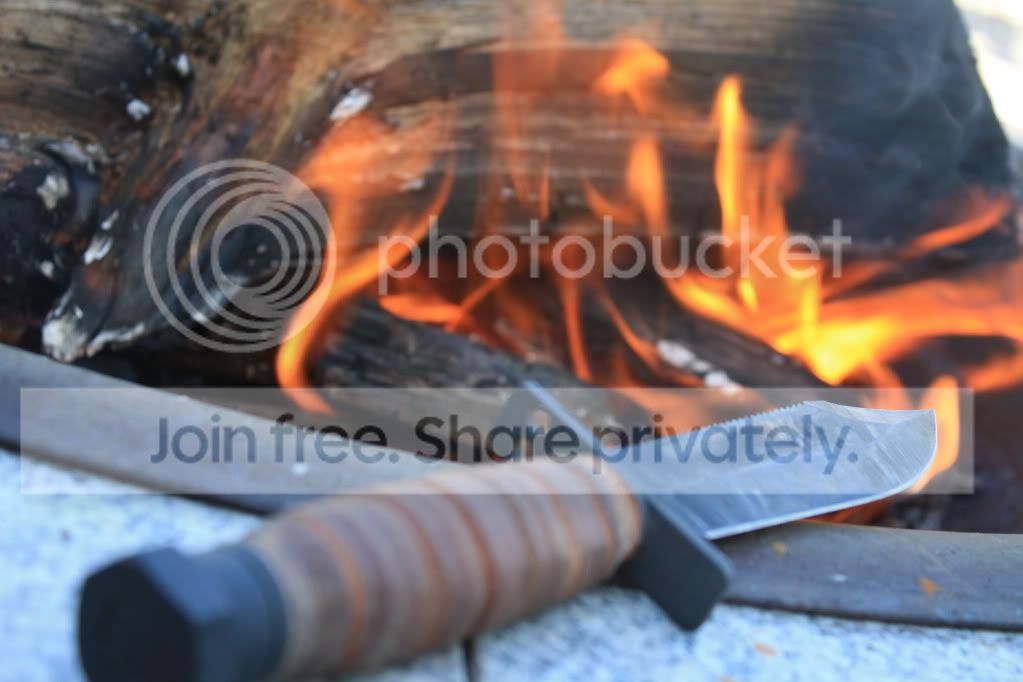
Camillus Pilot Survival Knife

I guess we all have our own idea as to what constitutes a "survival knife". The OP knife is indeed a purpose designed knife meant for downed military pilots, etc.

Yes, the edge geometry isn't the best for a lot of other purposes. Yes, the construction isn't the best for a lot of other purposes. This is why designers and makers are constantly coming up with their own versions of the ideal survival knife.

Very few of them are totally wrong or inadequate as long as the user is skilled and knowledgeable enough to stay within the design parameters of the knife and it's materials and construction.

For those who think a sheath knife should be able to perform tasks far outside of those traditionally expected of such a knife, there are knives made especially with these uses in mind.

I don't recall ever having broken a fixed blade knife. My son inlaw broke one of my stick tang fillet knives butchering a deer with it. He broke the blade in half. I have a box of broken fixed blades that came from the old Schrade factory auction. Every one of them has a blade broken in front of the tang.

The OP knife does have a thicker blade and edge than most people like these days. Thick knives aren't good slicers. Thin knives aren't good choppers. Most of either thickness are not good pry bars or log splitting wedges.

Like what you want and use what you like! :p
 
It is a good knife that will do anything you should ever require a knife to do. Not much more can nor needs to be said. Well, this: the edge needs work at the start. A lot of work.
 
Codger and Rockspyder summed it up perfectly I think... I've never tried using the blade to evac from an aircraft, though the sawback can be used for notching or scraping tinder for a one stick fire. It has it's uses... you can still baton it, so I really don't understand peoples' arguments with batoning being a factor with sawback blades.
 
In response to an earlier question, while I have not used nor seen one used to cut through the skin of an airplane with the spine, I have seen on youtube a guy saw through a 16d nail with one. So if it will do that, it shouldn't have a big problem sawing an aluminum aircraft skin. Might take a while, though.
 
i did some field testing (more like lawn testing live in the middle of a big city) and as you have all for the most part repeated i it did the job and did it right but it just didnt wow me as you guys said. i was able to split a little wood open a can and start a fire. was it the easiest? no, but it did the job. the thing i was most shocked about was the carving. my friend never used the knife so it had a completely factory blade. i stropped it a fiew times when i got it but i wanted to check it out before i ground the crap out of it. i couldnt hardily carve the bark of a green piece of ficus. all i have to say is i feel bad for anyone who had to make a dead fall or any other carving for that matter. but anyway thanks for all the help guys :D
IMG_0884.jpg
 
The saw teeth were meant solely for cutting through the skin on a downed plane or chopper. "Sawing on a 4" peice of dry Hickory could become a new lifetime hobby. :)

The knife performs it's design functions very well, that's how and why it got accepted. looking "kewl" or having a designer label was never part of the requirement.

It was not designed to substitute for a heavy pry bar or an axe or a scalpel. most Military downed aircrew 'survival' scenarios are resolved in a day or two, if not hours.

It's a modified Marble's "Ideal" pattern, same as the KaBar. With all the same pluses and minuses.

As was mentioned earlier, losing the top guard, cutting the bottom guard in half, reprofiling the edge and sanding the coating off the blade makes one a better and more useful GP woods knife.

The knife was tested and accepted in the pre-MacNamara days, and Camilus was NOT the lowest bidder. The highest priced entry was by Marbles, a work of art, 6" blade and saw teeth that would cut wood as well as thin aluminum. I managed to buy ($50, 1958 ) a Marbles version from the tests, and it currently lives with a Navy Corpsman I owed big time, but I get it back if he dies first! :)

Dumbest thing about them are the holes for lashing it to a stick to make a spear, better to use the knife to sharpen the stick and use it for a spear. Keep the knive close.

If the only tool you have left is a knife you're already in deep KimChee and don't want to risk losing it!

Not my favorite knife by a long shot but my modified Camilus has seemed to find it's way to my belt whenever I head for the woods, been that way for 50 years or so. saves a lot of wear and tear on the thinner bladed slicers that I prefer.

No complaints.

If you do not have a sheath with the metal backing plate ... get one ...the knife has a bad habit of cutting through the all leather ones.
And yes the presence of the saw teeth create the expected weakness in the blade, if she breaks it'll be in that area 99/100 but it still takes a lot of abuse to do that.

JMHO as always and IIRC, but I was there at the time. :)

PS: like Kabars, the edge as issued was dull, (safer handling and kept costs down) recepient was expected to sharpen it to his own standards.

Regards,
:) ...
 
Last edited:
Its the knife my wife chose. I told her I would buy her any knife of her choice, or she could pick one from my horde of knives. Whatever she wanted ( I was a, um, oh, negotiating :D) She went through my Beckers, Kabars, ESEEs, and an assortment of other production blades. She chose my Cam Pilot's knife. She said the handle fit her hand, she liked the blade length, and being able to pound stuff with the pommel. I did have to mod it and I am working on a sheath for her. I took the top quillion off, and blended it into the transition. I took the bottom to about half the size and buttered all the edges. Its what she wanted. Negotiations went well :thumbup:. Moose
 
what would happen if i put leather conditioner on the handle would it keep it from cracking? the desert tends to do that to old leather. and yah i have the metal backplate on my sheath, good to know.
 
I used Mink Oil to condition the handle and sheath of mine...but I was conditioning against a rain forest. There may be better options for the desert maybe someone else will chime in on that.
 
The handle was too small for my hand and the hexagon pommel was uncomfortable. The overlong guard needs to be a lot smaller. It's not a bad blade but it needs help to make the most of it. Think of it as a Marbles Ideal "improved" by a committee. I wouldn't recommend it.

Frank
 
what would happen if i put leather conditioner on the handle would it keep it from cracking? the desert tends to do that to old leather. and yah i have the metal backplate on my sheath, good to know.

I'm in high desert just a few hundred miles NE of you. Climates murder on leather handles isn't it?

Depending on the condition of the washers, I've used a tiny bit of lexol or neatsfoot oil , use it very sparingly.

Last ten years or so, I've used regular mineral oil (Food grade from any pharmacy, wally world, etc) also very sparingly, don't want the leather to get soft on you. Then I've been backing up a hundred years or so and giving it some boiled linseed oil, very light, let it dry and repeat three or four times. Just like in finishing a gun stock, very light amounts.

Do it right and the leather will fill out and the linseed oil will slowly harden up to seal everything. Takes a while though! as in weeks minimum, longer if you put on too much of anything.

I use the very light linseed oil application on the sheath too, stiffens it a bit, The issue ones are/were all made of very poor and soft leather.

That's just what seems to work for me in a similar environment to yours./

Bound to be other folks here that know better ways.

BTW, the brand on the blade 'aint necessarily so' major U.S knife makera have always helped each other out. I know of two knives bought from Camilus, in the regular Gov. issue packages, all labeled Camilus, but the blades are stamped ... Ontario!

My guess is Camilus was lending Ontario a hand filling contracts and ended up with a surplus.

Had the Ontario style sheath in the pkg too, both knives were dated 1980.

As always , JMHO.

Regards,
:) ...
 
Last edited:
I used Sno-Seal brand leather sealer on the leather handle of mine. Worked great. Or seems to have, so far. Applied it with my hands, laid it in hot summer sun, and then wiped off excess, best I remember. In the absence of hot summer sun, you could probably use an oven on its lowest setting. Just don't forget it is in there.
 
+1 for neatsfoot oil. That is my standard leather conditioner. I just found out that the stuff is made from cow shin bones:barf:, hmmm, maybe I'll switch to something else...
 
All one really has to do with this knife to make it very much better is to re-profile the edge.

I spent alot of time thinning the edge and sharpening it and it reallly becomes a different knife.

Many here have modded them in all sorts of ways. It worth the $$ and it's US made.
 
I have a fairly recent AFSK from Ontairo...about a year old. I have ground the guard, and ground off the saw teeth. I find it much more friendly in the hand that way.

There are two issues though, that I would like advice on addressing with it:

1.) After some batoning, the leather handle has become loose. It can be twisted a little up near the guard. Is there an oil or heat treatment that can fix this? Should I try to use epoxy between the handle and the guard, or wrapping some thin cord in there to tighten it up?

2.) I recently picked up a Mora #1 and have fallen completely in love with the Scandi grind... is it hard to re-profile the AFSK to have a flat scandi grind? It seems convex on the primary grind. Is this something only professionals can do?

Thanks!
 
Back
Top