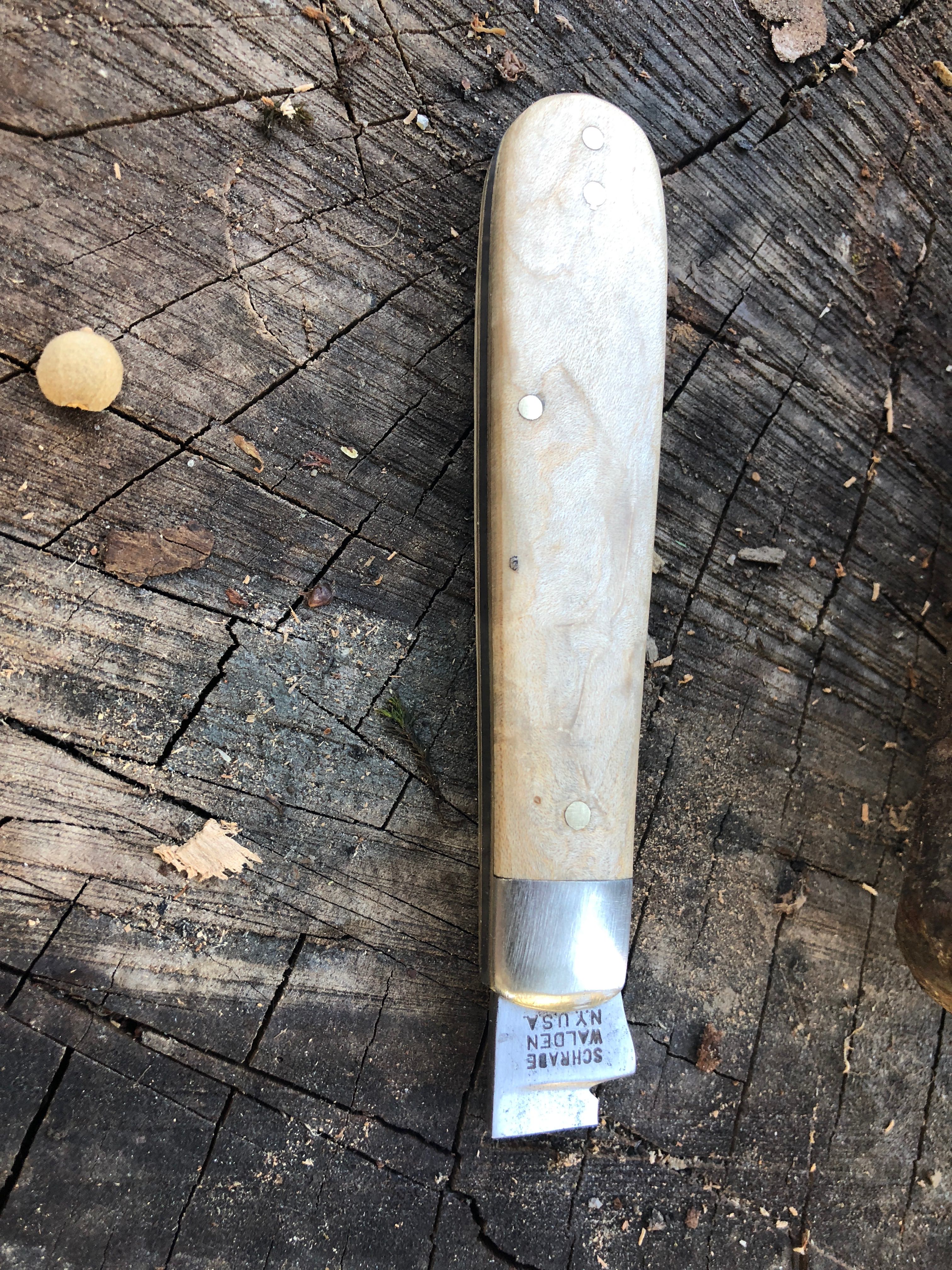
Can we talk about crinking?

Joined
Jul 10, 2017
Messages
32

(I mistakenly posted this on the general discussion board first)

This knife came out when I decided to breath some life into it.
It had a broken scale and no snap left in the blade.
I thought I could regrind the base of the tag to sharpen it up a bit and give it some snap and make a nice carry knife since the blade had some life left in it.
Plus, I liked it. Everything went fine.

As some of you know these Schrade knives use a Swinden Key Pivot, so I decided to drill the bolsters and put it together properly (in my humble opinion).
OK. These are all common practices for knife makers.........

When the knife is as you see it now, about 80% done, i decide the blade isn't centered and I can fix that right up.
I know a bit about crinking but haven't had much luck with it so I decided to put a little bend near the tang (I've had success with this in the past).
As I was applying pressure I knew it was a bad idea. It was.

I've searched the forum and the net and have found a few example and references to crinking, but was wondering if someone out there has experience with it or still does it to a degree that they can actually show or explain their process.

Propping up blade, supporting points, how hard to hit.

Please share your wisdom on this seemingly lost art.
Reaching out.

Thanks all.
Rob.
 
You and I can talk about it, but few others even know what it is!
How hard? Not as hard as you hit!
Some blades are just harder than others, and you always run the risk of breakage when you flex them.
 
Current factory practice is to soften the tang a bit more than the blade to facilitate straightening and crinking.
They put a localized heat to the tang area to bring it to spring hardness.
Hoss
 
What I’m interested in is hearing from someone who has some experience as to where to place the supports and what part of the blade we are trying to actually adjust. I’m am thinking the adjustment is right where the blade and tang meet.
Where to support.
Where to hit.

To be clear though, I broke this blade trying to bend it, not crink it.
Lesson learned (maybe).
Thanks.
 
There is a video series of GEC where the guy crinks a blade during the shop tour. I dont have data nor time to hunt the video down now.
 
I have used a hammer to straighten a blade befor. Little taps on the inside of the bow and she straightens our.
 
Generally it's more for multi-blade slipjoints, where you might have a blade on each end of the same spring. You "crink" or bend the blade at the tang slightly so that the blades don't rub or touch in the closed position. Often, the blade grinds will favor one side or the other as well. I've never really seen it used on a single blade folder as shown above, as any off center issues are usually the result of a tweaked liner, or out of square holes. If the blade DOES get bent off center, I would think it could also be straightened back, but I'd still give it some heat first.
 
've never really seen it used on a single blade folder as shown above, as any off center issues are usually the result of a tweaked liner, or out of square holes.

You’re probably right about the holes. I drilled new pivots in the bolsters and am probably a thousandth or two off.
Still, I’ve often wanted a slight tweak to the blade. I know it’s nothing to be slightly off center but you can’t always let it go.

I’ll just stick with trial and error unless someone pipes up.
If I manage to get it figured out I’ll I’ll let you guys in on the secret.

Rob.
 
I don't think there is a catch-all formula. When cutlers employed by manufacturers crinked a blade, there was a specific place to hit, and a specific time to do it.
With varied cutlery, there is no way to know- so you just use your best judgement.
 
I don't think there is a catch-all formula. When cutlers employed by manufacturers crinked a blade, there was a specific place to hit, and a specific time to do it.
With varied cutlery, there is no way to know- so you just use your best judgement

This is good advice!
If your standing in the factory you know a little bit more about what’s happening.
Think it’s best to not have to do it in the first place.
I think I’ll try planning and patience early and try to avoid this entirely.

Thanks all.
Rob.
 
Back
Top