Carter Cutlery intensive course

HSC ///

Gold Member
Joined
Nov 7, 2012
Messages
4,734
So this week I'm in Hillsboro Oregon where I have to opportunity to take an almost week long class with Murray Carter.

Yesterday was the first day and we worked on a neck knife. We went all the way to hardening/quenching. It's a bit difficult to take pictures throughout the course and still maintain full focus but here are a few of Monday. My write up is sparse but feel free to ask any questions if interested and I'll do my best. Obviously I'm a fan of Murray Carter's work, that's why I'm here. I've owned several of his knives.

Details of his class are here. - http://www.cartercutlery.com/japane...intensive-course-includes-100-101-201-and-301

I'll try to highlight the important steps learned. But first let me take a selfie :-)
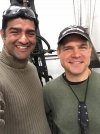
ImageUploadedByTapatalk1449589736.995273.jpg

Murray is an interesting fellow and passionate, proud and outspoken about his work. In his own rough words, his mouth doesn't quite have the filter it needs.
Murray shared some personal experiences and difficulties that he has overcome with our class of 4 total. A gentleman from Hong Kong, and one from West Virginia and the other from Boston.

Murray has also made a real success of his business model and at significant sales per month (Murray shared the figure with us) , his customers clearly like his knives. Murray now has 7 apprentices, a personal Asst and a front office man. They know need about 4000 sq ft of workshop and more equipment

I'm using tapatalk so I hope this works

Charcoal forge
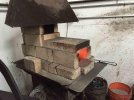
ImageUploadedByTapatalk1449590079.084261.jpg

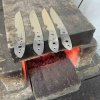
Hitachi white steel bar heated up and sheared into size for our neck knife project
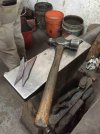
ImageUploadedByTapatalk1449590213.851046.jpg

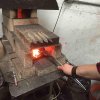
Heating up blank during power hammer forging step

ImageUploadedByTapatalk1449590262.542270.jpg

Cooling in rice ash similar to vermiculite
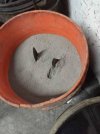
ImageUploadedByTapatalk1449590321.420457.jpg
 
Last edited:
More of day 1

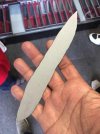
The blank after hammering and cooling in the rice ash, sandblasted to remove the scale. This blank has the tang tapered and slight taper towards the tip. The bevel is not shaped on the hammer
ImageUploadedByTapatalk1449590433.358531.jpg

Ready to trace pattern
ImageUploadedByTapatalk1449590553.621883.jpg

Profiled, Checking for straightness
ImageUploadedByTapatalk1449590513.968794.jpg

Messed up on the small wheel and removed too much material. So we peen repaired to move the metal Murray was steadfast in making sure we made a full faithful reproduction of the pattern and would not allow us to deviate. This was training on purpose to push us to know that we could
ImageUploadedByTapatalk1449590576.316539.jpg

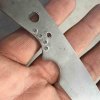
We drilled holes and then clay coated for the quench cycle which would be in water
ImageUploadedByTapatalk1449590713.885197.jpg
 
More on day 1

Since we are making 3 knives this week, the first day Murray was very hands on with us. By the end of the week and third knife we are supposed to do most of the steps on our own.

Harden and Quench cycle
ImageUploadedByTapatalk1449590912.387622.jpg

Stay with this video till the end when he quenches in water
https://vimeo.com/148237954

So what did we do that was important that Murray wanted to convey? The primary purpose of the first day was to refine the grain structure of the metal. That was the most important takeaway in making the best blade edge. We used successive heats starting with the hottest and then lower and lower temperature for each hammer forging step. The time and temperature control was very crucial.
 
Last edited:
Very Cool! Thanks for sharing your experience! Excited to see the remaining steps in creating the final product. Would love to some day make it out to Oregon and take one of Murray's classes.
 
interesting that you did not forge to shape. does Murry?

The main focus of the forge cycle is the grain structure refinement, not much else seems to be that important. We forged the tang taper and 20% taper on the blade side to the tip. The rest gets trimmed away. This is a small 3-3.5" blade and 1/8 thick so no bevels were forged in. This is how Murray forged this style of blade.

When Murray forged his blade , the shape of course looked much closer to the final overall shape.
 
Day 2 of the class was to finish the neck knife we had started
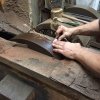
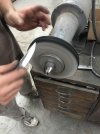
Murray began with bevel grinding on the rotating waterstone which is about 36 grit and makes a hollow grind.

He was amazingly fast and seemed to grind in just a few minutes. The stone throws up quite a bit of water so the blank never really gets even warm. We also practiced in the stone with mild steel blanks

ImageUploadedByTapatalk1449626616.327438.jpg

https://vimeo.com/148302662

ImageUploadedByTapatalk1449626685.093009.jpg

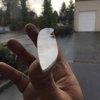
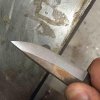
We then see if the blade will cut steel to check the hardness. Here I am shaving the edge of a steel table.

ImageUploadedByTapatalk1449626724.446742.jpg

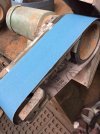
Then Murray finishes the bevel grind flat with 120 grit here on the wide belt

ImageUploadedByTapatalk1449626761.348619.jpg
 
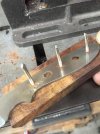
Murray literally has tons or ironwood he purchased. So then we went into handles and he peens the pins for fastening along with epoxy

ImageUploadedByTapatalk1449626849.059094.jpg

Rough shaped handle
ImageUploadedByTapatalk1449626941.621983.jpg

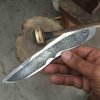
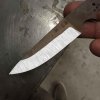
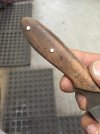
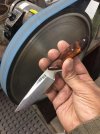
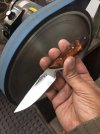
And the final product after hand sharpening on a waterstone
ImageUploadedByTapatalk1449627182.149990.jpg

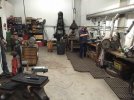
A look inside his shop
ImageUploadedByTapatalk1449627000.335962.jpg
 

Attachments

  • ImageUploadedByTapatalk1449626980.125058.jpg
    ImageUploadedByTapatalk1449626980.125058.jpg
    34.5 KB · Views: 87
bevel grinding with that wet stone looked interesting. ended to have a pretty aggressive speedbump on it. that would drive me nuts.
 
bevel grinding with that wet stone looked interesting. ended to have a pretty aggressive speedbump on it. that would drive me nuts.

Yes midway Murray stopped and checked for high spots and dressed the stone. That thing takes some getting used to, I can tell u that. :-)

But it was pretty amazing how quickly he was able to grind the bevels, I think it was in like 3 to 4 minutes Or at least it sseemed that way
 
so is the bevel grind left at 120 grit for the finished product?

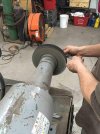
Yes 120 is the final because his knives are essentially working knives are meant to be used. The bevel is then polished on the buffer with green compound. So 120 and then polish buff.
ImageUploadedByTapatalk1449678188.876671.jpgImageUploadedByTapatalk1449678200.246349.jpg
 
Last edited:
Great posts H. Really enjoyable reading. I hope you guys aren't too slammed with rain up there. Bring some back to Cali please.
 
Very cool :thumbup: Your neck knife lturned out great, thanks for sharing. :)


Interesting that he's gone back a bit to the white steel.

Don, did you mean to say it's interesting that he went back to blue super, as opposed to soley using white steel? I saw on FB or somewhere (newsletter maybe?) a little while back that it's because he wants his apprentices to have the chance to work with both steels, or something along those lines anyway ;)

~Paul

My YT Channel Lsubslimed
... (It's been quite a while since I've posted any new vids)
 
Very cool :thumbup: Your neck knife lturned out great, thanks for sharing. :)


Don, did you mean to say it's interesting that he went back to blue super, as opposed to soley using white steel? I saw on FB or somewhere (newsletter maybe?) a little while back that it's because he wants his apprentices to have the chance to work with both steels, or something along those lines anyway ;)

~Paul

My YT Channel Lsubslimed
... (It's been quite a while since I've posted any new vids)

Had a break for lunch and showed this to Murray. The FS1 model is blue super steel because they had some leftover. All other knives are essentially all white steel now and In the future. I think Murray may have a video out that explains his thinking to Goto white steel completely. Sorry for the rushed answer but gotta get back to class
 
Last edited:
Back
Top