Carter Cutlery intensive course

Very cool :thumbup: Your neck knife lturned out great, thanks for sharing. :)


Don, did you mean to say it's interesting that he went back to blue super, as opposed to soley using white steel? I saw on FB or somewhere (newsletter maybe?) a little while back that it's because he wants his apprentices to have the chance to work with both steels, or something along those lines anyway ;)

~Paul

My YT Channel Lsubslimed
... (It's been quite a while since I've posted any new vids)

That's right, I was remembering incorrectly. Thanks.
 
Sure no problem, Don. :)

Had a break for lunch and showed this to Murray. The FS1 model is blue super steel because they had some leftover. All other knives are essentially all white steel now and In the future. I think Murray may have a video out that explains his thinking to Goto white steel completely. Sorry for the rushed answer but gotta get back to class

I like that you showed this to Murray haha, thanks for helpin us figure these things out. ;)

And so you don't take away any of your extra learning time, I'll post that video you're referring to right here for anybody who's interested. :)

[video=youtube;aXlgtpjSyM0]https://www.youtube.com/watch?v=aXlgtpjSyM0[/video]

Hope to see some WIP shots of your kitchen & camp knife builds as well!

~Paul

My YT Channel Lsubslimed
... (It's been quite a while since I've posted any new vids)
 
Sure no problem, Don. :)


I like that you showed this to Murray haha, thanks for helpin us figure these things out. ;)

And so you don't take away any of your extra learning time, I'll post that video you're referring to right here for anybody who's interested. :)

[video=youtube;aXlgtpjSyM0]https://www.youtube.com/watch?v=aXlgtpjSyM0[/video]

Hope to see some WIP shots of your kitchen & camp knife builds as well!

~Paul

My YT Channel Lsubslimed
... (It's been quite a while since I've posted any new vids)

Yes that's the video. Thank you
 
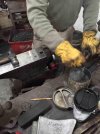
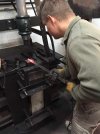
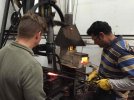
So day 3 the task was to learn forge welding and make a kitchen knife

Murray did The forge welding as its a very tricky process

On the anvil is a piece of white steel
ImageUploadedByTapatalk1449723300.076195.jpg

Murray split the outer piece and forge welded the inner white steel

ImageUploadedByTapatalk1449723515.034498.jpg

https://vimeo.com/148451440

Then we were guided into hammering out own piece into rough shape

ImageUploadedByTapatalk1449723652.218672.jpg
 
Last edited:
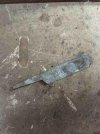
I forged this piece
ImageUploadedByTapatalk1449723764.942185.jpg

Then into this

ImageUploadedByTapatalk1449723787.303855.jpg

We traced out our pattern
ImageUploadedByTapatalk1449723825.639780.jpg

Annealed and cold forged
ImageUploadedByTapatalk1449723946.000070.jpg

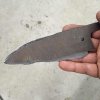
A lot of time spent straightening and checking for straighteness. Hard to do
 

Attachments

  • ImageUploadedByTapatalk1449723981.217878.jpg
    ImageUploadedByTapatalk1449723981.217878.jpg
    59.9 KB · Views: 56
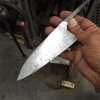
Then flap sander and buff polish the blade
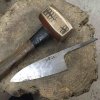
Put on a traditional Japanese pre made handle
ImageUploadedByTapatalk1449724597.429914.jpg

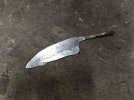
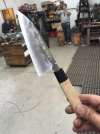
Sharpen and there it is

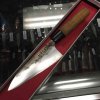
ImageUploadedByTapatalk1449724618.372191.jpg
 
This is murray hardening and quenching. He likes to turn off all the lights and do this in the dark so he can see the colors
https://vimeo.com/148452979

This is murray tempering using the traditional technique of water sprinkling to check the temp
https://vimeo.com/148453063

The tempering is done immediately after the water quench.
 
Last edited:
Good stuff.

What was the second steel forge welded to the white steel?

The second steel is a Mild steel

"Kuro-uchi: Traditional rural Japanese cutlery. These knives have a White Steel Core and are laminated with Gokunan-tetsu."

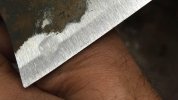
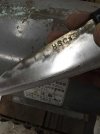
You can see the lamination line here
ImageUploadedByTapatalk1449762916.483930.jpg
 
Last edited:
Hope this isn't a derail. Wouldn't laminating mild steel result in carbon diffusion resulting in an edge with only .7 or .8% carbon? Unless a nickel layer was used in between? Maybe it's not at heat long enough to diffuse than much?
 
I've wondered for a while. Murray is importing his white and blue steel, but what about the mild steel used for the outer layer of san mai? I know he really likes the Japanese techniques and materials, just curious if he has a preference for Japanese mild steel as well.
 
Hope this isn't a derail. Wouldn't laminating mild steel result in carbon diffusion resulting in an edge with only .7 or .8% carbon? Unless a nickel layer was used in between? Maybe it's not at heat long enough to diffuse than much?

Murray says that you are correct. We did not heat long enough for this to be an issue. We had max 4-5 heats. Also his charcoal forge is carbon rich. You could have the carbon diffusion with too many heats.
 
Murray says that you are correct. We did not heat long enough for this to be an issue. We had max 4-5 heats. Also his charcoal forge is carbon rich. You could have the carbon diffusion with too many heats.

Makes sense. I've been using 15n20 between the core and outer layers so far, and have ordered some nickel sheet to be on the safe side. I might try one without and see how it turns out. :thumbup:

Edit: I looked it up in Verhoeven, and you would have to be at heat for minimum 18 minutes to affect the steel in a noticeable way. At 2100f, carbon can move 1mm in 18 minutes. I'm not sure how much lower one can go welding mild steel. An experienced smith would know. Your core probably starts off at 3mm+, so to affect the inside 1mm, the outer carbon would have to move first. This is oversimplified, as the steel gets thinner as its forged, but time to heat decrease as well. An experienced smith should have no problem with mild steel on a core with 1.2% C, especially with a carbon rich forge, or the right atmosphere in a propane forge.
 
Last edited:
So day 4/5 is used to make our third knife of our own design.

In working with Murray he is quite rigid at times in preserving the traditional Japanese bladesmithing methods. There is no deviating. He's also adamant about what he wants to teach/convey. He cautions us not to be married to our product but to appreciate the journey.

Murray's done a nice job with his apprentices I spoke to them individually to get a sense of who they are and their Interests. I would say Murray is a good leader in that he makes those around him better and that makes his company better. That's a philosophy I've learned and followed myself in management

Again Murray is proud of his knowledge and experience and is convinced traditional Japanese bladesmithing yields a superior working knife.

Murray's skills in forging, heat treating by eye are quite amazing. He can see things with his eyes that would take an average person a long time to gain that acuity. His eyes may well be his greatest asset in this sense.

I'm sure his methods can be considered unconventional and can be debated vs modern methods. But I don't think Murray cares in that he is trying to preserve traditional techniques and perhaps doesn't think the modern methods are better, just full of compromise.
An example of this is his the requirement to quench in water which would be the most extreme severe quench but the one that yields the best edge. The dictum paperwork on the hitachi steel they sell says - "Tip , we recommend using vegetable oil to reduce the risk of cracks...."

Overall Murray is a like-able guy and he and I share similar values and it's hard to argue with a guy who has made 23,000 blades and made a real success of his business.

In this final knife exercise the mission was to design a useable knife for ourselves and be able to justify the use(s). We also had to make the knife exactly to our design pattern and there was no deviating. This was a challenge for me as I like to have some freedom throughout the process but Murray insisted that we had to make a faithful reproduction of our design.

I tried hard not to be belligerent and fight him on this :-)

Edited- I deleted my earlier comment in after talking to Murray and getting clarification decided I wouldn't be able to articulate his opinion in my own words and so it's best left unsaid

 
Last edited:
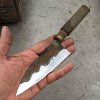
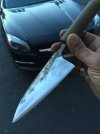
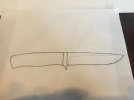
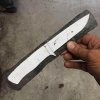
We started day 4 with working on our individual designs. We had to present our design and justify its use to the rest of the class. Mine was nothing revolutionary. A simple utility knife that I will use when backpacking , hiking etc. Blade size of about 4 1/2 " with guard

ImageUploadedByTapatalk1449848319.837995.jpg

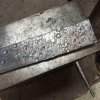
I had brought my own Suminagashi that I had purchased from Dictum. Murray had suggested I use it under his guidance and that made sense to me
ImageUploadedByTapatalk1449848363.359429.jpg

ImageUploadedByTapatalk1449848571.181602.jpg

We cut to size and then I hammered it for effect
ImageUploadedByTapatalk1449848606.614922.jpg
 
very cool, thanks for posting this. The traditional techniques are sooo interesting to read about.
 
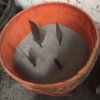
Then we hammered it to size over a few heats. The key being to use progressively lower temp heats. Then annealed and into the rice ash

ImageUploadedByTapatalk1449848812.668810.jpg

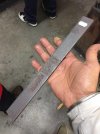
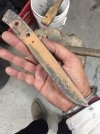
After pounding to correct thickness and tapering the tang
ImageUploadedByTapatalk1449848851.455269.jpg


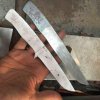
Trace out and cut to the pattern
ImageUploadedByTapatalk1449848863.544631.jpg

Also cold forging and straightening

After my eye surgery earlier this year I have trouble seeing In low light and Murray's shop is not brightly lit like mine so I messed up the bandsaw cut and made my blade depth shallower than the pattern. We cold forged it out a bit to fix my mistake.
ImageUploadedByTapatalk1449848908.920242.jpg

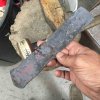
Drilled holes, dipped in clay hardened, quenched and immediately tempered. Done for Thursday.
ImageUploadedByTapatalk1449849583.037201.jpg
 
Last edited:
Excellent post btw! Thanks for taking time to document and share you experience. A great look into the Carter extensive class. Can't wait to see how your design turns out.
 
I would love to go to one of his classes. Its funny but I actually met his mother a few months ago at a craft show I go to.
 
Back
Top