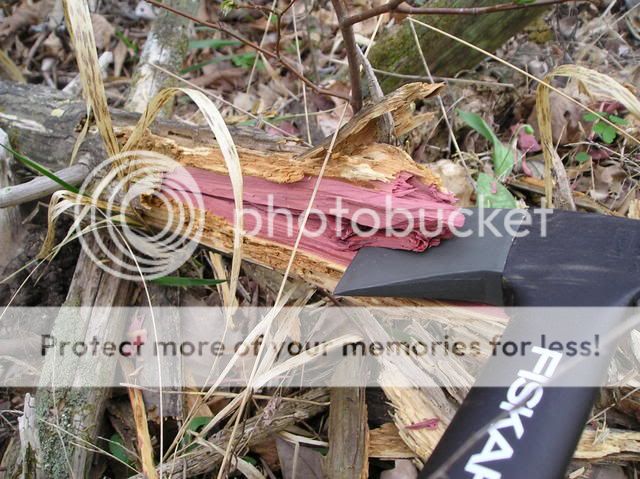
Cedar?

Joined
Sep 22, 2003
Messages
13,182
Not sure how it will hold up but I had this Bushcraft blade that I put too thin scales on so I thought I'd change the scales. Tried this cedar. We'll see. I think I maybe need to put some sort of coating on it but I like the way it looks.
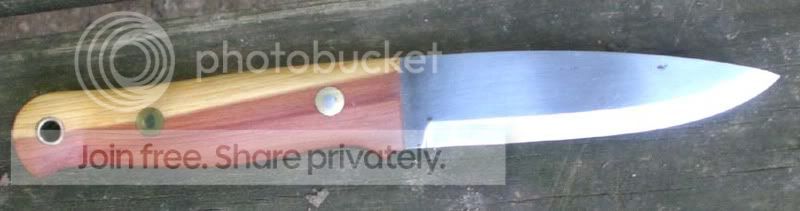
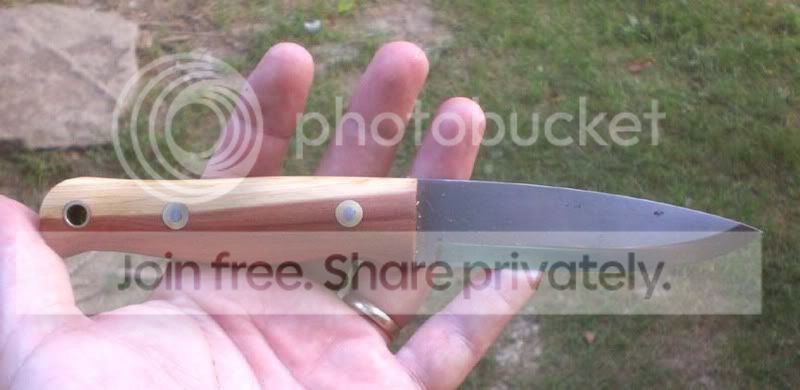
c2.jpg

c1.jpg
 
That's snazzy, HD, I have a few pieces of scrub cedar I use for peace pipe stems, I wondered if the cedar would hold up too. Nice work: )

Mark
 
Looks great and if my memory serves me right I believe that Ceder is naturally very rot resistant !!!!
 
hollow, nice looking knife there.

i have a couple of big pieces of cedar closet lining that i was thinking about making into some handle scales...

it seems pretty soft, and fell away under a knife like butter...but i wonder if some good treatment might make it alright for a knife. thinking about it, as long as the wood is treated to resist water and dry enough to avoid warping/cracking, it doesn't really have to be very hard to hold up to average knife uses...

when i first started putting handles on knives i made out of a shovel around 6 months ago i used soft pine...it was fine and easy to work. the blades didn't hold up so well, but...it was good practice for shaping handles anyways.
 
Looks good, HD. I love the look of (red) cedar myself, which is good since it's the most common around here. Sapwood generally isn't great structurally, but in a showcase piece like you've done the contrast is really striking.

Cedar's pretty soft though so I'd treat it for sure. I haven't used it for scales, but I have used it for file handles because it's soft enough that you can jam the rat tail into it without it splitting (with predrilling though) and it's soft enough that it only takes a few minutes to shape it.

You can make it a little more durable by treating it with a product called CPES (clear penetrating epoxy sealer). It should be easy to find in a hardware store if you look for liquid (not paste) rot repair formulations. Sorta like down-and-dirty home stabilizing...

Just be sure to get the natural oils off the surface so it'll be able to penetrate. A wipe with acetone will do it. If you warm the wood as well, the pores will open and the epoxy will penetrate better.

It's definitely a 'duct tape and bubblegum' approach to rot restoration but ideal for this sort of thing.

IMHO of course.
 
probably the ideal would be to send the cedar scales to be stabilized but if they mess up I'll just put new ones on.

I've been getting into this two toned effect lately:D I've got a big bushcraft blade from Shing I have some two toned Desert Ironwood I'm gonna use on it:thumbup:
 
Looks good, HD. I love the look of (red) cedar myself, which is good since it's the most common around here. Sapwood generally isn't great structurally, but in a showcase piece like you've done the contrast is really striking.

Cedar's pretty soft though so I'd treat it for sure. I haven't used it for scales, but I have used it for file handles because it's soft enough that you can jam the rat tail into it without it splitting (with predrilling though) and it's soft enough that it only takes a few minutes to shape it.

You can make it a little more durable by treating it with a product called CPES (clear penetrating epoxy sealer). It should be easy to find in a hardware store if you look for liquid (not paste) rot repair formulations. Sorta like down-and-dirty home stabilizing...

Just be sure to get the natural oils off the surface so it'll be able to penetrate. A wipe with acetone will do it. If you warm the wood as well, the pores will open and the epoxy will penetrate better.

It's definitely a 'duct tape and bubblegum' approach to rot restoration but ideal for this sort of thing.

IMHO of course.


Thanks for the tip sounds cool.

Speaking of rot resistant every now and then i'll see some hunks of non wormy American Chestnut and I think it would be cool to make some scales out of.
 
Some eastern red cedar has sections of wood that are very tight grained. I found some old tongue and grove red cedar in my barn when I bought the property. Several planks caught my attention. Back when it was a tree something had damaged one half of the trunk down to the heartwood. The other side of the tree had responded by growing slower and denser to support the tree's weight. When the tree was cut into boards some of the boards had one damaged side and one side that was blood red and very tight grained.
Eventually I had one of the boards planed down and glued to a clear section of second growth white hickory. The resulting long bow was almost unbreakable, good looking and had an excellent cast. I hunted with it for many years and it was both weather and wear resistant. A similar piece of tight grained red cedar would make an excellent knife handle.
 
Some eastern red cedar has sections of wood that are very tight grained. I found some old tongue and grove red cedar in my barn when I bought the property. Several planks caught my attention. Back when it was a tree something had damaged one half of the trunk down to the heartwood. The other side of the tree had responded by growing slower and denser to support the tree's weight. When the tree was cut into boards some of the boards had one damaged side and one side that was blood red and very tight grained.
Eventually I had one of the boards planed down and glued to a clear section of second growth white hickory. The resulting long bow was almost unbreakable, good looking and had an excellent cast. I hunted with it for many years and it was both weather and wear resistant. A similar piece of tight grained red cedar would make an excellent knife handle.

What a great story:thumbup:
 
HD that looks great.

One thing I had thought of is over here on oz the building industry sometimes used western red cedar for house cladding and due to it's chemical make-up we have to use specific nails.

From http://www.wrcla.org
"Hot-Dipped galvanized, aluminum and stainless steel nails are all corrosion-resistant and can be used to nail Western Red Cedar. Other types of nails are not recommended. They can rust and disintegrate and react adversely with the natural preservative oils present in cedar resulting in stains and streaks. Copper nails also react with cedar and should not be used. Stainless steel nails are the best choice, especially if the siding is to be finished with transparent stain. Use No.304 stainless for general siding applications and No.316 for seacoast exposures."

Just in case it affects the blade in a detrimental way.
 
That looks great, man. I have always loved cedar, especially in a camp fire. There's a lot of pretty red stuff around here.
P8030041.jpg
 
Gotta agree with Spooky, cedar is great in a fire, even though it doesn't get very hot. DOwn here it's all dying...sigh...we need rain...
 
I learned from Dirk (Oupa) several years back, that several coats of cheap super glue will act as a stabilizer. It works, and is very shiny, but takes away that great natural wood feel to the hand.
hope this helps!
be safe... Ted
 
Back
Top