Chronicles Of My Journey In Knife Making

Joined
Jul 5, 2013
Messages
17
Finally musterd up the courage to order a bar of steel and try my hand at creating a blade . After reading the shop talk threads and watching as many YouTube videos as I could regarding the subject matter , I decided I had enough information to start the process . I am a physician angle grinders , belt sanders and files are new to me so please bare with me if I sound like an idiot . I humbly ask for any advice you gentlemen can give me .

PROGRESS :
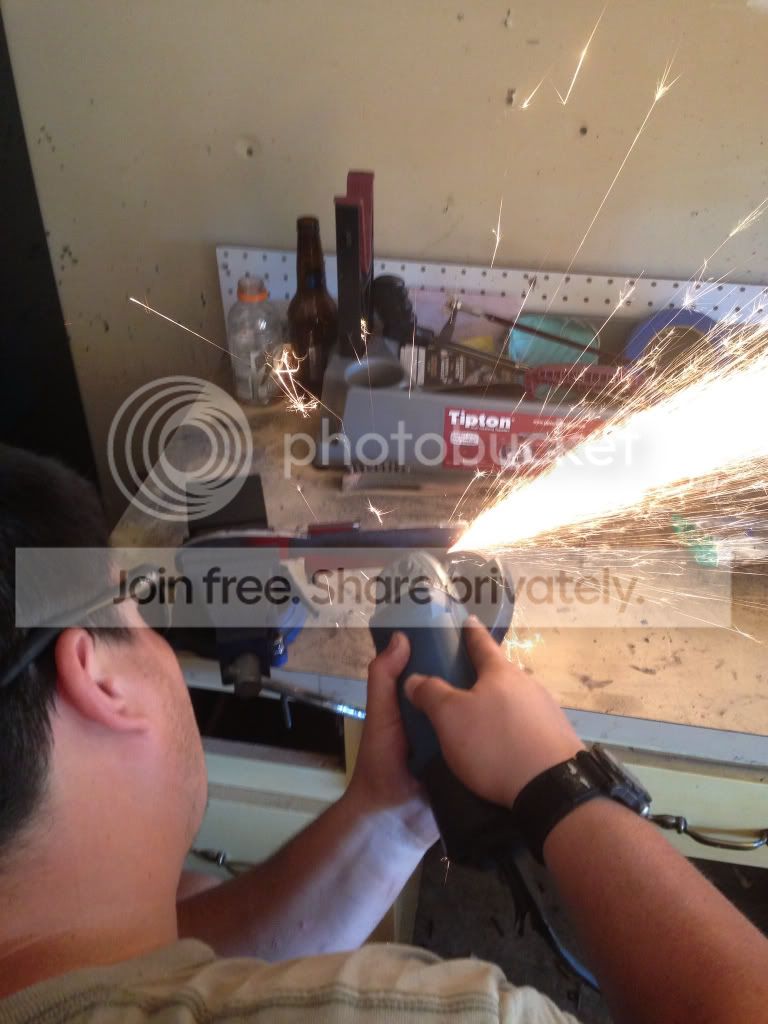
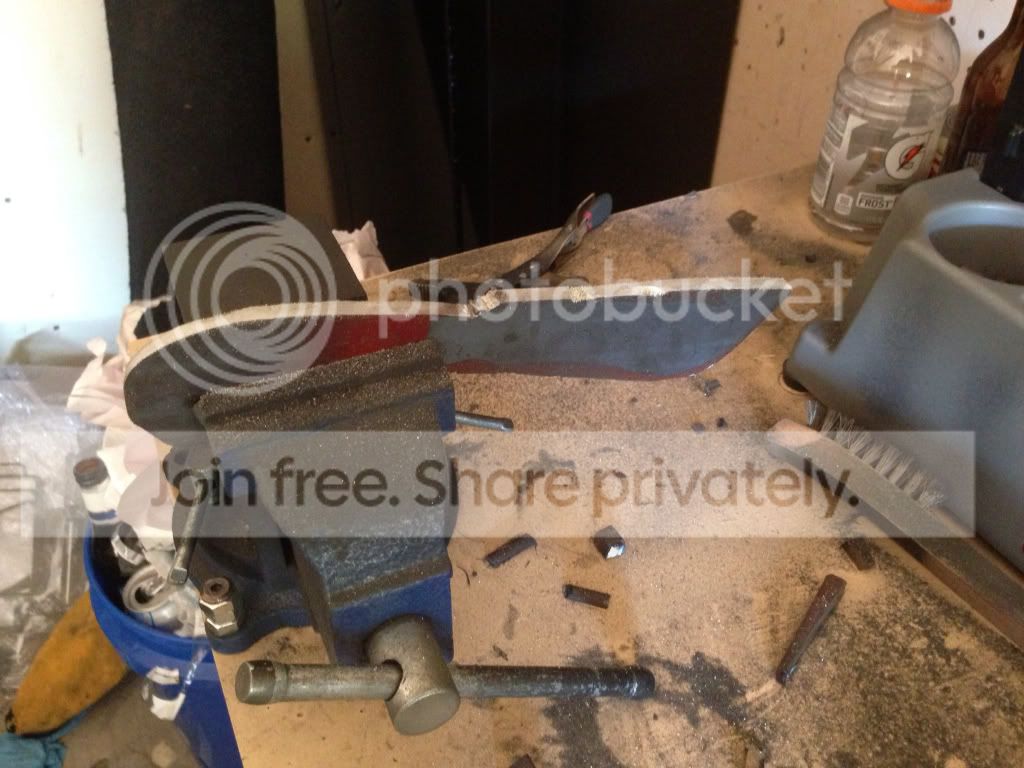
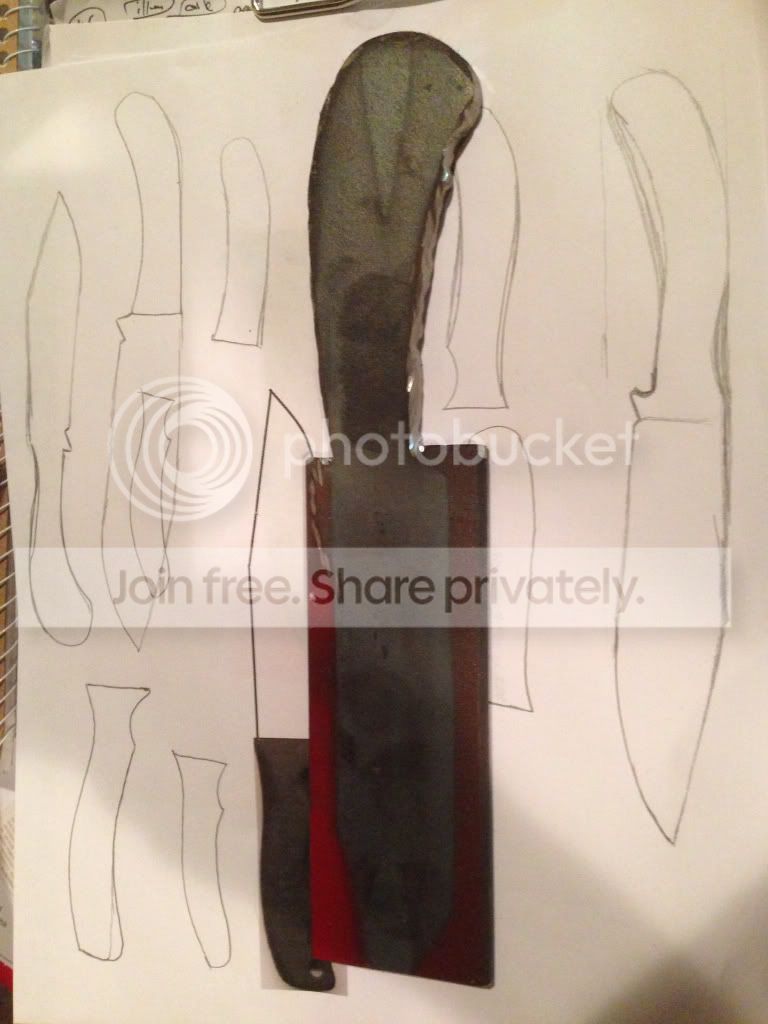
The journey began with a 18"x2"x.26" bar of 5160 steel . I settled on a design and cut it out of cardboard . I then placed the cut out on the steel and spray painted over it . Here came my first mistake , I decided to change the design as I was cutting the steel and ended up over complicating things . Since I had zero experience with the angle grinder I asked my friend to help me cut out the ruff shape . Amateur hands with the Angle grinder caused a few dings and uneven surfaces on the blade . I used a bastard file to clean out the dings and smooth out the surfaces as much as I could and managed to clean most of them out . Then it was time to close up shop and call it a night . MORE TO COME .

565234f7fb3b16bc63629952feabf68a.jpg

3d87dbd6f85303a7e672747090d17ced.jpg

6bcf4c6c11e5efd6e08a6d7124e9347f.jpg

b0c60d66d7d41df59c72232efba117b2.jpg

f0b47b36e97e672397b92ca4ec9f7e2a.jpg

null-9.jpg

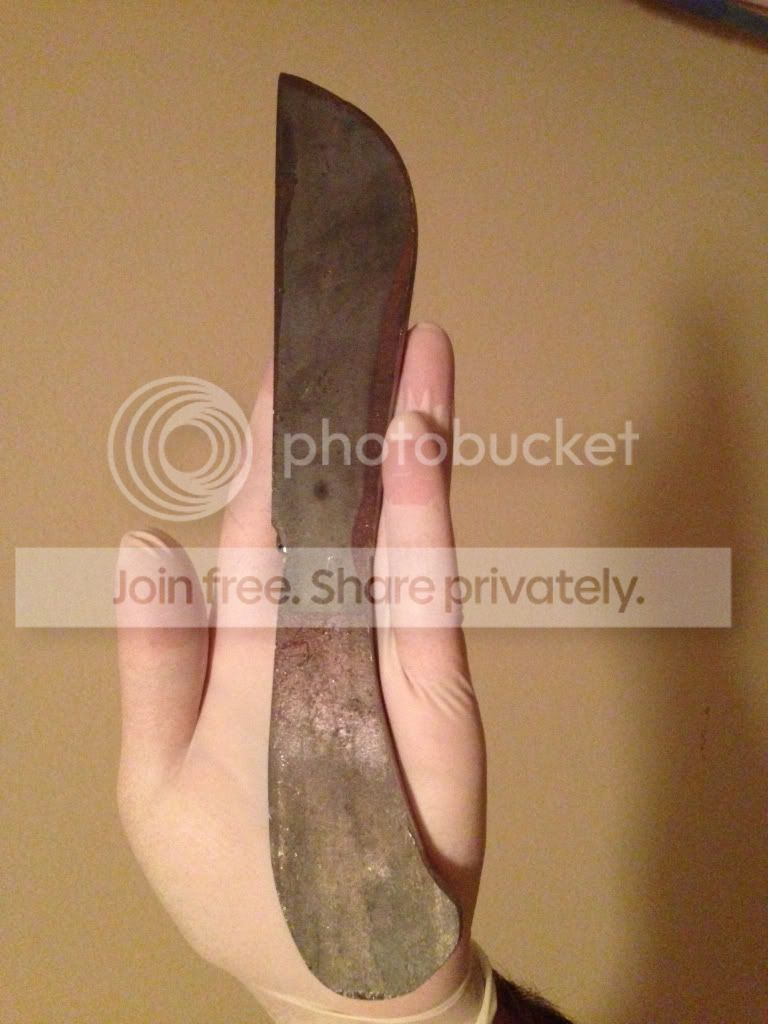
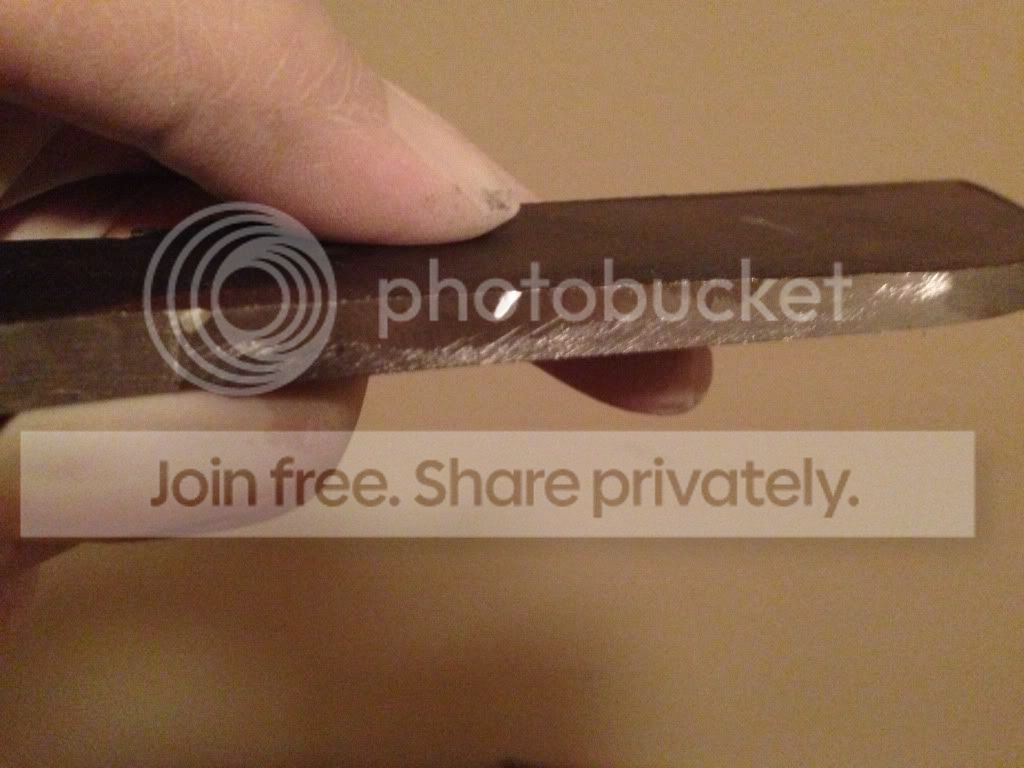
Above picture is of the spine
null-10.jpg

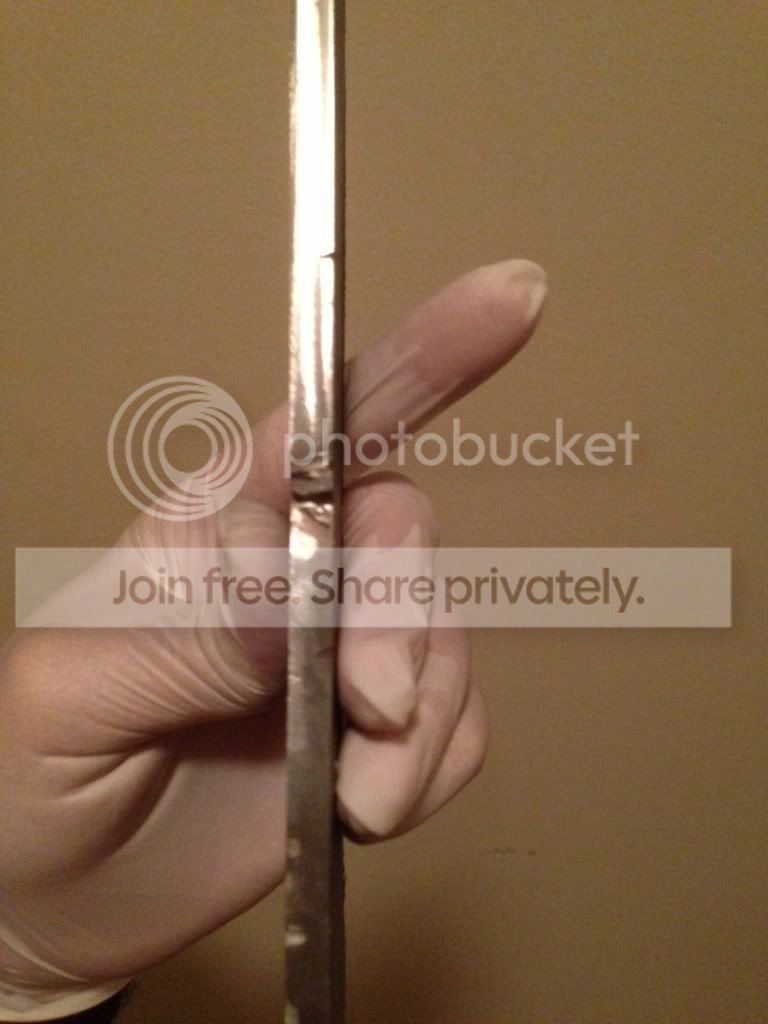
Above picture is of the edge

MISTAKES :

1. 0.26" was too thick to start with , Specially with hand tools

2. Do not change the design last minute . Original design had 5.5" blade but I ended up with 5.2" after the change .

3. I would like to try a hack saw instead of the angle grinder to see if I can get cleaner results

4. Apply equal pressure when hand filling since I kept creating slant surfaces when they should have been flat .

5. MORE TO COME

QUESTIONS :
What is your opinion on the design and what would you change if you could ?
What is the best method to smooth out the round pommel at the butt of the tang with a hand file ?
What shape file and what method of filling should be used to file out the thumb ramp on the spine ?
What grind do you guys recommend for this blades edge ?
How clean and smooth does the edge surface need to be before I can grind it to shape ? ( There are a few superficial dings from the angle grinder )
What would be the best method to decrease the over all weight of the knife ? Should I drill superficial holes in the tang ?
What is the best method to apply even pressure with the file as to avoid slanting the surface ?
 
Last edited:
You're right that .26" is way too thick for a knife of that size. I'm not saying that it won't work, but that it won't perform as well as it could. Basically, the cross section of the blade is a triangle with one leg being .26" long. The other two legs will come together at an angle that's rather steep. This intersection is the cutting edge of the knife, and if the angle is too much, you get a splitting wedge more than a knife. That's why you see knives of this general size being made from stock that's .125" or so.

Overall design is good and functional. I like the blade shape for a general-purpose field knife, though I can see some might like a more pointed design. The only thing I would change would be to shrink the bulbous pommel a bit. It looks a tad unwieldy, but it you made it into more of a hook shape, it would give the pinky some room and still prevent slipping a good deal.

As thick as that steel is, it will take a lot of lightening holes in the handle to bring the balance and weight to a good zone. You could remove 90% of the metal in the tang and not sacrifice real-world strength.

My suggestion, scrap the blank. You can always use that metal for guards and pommels, but trying to bring it down in weight and blade geometry is going to be a lot of work. By the time you get that squared away, you will have removed half of the metal - so you can just as easily order another piece that's a better thickness and get a good working knife out of it in a few hours work.

And don't feel bad, I had the same thing happen to me when I made my first few blades out of leaf springs. By the time I worked through the rust, pitting and hairline cracks, I had burned a lot of sanding belts and hours of sweat to end up with a piece that was about .130" thick. Hours of work on that "free" metal to end up with a blank that I could have purchased for pennies! Ugh!
 
Thanks for the advice and the encouraging comments . It is refreshing to be among classy gentlemen versus the usual 13 year old Trolls that roam the Internet forums .
This blade was intended as a field tool . I tried to incorporate ideas from my buddy who is USMC Sniper with a few years of field experience and my surgical experience to come up with something that can put holes through walls , chop wood , dig holes in the ground and dress deer if need be.
The blade design slightly resembles the number 22 scalpel blade which is my favorite cutter and thickness came from my friends input of him using thinner blades to do field tasks and it breaking on him , Granted he is a Marine and they are known for breaking things , haha .
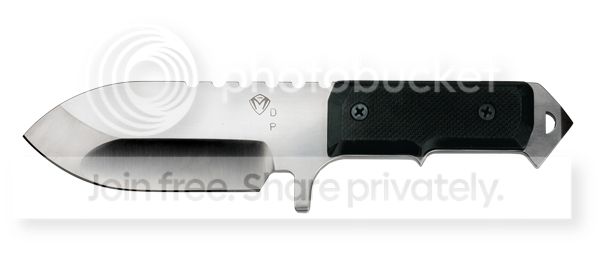
Greg Medford makes a few blades in .26" thickness ballpark but I'm not sure about the performance . I think one of them is called the Sea Wolf . What do you guys think ?
8a0ad338b1cd4b4f90df429c21ae1454.jpg
 
That grinder is a rabid animal waiting to bight off your finger or put metal in your eye. Knife making = fun......hand grinder used like that = hospital. Good luck and be careful.
 
That grinder is a rabid animal waiting to bight off your finger or put metal in your eye. Knife making = fun......hand grinder used like that = hospital. Good luck and be careful.

And in your lungs. Get a respirator and protect yourself. Good luck.
 
Thanks for the advice and the encouraging comments . It is refreshing to be among classy gentlemen versus the usual 13 year old Trolls that roam the Internet forums .
This blade was intended as a field tool . I tried to incorporate ideas from my buddy who is USMC Sniper with a few years of field experience and my surgical experience to come up with something that can put holes through walls , chop wood , dig holes in the ground and dress deer if need be.
The blade design slightly resembles the number 22 scalpel blade which is my favorite cutter and thickness came from my friends input of him using thinner blades to do field tasks and it breaking on him , Granted he is a Marine and they are known for breaking things , haha .
Greg Medford makes a few blades in .26" thickness ballpark but I'm not sure about the performance . I think one of them is called the Sea Wolf . What do you guys think ?
8a0ad338b1cd4b4f90df429c21ae1454.jpg

He has s complex multi grind on there and the result is that that hollow is very agressively deep and gives you a thinner edge.

That two step lower handle edge with the barb is not a good feature.
 
Get some thinner stock and use a good file.
Slow down a bit.
Slow is your friend right now.
Fast will come later.
Actually, I'm still waiting for my fast to come along.
 
Appreciate the safety tips guys . That is actually my friend the Marine in the picture with the grinder . I asked him to wear a mask but he said he had worse things fly at his face to which I replied " That's what she said " . I'll make him wear one next time .
I have two vote to scrap what I have and start again , who else cares to comment ? I am sentimentally attached to this one since its my first .
 
Finish what you started.Good /bad/ ugly.So what it's just an experiment at this point.You learn as you go.Just give it 110% .
Eddie
 
Amendment:
After you've used this stock up, get some thinner stock. Just my opinion.
 
I think I would regret not finishing this one . I understand that I might not be able to carve a rose out of a tomato with this one but its mine . My next purchase would definetly be thinner . Let me ask you this , What grind do you guys recommend for the edge and should I bring the tip lower a bit ?
 
Last edited:
Appreciate the safety tips guys .
he said he had worse things fly at his face

I have two vote to scrap what I have and start again , who else cares to comment ? I am sentimentally attached to this one since its my first .

Sunglasses don't cut it with an angle grinder either, those sparks sneak in under or from the side.

It's true, they use a dremel and burr to grind the rust spots off your eyeball.
 
I too would set that big chunk of metal aside. At some point you will come back to it with the right idea for the material. Draw filing is how to achieve a nice flat plane, any good file will work but a Long Axis Lathe File will draw file better and the Magicut file is supposed to be a step above a standard file. There are whole threads dedicated to files, worth the read. I have the bevels filed into my first knife, posted pics on here under the thread "What I am making". I still had some sanding and a little bit of file work left at the point of the pictures, bevels were not exactly even, fixed now. I did it all with a Nicholson 12" bastard file, hacksaw with Nicholson blades, and sand paper. The videos by Sugarcreek Forge helped a lot and I recommend checking them out. Good luck.
 
Do a distal taper, and the last 1/2 of the blade might get a useable edge. Go full flat grind as well. you could also surface grind the whole knife thinner. Go down to at least 3/16, and preferably 1/8". I say finish it. It will be a reminder of what you learned along the way. I look at my first knife and smile to myself. I am very new at this but the progress over 9-10 months has been staggering. I kept a couple blades I shattered in quench as well, just as a reminder.
 
Last edited:
Thanks Willie for the tips . May I ask why is everybody here under the impression that .26" is way too thick to hold an edge? I know a lot of custom knife makers do make field knifes in this thickness range specially the past 2 years when it started trending . I guess what I'm asking here is why should I scrap what I have just because it is .26" thick ?
 
I don't think you should scrap it, I think you should set it aside until you are ready to make something appropriate from the material. Would you use a 20 gauge needle to administer an allergy shot? (not taking into account the demeanor of the patient of course) Edge geometry is why it won't make a very usable cutting tool. Wouldn't even make a good crowbar since a crow bar is shaped the way it is for a reason. A hollow grind can remove enough material to make an edge that is thin enough to slice and not just displace. This is the grind that such makers are using with thick stock on a knife the size of yours. I do not know how to do a hollow grind with hand tools. Good steel in the appropriate thickness is cheap and available. But by all means have fun and get some practice. Just for me, I know that down the road I would at some point have a knife epiphany and that 1/4" piece of steel that I ground away would be just the thing to make it happen.
 
In my opinion, thats too thick for the tools you have to work with. Removing that much metal with an angle grinder may enable you to use your real skill on your fearless grinding buddy. If you are going to anyway, get a full face shield and some gloves.

James
 
Thanks Willie for the tips . May I ask why is everybody here under the impression that .26" is way too thick to hold an edge? I know a lot of custom knife makers do make field knifes in this thickness range specially the past 2 years when it started trending . I guess what I'm asking here is why should I scrap what I have just because it is .26" thick ?

It's not that it won't hold an edge, it's just so thick, like a splitting maul

This is a good summation

Y

... I'm not saying that it won't work, but that it won't perform as well as it could.

Basically, the cross section of the blade is a triangle with one leg being .26" long.
The other two legs will come together at an angle that's rather steep.

This intersection is the cutting edge of the knife, and if the angle is too much, you get a splitting wedge more than a knife.

That's why you see knives of this general size being made from stock that's .125" or so.

!
 
You could think of .25" as big margin of error. There is enough metal there that you can play with your technique until you like it. Just keep refining it until you like it, then use that blade as springboard into the next blade design in a thinner material.
 
Ok I fully understand the point . Thank you guys for taking the time to explain . Sadly my personality gets in the way some times , I cannot just let whatever I'm working on unfinished and move on . I think I will use this to develope appropriate muscle memory and overal experience in filling and shaping a blade . I wish I had a better product to show you guys since I have high respect for this craft and you people here in this forum ( Slightly embarrassed ) . What would you guys recommend I start with ? Thickness and steel type .
 
Back
Top