Chronicles Of My Journey In Knife Making

How are you planning on putting the bevels on? A hollow grind like the one in your example would be difficult with the tools you've mentioned so far, not impossible just tough. A flat grind would not complicate things too much. Plan your work and work your plan. If you get an idea mid stream,instead of changing direction, make some notes and refine them at the end of each day. When your done with it (and it's hard knowing when that is) sit down and go over what you did, what you like and what you would change, how you would change it. Going over your notes along with your post you come up with your next plan. Think of this as your first weeks of A&P, there's much to come.

I could tell you all the things I did wrong on my first knife but I don't feel like typing that much. Good luck, be safe and have fun.
 
I will second (third/fourth etc) what the others are saying. The width of blade you have will be OK for chopping, but it won't slice well. The width of the wedge is simply too wide. I made the mistake of ordering 52100 in .201 width for a friend's hunter knife. Comparing this steel in hand to the 1/8 I'm used to working with really showed off the difference. For my own experience, I drew out the cross section of the blade at full width, and the difference in cutting angle was really pronounced. I ground the steel down to .180, then draw filed it to flat again. This knife is on the large side for a hunter, as my friend wanted a 6" blade. It looks more like a small fighter. He is using it for moose and buffalo. The distal 4" with the taper are all less than 1/8", which would have been the standard size I should have used for this knife, but with my workarounds, the blade at the belly should be very similar to a 1/8" knife.

It is trendy to want a thick steel, as it is being marketed right now. What is telling to me is looking at the blades by Loveless, Big Chris, Big Blue, who all use or used knives made really simple designs in slicing thicknesses. If you are making a chopper, you need the weight, and are more likely to wedge the knife, so you will temper it softer. In the short time I have been doing this, I learned a very important lesson. When designing a knife:

1. Pick the purpose.
2. Draw out the design (make a cutout if that is your process.)
3. Pick the correct steel for the application, in the correct size and thickness.
4. Have a knife without compromises.
 
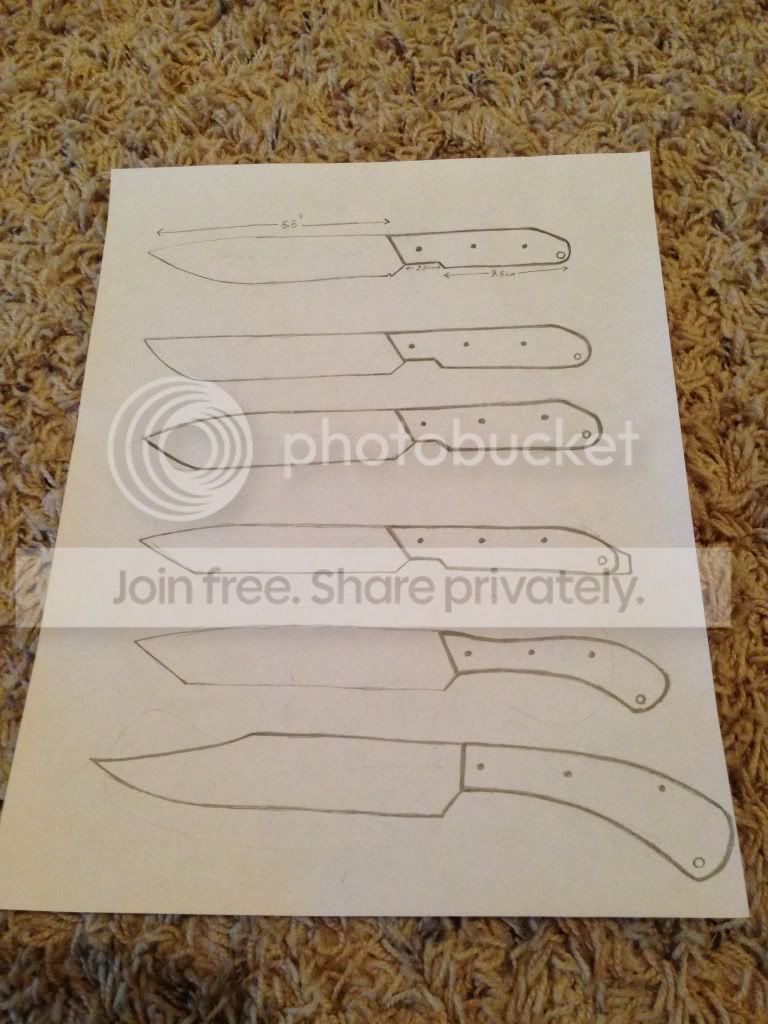
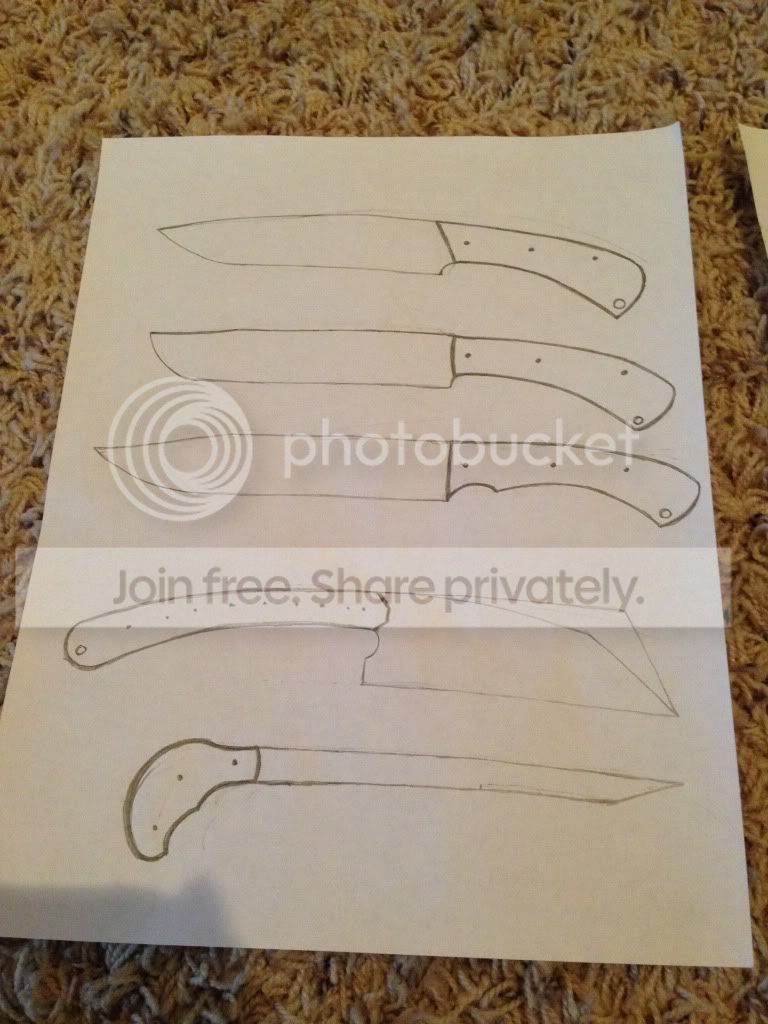
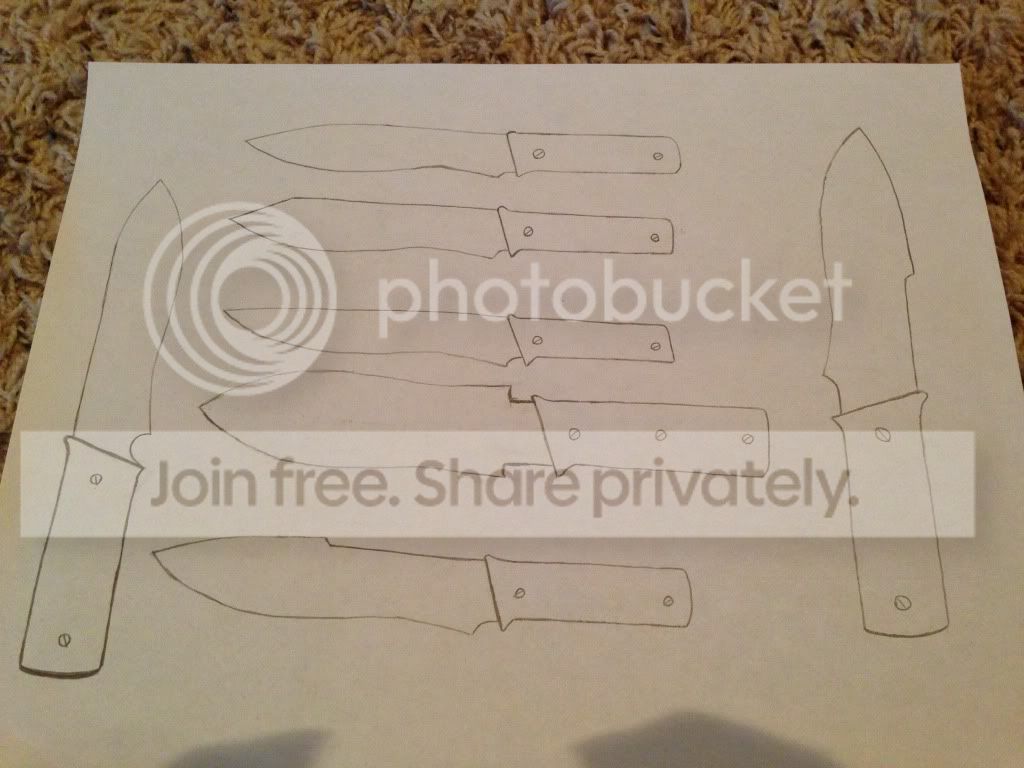
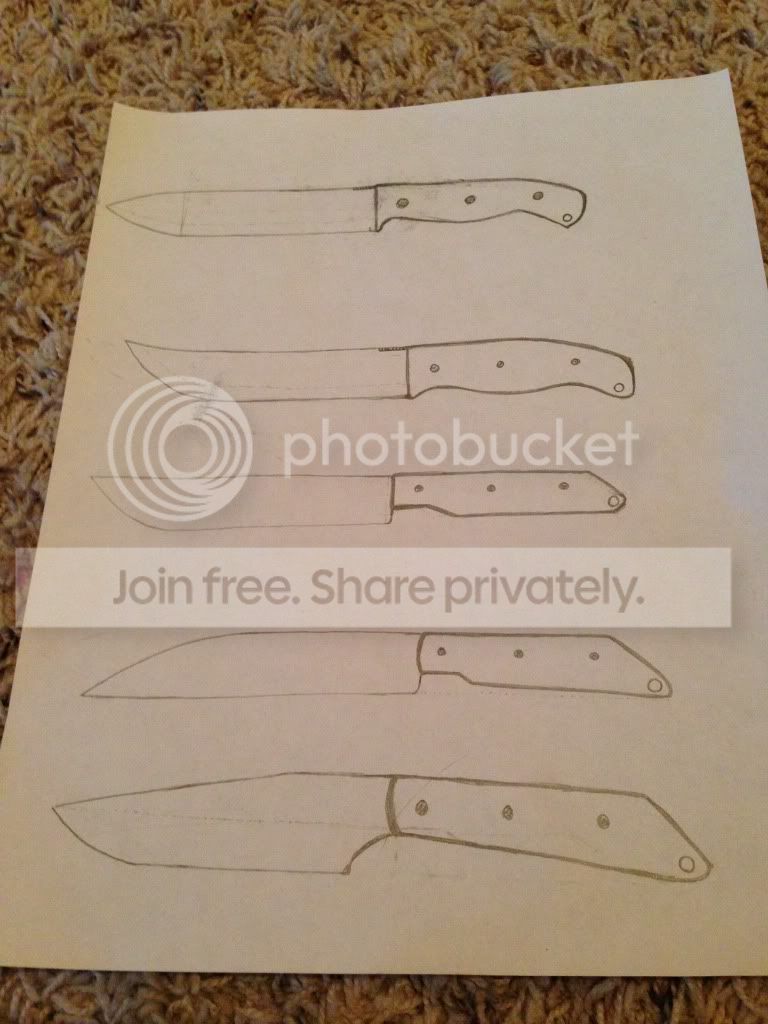
Excellent information gentlemen . You guys are going to make a knife maker out of me yet ! Haha . Talent might have skipped a few generations since both my grand father and his father were famous persian blade makers . I will upload a few design ideas I have when I get home from work to see your opinion on the overall shape and function . Does anyone here recommend a harpoon shape blade for field work ? I really enjoy the Aesthetics but am not sure about performance . If you guys need any medical advice send me a private message .
 
Last edited:
null-12.jpg

null-11.jpg

null-13.jpg

null-14.jpg
 
Immortals, starting off with 1/4" material is ambitious with the tools you have. But I say go ahead and finish what you started. You should always finish your first knife before starting on a second. Figure out your mistakes. Find out whats difficult for you to do with your tools and whats not. Experience is THE best learning tool you will use. Once you figure out what you did wrong and what you did right, then move on to blade number 2. As you progress you will get better. If you work on more then one blade at a time so early in your quest, you may get frustrated and become discouraged. My first blade was 3/16" 1095 that had a hamon. The blade turned out quite nice, but then I botched the handle and I don't like showing it to people now. So my handle design was the first thing I addressed on my next knife. Just keep at it. Good luck!
 
Sunglasses don't cut it with an angle grinder either, those sparks sneak in under or from the side.

It's true, they use a dremel and burr to grind the rust spots off your eyeball.

More often a 20Ga hypodermic needle on the end of a stick, but that depends how long the metal has been embedded there. If things penetrate the globe, it's all downhill from there.

Get you some goggles!
 
Doc,

I'm looking at your drawings and you have a pointy sharp spot in several of your designs.

I don't know if I posted this to any of your threads yet or not.

Have a look at this post

http://www.bladeforums.com/forums/s...al-Testing-Facilities?p=11996394#post11996394

specifically:

U]Knife Design:[/U]
Think thin. Forget swords, saw-tooth spines, guthooks, crazy grinds and folders for your first knife.

Start with a drawing and show us, we love to comment on photos.
Then make a cardboard cutout template & draw in handles, pins and such.
Use playdough to shape a comfortable handle, good handles are not flat.


Google books thread for Lloyd Harding drawings, Loveless book & Bob Engnath Patterns. http://www.bladeforums.com/forums/showthread.php?t=603203

Bob Engnath Patterns in a PDF http://www.mediafire.com/?qgx7yebn77n77qx


Studying those 3 sets of patterns and drawings, should put you ahead of the curve

Plus see the knifemaker supply website for photos of their blanks like
Knifekits.com
 
i like that design at the bottom of the first page you posted. i can understand how you feel about the time you have already invested in that first knife you started. I am guessing soon as you start another you will like that one even more, and so on. Good thing is you can always come back to the first one when you are in the mood .. or you just wanna practice and get the feel of your tools before moving on to a more refined design (less margin for error) piece. Ive started making thicker and thinner versions of every model i try. It really gives you more perspective on what your design can accomplish.
 
Thanks for the links 123 , I am Ray by the way . Play-dough is an excellent idea . Thank you Timos for the encouraging comments . I think I'm gonna get back to the design and play around with it a little more , I kinda rushed into it since it was my only free weekend this month but as you all mentioned , I need to take things slow and use the advice I get from you guys to minimize mistakes . I also plan on finding a knife maker in the DFW area to see if I can meet them in person and maybe see a blade made first hand if possible .
 
You'll do well, I, if you remember that what you see on the market isn't necessarily indicative of a good design. As someone once said, a fool and his money are soon parted, and that applies to knives just like anything else.

The design of a good, practical knife is about function more than anything else. If you look at the plethora of multi-tools on the market, you'll see that they all have a dozen functions, but none of those functions perform nearly as well as a tool built solely for that purpose. I've cut limbs with my leatherman's 3" sawblade, but it took longer and was far rougher on my hand than if I had used a proper saw. I've tightened screws with the phillips bit, but it was a bugger of a job compared to using a regular screwdriver. Even the blades on my leatherman supertool, while properly shaped and very sharp, don't function well as a real knife because the handle is so slippery and non-ergonomic.

But what you do get in a package like that is the idea that "it will get me by til I get to my real toolbox!"

Making a knife that functions also as a prybar, glass breaker and spinning wheel might sound like a practical tool, but how much function are you going to sacrifice to get all of those features into the package? Furthermore, how many of those features are going to be honestly needed by the end user in a situation where they can only have this one particular implement? I know three people that have been injured by the sharp glass-breaker pommels on their knives, but not one that has ever used the glass-breaker to save the life of a trapped victim. Not saying that it doesn't happen, but...

Most of the designs you posted were solid, but the second set was getting a little out there. Two edges are twice as hard to keep straight and looking good, and they have little real-world value. Recurved edges are dead sexy, but not something I'd recommend for a beginner. That keyhole saw stabby thing?

As one of my firearms instructor used to say, "Master the fundamentals." That applies to a lot of endeavors, including making knives.

 
Back
Top