I'm somewhat new to knives and want to learn to sharpen them myself. So, I purchased a Lansky System. With the vise it is a really good tool. Here is my question: Is the paper test the gold standard to tell if I've done a good job? Just as important (for me) is a second question: If I've used reasonable care on the sharpening and I can't cut paper, now what? Do I start again moving up one level on the process? For example if I sharpen starting with fine going to ultrafine, do I now repeat the process starting with medium? Or do I just repeat the process increasing the angle say from 20 to 25? All relevant comments would be gratefully appreciated.

-
The BladeForums.com 2024 Traditional Knife is available! Price is $250 ea (shipped within CONUS).
Order here: https://www.bladeforums.com/help/2024-traditional/
You are using an out of date browser. It may not display this or other websites correctly.
You should upgrade or use an alternative browser.
You should upgrade or use an alternative browser.
Comments on the paper test please?
- Thread starter jebib
- Start date

Ankerson
Knife and Computer Geek
- Joined
- Nov 2, 2002
- Messages
- 21,094
Cutting Printer paper is good to see if the knife is sharp enough to use, a starting point...
Newsprint is the next stage of sharpness.
Phonebook paper is the stage after that.
All of them would be cutting through without tearing the paper.
Newsprint is the next stage of sharpness.
Phonebook paper is the stage after that.
All of them would be cutting through without tearing the paper.

- Joined
- Sep 2, 2009
- Messages
- 1,174
You have to determine the angle of the grind that you want first, what`s best for your purpose...
Then you work with one grit till you get a "burr" on the edge, then start on the other side of the blade...
Make sure you get the "burr" here too... Then move to finer grit, making sure you always get that burr going before you switch sides...
And then you just repeat through the grits as far as you want to go.....
But keep in mind, the "burr" is essentiall, cause this tells you that you`ve reached all the way to the edge....
The burr will get smaller for each step you take towards the finer grits..
Hope this helps you on your way to sharp steel heaven, LOL... Welcome to the world of knives, beware, it`as addictive as some drugs, hehe
Then you work with one grit till you get a "burr" on the edge, then start on the other side of the blade...
Make sure you get the "burr" here too... Then move to finer grit, making sure you always get that burr going before you switch sides...
And then you just repeat through the grits as far as you want to go.....
But keep in mind, the "burr" is essentiall, cause this tells you that you`ve reached all the way to the edge....
The burr will get smaller for each step you take towards the finer grits..
Hope this helps you on your way to sharp steel heaven, LOL... Welcome to the world of knives, beware, it`as addictive as some drugs, hehe
- Joined
- Jun 29, 1999
- Messages
- 10,128
When you see blood spraying all over the place and don't even realize until then that you've cut yourself, you have achieved a 'sufficient' edge. 'Beyond sufficient' means you can create isotopes by whittling neutrons off atoms.

glockman99
RIP Dann, you were a good guy.
- Joined
- Jun 12, 2000
- Messages
- 21,269
Also, if you can cut water with your knife, you have gone too far. ..
..
..
- Joined
- Sep 2, 2009
- Messages
- 1,174
No problem jebib, that`s what we meet up here for, sharing the know-how, lol.....
I started with the Lansky myself, but now I freehand most of the time, and once in a while I use my watergrinding-wheel with a jig to restore the edges that have been misused the most...
I started with the Lansky myself, but now I freehand most of the time, and once in a while I use my watergrinding-wheel with a jig to restore the edges that have been misused the most...

- Joined
- Mar 3, 2006
- Messages
- 7,132
I have 3 principal tools that I use for sharpening, the Lansky, Crock Sticks, and a loaded strop. The Lansky profiles the edge, the Crock Sticks tune the edge and the strop maintains the edge. I try to take off as little metal as possible through sharpening.
I use the 'paper test' to determine a 'working' edge, which for me is the ability to push cut copy paper. Slicing paper is a 'given', but I find that a push cut will quickly reveal any dull parts of the blade.
I use the 'paper test' to determine a 'working' edge, which for me is the ability to push cut copy paper. Slicing paper is a 'given', but I find that a push cut will quickly reveal any dull parts of the blade.

- Joined
- Mar 31, 2009
- Messages
- 2,237
Use a sharpie to mark your bevel, and then sharpen for about five minutes. If the sharpie remains, then you are probably hitting the edge, if some of the sharpie is being worn away, you are hitting the bevel, and NOT the edge.
I use receipt paper to test the quality of my edges. As long as it will push cut receipt paper, then I'm perfectly a-okay with the edge.
I use receipt paper to test the quality of my edges. As long as it will push cut receipt paper, then I'm perfectly a-okay with the edge.
Cynic2701: Thank you for your comment! Can you please elaborate on the difference regarding the sharpie? Which do I want, to remove the sharpie namely the to get to the bevel? And if I may do I do this one side at a time, and repeat it for each step (stone) in the process? Thanks to all for your patience. I'm just trying to learn my experience. bib
- Joined
- Mar 31, 2009
- Messages
- 2,237
I'm unfamiliar with the Lanksy system, but I'm assuming (possibly incorrectly) that you place the knife in a vice and then run a stone over the blade from a specific angle.
Depending on what angle you want your knife edge to be, I've generally found making my bevels 10 degrees shallower works pretty well. For example, if you want a 40 degree inclusive edge, I'd put a 30 degree inclusive bevel on the knife; I usually do a 30/20 microbevel/bevel.
Because the edge is at a higher angle than the bevel, if you are removing the sharpie (which you have marked the bevel with) when you are trying to sharpen the edge, then the angle that you are sharpening at is too acute to actually reach your edge. If you are sharpening at 40 degrees inclusive and you are hitting the bevel, then you are going to need to re-profile the bevels on your knife to a more acute angle--an angle less than 40 degrees.
Getting the correct and consistent angles on your knife might take a long time depending on what grits you have available.
Edit: When some says something like "40 degrees inclusive" they mean that each side is actually 20 degrees, but combined they equal 40 degrees. So for a 40 degree inclusive edge, you should sharpen both sides of the knife at 20 degrees.
Depending on what angle you want your knife edge to be, I've generally found making my bevels 10 degrees shallower works pretty well. For example, if you want a 40 degree inclusive edge, I'd put a 30 degree inclusive bevel on the knife; I usually do a 30/20 microbevel/bevel.
Because the edge is at a higher angle than the bevel, if you are removing the sharpie (which you have marked the bevel with) when you are trying to sharpen the edge, then the angle that you are sharpening at is too acute to actually reach your edge. If you are sharpening at 40 degrees inclusive and you are hitting the bevel, then you are going to need to re-profile the bevels on your knife to a more acute angle--an angle less than 40 degrees.
Getting the correct and consistent angles on your knife might take a long time depending on what grits you have available.
Edit: When some says something like "40 degrees inclusive" they mean that each side is actually 20 degrees, but combined they equal 40 degrees. So for a 40 degree inclusive edge, you should sharpen both sides of the knife at 20 degrees.
I use the Smith's equivalent to the Lansky clamp system, and I have found that while it makes a sharp edge, I still have to refine the edge with something above a 600 grit (the finest stone in my system) before I get the edge to bane-of-paper sharp. I can't seem to strop my edge with my green compound, though. It's a wax based compound in a giant bar. Any advice for me?

- Joined
- Jul 17, 2010
- Messages
- 1,490
I use the Smith's equivalent to the Lansky clamp system, and I have found that while it makes a sharp edge, I still have to refine the edge with something above a 600 grit (the finest stone in my system) before I get the edge to bane-of-paper sharp. I can't seem to strop my edge with my green compound, though. It's a wax based compound in a giant bar. Any advice for me?
My green compound comes in bar form too. I just rub it briskly along my strop until I get an even coat. I read somewhere not to overdo the amount you put on too.
- Joined
- Mar 31, 2009
- Messages
- 2,237
IIRC the "grit size" doesn't translate well to ceramics. Comparisons are made according to the scratch patterns.
If the brown Spyderco Sharpmaker rods are about 600-800 grit, then the fine is 1200, and the ultrafine is 2000.
Micron sizes are something like 15/6/3 (again I'm estimating).
So if the finest stone you have is ~15 micron, I'd recommend getting some intermediate grit sizes before you hit a strop. If we are talking about the same compound, the grit size is ~1 micron, so a jump from 15 to 1 is pretty big--I'm not surprised that stropping is having little effect.
If the brown Spyderco Sharpmaker rods are about 600-800 grit, then the fine is 1200, and the ultrafine is 2000.
Micron sizes are something like 15/6/3 (again I'm estimating).
So if the finest stone you have is ~15 micron, I'd recommend getting some intermediate grit sizes before you hit a strop. If we are talking about the same compound, the grit size is ~1 micron, so a jump from 15 to 1 is pretty big--I'm not surprised that stropping is having little effect.

Jason B.
Knifemaker / Craftsman / Service Provider
- Joined
- Jun 13, 2007
- Messages
- 11,196
IIRC the "grit size" doesn't translate well to ceramics. Comparisons are made according to the scratch patterns.
If the brown Spyderco Sharpmaker rods are about 600-800 grit, then the fine is 1200, and the ultrafine is 2000.
Micron sizes are something like 15/6/3 (again I'm estimating).
So if the finest stone you have is ~15 micron, I'd recommend getting some intermediate grit sizes before you hit a strop. If we are talking about the same compound, the grit size is ~1 micron, so a jump from 15 to 1 is pretty big--I'm not surprised that stropping is having little effect.
Actually you are spot on, everything from not having a grit rating to the Micron size for the spyderco ceramics and stropping advise is all correct. Unfortunately these numbers likely don't translate well with the lansky.
- Joined
- Mar 31, 2009
- Messages
- 2,237
Actually you are spot on, everything from not having a grit rating to the Micron size for the spyderco ceramics and stropping advise is all correct. Unfortunately these numbers likely don't translate well with the lansky.
Good to know that my theory is strong in the force

So should I look at a white ceramic stone to use between diamond stone and strop? I know white ceramic is higher than 600, but lower than my green compound. Would that make a good step between?
Yeah, you are going to want an intermediate step--probably even a few intermediate steps. Even when I stop at just the Spyderco ultrafine stone, I can get basically a mirror-edge on my knife. The stropping compound refines it even further. I'll dig up an old picture I've got floating around on the forums to provide an example.
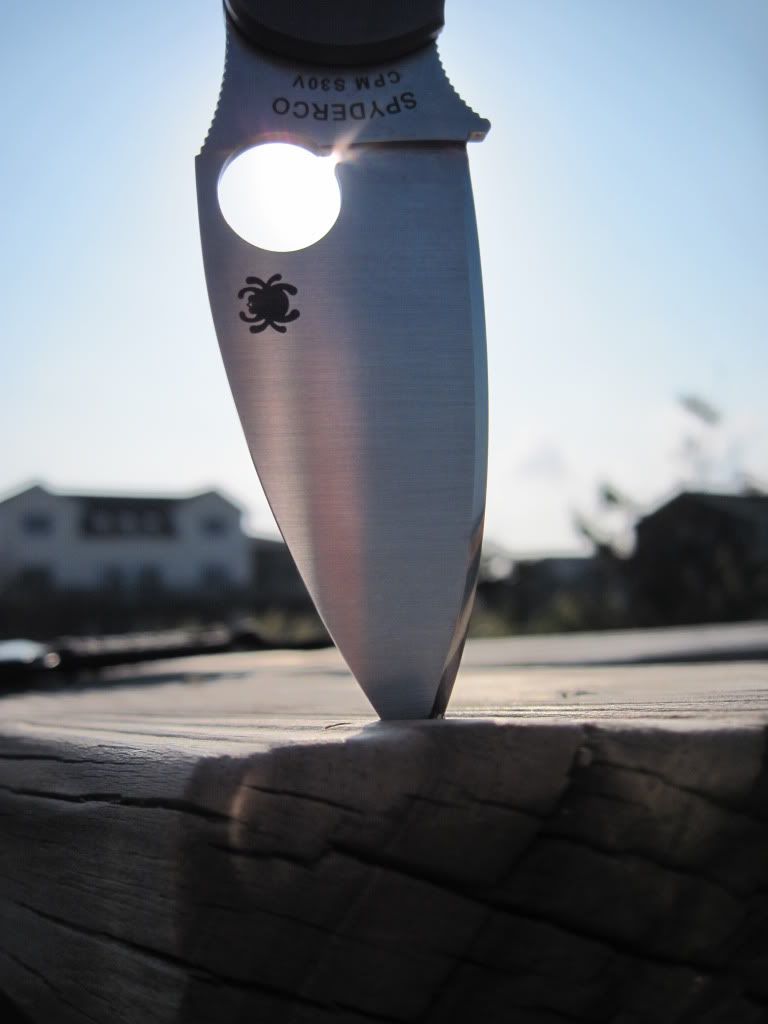
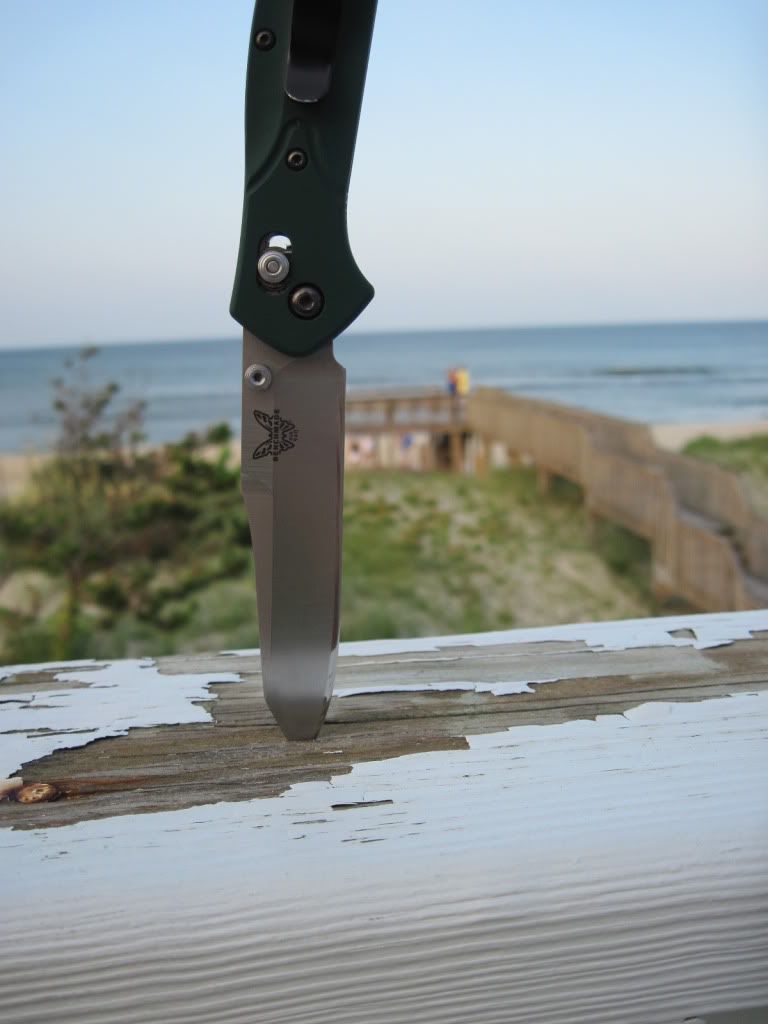
Please forgive the less than stellar photography.

- Joined
- Jan 9, 2011
- Messages
- 16,458
If it doesn't cut paper I won't send it out.
I have done a couple of super steep 45 degree chisel grinds that wouldn't really pass the test but they were more prybar than knife. My big choppers will cut paper no problem.
I have done a couple of super steep 45 degree chisel grinds that wouldn't really pass the test but they were more prybar than knife. My big choppers will cut paper no problem.