Concrete question

I can immediately tell they have no idea what they are in for, before I unload anything from my truck I give them concrete safety 101, which is very simple, protect yourself, and don't get it on you! it can burn you.
Probably worth noting that it can both burn you chemically and from heat, albeit at different stages of curing. I made the mistake of mixing concrete with my bare hands for testing specimens in a lab at GA Tech (.41 w/cm ratio with a good amount of class C fly ash, ended up about 6 ksi compressive strength after 2 weeks of curing in a fog room). For those of you who don't know, concrete is a pretty strong base(I suppose this could be a pun) with a pH of anywhere from 12.5 to 13.5, needless to say my hands felt very slippery once I washed the wet concrete off and then were very dry for the next few days. On the plus side, I'll never forget that concrete has a high pH.

Also, to answer your original question about what problems could occur if you use the concrete too soon, you could apply a load that puts the concrete past its yield strength since concrete doesn't gain full strength until a full cure. Going past the yield strength would typically result in cracks, which even at a full cure would drastically reduce the strength of the concrete.
 
Last edited:
I work for a lab that does concrete testing daily. We test at 7 days, 28 days, and 56 days if need be. The target for 7 days is 70% of the design strength. 28 days is 100%. The 56 day test is in case the 28 day test doesnt make it. The concrete gets harder up to a point, measured in years, then starts to go down hill, though at a much slower rate. The turning point can be between 30 and 50 years and the decline is very slow. We deal mostly with ready mix plants and for the most part they get what they say they will. Your bag mix I have less experience with, though for grouting masonry walls, many people have started using it lately. Some of the strengths are very high, over 6000 psi at 28 days. Confining it in the steel box like you did will help, though I'm not sure how much. When we moved our Charpy machine to the new lab, to meet the ASTM for the foundation, we had a footing of around 1.5 to 2 yards on compacted soil. I dont know how much it weighed, but it will not see the kind of impact to the footing your hammer probably will. One thing I've learned about concrete is that it will crack despite your best efforts to prevent it. When the cracks keep growing or if there is a difference in height from one side of the crack to the other, that's when you know you have a problem. The manufacturer should be able to tell you an estimate for the strength, and that will be based on a 28 day cure. Multiply by 0.7 for your current level. For what its worth, most building codes require a 75% strength before setting structural steel on concrete footings, which you should reach in about 8-10 days. That is not impact based, but the loads can be much higher.
 
http://www.sakrete.com/products/product.aspx?ID=CrackResistantConcrete

This is the stuff I used.

Safta, yeah that sounds like me :D.

Thanks everyone for your information, I hope I did not make a big mistake doing it the way I did. I am keeping it moist, with a garbage bag over it. I found out also that concrete has Lye in it, which might account for a chemical burn. I know I did mix some by hand pouring and spreading it around inside the box, but all I ended up with was VERY dry skin afterwards.
 
Hee Hee Hee, this reminds me of a project I did for a mining company in Northern New Mexico. For busting up rocks down in the shaft, there is a stationary rockbreaker and a grizzly grate that the rocks get sized / pounded through. I had to design the concrete pedestal to withstand a working torque of 305000 foot lbs.

The solution, 6000 psi concrete mix, two rebar mat's of #8 rebar on 12" centers and rockbolts driven 8' into bedrock just in case. The operator managed to tear up the grizzly, managed to break pins on the rockbreaker boom, but nobody ever tore my pedestal out of the ground.

Sorry..... kinda threw in a tangent. Lesson learned though in dealing with concrete and steel, go hell for stout and you won't have to worry about it later.
 
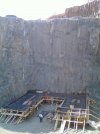
Heres one hell of a footing!!
attachment.php


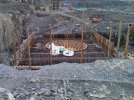
And the top,less the 28 foot walls
attachment.php


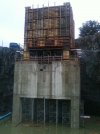
This one got a real water cure!!So did the crane and the manlift!
attachment.php
 

Attachments

  • phone pics 6-09 004.jpg
    phone pics 6-09 004.jpg
    47.1 KB · Views: 38
  • phone pics 6-09 108.jpg
    phone pics 6-09 108.jpg
    103.8 KB · Views: 39
  • phone pics 6-09 141.jpg
    phone pics 6-09 141.jpg
    41.6 KB · Views: 38
Hee Hee Hee, this reminds me of a project I did for a mining company in Northern New Mexico. For busting up rocks down in the shaft, there is a stationary rockbreaker and a grizzly grate that the rocks get sized / pounded through. I had to design the concrete pedestal to withstand a working torque of 305000 foot lbs.

The solution, 6000 psi concrete mix, two rebar mat's of #8 rebar on 12" centers and rockbolts driven 8' into bedrock just in case. The operator managed to tear up the grizzly, managed to break pins on the rockbreaker boom, but nobody ever tore my pedestal out of the ground.

Sorry..... kinda threw in a tangent. Lesson learned though in dealing with concrete and steel, go hell for stout and you won't have to worry about it later.

At Questa?
 
For the concrete guru's, I've heard that some of the strongest concrete is cured under water??

Sam, if all else fails, that sakrete will hammer out of your steel box fairly easily,
considering that you don't have rebar in place, and probably won't hurt your box at all.

If you have to start over, have 3 to 4 levels of rebar wired or welded to your upright attachment bolts.

If I read the post above correctly, it's as important to have your base hard as is the weight.

Leadfoot
 
Back
Top