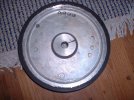
Contact wheel bearings

Joined
Feb 17, 2007
Messages
3,375
I got a 10" Grizzly contact wheel from Eboese, (THANKS) It has a nice beefy hub in the center and I want to install some bearings and make a bolt to use it on my KMG. Question is what bearings should I use. I have a small wheel attachment and the platen but no contact wheel. So nothing to gauge with. Is the bolt just a good 1/2" bolt or is it a shouldered bolt with a bigger shaft dia. I did get a piece of 1 1/2"x 1 1/2" sq. stock and cut intoo 5 tooling arms lengths so I can have one for each set up. Anyone need a 18+1/2" inch piece of sq stock?

I do have a mill and lathe so can get proper holes for bearings.

Thanks
 
What I did on mine was to mount the wheel on a shaft and use pillow block bearings on a plate.

DSCN0188_001.JPG


DSCN0190_001.JPG


Also, I could totally use an extra tooling arm. I'm one short and the local welding supply is out of 1.5" sq. PM Sent on that one ;)

-d
 
Neat idea. I will stick with mounting bearings in the hub. and mounting to an arm as close as possible to the way KMG does it. Thanks
 
Neat idea. I will stick with mounting bearings in the hub. and mounting to an arm as close as possible to the way KMG does it. Thanks

If you're going to keep with that idea, give me the exact dimensions of the wheel hub. I need both the Inside Diameter of the hub and the width that you're trying to fill. Once I have this, I'll be able to suggest a bearing to fill it that will work. I'll also give you the exact size that you will need to make the shaft. Just promise me you won't fill it with some cheap bearing. Put a Timken Fafnir in it. I'll even find a distributor near you that carries the bearing. The only thing I won't do is pay for it.

p.s.
Try to measure to .0001" tolerances. I'm assuming that you're ID micrometers will probably only measure to .001" tolerance, but try to guess at the .0001" tolerance. Measure the hub ID in two directions, 90 degrees apart from one another, and if they're different, average them. If they aren't real close and your hub is egg shaped, let me know that too.

Ickie
 
LOL, what a guy won't even buy me a bearing. Actually thanks, I will get the measurements. There is plenty of meat in the hub and I was thinking of making the hole larger. I could even use a mill to make it sq shouldered. Jim. PS. I have noticed you are in Portland. I am just above Seattle. I sometimes get down your way and I used to run the floor in a metal shop down there,
 
Here are the numbers the hub is 1.452 to 1.454 in thickness. The center section holds that thickness for about 2.5 inches. The hole is side A .7490 and .7505 Side B .7480 and .7485 all numbers in inches. I could probably get a drill and reamer from the machinist at work to take it to another size if you think it wise or needed. I owe you a favor. I live in Mt Vernon. I think the Bearings Inc here is gone.
 
After reviewing the data on bearings that will fit the hole, the load carrying capacity of those bearings is not large enough to survive on a belt grinder. You'd have to bore the hole in the contact wheel out considerably. Without knowing how much material you have, it's better to go with the Wide inner ringed housed units as suggested by Deker.

The largest capacity bearing that will fit your contact wheel hub can only carry a dynamic load of about 300 to 550 lbs. of dynamic load. The life of those bearings won't be very long, as they are designed for computers, fractional horsepower motors, projectors, domestic appliances and similar devices.

The shaft size would have to be 1/4" which is way to small for a grinding machine.

I suggest that you use bearings with the part number SAS 7/8 . These bearings have set screw locks so that you can reverse directions if need be. It has positive contact land-riding seal. It comes factory pre-lubricated, but has a grease fitting if you desire to relubricate it from time to time.

You should make the shaft .875" to .8745". Bore the contact wheel hub out to .874". When you put the shaft through the contact wheel hub, just put the shaft into the freezer for about 3 hours prior to inserting it into the hub. The shaft will still have a light press fit going in, but once the temperatures normalize between the shaft and contact wheel hub, you won't have to worry about the hub slipping on the shaft.

The bearings will be able to be slipped onto the shaft. Try to keep the contact wheel as close to the bearings as possible. The overhanging load should be minimized as much as possible. Keep the two bearings spaced as widely apart as convenience will allow, while keeping the contact wheel as close to the nearest bearing as possible.

The reason I suggested boring out the hub is to get a slightly larger shaft size that will be stiffer and less likely to flex under grinding loads. Ball bearings do not handle misalignment very well and any bending loads on the shaft would be detrimental to the bearings life.

Torque the set screws that lock the bearing to the shaft to 80 in/lbs. This is the specification for locking the bearing down. If you lock them too tightly, you'll distort the inner ring and the bearing will spall out quickly. If you don't lock the set screws tight enough, the inner ring will work loose and spin on the shaft.

Here are the two closest distributors to Mt. Vernon, WA.

Motion Industries
3949 Irongate Rd
Bellingham, WA 98226
(360) 752-3303

Applied Industrial Technologies
901 Iowa St
Bellingham, WA
(360) 733-4580

Good luck.

Ickie

 
Hmm ... that wheel looks like it will take your regular 1/2" ID bearings, not ?
That what I use in my contact wheels and some of them are home made .

If your lathe dont have nuff SOB to chuck up 10" wheel, you can easily
do it on a mill - indicate the center of existing hole and bore away. I am sure
that Al will bore like a dream :)

Just make sure to sneak up on BB's OD. Don't quite have to aim for a press fit (you want those to be easily replaceable).
 
I'm a tad confused.

Rashid says:

"Just make sure to sneak up on BB's OD. Don't quite have to aim for a press fit (you want those to be easily replaceable)."

So how tight should the bored out hub be? The reason I ask is I have a 4" X 2" that I want to do this exact same thing to. It has a 5/8ths hole that I think I should have bored out to take a 3/4" ID bearing. Those bearing that Scottickes mentions, with the allen screw, sound like just the ticket.

Thanks

Syn
 
The bearings that I use are english sized: R8-2RS

The R8 bearing has a 1.125" OD, .500" ID and is .312 wide. "2RS" designates 2 rubber seals.

I use a .0003"-.0008" press fit.

I've mounted them in grizzly wheels before and found it very challenging. The griz wheel has a softer cast aluminum hub that was very gummy to machine and more difficult to achieve my desired press fit. I think I relied on loctite when everything was said and done.

Good luck and have fun with your project!!

-Rob
 
The center section that is 1.452 has a diameter of 2.5 inches I could easily make the hole 1" or 1 1/2". I was thinking of making a shaft that had 1/2" course on one end, then a flange about an 3/4" in diameter next to the threads. This would turn into the tooling arm. Make the flange wide enough to space the wheel out to the proper location. Then have a enough 1/2" shaft to go thru a bearing set into each side of the wheel, then step down and go to 3/8" nc threads so I could put on a collar with 3/8 id and about 3/4 od and a nylock nut or a castle nut with a cotter key. The flange on the shaft and the collar would hold the centers of the bearing trapped to eliminate side play. The od of the bearing would have a slight press fit in the hub of the wheel. I would machine the holes on each side just deep enough to accept the bearings. I had assumed that KMG used a system similar to this and was wondering what bearings they used or what bearing I should use in this manner.

Scottickes, are you thinking of a bearing assembly that passes completely thru the hub and assembles with the hub trapped between. That would work well and Like I said I could bore the hub out quite a ways to accept something larger. I do know the KMG arms have a 1/2 NC holes for tool attachment, but as I have the sq bar blanks and a set of large taps, I could easily do a 5/8, or 3/4 nc.
 

Attachments

  • DSCF0031.jpg
    DSCF0031.jpg
    80 KB · Views: 52
Like Rob sez - 1/2 ID bearing is the way go. 3/4" ID is an overkill, IMO. It will also
require larger bore to where less "meat" will be left to hold the bearing.

If one never bored out for BBs before, you'll quickly discover that you need to be
very careful with it - as you approach your size, go in really small increments and measure
often. If you get greedy, you just might have to re-bore for _next_ larger BB :) . Good thing
there's metric :)


http://img170.imageshack.us/img170/6236/dsc0008oc7.jpg


I most highly recommend this particular "wheel" - it is extremely lightweight, robust, easy-to-machine,\
poly-coated 2" wide caster wheel from surplus center. You can turn it into 4", 5" contact wheel , drive wheel,
tracking wheel. The poly machines real nicely - if one is so inclined, you can remove all of it on a lathe.
And it costs .... drum roll ....

6 bux

http://surpluscenter.com/item.asp?UID=2007080508015252&item=1-2875&catname=wheels


As you can see, it bores nicely for 1/2" ID BB - you only have to remove may be .080
 
Well, I think I will go with the r8-2rs bearings unless Scottickies hits me with another one. He is the bearing expert. I got the wheel chucked up in my lathe. It will barely swing 10" and I think I will need to make a small bar to do the cut. Had to use my 4 jaw. Took a while to get it centered and sq. Right now I need to go get a 5hp Sears commpressor and a bunch of air tools I bought for $150. Love Craigs list
 
The bearings that I use are english sized: R8-2RS

The R8 bearing has a 1.125" OD, .500" ID and is .312 wide. "2RS" designates 2 rubber seals.

I use a .0003"-.0008" press fit.

I've mounted them in grizzly wheels before and found it very challenging. The griz wheel has a softer cast aluminum hub that was very gummy to machine and more difficult to achieve my desired press fit. I think I relied on loctite when everything was said and done.

Good luck and have fun with your project!!

-Rob


Rob,
Try not to use loctite to hold a bearing in. On aluminum hubs, increase the press fit by 2X. For example if you need a .0005" press fit for a normal hub, increase the press fit to .001" for an aluminum or magnesium hubs.

Get your tolerances as close as you can on the hub ID. It doesn't have to be an exact science. Just don't go over 2X. The press fit does more than just keep the bearing from spinning in the hub, it also reduces clearance in the bearing. If it's an aluminum hub, I'd double the press fit and go to a bearing with a c3 clearance. Ball bearings come with different clearances. If the bearing part number does not say, c3, c4, c5 or c6, then it defaults to c0 (normal clearance). c3 and higher is more clearance than c0. The extra press fit of the hub on the bearing will remove more clearance, thus the need to have more clearance to begin with, so that it doesn't get too tight and burn the bearing up.

Ickie
 
Scott, you are a real asset to this forum. :thumbup::thumbup::thumbup:

Awww shucks. This is stuff I do every day. I've learned so much about making knives from the members here, that I'm getting way more than I give IMHO.

My heat treat, forging, blade finish, handle and guard fit and finish have made leaps and bounds in the past year, due entirely to the members here.

I owe all of you the thanks for enhancing my knifemaking experience.

Ickie
 
The center section that is 1.452 has a diameter of 2.5 inches I could easily make the hole 1" or 1 1/2". I was thinking of making a shaft that had 1/2" course on one end, then a flange about an 3/4" in diameter next to the threads. This would turn into the tooling arm. Make the flange wide enough to space the wheel out to the proper location. Then have a enough 1/2" shaft to go thru a bearing set into each side of the wheel, then step down and go to 3/8" nc threads so I could put on a collar with 3/8 id and about 3/4 od and a nylock nut or a castle nut with a cotter key. The flange on the shaft and the collar would hold the centers of the bearing trapped to eliminate side play. The od of the bearing would have a slight press fit in the hub of the wheel. I would machine the holes on each side just deep enough to accept the bearings. I had assumed that KMG used a system similar to this and was wondering what bearings they used or what bearing I should use in this manner.

Scottickes, are you thinking of a bearing assembly that passes completely thru the hub and assembles with the hub trapped between. That would work well and Like I said I could bore the hub out quite a ways to accept something larger. I do know the KMG arms have a 1/2 NC holes for tool attachment, but as I have the sq bar blanks and a set of large taps, I could easily do a 5/8, or 3/4 nc.

Can you do a hand drawing of the contact wheel and hub with dimensions marked for me. It would really assist me in helping you. I know that you want to bore the hub out larger, but if you go too far, you'll lose the support for the bearing and the contact wheel. If the hub flexes when you grind, the outer bearing race will distort and lead to premature bearing damage.

Ickie
 
OK. I should have looked at the picture of the hub before making some of those responses. You got LOTS of hub to play with. My advice now, is get a big ass ball bearing and bore the hub out to the size you want. Once you've chosen a bearing part number, I'll give you the hub dimension to bore it out to.

You do have a few other issues to deal with, one of which is how to clamp the hub to the bearing outer race. Even though it will be press fit, you still don't want it unclamped from the bearing. If wear were to cause you to lose that fit, you'd have a dangerous situation on your hands. As far as the shaft is concerned, once you choose a bearing, get me the part number, and I'll draw up a shaft for you with sizes, tolereances, and maximum fillet radius. You'll only need threads on one side of the shaft to hold the bearing in place, with the bearing seating against a shaft shoulder on the other side.

One other thing is that the contact wheel will need to be rebalanced if you bore it out.

Ickie
 
Back
Top