Convex Grind - Issues?

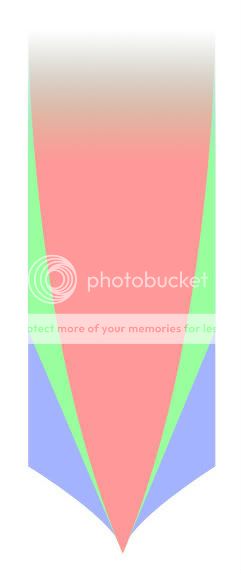
convex grind without secondary bevel agains other grind (also without secondary bevel) will always be thinner. The reason it's stronger is that against those with secondary bevel, it has more metal behind the edge, supporting in one smooth curve that distribute the pressure, plus pushing the cut material apart (wedging it). Huugh second picture shows that.

This aspect is what Jay talking about. On companies, Jay is right for most manufacturer that's not on the forum (we are still the minority). If you go to supermarket, (at least down here), they don't carry any of the brand we know on the forum. Mostly, CCC (borrowing term from Balisong folks).

So, it's a broad brush, but not entirely inaccurate. He should make it better by saying not all companies are like that. In any industry, majority will be operating with the principle of making as much profit as they can, squeezing expenses and inflate price as much as they can. However, the minority who cares about their product and quality, will keep their value. It's unfortunate that our society doesn't value quality anymore. It can be seen pervasively in the fast changing new model coming up every day from various companies, none of them will last long (phone, TV, fridge, etc.) because what people want is always something new, not something that lasts. Again, knife community is a minority in this aspect.
 
Chris "Anagarika";5877977 said:
convex grind without secondary bevel agains other grind (also without secondary bevel) will always be thinner. The reason it's stronger is that against those with secondary bevel, it has more metal behind the edge, supporting in one smooth curve that distribute the pressure, plus pushing the cut material apart (wedging it). Huugh second picture shows that.

You're going to have to elaborate on the thinnest grind being convex if the blades are zero ground (no secondary bevel). From the same stock thickness, a flat and a hollow ground blade will fit inside the grind of a convex blade. See the multicolored illustration above for what I mean. I can sort of see how what you're saying could be true, but the wording you use doesnt convey that to me. Do you mean with the same included edge angle? If that is the case, I agree. All blade grinds wedge material apart. This is not exclusive to the convex blade.
 
He is right in that the vast majority of <del>production</del> knives will never increase in value, at least not to the extent of an actual investment medium, like a certificate of deposit or a savings bond.

Maybe this way it would fit even better :)


As for the Lucky Bob's picture and claim that convex is thinner than other grinds:
if you make flat as high as convex, then flat is thinner.
Picture-1.jpg
 
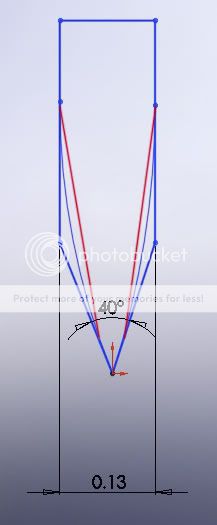
Lucky Bob's diagram is based on the premise that the tangent to the curve at the apex of the edge (the "edge angle") is equivalent for each grind, whether it be convex, flat, or concave. Given that constraint, the convex grind will ALWAYS BE THINNER. You can make a convex grind thicker by increasing the edge angle, but you sacrifice cutting performance. You cannot have both the thinnest edge and the most metal behind it. If you cannot wrap your head around this then you need to go back to geometry class.

Look at Huugh's color picture on the last page. The fattest grind is the convex grind. Also, the grind with the most "otuse edge" is the convex grind. It may be the most robust, but it is also the poorest cutter.

Now look at the picture by Lucky Bob. Both edges have the same included angle, so there is no bias based on edge angle. They are also from the same stock. The convex ground blade is thinner, and must be thinner if it is going to be convex.

Huugh has obfuscated the issue by drawing a flat grind within the convex grind to show that it is thinner. However, by doing this he has reduced the inclusive edge angle of the flat ground blade and made it a much better cutter in the process.

Regardless of how it is ground- flat, convex, or hollow- the only way to make a blade more robust at the edge is to sacrifice cutting performance (increase the inclusive edge angle). And, given the same inclusive edge angle, a flat ground edge is more robust than a convex ground edge.

Note that the above discussion is under the asumption of no microbevel at the very edge.
 
Lucky Bob's diagram is based on the premise that the tangent to the curve at the apex of the edge (the "edge angle") is equivalent for each grind, whether it be convex, flat, or concave. Given that constraint, the convex grind will ALWAYS BE THINNER. You can make a convex grind thicker by increasing the edge angle, but you sacrifice cutting performance. You cannot have both the thinnest edge and the most metal behind it. If you cannot wrap your head around this then you need to go back to geometry class.

Look at Huugh's color picture on the last page. The fattest grind is the convex grind. Also, the grind with the most "otuse edge" is the convex grind. It may be the most robust, but it is also the poorest cutter.

Now look at the picture by Lucky Bob. Both edges have the same included angle, so there is no bias based on edge angle. They are also from the same stock. The convex ground blade is thinner, and must be thinner if it is going to be convex.

Huugh has obfuscated the issue by drawing a flat grind within the convex grind to show that it is thinner. However, by doing this he has reduced the inclusive edge angle of the flat ground blade and made it a much better cutter in the process.

Regardless of how it is ground- flat, convex, or hollow- the only way to make a blade more robust at the edge is to sacrifice cutting performance (increase the inclusive edge angle). And, given the same inclusive edge angle, a flat ground edge is more robust than a convex ground edge.

Note that the above discussion is under the asumption of no microbevel at the very edge.

Different types of grind on the same blade with the same height produce different edge angle. That's obvious and is in fact the reason why there are different types of grinds - to change cutting performance.

Hollow needs least height of the grind to match the specific edge angle, while flat needs more height and convex most.
This picture respect Lucky Bob's (improper) premise of equal edge angle. Not very illustrative, as it only seems that convex is thin, while what you really see is that convex needs much more space to match the angle.
grind3.jpg


For fair comparison, you have to give them equal conditions. That means, stick to the same stock, the same grind height and only change the type of the grind. I already posted those illustrations.
grind-1.jpg
grind2-1.jpg
 
Last edited:
There are also a number of possible convex curves possible that yield the same edge angle within the same width of stock. Some would be very close to the flat grind. Mike Stewart mentions than the blade stock forms an approximately 13 degree angle to the slack belt in their convex technique. However, that is not the resulting angle at the edge as the belt curves around the stock. What that final edge angle is I don't know nor has Mike mentioned a precise finished angle, probably because if varies a bit from knife to knife that comes off the line.

I sent in my Jerry Hossom Retribution 1 for convexing to Bark River. The resulting convex edge was ground in about 1/3 of an inch up the blade.That's where the convexness met the flat grind of the Retribution, essentially approaching the flat grind asymptotically. So yes, the shoulder was knocked off, but that doesn't mean that the convex grind has to flare out to the full extent shown in the diagrams.
 
Chris "Anagarika";5877977 said:
convex grind without secondary bevel agains other grind (also without secondary bevel) will always be thinner. The reason it's stronger is that against those with secondary bevel, it has more metal behind the edge, supporting in one smooth curve that distribute the pressure, plus pushing the cut material apart (wedging it). Huugh second picture shows that.

This aspect is what Jay talking about. On companies, Jay is right for most manufacturer that's not on the forum (we are still the minority). If you go to supermarket, (at least down here), they don't carry any of the brand we know on the forum. Mostly, CCC (borrowing term from Balisong folks).

So, it's a broad brush, but not entirely inaccurate. He should make it better by saying not all companies are like that. In any industry, majority will be operating with the principle of making as much profit as they can, squeezing expenses and inflate price as much as they can. However, the minority who cares about their product and quality, will keep their value. It's unfortunate that our society doesn't value quality anymore. It can be seen pervasively in the fast changing new model coming up every day from various companies, none of them will last long (phone, TV, fridge, etc.) because what people want is always something new, not something that lasts. Again, knife community is a minority in this aspect.

Hi, Chris.
Hello all of you who've commented. I'm sorry you didn't bother to just write and ask me to clarify some of my points on my website, but I do appreciate the traffic and interest.

Chris has summed it up nicely. When I write about factory knives on my site, I am talking about the cheap stuff, most of it coming out of foreign factories. If you have a personal favorite factory or botique shop knife, by all means, purchase and collect those types of knives. Everyone has a different idea and desire in fine knives.

Most of you who comment here know a great deal more than the typical public. The public who is new to knives might simply want to know why a handmade knife is different, and why they may wish to spend their hard-earned money on a handmade or custom knife. Most of the knives they've seen are cheap foreign factory knives, and I'm simply describing the differences. If you're buying a knife to use up, abuse, and eventually throw away, that's one type of purchase.
If you're buying a knife that will appreciate year after year, that's another type of purchase. The two are very different.

My information on my website is simply my opinion, after having made knives for many (30) years. It is my full time professional occupation and has been for over 20 years. My opinions are derived from having made knives for other professionals: military, police, chefs, collectors, and museums in my career and their direct input and feedback. These guys use knives more than I ever will, and I listen to, respect, and continue to build knives for them the way they request. That is what being a custom maker is all about.

If my views differ from yours, that's okay too!

When I write about convex grinds, I'm talking about axe grinds. When you are talking about convex grinds on this post, I think you are talking about what us older makers call a "taper" grind. I think it's simply a difference in semantics. On my site, I do mention that I make taper grinds, too, and that I find them most useful on thinner stock blades. They do have a purpose, can be made extremely sharp, and if they are made on thin stock have great longevity. I've made many knives this way. I've also made axe grinds. Knives that are used to chop need to be made this way. Not all knife grinds are alike, there is no set standard guaranteeing one is absolutely the best grind ever. If there was, don't you think that all the other grinds would be discarded?

Any grind that has sufficient thinness can be made sharp at the cutting edge. Any grind. Any.

The point I'm trying to illustrate on my site is that as a knife is used up, sharpened again and again, more stock will have to be removed behind the cutting edge to keep it sufficiently thin. If the blade is thick, you'll simply have to remove more stock. A hollow grind is thin, so it may be able to be sharpened more often without spending a large amount of time and effort to removing or releiving the blade behind the cutting edge. I also state on my site that a hollow grind is not a grind suitable for chopping or high impact, though a hollow grind, if made well, can be strong. Most guys who use a knife professionally know that it is not an axe.

If I'm still entitiled to my own opinion, I'll offer this: I know that guys can go on and on about the intricacies of grind geometry and complex angles, micro crystalline structure, wear characteristics, and steel alloy components, and these are important. My question is: are they also looking at fit, finish, balance, design, service, and accessories? These are what I believe sets knives apart, in addition to steel type and grind shape. I think they are important enough that I've given them their own page on my site here.


Chris, I'm going to take you up on your comment about the factory comparison. It is a broad brush I've painted with, and I guess I need to make it clear that there are some good production knives made, just not many. I'll do that.

Back to work!
 
Given equal stock and an equal edge angle, the convex edge has LESS metal behind it.

My thanks to Lucky Bob and to theonew
Looking at that picture I am thinking the convex grind would be a much better slicer. We are talking knives here, not axes.
 
Hi, Chris.
Hello all of you who've commented. I'm sorry you didn't bother to just write and ask me to clarify some of my points on my website, but I do appreciate the traffic and interest.

Chris has summed it up nicely. When I write about factory knives on my site, I am talking about the cheap stuff, most of it coming out of foreign factories. If you have a personal favorite factory or botique shop knife, by all means, purchase and collect those types of knives. Everyone has a different idea and desire in fine knives.

Most of you who comment here know a great deal more than the typical public. The public who is new to knives might simply want to know why a handmade knife is different, and why they may wish to spend their hard-earned money on a handmade or custom knife. Most of the knives they've seen are cheap foreign factory knives, and I'm simply describing the differences. If you're buying a knife to use up, abuse, and eventually throw away, that's one type of purchase.
If you're buying a knife that will appreciate year after year, that's another type of purchase. The two are very different.

My information on my website is simply my opinion, after having made knives for many (30) years. It is my full time professional occupation and has been for over 20 years. My opinions are derived from having made knives for other professionals: military, police, chefs, collectors, and museums in my career and their direct input and feedback. These guys use knives more than I ever will, and I listen to, respect, and continue to build knives for them the way they request. That is what being a custom maker is all about.

If my views differ from yours, that's okay too!

When I write about convex grinds, I'm talking about axe grinds. When you are talking about convex grinds on this post, I think you are talking about what us older makers call a "taper" grind. I think it's simply a difference in semantics. On my site, I do mention that I make taper grinds, too, and that I find them most useful on thinner stock blades. They do have a purpose, can be made extremely sharp, and if they are made on thin stock have great longevity. I've made many knives this way. I've also made axe grinds. Knives that are used to chop need to be made this way. Not all knife grinds are alike, there is no set standard guaranteeing one is absolutely the best grind ever. If there was, don't you think that all the other grinds would be discarded?

Any grind that has sufficient thinness can be made sharp at the cutting edge. Any grind. Any.

The point I'm trying to illustrate on my site is that as a knife is used up, sharpened again and again, more stock will have to be removed behind the cutting edge to keep it sufficiently thin. If the blade is thick, you'll simply have to remove more stock. A hollow grind is thin, so it may be able to be sharpened more often without spending a large amount of time and effort to removing or releiving the blade behind the cutting edge. I also state on my site that a hollow grind is not a grind suitable for chopping or high impact, though a hollow grind, if made well, can be strong. Most guys who use a knife professionally know that it is not an axe.

If I'm still entitiled to my own opinion, I'll offer this: I know that guys can go on and on about the intricacies of grind geometry and complex angles, micro crystalline structure, wear characteristics, and steel alloy components, and these are important. My question is: are they also looking at fit, finish, balance, design, service, and accessories? These are what I believe sets knives apart, in addition to steel type and grind shape. I think they are important enough that I've given them their own page on my site here.


Chris, I'm going to take you up on your comment about the factory comparison. It is a broad brush I've painted with, and I guess I need to make it clear that there are some good production knives made, just not many. I'll do that.

Back to work!

Jay, I'll accept responsibility for not just emailing you with my question. I started this thread after buying a couple of Fallknivens and then reading your site. BTW, it's probably the most informative and authoritative site out there.

After getting back into knife collecting after several years hiatus, I'm like a newbie without good judgment, sometimes. I think I know now more about blade geometry than I ever wanted or needed to know. But, it's been a good discussion, I think, and you put the edge on it. :)
 
Jay, I'll accept responsibility for not just emailing you with my question. I started this thread after buying a couple of Fallknivens and then reading your site. BTW, it's probably the most informative and authoritative site out there.

After getting back into knife collecting after several years hiatus, I'm like a newbie without good judgment, sometimes. I think I know now more about blade geometry than I ever wanted or needed to know. But, it's been a good discussion, I think, and you put the edge on it. :)

Hi, Halbie. Thanks for writing, and thanks for your kind words about my site.

I'm glad you're collecting and asking all the important questions. I look forward to putting you on my list for a fine custom knife one of these days!

Jay
 
I LOVE convex and anyone who says it's not a real grind is a little off their rocker.

I convex ALL my FB's and my folders as well.

Stable grind that slices like a demon.

What's not to like?

brett
 
For fair comparison, you have to give them equal conditions. That means, stick to the same stock, the same grind height and only change the type of the grind.

There is absolutely no rule of knifemaking that requires us to be fair. The fact is that regardless of what primary grind you use, you can apply a convex edge having whatever material thickness at the top of the convex that you choose.
 
I LOVE convex and anyone who says it's not a real grind is a little off their rocker.


brett


Yup and to quote the website posted...

"The convex grind is an axe grind. Advantages: It's made to enter wood or other materials at the cutting edge (which can be made very sharp), then split the material by wedging it apart. It is very strong, with a lot of thick metal behind the cutting edge. Disadvantages: it cannot be made as sharp as a knife, and when sharpened, quickly becomes chisel-like. It also requires a great deal of thick metal to construct. Since this is not really a knife grind, I'll spare details on this one."

I am going to address the Disadvantages issue with this one...

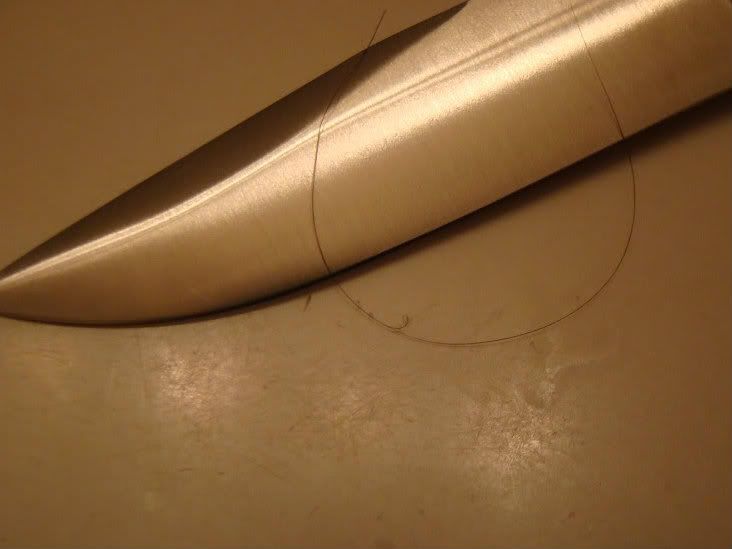
It cannot be made as sharp as a knife...don't let the whittled hair from my stainless steel Bark River Escort know that it can't be done...

Don't tell that to the news print that got shaved off the top of a newspaper, or the hair thin curls made off of a maple branch either. As far as I can tell, these objects didn't know the difference of what grind was being used.
fuzzhair.jpg


When sharpened, quickly becomes chisel like
...

I took a couple of my convexed blades to work today and put them on an optical comparator to view the edge. They were indeed well convexed. Oh, they have had the snot kicked outta them too and been sharpened extensively.

It also requires a great deal of thick metal to construct...

Once again, don't tell this to the several convexed knives that I have that are under .093". Currently they do not know the difference and perform flawlessly...they, too, have a beautiful convex edge...actually, they are full convex. Odd ain't it. :D

Since it is not really a knife grind...

Odd statement given it is the OLDEST knife grind in history...even dating back to the Romans. I am quite certain it is not only a knife grind, but a highly usable, older than dirt, proven, tested, tried and true, strong and efficient one at that. :thumbup:

I also saw on the site something regarding defense of a grind. Here is a Bark River hatchet that shaves arm hair effortlessly. Note the extremely heavy convex edge on it. :)

BarkieHatchet003.jpg

BarkieHatchet002.jpg
 
Last edited:
I think that convex edges are the easiest to hand sharpen ever. I can't sharpen a standard edge by hand very well (I can do decent work, but usually not hair popping sharp). I can sharpen hair popping sharp with a controlled kit (like lansky) that holds the blade angle for me.

But with my convex edges I can sharpen hair popping, push cut paper sharp with little effort. Just a compound loaded strop, and a few minutes at night after use. I saw a tutorial on this site for how to make a standard edge convex, took one of my folders and did it, so nice and sharp, that I decided to do it to another more expensive knife. very very sharp now (and that is coming from some one who everyone says keeps his standard edges stupid sharp). I can drop a sheet of paper in the air, and cut downward all the way through in one slice in the air.

I had a hard use bowie that had a excellent convex edge. It took longer than 2+ years of frequent use till it needed to be sharpened.
 
Back
Top