Convex grinds

I read this thread and I seriously think my head is about to explode. Unfortunately I was horrible with math and I dont think I will ever understand edge geometry. Especially when people throw in hollow grinds. Someone said they are incredibly common. Yes hollow grinds for the primary grind of the blade but I thought the majority of actual edges were flat ground edges regardless of the blade grind. Sometimes when reading these conversations I cant make out which people are talking about.

They are.

Can you imaging sharpening a secondary "bevel" that looked like that?
 
To give another example, the only time a convex edge wouldn't have an angle created by two straight lines is if you had the arc taken from a circle and had that as an edge. Anything shy of a circle and you'll end up with some kind of angle at the apex created by two lines. A circle is 360 degrees. You take the arc of a circle and it will still have the same curvature. As soon as this circle becomes an "edge" it will have some angle created by two lines. In an extreme example, you might have a very terrible convex edge of 170 degrees, close to a straight line, which would be analogous to the edge a circle creates if you were to try and "draw a circle" with straight lines only.

It's been a long time since I've studied programming and things like that, but if I'm not mistaken, computer graphics are limited because they cannot render a perfect circle; they render polygons. What looks like a circle is just a bunch of lines connected to each other in such a way that the appearance is a circle. That's why modern games these days have anti-aliasing.

Nailed it. Any curve or arc has a tangent at each point on that curve. When two curves meet at a point, they each have a tangent at that point. The angle that those 2 tangents form is the edge angle.

UNLESS...you have rounded off your edge. And that is exactly what you do not want to do with a convex (or any other):edge.

I know its getting nerdy in here...but convex edges do not have more steel behind the edge than a vee.

And I convex my vees...so I'm no "hater. " I do it because they cut better for 2 reasons: 1) they have less material behind the egde and less "friction"; and 2) I find them very easy to create and maintain.
 
Nailed it. Any curve or arc has a tangent at each point on that curve. When two curves meet at a point, they each have a tangent at that point. The angle that those 2 tangents form is the edge angle.

UNLESS...you have rounded off your edge. And that is exactly what you do not want to do with a convex (or any other):edge.

I know its getting nerdy in here...but convex edges do not have more steel behind the edge than a vee.

And I convex my vees...so I'm no "hater. " I do it because they cut better for 2 reasons: 1) they have less material behind the egde and less "friction"; and 2) I find them very easy to create and maintain.


A convex edge may have more steel behind the apex than a V edge, or a V edge may have more steel behind the apex than a convex edge. It depends on the specific geometry of the two edges.

But if you compare a V edge to a convex edge fairly -- holding the edge widths and heights constant -- the convex edge will always have more steel behind the apex; and the V edge will always be more acute.

You can easily prove this. Just draw a convex edge. Then draw straight lines from the edge shoulders to the apex -- that will be the V edge. It will be more acute than the convex edge and have less steel behind the apex.
 
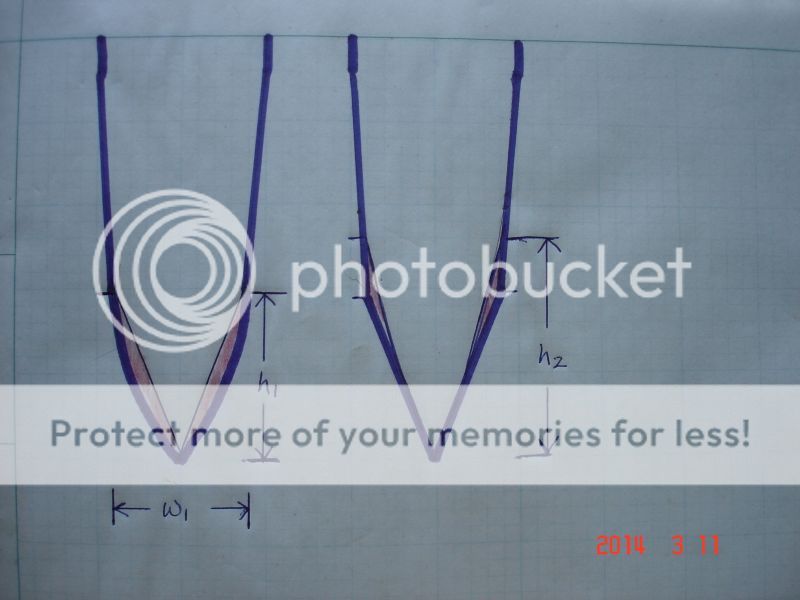
The drawing on the left compares a V edge to a convex edge that has the same edge width (w1) and height (h1). You can make the convex edge more acute than the V edge by giving it a taller edge height, but that's no longer apples to oranges.

DSC02006_zps10afa198.jpg
 
UNLESS...you have rounded off your edge.


That's the biggest problem I have with convex edges. I can never maintain them for long before they start getting too obtuse to be useable.

But I should start experimenting with them some more because I'm sure they're great when you know how to do them properly
 
I love a nice convex edge.

I find them easier to maintain than a V edge if I want to keep a hair whittling edge.

I have recently become more lazy though, and have started sharpening with my ceramic sticks again. It is a matter of being lazy for me.

I have been much too lazy to get my sandpaper out of the the garage.

I have a belt sander, but it only gets used when I have do some real metal removing to set the bevel initially, or to fix a big gouge, dent or chip.


My convex edges tend to be a bit more polished than my ceramic stick/v edges.

Frankly, if you looked at my "v" edges, they would also be a bit convex, because I do a bit of work behind the shoulder to improve cutting anyway. And, my sharpening on the diamond stone usually involves the same.


A nice sharp convex edge cuts beautifully, but so does an equally sharp v edge.


I find the convex edge does great when chopping wood, shaving wood, and cutting some materials.

For fibrous stuff I like a toothier edge, and for me that means v edge.
 
The drawing on the left compares a V edge to a convex edge that has the same edge width (w1) and height (h1). You can make the convex edge more acute than the V edge by giving it a taller edge height, but that's no longer apples to oranges.

DSC02006_zps10afa198.jpg

Again, all you are saying is that a more obtuse edger has more steel behind the edge than a more acute edge angle. The picture on the right shows a vee and a convex that have the same edge angle. And the convex is inside the vee.

Its your picture.
 
They are.

Can you imaging sharpening a secondary "bevel" that looked like that?

There are tools with actual hollow edges out there. Scythes and hay knives are two examples. The edge is honed using a scythe stone (sometimes called a canoe stone because of its shape) and the curved edge of the stone is used with a rolling action of the wrist to mimic the rotation of a grinding wheel.

A simple way to find the approximate angle of a convex edge is to find the lowest angle at which it will cut. If you bring the angle so low that the bevel face of the edge is parallel to the target surface or beyond then the edge will never bite into the target. No tricky math involved.

I was the one that drew up the "how people are told/how it actually works" diagram, and it was for the purposes of illustrating exactly what Marcinek has been describing. If edge angle and stock thickness are held constant and no relief bevels present then the convex will have less material at the shoulder transition and as such will see an increase in cutting performance at negligible detriment to the strength of the edge unless taken to irrelevant extremes.

So convex edges have advantages, but they're not what most folks think they are. You can make a convex edge that's stronger than a V edge, but you have to increase the edge angle to do it and cutting performance drops as a result, and if you were to do a V edge at that same thicker angle that would be stronger still than the convex.
 
There are tools with actual hollow edges out there. Scythes and hay knives are two examples. The edge is honed using a scythe stone (sometimes called a canoe stone because of its shape) and the curved edge of the stone is used with a rolling action of the wrist to mimic the rotation of a grinding wheel. .

Very interesting, thanks. I hadn't heard of this before

Still, I'll bet they're pretty rare. And definately not going to be found on any major production folders
 
I think the convex edges seem "tougher" than flat ones is because circles and arcs are stronger than flat planes. Are they not? Like an egg. I love an acute convex edge.
 
So convex edges have advantages, but they're not what most folks think they are. You can make a convex edge that's stronger than a V edge, but you have to increase the edge angle to do it and cutting performance drops as a result, and if you were to do a V edge at that same thicker angle that would be stronger still than the convex.

Elegantly put. :thumbup:
 
That's the biggest problem I have with convex edges. I can never maintain them for long before they start getting too obtuse to be useable.

But I should start experimenting with them some more because I'm sure they're great when you know how to do them properly

You need to start with the blade flatter on your sharpening implement. Also very little pressure, almost just the weight of the blade.
 
Top one's mine. Bottom one I stole from somebody here :D

I often reference that same drawing too. Some people take issue with it because they claim it's misleading, but in reality it only represents a specific scenario and doesn't claim otherwise. Common sense can extrapolate the concept it demonstrates.

I was the one that drew up the "how people are told/how it actually works" diagram, and it was for the purposes of illustrating exactly what Marcinek has been describing. If edge angle and stock thickness are held constant and no relief bevels present then the convex will have less material at the shoulder transition and as such will see an increase in cutting performance at negligible detriment to the strength of the edge unless taken to irrelevant extremes.

So convex edges have advantages, but they're not what most folks think they are. You can make a convex edge that's stronger than a V edge, but you have to increase the edge angle to do it and cutting performance drops as a result, and if you were to do a V edge at that same thicker angle that would be stronger still than the convex.

Thank you for drawing that up, then. It's come in handy pretty often.

Very succinct explanation.
 
The drawing on the left compares a V edge to a convex edge that has the same edge width (w1) and height (h1). You can make the convex edge more acute than the V edge by giving it a taller edge height, but that's no longer apples to oranges.

DSC02006_zps10afa198.jpg
You're using a method of calculating the angle of a triangle here. You can't describe the arc in that way. You have to use the tangents to describe the edge angle like Marcinek was saying(thanks Marcinek. It's been about 20 years since I had to do any of these calculations. I couldn't pull the word 'tangent' out if my life had depended on it.) Further, the picture on the left clearly illustrates a more obtuse convex grind at the apex when compared to the v. In order to have the arcs outside of the v, you made the initial angle at the apex larger on the convex.
 
You're using a method of calculating the angle of a triangle here. You can't describe the arc in that way. You have to use the tangents to describe the edge angle like Marcinek was saying(thanks Marcinek. It's been about 20 years since I had to do any of these calculations. I couldn't pull the word 'tangent' out if my life had depended on it.) Further, the picture on the left clearly illustrates a more obtuse convex grind at the apex when compared to the v. In order to have the arcs outside of the v, you made the initial angle at the apex larger on the convex.


Yes, when the height and width of the edge is held constant, the V edge will be more acute and the convex edge will have more steel behind the apex. That is what I keep saying.

You can change those characteristics by changing the height or width of the edge in ways that can make the V edge more or less acute than a convex edge and more or less robust than a convex edge. So, for example, in the drawing on the right, the convex edge an be made more acute than a V edge by making the edge height of the convex edge taller than the edge of the V edge. I could also take that new convex edge and convert it to a V edge that is more acute than the convex edge.

What Marcinek is saying -- or repeating -- is not correct. It is not true that a convex edge has less steel behind the edge than a V edge. It may or may not, depending on the geometry.

You can't directly compare angles of V edges to the acuteness of convex edges because convex edges are not straight angles. The acuteness of V edges and convex edges is measured differently. The acuteness of a convex edge is not constant -- it varies. And with obtuse convex edges, the acuteness is considerably different (more acute) near the shoulders than it is near the apex. That variation in acuteness does not apply to a V edge, unless you are adding a micro-bevel.

That apples-to-oranges comparison is what 42 gets wrong. He's trying to compare straight angles on a V edge to the acuteness of a convex edge, assuming that the convex edge is measured the same. They are not measured the same. Mixing geometry in that manner is like dividing by 0 to get any kind of mathematical answer you want.

The truth is that convex edges and V edges come in an infinite number of variations. For any given knife doing any given task, there will be little to no performance difference between an optimized convex edge and an optimized V edge.

All this talk about the magic of convex edges is smoke and mirrors. Both V edges and convex edges can do anything you want.

 
If you take a "V" profile and convex it, the bevel angle increases.
Here is a blade that was honed 16.5 degrees (inclusive) and then convexed by stropping.

convex_01.jpg


The white lines show the blade profile prior to stropping. If those lines are translated down to the new (convex) apex, it is clear that the blade is thicker behind the apex.

convex_02.jpg


We can measure a tangential angle at various points on that convex edge:

stropped_microconvex_02.jpg


stropped_microconvex_03.jpg


The advantage to convexing is that you can start with a much smaller bevel angle and convex just the last few microns to an optimal angle and produce a blade with much less steel behind the apex.
 
Last edited:
Back
Top